
Author: Zuo Ye
The direct triggers for the October 11th and November 3rd incidents were not yield-generating stablecoins, but they dramatically dealt heavy blows to USDe and xUSD in succession. Aave's hard-coded USDe peg to USDT prevented the crisis on Binance from spreading to the blockchain, and Ethena's own minting/redemption mechanism was also unaffected.
However, the same hard-coded approach prevented xUSD from crashing out immediately, instead causing it to languish for an extended period. This prevented the timely clearing of bad debts from the issuer, Stream, and also led to questions surrounding related parties such as Elixir and its YBS (yield-generating stablecoin) product, deUSD.
In addition, multiple Curators on Euler and Morpho accept xUSD assets, causing user assets to randomly explode across various Vaults. Lacking the emergency response role of the Federal Reserve in the SVB, a potential liquidity crisis is looming ahead.
Amplifying a single crisis into an industry upheaval, when xUSD transcends its fallen leader and embarks on a war against eternity.
Manager + Leverage: The Source of Crisis?
The crisis was not caused by leverage, but by the lack of transparency resulting from private transactions between agreements, which lowered users' psychological defenses.
When a crisis breaks out, the following two points form the basis for determining who bears responsibility:
- The under-issuance of xUSD, which originated from the leveraged cycle of Stream and Elixir, is the fault of the management teams of both companies.
- Euler/Morpho and other lending platforms' Curated Markets accept "toxic assets" xUSD, and the platforms and managers should bear joint liability.
Let's set aside our initial opinions and examine the operating mechanism of YBS. Compared to the operating logic of USDT/USDC, where US dollars (including US Treasury bonds) are deposited in banks, Tether/Circle mints an equivalent amount of stablecoins, and Tether/Circle earns deposit interest or Treasury bond interest, the usage of stablecoins in turn supports Tether/Circle's profit margin.
YBS operates on a slightly different logic. Theoretically, it will use an over-collateralization mechanism, that is, issuing $1 of stablecoins with collateral exceeding $1, and then investing them in DeFi protocols. After earning revenue and distributing it to holders, the remainder is its own profit, which is the essence of its returns.
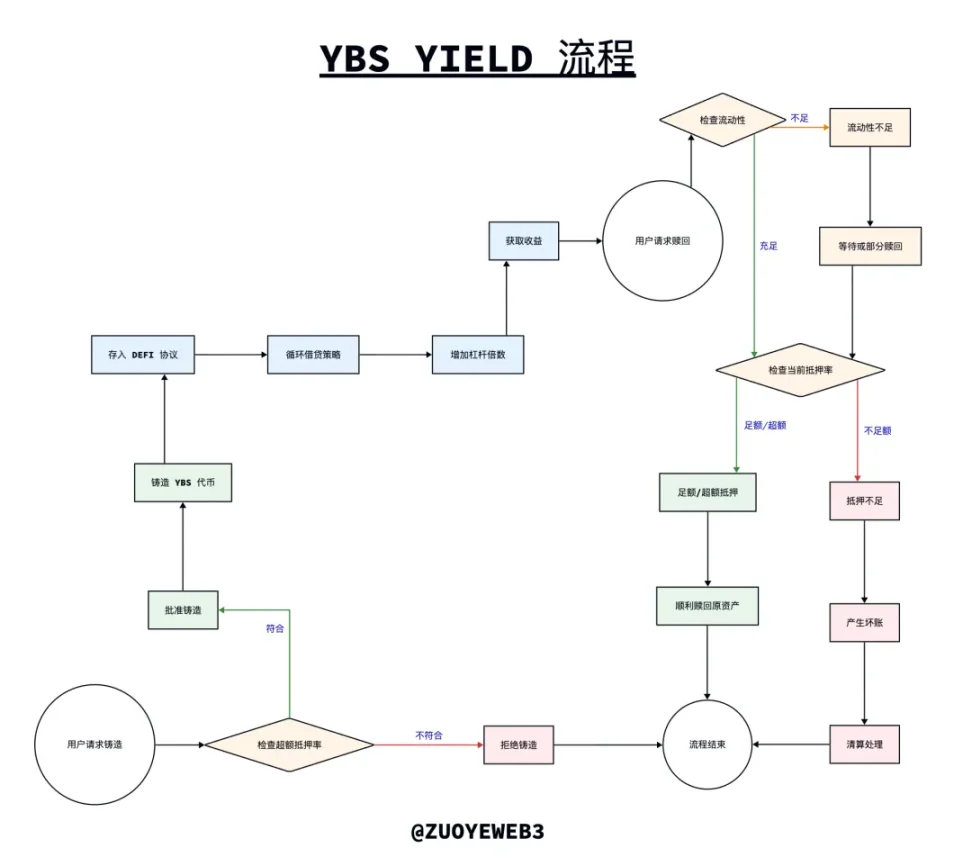
Image caption: YBS minting, yielding, and redemption process. Image source: @zuoyeweb3
Theory is not reality. Under the pressure of high interest rates, YBS project teams have developed three "cheating" methods to increase their profitability:
1. Converting over-collateralization to under-collateralization, directly reducing the value of collateral, is foolish and unlikely to be effective, but corresponding strategies are evolving:
- With a mix of "expensive" and "cheap" assets providing support, US dollar cash (including US Treasury bonds) is the safest, and BTC/ETH is also relatively safe, but TRX is also supporting USDD, so its value is discounted.
- The use of a mix of on-chain and off-chain assets is not a bug, but a form of time arbitrage. It ensures that the assets are in the correct location during the audit. Most YBSs adopt this mechanism, so I will not give a separate example.
2. To enhance leverage, YBS, once minted, will be invested in DeFi protocols, primarily various lending platforms, and ideally mixed with mainstream assets such as USDC/ETH:
- By maximizing leverage, making $1 appear as $100, the potential profits can be enormous. For example, the revolving loan combination of Ethena and Aave/Pendle, with a conservative estimate of 5 revolving cycles, can achieve a supply leverage of approximately 4.6x and a borrowing leverage of approximately 3.6x.
- Using less capital to leverage assets, such as Curve's Yield Basis's plan to directly issue new crvUSD, effectively reduces the amount of capital required for leverage.
Therefore, xUSD employed a combination of tactics: upfront leverage and cyclical issuance, which is the version mechanism of xUSD. As can be seen from the diagram above, YBS enters a yield "strategy" after minting, which is essentially a process of increasing leverage. However, xUSD and deUSD work together to migrate this to the issuance process, so users can see both the over-collateralization ratio and the yield strategy. But this is entirely a smokescreen by Stream. Stream acts as both referee and player, making xUSD an under-collateralized YBS.
xUSD uses the leverage from the second step to increase issuance in the first step, relying on Elixir's deUSD to leverage around 4 times, which is not a large amount. The problem lies in the fact that 60% of the issuance is controlled by Stream itself. When making money, the profits are kept for themselves, but when the system collapses, the bad debts are also theirs, failing to achieve the most important aspect of the liquidation mechanism: loss socialization.
The question is, why would Stream and Elixir do this?
In fact, direct exchange between protocols is nothing new. When Ethena introduced CEX capital, it gained partial exemption from ADL liquidation. Returning to xUSD, among the responses from many vault managers, Re7's was the most interesting: "We recognized the risks, but we still listed it due to strong user requests."
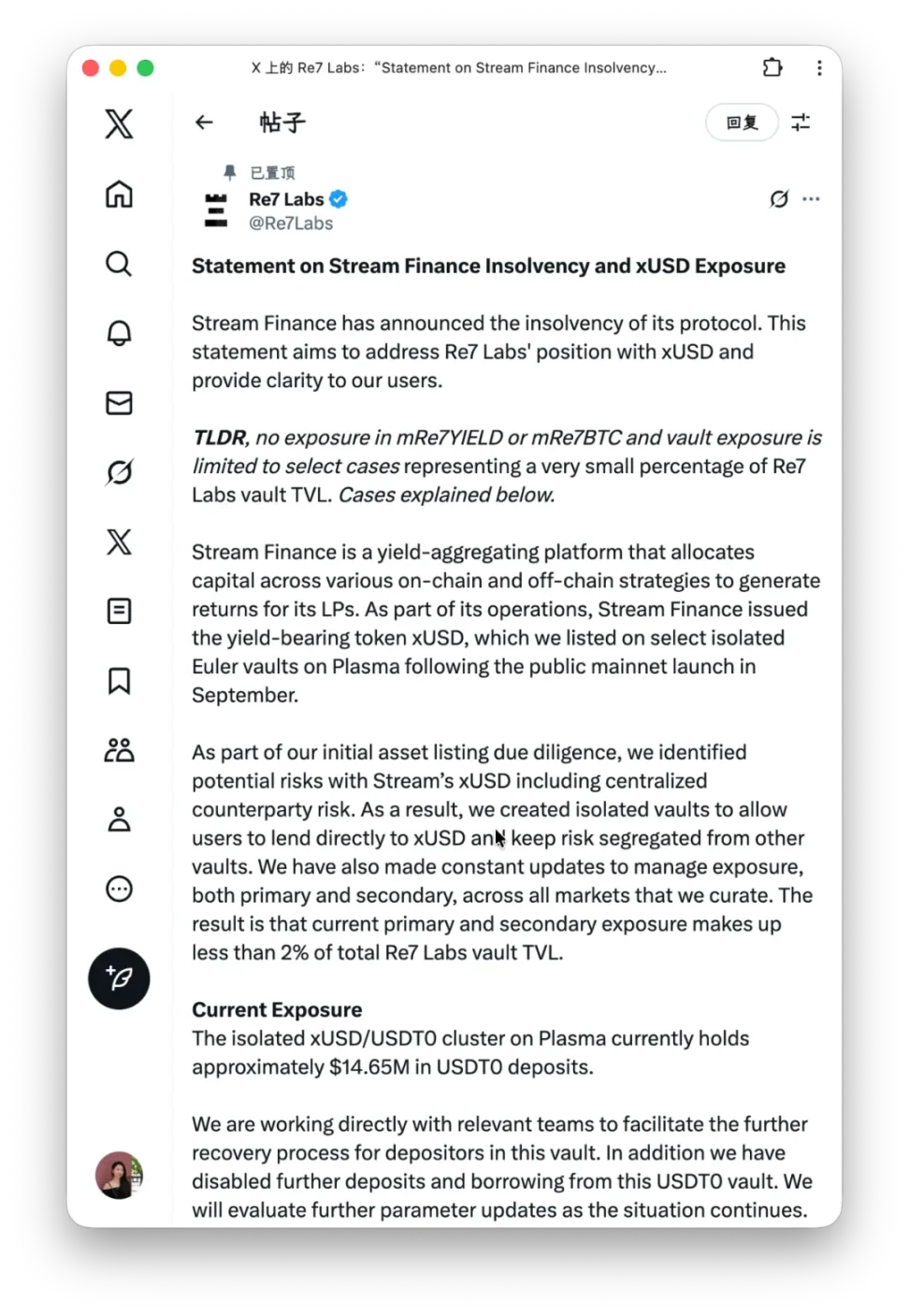
Image caption: Re7's response, image source: @Re7Labs
In fact, vault managers on platforms like Euler/Morpho are absolutely capable of recognizing the problems with YBS, but due to APY and profit requirements, some will accept it voluntarily or involuntarily. Stream does not need to convince all managers; it only needs to avoid being rejected by everyone.
The managers who accepted xUSD certainly bear responsibility, but this is a process of survival of the fittest. Aave was not made in a day, but grew into Aave through continuous crises. Would using only Aave make the market safer?
Actually, no. If Aave were a lending platform, it would be the only source of systemic crisis.
Platforms like Euler and Morpho represent a decentralized market or "new third board" mechanism, offering more flexible allocation strategies and lower entry barriers, which is of great significance for the popularization of DeFi.
However, the problem remains opaque. Euler/Morpho's Curator essentially allows third-party sellers to exist, while Aave/Fluid is entirely operated by JD.com. Therefore, when interacting with Aave, Aave is responsible for security. However, some of Euler's vaults are managed by the Curator, and the platform intentionally or unintentionally obscures this point.
In other words, platforms like Euler/Morpho have lowered users' expectations for defense and due diligence. If these platforms adopted a friendly fork similar to Aave or a liquidity backend aggregation like HL, while maintaining absolute separation between the frontend and branding, they would face far less criticism.
How should retail investors protect themselves?
In DeFi, every dream ends with pressing the doorbell of retail investors.
As the main public chain supporting DeFi, Vitalik is not so fond of DeFi. He has long advocated that non-financial innovation should occur on Ethereum. However, he is genuinely concerned for retail investors. Since he cannot eliminate DeFi, he has begun to advocate for Low Risk DeFi to empower the poor around the world.
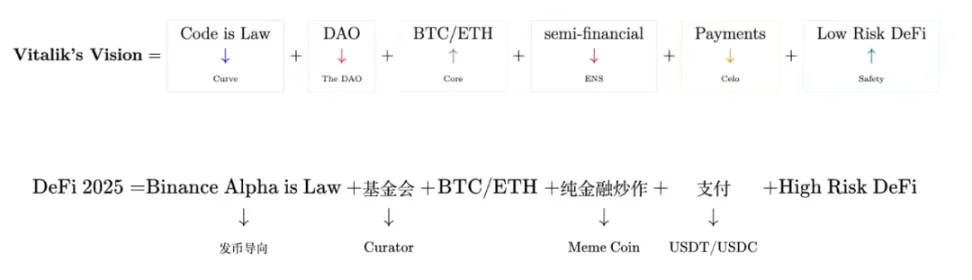
Image caption: Vitalik's perspective on DeFi and the real world. Image source: @zuoyeweb3
Unfortunately, what he fantasized about was never the reality, and people have long believed that DeFi is a high-risk, high-return product. This was indeed the case during the DeFi Summer of 2020, with returns often exceeding 100%. But now, even 10% is suspected of being a Ponzi scheme.
The bad news is there are no high returns, the good news is there are no high risks.
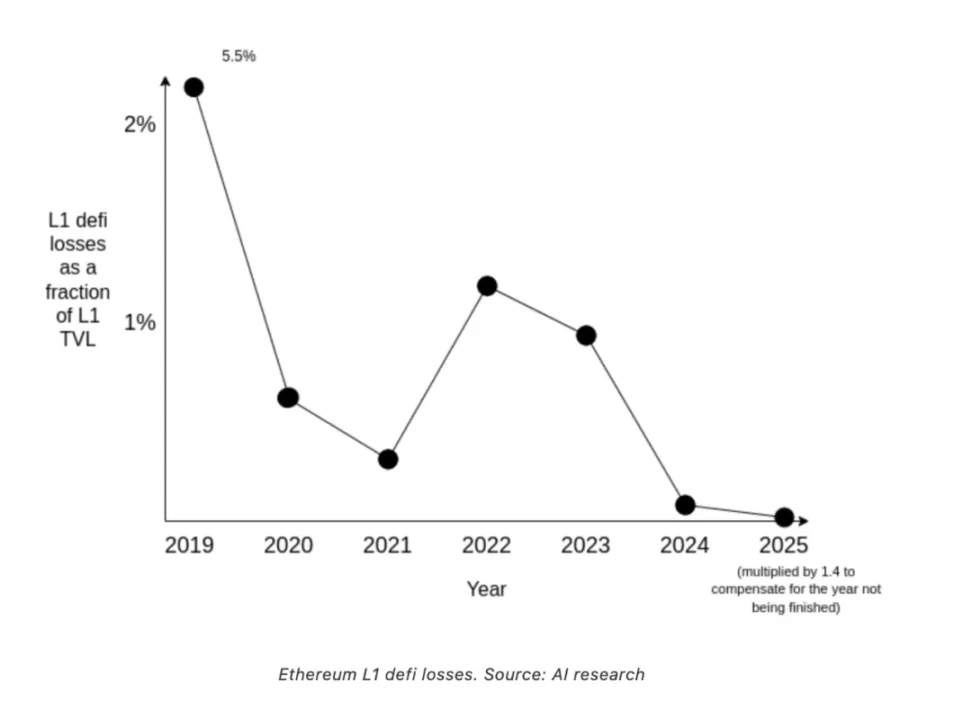
Image caption: Ethereum loss rate, image source: @VitalikButerin
Whether it's the data provided by Vitalik or data from more professional research institutions, the security level of DeFi is indeed rising. Compared to the 1011 Binance liquidation data and the huge theft of Bybit, the collapse and losses of DeFi, especially YBS, are insignificant.
However! And I must say "however," this doesn't mean we should rush into DeFi with confidence. While centralized exchanges (CEXs) are becoming increasingly transparent, DeFi itself is becoming increasingly opaque.
The era of regulatory arbitrage in CEXs has ended, but the era of relaxed regulation in DeFi has returned. This is certainly beneficial, but despite being called DeFi, the degree of centralization is becoming increasingly serious. There are too many hidden terms between protocols and between administrators that cannot be known to outsiders.
What we thought was on-chain collaboration was code, but it's actually Telegram's commission rate. This time, many xUSD managers released Telegram screenshots, and their decisions will directly affect retail investors' future.
Demanding regulation from them is not very meaningful. The core is still to combine usable modules from the on-chain perspective. Don't forget that over-collateralization, PSM, x*y=k, and Health Factor are sufficient to support the macro activities of DeFi.
In 2025, the yields supported by YBS will consist of nothing more than the following: YBS assets, leveraged yield strategies, and lending protocols. They are not countless; for example, Aave/Morpho/Euler/Fluid and Pendle will meet 80% of the interaction needs.
Lack of transparency in management leads to the failure of strategies. The person in charge has not demonstrated superior strategy-setting capabilities, and the elimination process occurs only after each problem arises.
Beyond that, what retail investors can do is see through everything, but frankly, that's not easy. Theoretically, both xUSD and deUSD are over-collateralized, but mixing the two together brings the leverage process that should have been done after minting to the minting stage, making xUSD not actually over-collateralized.
When YBS is minted based on another YBS, the collateral ratio after the iteration becomes difficult to distinguish.
Until a product that can overcome all obstacles is available, retail investors can only rely on the following beliefs to protect themselves:
- Systemic crisis is not a crisis (socialized). Participation in mainstream DeFi products is safe by default. Insecurity is unpredictable and unavoidable. The problems with Aave show the decline or restart of DeFi.
- Don't rely on KOLs/media. Participating in projects is a subjective choice (all judgments are our own thoughts). News is just a reminder that "this product exists." Regardless of KOL reminders, warnings, trading recommendations, or DYOR liability disclaimers, you ultimately need to make your own judgment. Professional traders shouldn't even look at the news, but rely solely on data to make decisions.
- Pursuing high returns is not more dangerous than low-return products. This is a counterintuitive judgment, but it can be viewed using Bayesian thinking. P(high returns | no defaults, high risk) = very small, P(low returns | no defaults, low risk) = very large. However, we cannot quantify the ratio between the two, i.e., obtain the odds. In simpler terms, the two are independent events.
Use external data to revise our beliefs, but don't seek data to support our beliefs.
Furthermore, there is no need to worry excessively about the market's self-correcting ability. It is not that retail investors will pursue volatility gains, but rather that funds will seek liquidity. When all funds retreat to Bitcoin or USDT/USDC, the market will automatically induce them to pursue volatility. In other words, stability creates new volatility, and volatility crises trigger a pursuit of stability.
You can look at the history of negative interest rates; liquidity is the eternal buzzing of finance, and volatility and stability are two sides of the same coin.
Conclusion
What retail investors need to do in the upcoming YBS market:
- Seek data, data that penetrates everything, data that penetrates leverage ratios and reserves. Transparent data does not lie. Do not rely on opinions to evaluate facts.
- Embrace strategy, continuously increase/de-leverage; simply reducing leverage cannot guarantee safety; always ensure that your strategy includes exit costs.
- While you can't control the percentage of losses, you can set your own psychological position size based on points 1 and 2, and then take responsibility for your own judgment.