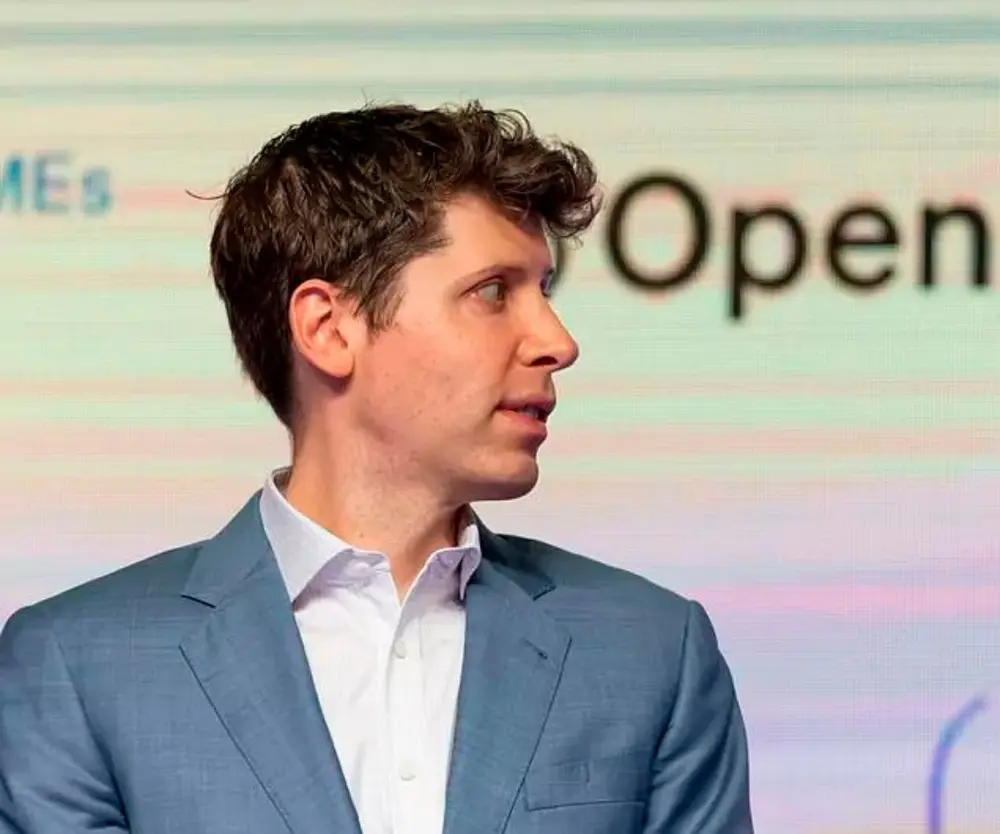
“Robots are not yet on the streets, and most of us don’t talk to AI all day long. People are still dying from disease, we can’t easily go into space, and there are still many things in the universe that we don’t understand. However, we have recently built systems that are smarter than humans in many ways, and that can significantly amplify the output of those who use them. The hardest part is over; the scientific breakthroughs that have brought us to systems like GPT-4 and o3 have not come easily, but they will take us even further.”
On June 11, OpenAI CEO Sam Altman wrote in an article published on his personal website.
According to him, humanity may have entered the early stages of the "singularity" - the tipping point where artificial intelligence surpasses human intelligence. Altman said humanity has crossed a critical turning point, an "event horizon" that marks the beginning of a new era of digital superintelligence.
“We have crossed this event horizon, and takeoff has begun,” he wrote. “Humanity is close to creating digital superintelligence, and so far it is not as weird as imagined.”
Altman’s comments come as leading developers in the field of artificial intelligence are warning that artificial general intelligence (AGI) could soon replace many jobs and disrupt the global economy at a pace that even governments and institutions cannot cope with.
The so-called "singularity" is a theoretical moment when artificial intelligence surpasses human intelligence, triggering rapid and unpredictable technological leaps and potentially leading to profound changes in society. The "event horizon" means an irreversible tipping point after which the direction of AI development cannot be changed.
Altman believes we are entering a “gentle singularity” — a gradual, controlled transition to powerful digital intelligence rather than a sudden, drastic change. The takeoff has already begun, but it is still understandable and positive.
In the gradual move toward a gentle singularity, “ we already live in the midst of incredible digital intelligence, and after the initial shock, most people have become fairly accustomed to its presence. We will quickly go from being amazed at an AI that can write a beautiful paragraph to expecting it to write a beautiful novel; from being amazed at an AI that can make a life-saving medical diagnosis to expecting it to develop a cure; from being shocked at an AI that can write a small program to expecting it to create an entirely new company. This is how the singularity happens: miracles become routine, and then become basic requirements. ”
As evidence, Altman pointed to ChatGPT’s rapid adoption since its public release in 2022: “Hundreds of millions of people rely on it every day, for increasingly important tasks,” he said.
The data backs up his claims. ChatGPT reportedly had 800 million weekly active users by May 2025. Despite ongoing legal battles with writers and media outlets, and calls for a moratorium on AI development, OpenAI clearly shows no signs of slowing down.
Altman stressed that even small advances in technology can bring huge benefits, but at the scale of serving hundreds of millions of users, even the slightest deviation can have serious consequences.
To address these potential biases, he offers several suggestions:
○ Ensure that AI systems are aligned with long-term human goals, rather than just satisfying short-term impulses;
○ Avoid centralized control by any one person, company or country;
○ Start an immediate, global discussion about the values and boundaries that should guide the development of powerful AI.
Altman pointed out that the next five years will be a critical period for the development of artificial intelligence.
“2025 saw the emergence of ‘agents’ that can perform truly cognitive tasks; the way we write computer code will never be the same,” he said. “2026 might usher in systems that can discover new insights, and 2027 might see robots that can complete tasks in the real world.”
He predicts that by 2030, intelligence itself, the ability to generate and execute ideas, will become ubiquitous. "We already live in the presence of powerful digital intelligence, and after the initial shock, most people have become accustomed to its presence." He points out that people quickly move from being amazed at AI to expecting it. " We already live in the presence of incredible digital intelligence, and after the initial shock, most people have become fairly accustomed to its presence. We will quickly go from being amazed at an AI that can write a beautiful paragraph to expecting it to write a beautiful novel; from being amazed at an AI that can make a life-saving medical diagnosis to expecting it to develop a treatment; from being amazed at an AI that can write a small program to expecting it to create an entirely new company. This is how the singularity happens: from wonder to routine to standard requirement. "
As the world awaits the arrival of general artificial intelligence and the Singularity, Altman believes that the most astonishing breakthroughs won’t be as shocking as revolutions—they’ll become commonplace, becoming the minimum standard for market entry.
“This is how the Singularity manifests itself: Miracle becomes routine, then becomes essential,” he said.
" The speed with which new wonders are realized will be staggering. Today it is hard to imagine what we will discover before 2035; perhaps we will solve high-energy physics this year and colonize alien planets next year; perhaps we will make a major breakthrough in materials science this year and realize a true high-bandwidth brain-computer interface next year. Many people will continue to live their lives the same way they have always lived, but at least some of them may choose to ' plug in ' . "
Looking ahead, all this may sound incomprehensible. But experiencing it in person may only feel shocking but manageable. From a relativistic perspective, the singularity happens bit by bit, and the convergence is slow. We are climbing along a long arc of exponential technological progress; it looks like vertical ascent from the front and flat from the back, but it is actually a smooth curve. (Recall how crazy it sounded in 2020 if someone said that we would be close to general artificial intelligence by 2025; how common the reality of the past five years has been.) "
He concludes his article by writing: “ May our march toward superintelligence proceed smoothly, exponentially, and silently. ”