
1. Bitcoin crash and market resonance
On November 4th, the cryptocurrency market suffered a severe blow, plunging into an overall slump. Bitcoin's price briefly fell below the $100,000 mark, hitting a low of $99,000, marking its most significant pullback since its year-to-date high. Ethereum also suffered, with its price hitting a low of approximately $3,000, a new low in nearly six months. Altcoins and meme coins also experienced sharp price declines, with liquidity and trading volume plummeting.
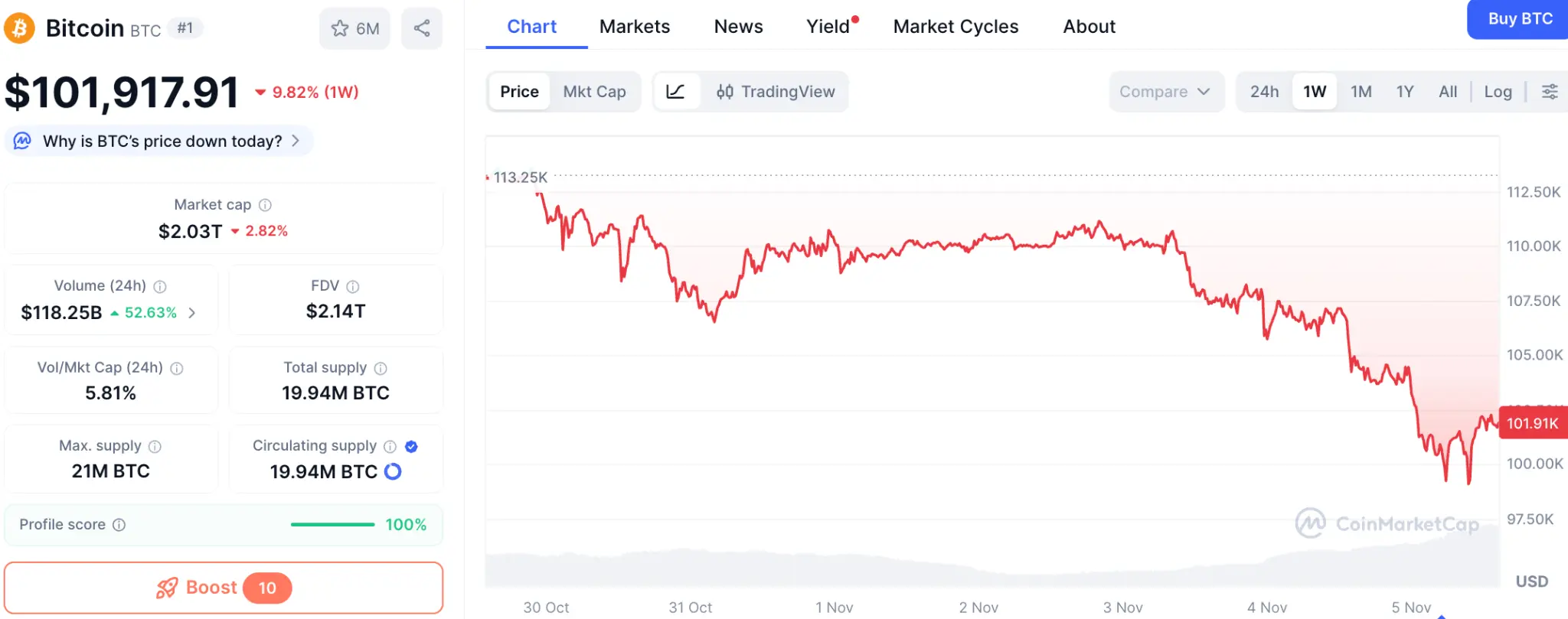
Data source: https://coinmarketcap.com/currencies/bitcoin/
From an overall market perspective, this is not an isolated phenomenon. Global risk assets generally declined that day, and the crypto market also came under pressure. According to Coingecko data, as of November 5th, the total market capitalization of the crypto market was approximately $3.45 trillion, a decrease of about 9.5% from November 3rd ($3.81 trillion).
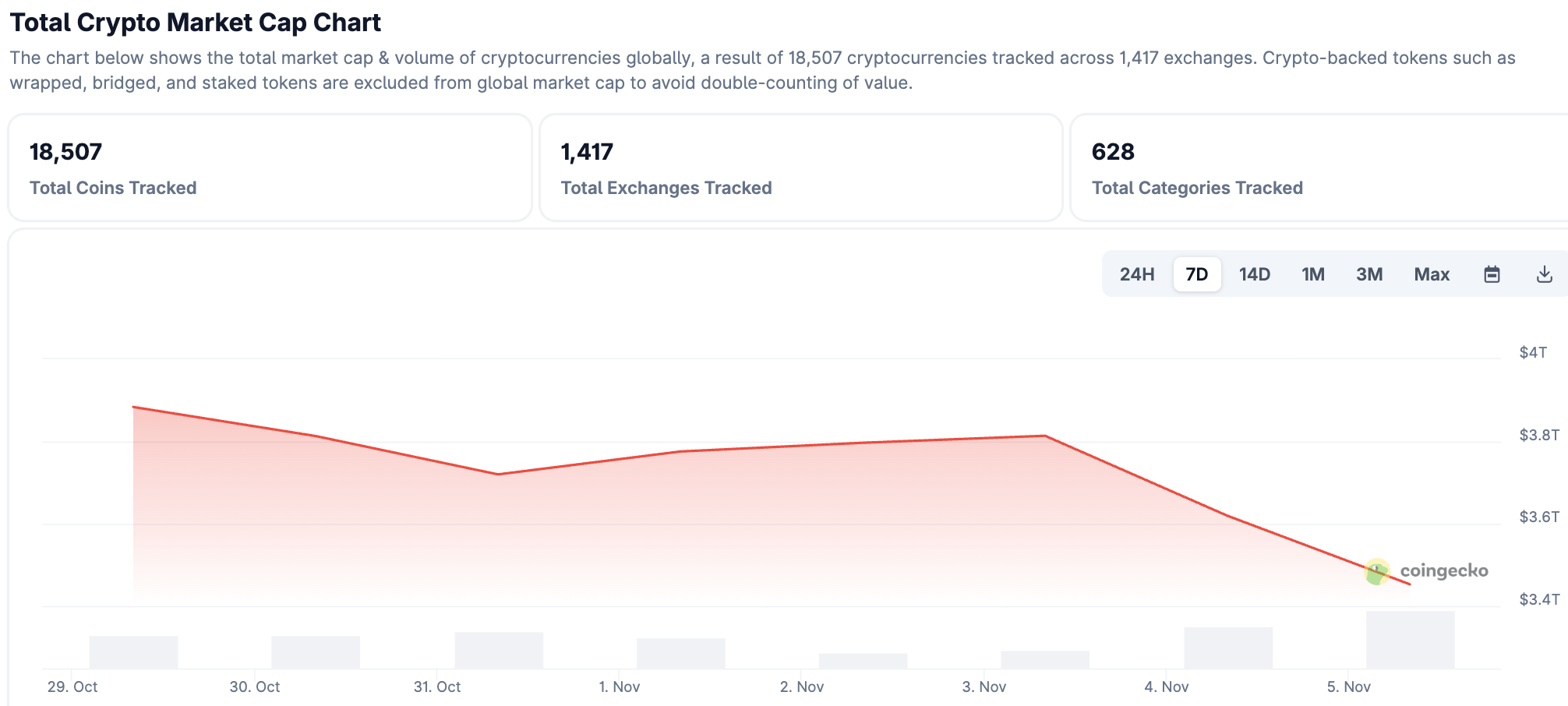
Data source: https://www.coingecko.com/en/charts
Meanwhile, a massive wave of liquidations occurred in the derivatives market. Coinglass statistics show that over $2 billion in liquidations occurred across the network within 24 hours on November 4th, with long positions losing $1.63 billion, accounting for nearly 80%. The overall TVL (TVL) of the DeFi ecosystem also declined significantly, from $150 billion on November 3rd to $141.7 billion on November 4th, a single-day drop of 5.5%; as of November 5th, TVL further fell to $133 billion, a cumulative decline of approximately 11.3%.
This decline reflects a sharp collapse in market confidence, a sudden tightening of liquidity, and a concentrated reaction after BTC prices broke away from support levels. This article will further analyze the potential triggering factors and explore the profound impact of this correction.
2. Analysis of the Causes of the Plunge: Recent Events and Macroeconomic Factors
Balancer suffers $116 million theft: DeFi security crisis intensifies
On November 4th, Balancer, a veteran DeFi protocol, suffered a hacker attack due to a smart contract vulnerability, resulting in the theft of over $116 million in assets and sparking market concerns about DeFi security. It's worth noting that in the past year, established DeFi protocols such as Curve and Euler Finance have also suffered large-scale financial losses due to contract vulnerabilities, exposing that even established protocols in the industry are not immune to systemic risks. These consecutive security incidents have significantly reduced market risk appetite and drastically weakened investor trust in the DeFi ecosystem, leading to a surge in capital outflows from the DeFi market and a severe reduction in TVL (Total Value Added). The Balancer incident undoubtedly deepened market anxiety, prompting investors to accelerate their withdrawal from high-risk assets and further exacerbating the Bitcoin crash.
Macro: The US federal government shutdown triggers risk aversion in the market.
The US federal government shutdown has entered its 35th day. The direct consequence of the shutdown is severe restrictions on public services and government spending, exacerbating market concerns about US economic growth. As a high-risk asset class, the cryptocurrency market has seen a significant increase in risk aversion due to this event, with investors choosing to take profits and reduce risk exposure. The large outflow of funds has directly impacted the price trends of Bitcoin and other digital assets, further deepening market panic.
Declining expectations of a Federal Reserve rate cut led to a stronger dollar and tighter liquidity.
Besides the impact of the government shutdown, the Federal Reserve's monetary policy is also a factor influencing market volatility. As expectations for a December rate cut by the Fed declined, the dollar index rebounded, and the strengthening dollar negatively impacted risk assets, including Bitcoin. A stronger dollar is often accompanied by tightening global liquidity, which is undoubtedly a bearish signal for the crypto market. With tightening liquidity, market risk appetite decreases, and investors begin to reassess the value of crypto assets, triggering sell-offs and exacerbating the decline in assets like Bitcoin.
Divergence in financial markets: Gold rises, Bitcoin falls
During the turmoil of November 4th, gold and Bitcoin exhibited a clear divergence in their price movements. Despite increased market risk, gold, as a traditional safe-haven asset, rose, while Bitcoin failed to demonstrate similar safe-haven characteristics. Data shows that gold prices continued to rise, while Bitcoin continued to fall. This phenomenon indicates that the crypto market is not yet widely regarded as a safe-haven asset; in fact, when macroeconomic uncertainty increases, the market tends to choose traditional safe-haven assets like gold rather than cryptocurrencies. This also reflects the vulnerability of the crypto market in risk aversion, especially against the backdrop of increased global economic uncertainty, where investor confidence in assets like Bitcoin as a safe haven remains low.
3. On-chain funding retreat and institutional trends
The role and changes of corporate and ETF support for Bitcoin price
This year, corporate Bitcoin treasuries and ETF participation have provided strong support for BTC prices. Companies purchase Bitcoin by issuing stocks or bonds, adding it to their balance sheets, while ETFs absorb new Bitcoin supply through continuous inflows, collectively creating a strong demand base. This mechanism helped Bitcoin withstand financial pressures and stabilize prices during periods of global economic stress. However, with increased policy and macroeconomic uncertainty, the investment trends of ETFs and corporations have changed significantly. Outflows from ETFs and a slowdown in corporate acquisitions have weakened market demand for Bitcoin, making price support more fragile.
BTC ETF continues to see net outflows: a signal of institutional withdrawal.
According to Sosovalue data, Bitcoin ETFs have experienced continuous outflows since the end of October, with a single-day outflow of $570 million on November 4th. While Bitcoin's fundamentals still appear solid, the ETF outflows clearly reflect institutional withdrawals. This indicates that institutional investors are concerned about future market uncertainty, leading them to reduce their Bitcoin holdings. With weakened liquidity and declining market confidence, Bitcoin's price faced increased selling pressure, resulting in greater market volatility.
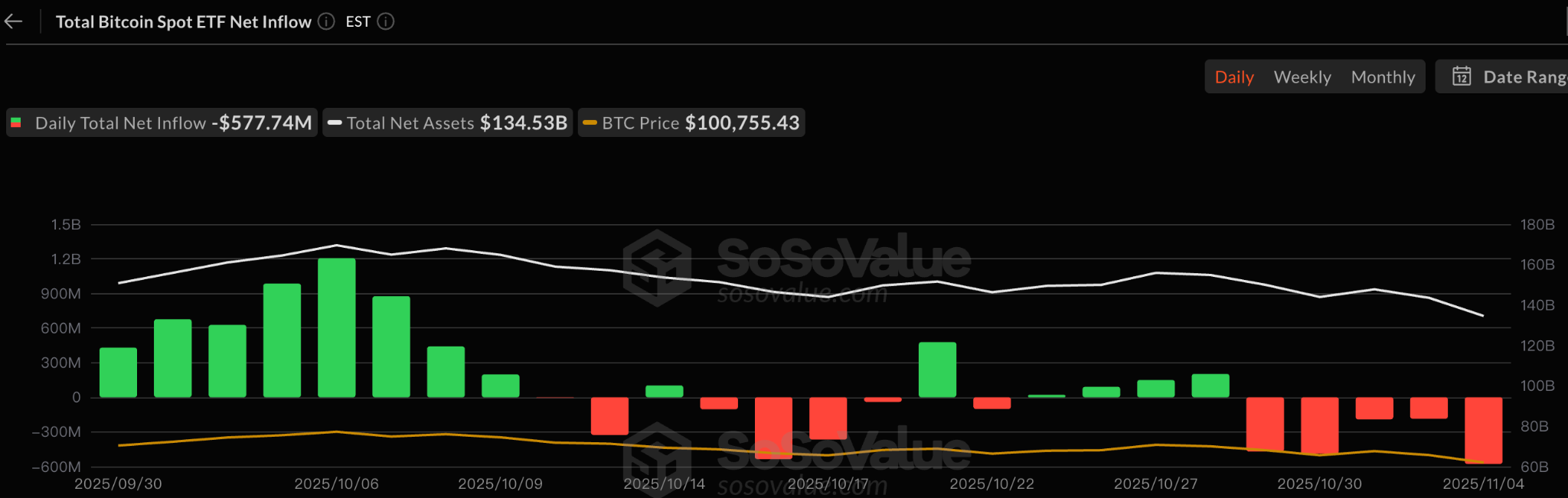
Data source: https://sosovalue.com/assets/etf/Total_Crypto_Spot_ETF_Fund_Flow?page=usBTC
Long-term holders sell: Smart money locks in profits
The large-scale selling by long-term holders (LTH) is also a significant factor contributing to the current pressure on the Bitcoin market. Long-term holders are often considered "smart money" in the market; they typically accumulate assets during market rallies and lock in profits when prices reach a certain high. According to on-chain data, a large number of LTH holders have recently begun to gradually reduce their Bitcoin holdings. In the month leading up to November 4th, LTH holders sold over 400,000 BTC, representing approximately 2% of the current circulating supply (19.94 million BTC), realizing over $40 billion. Especially when Bitcoin prices are fluctuating at high levels, the selling by long-term holders typically exacerbates downward pressure on the market. This withdrawal of funds suggests that investors' risk appetite is decreasing, and they may be beginning to worry that Bitcoin is nearing its cyclical peak.
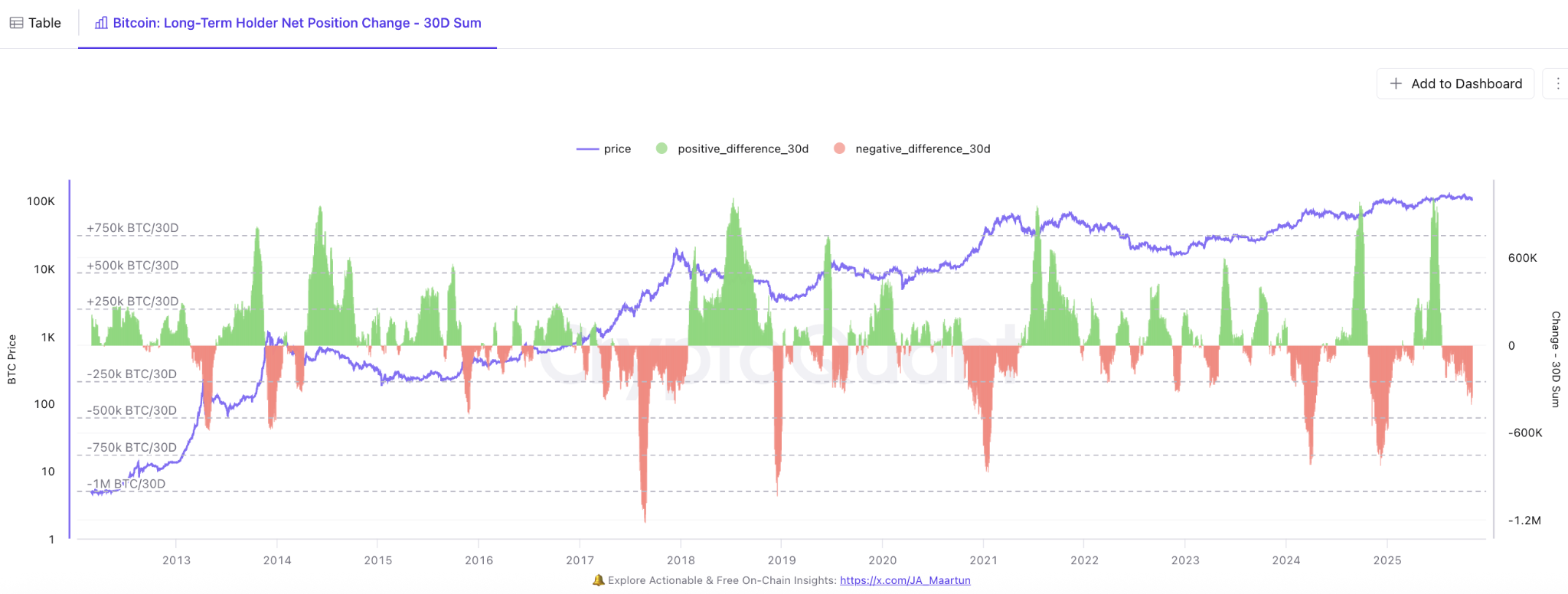
Data source: https://cryptoquant.com/analytics/query/65ed815767c8123d4840c81e?v=65ed815767c8123d4840c820
Slowing Corporate Treasury Holdings: A Signal of Cycle Top
Besides ETF outflows and investor profit-taking, corporate Bitcoin treasury accumulation strategies are also cooling down. In the past, many companies used Bitcoin accumulation to hedge risks and improve asset allocation flexibility. However, recent data shows this trend is slowing. For example, Strategy, the world's largest Bitcoin holder, only added about 12,000 BTC between August and October, far lower than the previous growth rate, and other companies are also slowing their accumulation. This reflects institutions' increased caution regarding macroeconomic uncertainties and a reduction in their exposure to Bitcoin. Reduced corporate buying means that the previously stable "structural demand" in the market is disappearing. When ETF outflows are coupled with weakened corporate buying, market absorption capacity decreases, and Bitcoin prices become significantly more sensitive to short-term selling pressure. This is one of the reasons why BTC prices were able to quickly break through key support levels in a short period during the decline in early November.
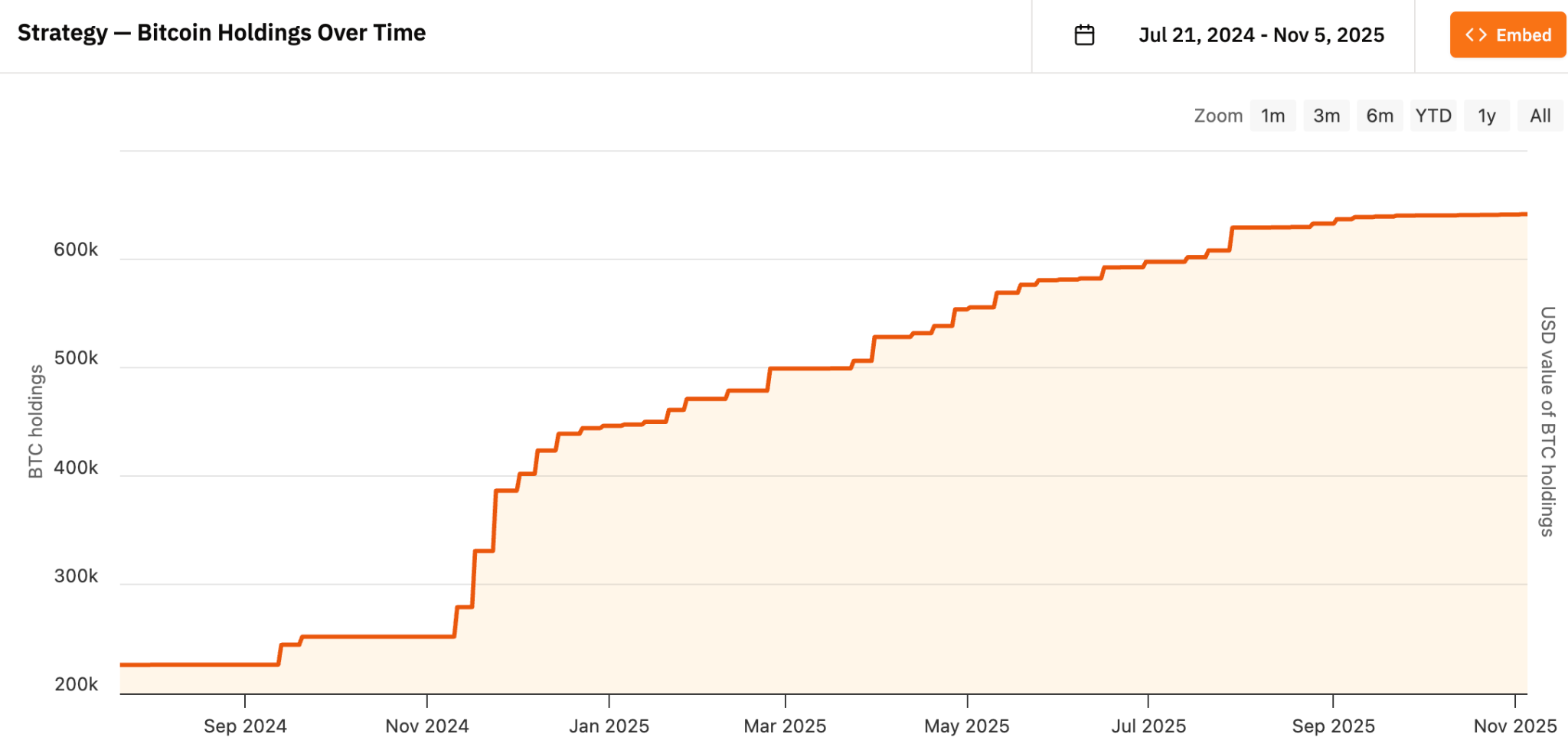
Data source: https://bitcointreasuries.net/public-companies/microstrategy
4. Future Outlook and Potential Impacts
The Bitcoin market is currently in a period of "high-level hesitation." Continuous net outflows from ETFs, institutional selling, and a slowdown in corporate buying all indicate that mainstream funds are becoming more cautious at the current price range, and the market may have entered an observation phase at the top of the cycle.
The key variables for the future remain macro liquidity and institutional behavior. If the Federal Reserve restarts its rate-cutting cycle early next year, the funding environment will shift towards easing, risk assets are expected to regain support, and Bitcoin may resume its rebound logic. Meanwhile, if ETFs see sustained net inflows and institutions rebuild their positions, this will be a significant signal of a market sentiment reversal. From a technical and psychological perspective, the $100,000 mark may become a crucial "psychological floor" and medium-term support level for Bitcoin. Once this price level is widely accepted by the market, Bitcoin is expected to form a new consolidation range within this area.
However, if the macroeconomy remains under pressure, US inflation is stickier than expected, or regulatory policies tighten again, the market may enter a longer period of sideways movement and consolidation. Overall, the direction of the Bitcoin market in the coming months will depend on the convergence of macroeconomic policies, institutional attitudes, and market sentiment.