
Written by: Liu Honglin
I don't know why, but lately, conference documents related to the crypto industry seem to be released on Fridays.
Just now, a message suddenly circulated on lawyer Honglin's WeChat Moments: a joint risk warning issued by seven financial industry associations regarding the prevention of illegal activities involving virtual currencies. The China Internet Finance Association, China Banking Association, China Securities Association, China Asset Management Association, China Futures Association, China Association of Listed Companies, and China Payment and Clearing Association all signed the warning.
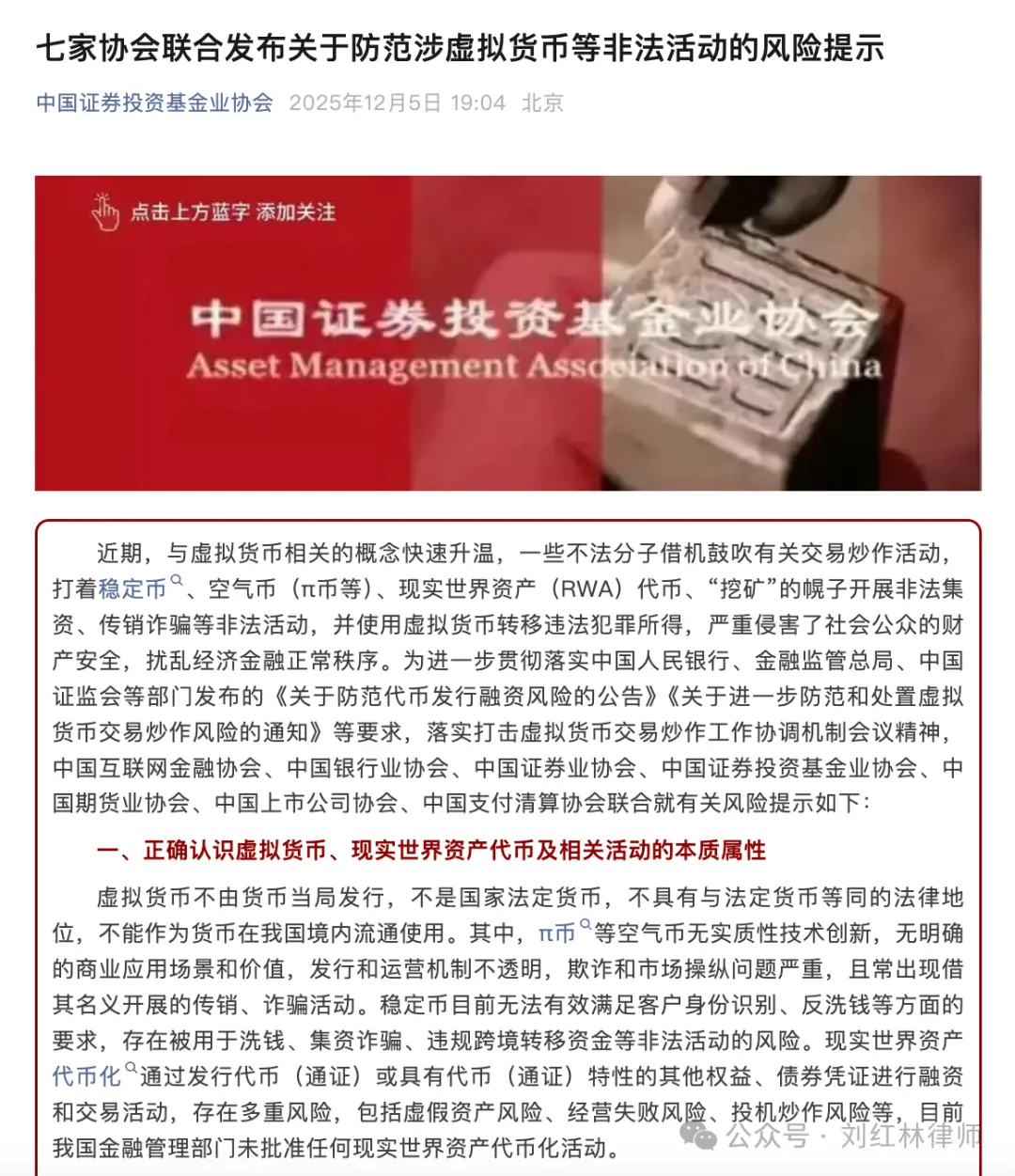
After reading the document, Attorney Honglin was completely bewildered.
This is no ordinary statement from an industry association; it's a blatant cross-industry, cross-regulatory "unified messaging" operation. Similar association collaborations often occur at critical junctures in the prevention and control of systemic financial risks.
One can't help but wonder, could RWA really be that destructive?
The most notable aspect of this document is its first explicit mention of RWA (Real-World Asset Tokenization), along with a qualitative assessment. Throughout the document, RWA is listed alongside stablecoins, worthless cryptocurrencies, and cryptocurrency mining as a primary manifestation of "illegal activities related to virtual currencies," effectively drawing criticism from the outset.
This wording itself sends a strong signal: RWA is no longer a "new technology" awaiting regulatory clarification, but a "risky business" directly included in the regulatory crackdown list.
Specifically, the document describes RWA as follows: "Real-world asset tokenization involves financing and trading activities through the issuance of tokens or other rights and debt instruments with token characteristics. This carries multiple risks, including the risk of fictitious assets, the risk of business failure, and the risk of speculation. Currently, my country's financial regulatory authorities have not approved any real-world asset tokenization activities."
This statement clearly outlines three bottom lines:
First, RWA is explicitly defined as a "financing and trading activity." This means that regardless of whether it is backed by real-world assets or uses blockchain technology, it is essentially a fundraising mechanism. As long as it involves token issuance, asset trading, and profit distribution, it naturally falls under the regulatory scope of the existing financial legal framework, especially the areas prohibited by relevant laws such as the Securities Law and the Measures for the Prohibition of Illegal Financial Institutions and Illegal Financial Business Activities.
Second, regulators emphasize the risks of "fake assets," "business failure," and "speculative manipulation." This is not only a characterization of fraudulent projects but also a denial of the potential market risks of so-called "normal projects." Even if the project team believes that its assets are genuine, its technology is transparent, and its structure is compliant, the regulator's judgment remains: such a token structure cannot guarantee the legal ownership and liquidation capabilities of the underlying assets, and the extent of its risk spillover is uncontrollable.
Third, and more crucially, is the statement: "my country's financial regulatory authorities have not approved any real-world asset tokenization activities." This is tantamount to a direct declaration that all tokenized assets, services, matching platforms, and trading platforms currently operating under the name RWA lack a legal basis for operation. There is no room for explanation that it is "in the regulatory exploration stage," nor is there any possibility of it "awaiting registration."
In fact, RWA has been regarded as an "alternative token path" within the industry for some time. Especially after stablecoins were officially included in the cryptocurrency regulatory framework, many teams chose to turn to RWA, attempting to circumvent regulations by using terms such as "real-world asset anchoring," "overseas compliance path," and "technology service output." This document has refuted these claims one by one.
The document explicitly states that RWA's activities pose legal risks such as "illegal fundraising, unauthorized public offering of securities, and illegal operation of futures business." These statements are not generalities but rather direct characterizations based on explicit provisions in the Criminal Law and the Securities Law.
- If you issue RWA tokens to the general public and raise funds, you are suspected of illegal fundraising.
- If you facilitate transactions or distribute tokens without permission, you may be committing an illegal securities offering.
- If your token trading involves leverage or betting mechanisms, it may constitute illegal operation of a futures business.
These charges are already very clear in terms of legal application, and in recent years, many court judgments have been made based on similar logic. RWA is not a new species existing outside the law, but rather a "familiar target" that regulators have categorized as part of the existing financial enforcement toolbox.
The timing of this risk warning is closely related to the frequent occurrence of fraudulent activities operating under the "RWA name" in recent times. Previously, lawyer Hong Lin was invited to participate in a program on Shanghai People's Radio, the topic of which was "Preventing RWA Financial Scams." Unexpectedly, this topic has risen to the national level.
The first paragraph of the document from the seven associations mentions that "criminals are taking advantage of this to promote related trading and speculation activities, using stablecoins, worthless coins (such as π coin), Real-World Asset (RWA) tokens, and 'mining' as a guise to carry out illegal fundraising, pyramid schemes, and other illegal activities." It seems that regulatory authorities are judging RWA on the same level as worthless coins, pyramid schemes, and other high-risk fraudulent methods, reflecting the actual frequency of cases and social harm observed by law enforcement.
More importantly, this notice specifically emphasizes the joint liability of service providers and intermediaries. The original text states: "Domestic staff of relevant overseas virtual currency and real-world asset token service providers, as well as domestic institutions and individuals who knowingly or should have known that they are engaged in virtual currency-related businesses and still provide services to them, will be held accountable according to law."
This statement has a profound impact and deserves our special attention.
First, it targets not only project owners but also service providers within the ecosystem, including project planners, technology outsourcing providers, marketing agents, KOL promoters, and payment interface providers. Second, "knowing or should have known" is a legal presumption of liability, no longer limited to subjective intent; as long as there is a reasonable objective basis for judgment, liability can be established. Third, it explicitly negates the common "overseas entity + domestic personnel" operating model in the Web3 industry. Even if your company is registered overseas but your team operates in mainland China, you cannot escape the classification of "providing services within China."
In other words, there's no such thing as "pure technology companies are fine" or "I'm just providing infrastructure" that absolves you of liability. If you know this project is implementing RWA in mainland China and still choose to provide services, you could be held accountable.
This also means that the entire Web3 service chain built around RWA has almost completely ceased within China. Not only are projects no longer viable, but the supporting services also lack a viable business model. Teams wanting to develop RWA in the future have only one option: to "go completely overseas." From legal structure, asset custody, user access, compliance auditing, and financial services, every link must be detached from the Chinese market, with no remaining foothold or connection. Otherwise, even simply hiring an operations person in China could trigger legal risks.
Currently, many projects are still attempting to secure policy space for RWA from the perspective of "technological innovation." They emphasize the efficiency of on-chain clearing, the transparency of asset transfers, or propose "technical solutions" such as integrating KYC and building multi-layered audit structures. However, the signal released by regulators this time is very clear: it's not a technical issue, nor a mechanism issue, but rather that the real-world financial risks far outweigh these technological benefits. The entire risk warning document contains no phrases like "technology pilot," "categorized regulation," or "prudent development," indicating that the regulatory goal is not to optimize the operation of RWA, but to explicitly exclude it from legal boundaries.
This isn't just a tightening of policy; it's a complete rejection of the underlying direction. It ends the very foundation of the RWA model—regardless of whether you distribute tokens using an SPV architecture or manage underlying equity with on-chain contracts, as long as the final structure possesses the attributes of "financing + trading," it cannot escape the regulatory definition of illegal financial activity. Projects still expanding their market on WeChat groups, Telegram groups, and Twitter under the guise of "node partners" or "regional representatives" are no longer considered fringe explorations from a regulatory perspective; they are directly categorized as participating in illegal activities.
For teams within China, this also means that the entire narrative surrounding RWA—from asset providers, technology development, and market matchmaking to the accompanying consulting, outsourcing, and promotional services—no longer possesses any sustainable business logic. As long as there are Chinese nodes in the chain, it poses a potential risk.
For overseas projects, the situation isn't much better. The Chinese mainland market is no longer a region "waiting for regulatory clarification," but rather a region that has clearly expressed its rejection—not a suspension, not a wait-and-see approach, not a postponement, but a clear exclusion.
In this context, the choices left to practitioners are very clear: either completely relocate their business systems to a compliance system that has no overlap with Chinese regulations, or completely abandon RWA.