Author: Iris, Bai Qin
Lawyer Mankiw still remembers that in August 2024, the Hong Kong Monetary Authority announced the launch of the Ensemble project sandbox, which aims to promote the combination of virtual assets and traditional financial products and lead the integration and innovation of the RWA track in Hong Kong.
In February 2025, as one of the participants in the first phase of the Ensemble project sandbox trial, China Asset Management (Hong Kong) announced that the tokenized retail money fund it built has been approved by the Hong Kong Securities and Futures Commission (SFC) and was officially launched at the end of February.
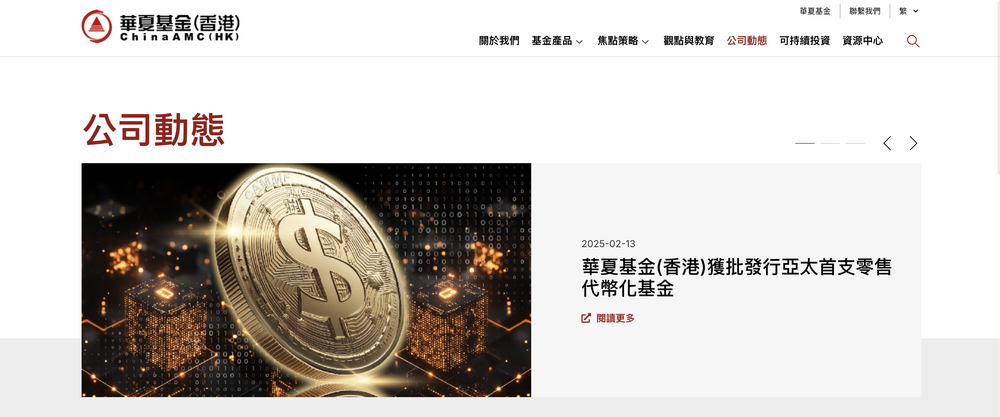
As the first fund of its kind in the Asia-Pacific region, it not only marks the further penetration of virtual assets into the traditional financial sector, but also represents the latest progress of the Hong Kong Ensemble project sandbox. It also provides a new direction for regulators, fund management companies and investors to think about - how to use blockchain to improve the transparency and liquidity of financial products while ensuring compliance.
Then, Attorney Mankiw will discuss the fund's operating mechanism, compliance points, market significance and other aspects one by one.
What are Tokenized Retail Money Funds?
The tokenized retail money fund launched by China Asset Management (Hong Kong) is derived from the traditional money market fund (MMF) and optimizes the registration, trading and settlement of fund shares through blockchain technology, becoming the latest practical case of RWA (real world assets) in the financial market.
In the traditional financial market, money market funds have always been the core tool for liquidity management and low-risk investment, and are favored by enterprises, institutional investors and prudent individual investors. Its core operating model is that after the fund company raises funds, it invests in high-liquidity, low-risk assets such as short-term bank deposits, government bonds, and repurchase agreements to maintain the security of funds and provide stable returns.
However, the operation mode of traditional money market funds also has certain limitations. For example, the transaction settlement cycle is long, and it usually takes 1-2 working days for investors to purchase or redeem fund shares; information transparency is limited, and ordinary investors find it difficult to obtain real-time data on fund operations in a timely manner; asset liquidity is limited, and capital turnover efficiency is relatively low.
It is precisely based on these pain points that when the Ensemble sandbox was launched, China Asset Management (Hong Kong) actively applied to participate and explore the feasibility of fund tokenization.
Today, China Asset Management (Hong Kong) has officially launched a tokenized retail money fund, which completes the digital registration, holding and trading of fund shares based on blockchain technology, realizing the digital upgrade of traditional funds under a compliance framework.
Compared with traditional money market funds, tokenized funds have obvious advantages in many aspects, such as:
Improve transaction efficiency and liquidity
Tokenized funds can achieve near-instant settlement through blockchain, greatly improving the efficiency of liquidity management. In addition, investors can freely transfer on trading platforms that meet regulatory requirements without having to wait for the redemption cycle of traditional funds.
Transparency and traceability
Since fund shares are directly registered on the blockchain, investors can query fund net value, holdings and transaction records in real time, avoiding the information opacity that may occur in traditional funds. This not only helps to enhance investor trust, but also provides regulators with a more efficient means of market supervision.
Reduce operating costs
Traditional funds involve multiple intermediaries, including fund custodians, clearing agencies, and distribution channels, while tokenized funds automate most operational processes through smart contracts and blockchain technology, reducing dependence on intermediaries and thus reducing management costs.
Cross-border transactions are more convenient
Due to the global nature of blockchain, tokenized funds have a natural advantage in cross-border transactions. Investors are not subject to the geographical restrictions of the traditional financial system and can participate in the global financial market more conveniently. Especially in Hong Kong, an international financial center, the launch of this fund is expected to further promote the development of RWA (real world assets) in the Asia-Pacific market.
How tokenized funds work under regulation
The successful launch of the tokenized fund by China Asset Management (Hong Kong) is due to the optimization of the chronic problems of traditional funds through the RWA model, and the efforts of compliance are indispensable. Before the official launch, the fund has been strictly tested and reviewed under the Hong Kong regulatory framework, including but not limited to:
Take the lead in participating in the Ensemble project sandbox to test the application of blockchain technology in fund products in a controlled environment;
Accept compliance review by the Hong Kong Securities and Futures Commission (SFC) to ensure that the fund tokenization structure complies with the current Securities and Futures Ordinance;
Adopt compliant custody and settlement models to ensure that investors' rights and interests are legally protected.
These compliance measures not only ensure the fund's innovative application of blockchain technology, but also enable it to operate legally under the regulatory framework of traditional financial markets. As a result, Mankiw also got a glimpse of the key points of the tokenization of many traditional funds in terms of compliance:
Requirements for fund licenses
The Hong Kong SFC has a strict licensing system for fund management companies. All funds issued to the public must be operated by institutions holding an asset management license (Category 9) approved by the SFC and be subject to continuous supervision by the SFC. Money market funds involve low-risk investment management and have higher requirements for fund security and liquidity. Investment targets must comply with SFC regulations, such as bank deposits, short-term government bonds, repurchase agreements, etc.
As a long-established licensed asset management institution, China Asset Management (Hong Kong) has obtained the SFC Category 9 (Asset Management) license, and therefore complies with regulatory requirements and can legally operate fund products.
Fund structure requirements
The tokenization of funds does not create new virtual assets, but introduces blockchain technology to optimize trading and registration methods based on the existing fund structure to achieve digital upgrades. The core adjustment is that the registration, trading and settlement of fund shares are transferred from the traditional financial system to the blockchain platform, but the fund's investment targets, risk management model and investor protection mechanism still strictly follow the SFC's regulatory framework and will not change due to tokenization.
Under the SFC’s review, China Asset Management (Hong Kong) ensured that tokenization would not affect the security of the fund’s underlying assets, nor would the fund be reclassified as an unauthorized virtual asset product due to technological innovation.
Fund Custody Requirements
In the traditional financial system, the asset custody of money market funds is usually handled by licensed custodians to ensure the safety of fund assets and to strictly isolate them from the funds of fund managers. This tokenized fund continues this regulatory requirement under the compliance framework, with Standard Chartered Bank acting as the tokenization agent, digital platform operator and token custodian, while providing traditional fund management and trust services to ensure the security and compliance of the fund.
Specifically, the tokenization process of the fund will be implemented through Libeara, the tokenization platform of SC Ventures under Standard Chartered Bank. The fund shares will be digitally registered, traded and settled on the blockchain, but the underlying assets will still be subject to traditional financial supervision and maintain the same security and investor protection mechanisms as traditional money market funds.
Requirements for blockchain technology
The Hong Kong Monetary Authority (HKMA) and the Securities and Futures Commission (SFC) have set strict compliance standards for the application of blockchain technology in financial products, focusing on smart contract security, investor protection, data transparency, and anti-money laundering (AML) compliance to ensure that tokenized financial products comply with the existing regulatory framework and do not undermine investor rights due to technological innovation.
Therefore, in order to meet these compliance requirements, China Asset Management (Hong Kong) adopted the Libeara tokenization platform under Standard Chartered Bank to ensure that the digital registration, trading and settlement processes of fund shares meet regulatory requirements.
Requirements for investor protection mechanisms
The Hong Kong SFC has set strict requirements for investor protection of retail funds. Even though China Asset Management (Hong Kong) uses tokenization technology, its investor protection standards must still comply with the regulatory framework of traditional funds.
For example, fund managers need to ensure that investors receive adequate information disclosure, including fund portfolios, returns, fee structures and potential risks; at the same time, investor transactions must be conducted through regulated platforms to prevent fund shares from entering non-compliant markets, thereby reducing risks caused by market manipulation or illegal transactions; in addition, fund operators must ensure that the application of smart contracts and blockchain technology will not affect the rights and interests of investors, ensure that the holding and trading of fund shares are secure and traceable, and are subject to continuous supervision by regulators.
In addition, as the first tokenized retail money fund in Hong Kong and even the Asia-Pacific market, the launch of this fund not only needs to comply with local regulatory requirements, but also faces the challenge of cross-border compliance. Since the regulatory standards for tokenized financial products vary from jurisdiction to jurisdiction, when the fund expands to other markets in the future, it may need to be adjusted according to the regulatory framework of different countries or regions to ensure its compliance.
Attorney Mankiw's Summary
The tokenized retail money fund launched by China Asset Management (Hong Kong) is not only an important practice in the Hong Kong Ensemble project sandbox and RWA track, but also indicates that the traditional fund management industry is accelerating its move toward blockchain technology.
The successful launch of this fund may also mean that under the compliance framework of Hong Kong, compared with the exploration of crypto funds, this type of tokenized fund led by licensed institutions is more in line with the existing regulatory system and is more likely to become the mainstream direction of RWA compliance development in the future.
Of course, this is just a starting point. In the future, as the Hong Kong Ensemble Sandbox Program continues to advance, RWA innovation will still have more room for imagination. In this transformation, Mankiw also hopes to use his professional capabilities to reach more cooperation with the Hong Kong Web3 industry and regulators to jointly promote the implementation and development of RWA under the compliance framework.
 Author: Mankiw Blockchain This article is the opinion of the PANews columnist, does not represent the position of PANews, and does not bear any legal responsibility. The article and opinions do not constitute investment advice.
 Image source: Mankiw Blockchain. If there is any infringement, please contact the author to delete it.