
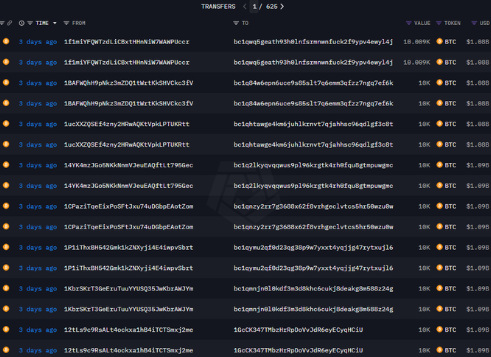
What these wallets have in common is eerie:
The last transfer took place in 2011
At that time, the price of Bitcoin was less than $1
This means that these BTC holders are sitting on a profit of more than 100,000 times.
But 14 years later, at the same time, they chose mobile money
Such a synchronized and sudden operation has caused a lot of speculation:
🧠 Was it a hacker, a legacy, or a long-planned plot?
Initially, people thought that these BTC had been lost long ago, and some even regarded them as the legacy of Satoshi Nakamoto himself. But the key to this incident is "why use them now?" There may be three explanations behind this:
① Wallet service providers secretly control private keys?
A popular theory is that some old wallet service providers or platforms still hold users' private keys and clear them out after years of no one claiming them.
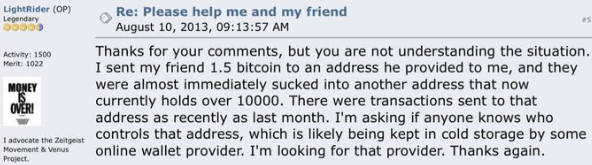
As early as 2013, a user complained on the forum that he transferred 1.5 BTC to a friend, but the funds were "automatically returned" to an address holding 10,000 BTC.
Strangely, there is no trace of this transaction on the chain.
In 2021, someone also claimed that he once owned 10K BTC at this address, but the private key was saved in an old computer and had been sold long ago.
It is difficult to tell whether these stories are true or false, but they are always brought up again in every bull market, and seem more like fantasies of "mysterious wealth."
② Hacker test path: first practice with BCH, then BTC
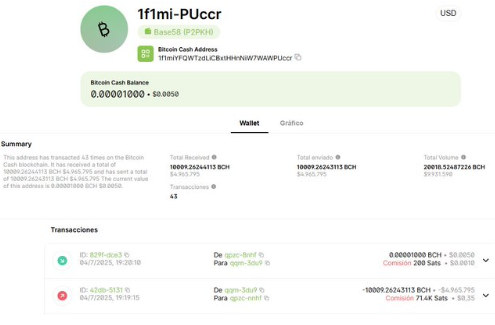
A more interesting clue is that some wallets first test small amounts on the BCH network before transferring large amounts of BTC.
Since Bitcoin and Bitcoin Cash share the same private key structure, hackers can use the BCH network for testing and circumvent on-chain monitoring on the BTC mainnet.
This shows that the operator is very professional and has awareness of on-chain security - he is not like an ordinary person who "accidentally retrieves his private key".
③ Is it related to the “Silk Road”?
One detail is alarming: almost all of these BTC were transferred into the wallet between April and May 2011.
This period of time was the initial stage of the rapid development of the dark web Silk Road. As we all know, not all BTC were recovered in the Silk Road case.
One possibility cannot be ruled out: these wallets belong to Ross Ulbricht or someone he trusts, and these BTC are deliberately "sleeping" and waiting for the right time to use them.
⚠️ It is not a quantum attack, the address type does not support cracking
Others have questioned whether quantum computing unlocked these wallets.
But from a technical point of view, this is almost impossible:
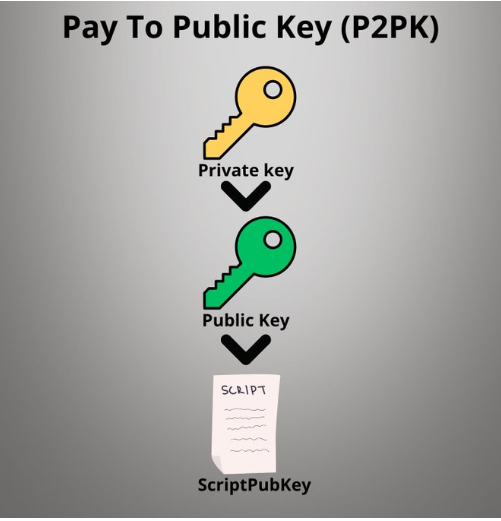
All wallet address types are P2PKH
The public key is only visible when spending for the first time
Quantum computers cannot obtain public keys without having used them before
In other words: even with top-level quantum computing power, these wallets are **doubly impossible** to crack.
✅ Conclusion: What is really worth being vigilant about is not the transfer itself, but the "signal" it represents
This “zombie wallet awakening” did not cause a direct market crash, and the $8B volume can still be digested in the daily BTC trading volume of $50B.
But its symbolic significance is very significant:
Very early wealth is being released or redeployed
On-chain behavior is becoming increasingly complex, and retail investors with less information have difficulty distinguishing authenticity
The BTC market is increasingly like a "power game" rather than a free market
This transfer is an on-chain reminder that real whales never post on Twitter, but quietly make plans on the chain.
The next time you see “BTC new high is coming,” don’t forget that on-chain data is the clue to the truth.