
Since entering the stock tokenization business in June, Robinhood (NASDAQ: HOOD) has been accelerating its transformation from a single retail trading platform to a deeply integrated Web3 financial infrastructure. By mapping US stocks onto the blockchain, Robinhood aims to address core pain points in traditional finance, such as T+N settlement delays, cross-border access restrictions, and high commissions. Within this framework, investors can participate in the allocation of high-quality global assets through stock tokens, enabling 24/5 continuous trading. This not only lowers the barrier to entry for asset allocation but also improves the accessibility and inclusiveness of cross-regional financial services. To date, Robinhood has completed the tokenization mapping of 1,491 stocks, with a total market capitalization of $13.55 million. In addition, Robinhood's growth in emerging areas such as prediction markets is also noteworthy. Its November 2025 operational report shows that its monthly trading volume of event contracts has exceeded 3 billion, a 20% increase month-over-month, making it one of the fastest-growing core engines. Against this backdrop, CoinW Research Institute will further analyze Robinhood's existing core business matrix and product logic, and explore its further possibilities.
I. Robinhood's Breakthrough Path
1. Robinhood's Zero-Commission Growth Engine
Robinhood's rise is considered a prime example of business model innovation in the fintech sector. Its founding team successfully broke through the highly competitive mature financial market through three core strategies: pioneering zero-commission trading, prioritizing mobile-first experience, and building a highly approachable brand image. Zero-commission service was the core driving force behind its first-mover advantage. By eliminating the explicit costs of transactions, Robinhood significantly lowered the barrier for retail investors to enter the capital markets, thereby rapidly accumulating a massive initial base of retail investors.
Behind this "free model" lies its cleverly designed Payment for Flow (PFOF) profit mechanism. Robinhood directs its clients' trading orders to high-frequency traders or market makers for execution. These market makers profit from the bid-ask spread and pay Robinhood a rebate. While the PFOF model has been controversial at the regulatory level due to concerns about execution quality and potential conflicts of interest, it has indeed provided long-term financial viability for a zero-commission strategy. Through this mechanism, Robinhood successfully converted its early user acquisition gains into a solid asset base, laying a strong foundation for its subsequent expansion into comprehensive financial services. Meanwhile, Robinhood's success has not only forced established financial giants to pay attention to the zero-commission model but has also provided a reference for other industries in their user growth strategies. For example, Web3 projects such as the decentralized perpetual contract platform Lighter are attempting to replicate this low-friction, high-growth path in the DeFi field, leveraging low-cost trading methods to achieve a new round of user expansion.
2. Robinhood may be the largest beta platform to integrate crypto and stocks.
As the crypto asset ecosystem and stock tokenization gradually merge, Robinhood has become one of the key platforms in the crypto-stock convergence market and is considered the most representative beta platform in this trend. Its core advantage lies in its unique positioning at the platform structure level. Robinhood integrates regulated traditional brokerage business with crypto asset trading functions within the same system, forming a hybrid financial system that combines compliance with on-chain efficiency. Regarding asset tokenization, Robinhood's tokenized stocks are essentially an on-chain mapping model of regulated custodial assets. First, a licensed entity compliantly holds real assets, then corresponding tokens are generated on-chain for internal trading, thus reflecting the holdings and changes of real assets on-chain. Specifically, Robinhood's European subsidiary, holding a Lithuanian securities license, acts as the compliant entity, legally purchasing and custodial assets such as US stocks within the traditional financial system, then generating stock tokens on Arbitrum according to the corresponding custody scale, and restricting trading to its own platform. During operation, each token transaction is simultaneously reflected on the on-chain ledger, and the back-end system dynamically adjusts the corresponding mapping relationship based on the actual holdings in the regulated accounts. In the future, Robinhood also plans to gradually migrate this mapping and settlement system to its self-developed Robinhood Chain to enhance the system's on-chain autonomy and support cross-chain transactions.
From a business development perspective, Robinhood's advantages lie primarily in its user base and product distribution capabilities. Robinhood simultaneously caters to both traditional stock investors and crypto asset traders, allowing equity tokenization products to be directly embedded into existing account systems and trading scenarios without relying on external traffic or additional user education costs. This model of accessing multiple assets from a single account reduces the difficulty of cold-starting equity tokenization products and makes them easier to scale. In a horizontal comparison, Robinhood's market position lies between crypto-native issuance platforms and traditional large brokerages, and it differs significantly from both. Compared to tokenization issuance institutions like Backed, which primarily target professional or qualified investors, Robinhood focuses more on retail users, emphasizing usability, trading frequency, and user experience in its product design. Meanwhile, compared to traditional brokerages, although the latter have advantages in institutional services and professional trading, their progress in areas such as blockchain asset issuance, on-chain settlement, and 24/7 trading is relatively cautious, and equity tokenization has not yet become a core business focus.
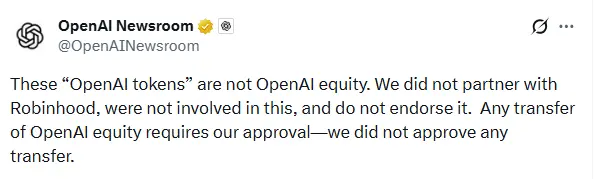
It's worth noting that Robinhood's attempts at equity tokenization have sparked regulatory controversy. In June 2025, after Robinhood launched equity tokens, including OpenAI's, in the European market, OpenAI immediately issued a public statement declaring that it had no partnership with Robinhood, nor authorized the issuance of any form of tokenized equity, and emphasizing that the tokens did not represent actual OpenAI equity. Following this statement, regulatory agencies also raised concerns, and Robinhood subsequently delisted the relevant token products. This indicates that Robinhood's current tokenization business is still in a transitional phase, and there are still significant boundary issues regarding actual equity mapping, issuance authorization, and legal attributes.
Source: @OpenAINewsroom, https://x.com/OpenAINewsroom/status/1940502391037874606
3. Robinhood enters the prediction market arena.
As its tokenization-related businesses progressed, Robinhood began extending its reach into prediction markets. However, its approach wasn't to build infrastructure from the ground up, but rather to start with specific product forms like event contracts, gradually guiding retail users to participate in event-driven trading. In October 2024, Robinhood officially launched event contracts through its Robinhood Derivatives platform, allowing users to trade based on the outcome of the US presidential election, with the occurrence of the event serving as the basis for contract settlement. This marked Robinhood's first expansion of its retail trading scenarios beyond traditional asset price fluctuations to the pricing expression of macroeconomic events and uncertainty themselves. Subsequently, in 2025, Robinhood continued to enrich the coverage of event contracts, extending the model to more scenarios such as sports events, gradually making prediction markets an independent product branch within its retail trading system. From a product logic perspective, these event contracts differ from traditional betting and standard financial derivatives, resembling more of a probabilistic risk expression tool operating within a regulatory framework.
After completing initial product validation, Robinhood began to fill gaps in its prediction market-related trading and clearing capabilities. In November 2025, Robinhood and Susquehanna International Group (SIG) announced their intention to acquire a 90% stake in MIAXdx (formerly LedgerX) through a joint venture. MIAXdx is an institution regulated by the U.S. Commodity Futures Trading Commission (CFTC) and holds important qualifications such as Designated Contract Market (DCM) and Derivatives Clearing Organization (DCO). The transaction still requires regulatory approval and is expected to settle in early 2026. Building on this foundation, Robinhood is taking two steps: firstly, by introducing top quantitative market makers like SIG, it is providing institutional-grade liquidity support for event contracts to alleviate the common problems of insufficient depth and wide spreads in prediction markets; secondly, in December 2025, it joined forces with leading prediction market platform Kalshi, crypto trading platforms Crypto.com and Coinbase, and sports betting platform Underdog to establish a prediction market industry alliance, promoting the compliance of prediction markets within the regulatory framework. On December 17, Robinhood CEO said, "We are in the early stages of a supercycle in the prediction market, and as it develops, we should see continued growth in user adoption and transaction volume, with contract sizes reaching trillions of dollars annually."

Source: robinhood, https://robinhood.com/us/en/newsroom/robinhood-prediction-markets-joint-venture/
II. Robinhood Business Data
1. Robinhood Integrated Business Data
According to Robinhood's Q3 2025 financial report, Robinhood achieved net revenue of approximately $1.27 billion, representing a year-over-year increase of approximately 100%. Of this, transaction revenue increased by 129% year-over-year to $730 million, primarily driven by cryptocurrency revenue of $268 million (over 300% growth), options revenue of $304 million (50% growth), and equity revenue of $86 million (132% growth). Net interest income increased by 66% year-over-year to $456 million, mainly due to growth in interest-bearing assets, but partially offset by lower short-term interest rates. Other revenue increased by 100% year-over-year to $88 million, primarily due to an increase in Robinhood Gold subscribers. During this period, total assets on the Robinhood platform increased by 119% year-over-year to approximately $333 billion, demonstrating rapid expansion in user asset size. This indicates that Robinhood's revenue streams have gradually expanded from a single transaction commission and order flow payment (PFOF) model to multiple business lines such as interest income, crypto trading, subscription services, and derivatives, presenting a more diversified business structure.
2. Robinhood Stock Tokenization Business Data
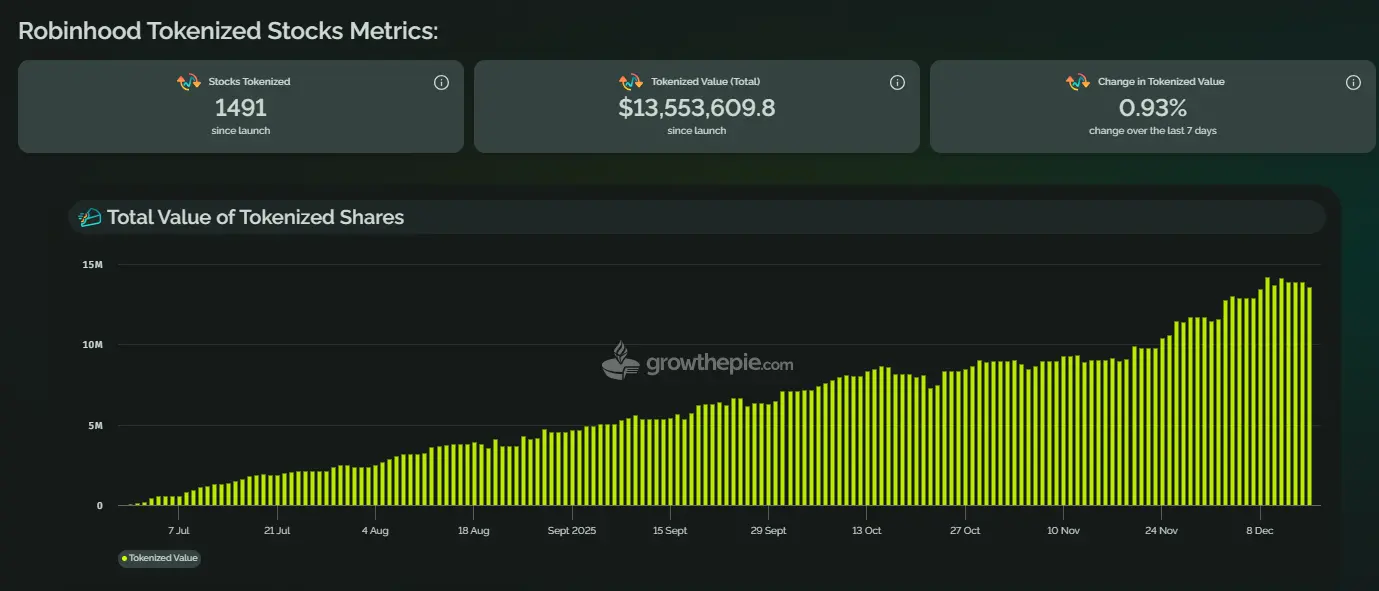
To date, Robinhood has tokenized 1,491 stocks, with a total market capitalization of approximately $13.55 million. In the past seven days, the total value of tokenized stocks has increased by 0.93%. Since the launch of its stock tokenization business, the total value of tokenized assets has shown a steady upward trend, with particularly accelerated growth recently, indicating a continued increase in market demand for Robinhood's tokenized stock products.
Source: growthepie, https://www.growthepie.com/quick-bites/robinhood-stock
Among these on-chain assets, the top five tokens are concentrated in tech giants and popular stocks with high liquidity and strong market attention. The following is the specific information of the top five:
a. YieldMax MSTR Option In. (MSTY): Tokenized value is approximately $1.6 million. This asset ranks first with the highest total tokenized value, indicating strong market demand for financial instruments associated with MicroStrategy (typically related to Bitcoin exposure). Its share price is $31.76, with 50,272 shares tokenized, and the number of shares has increased by 47.8% in the last 7 days.
b. Alphabet Class A (GOOGL): Tokenized value of $1.06 million. As a Class A stock of a tech giant, its tokenized value ranks second, reflecting the continued appeal of large-cap tech stocks. Its share price is $308.22, with 3,448 tokenized shares, but the number of shares has decreased by 6.1% in the last 7 days.
c. Microsoft (MSFT): Tokenized value of $790,000. Microsoft ranks third in tokenized value. Its stock price is $474.82, with 1,669 tokenized shares, representing a 1.0% increase in the number of shares held over the past 7 days.
d.BitMine Immersion Techn. (BMNR): Tokenized value of $720,000. This asset ranks fourth with a stock price of $30.95 and 23,312 tokenized shares. The number of shares has decreased by 4.3% in the last 7 days.
e. Meta Platforms (META): Tokenized value of $660,000. As another major tech giant, Meta Platforms ranks fifth in tokenized value. Its stock price is $647.51, with 1,029 shares tokenized, representing a 1.7% increase in share count over the past 7 days.
3. Robinhood Prediction Market Business Data
Since its official launch of presidential election event contracts in October 2024, the prediction market has rapidly grown into one of Robinhood's fastest-growing emerging business lines in terms of user penetration and revenue. According to Robinhood's November 2025 operational data report, its event contract trading volume reached 3 billion contracts in November, a month-over-month increase of approximately 20% from 2.5 billion contracts in October. This data reflects a temporary surge in monthly trading activity for Robinhood's prediction market contracts and also indicates increased participation from retail investors in event-driven assets.
III. Summary
Looking at Robinhood's continuous expansion in areas such as stock tokenization, crypto assets, and prediction markets, its core logic is not the blind expansion of a single business, but a systematic expansion based on the platform's capabilities. Robinhood is gradually incorporating asset forms and risk representation methods, previously fragmented under different regulatory and technological systems, into a unified operating framework through a unified account system, compliance infrastructure, and Web3 technology architecture. This means that Robinhood is evolving from a traditional securities trading portal into a more universal financial service platform. Robinhood's practices also provide a realistically constrained observation sample for the integration of traditional finance and on-chain finance. Within the existing regulatory framework, it promotes asset tokenization and new trading models such as event contracts, effectively exploring the feasible boundaries of blockchain technology in supporting securitized assets and large-scale retail participation. This process reflects a continuous interplay between institutional space and technological frontiers. This model attempts to unleash the efficiency advantages of on-chain technology while maintaining control over core issues such as ownership determination, risk disclosure, and regulatory compliance. Against the backdrop of accelerated digitalization of financial infrastructure, this kind of exploration based on the real regulatory environment will become an important reference for assessing the feasibility of putting traditional assets on-chain.