1. GameFi: The integration of games and DeFi reconstructs digital ownership
GameFi, or Game + DeFi, is a new paradigm that combines blockchain technology with game mechanics:
Players can earn real income through gaming behavior (Play to Earn)
The ownership of virtual assets belongs to the players themselves, not the centralized platform
Blockchain ensures transparency, tradability and composability
GameFi has completely changed the relationship between players and games, from "consumers" to "participants + investors".
2. Axie Infinity: Pioneer and inspiration of Play-to-Earn
Axie Infinity, launched in 2018, allows players in the Philippines and other regions to earn crypto income through "pet battles"
At its peak, some players’ monthly income even exceeded the local average salary.
But in 2022, Axie suffered a hacker attack, resulting in losses of up to $620 million, while exposing major challenges in security and sustainability.
This case shows that GameFi needs stronger infrastructure and compliance, especially when facing large-scale users.
3. FIFA’s initial attempt at blockchain: FIFA+ Collect
FIFA has already tried blockchain applications as early as 2022:
Collaboration with Algorand to launch “FIFA+ Collect”
Users can collect and trade NFTs of World Cup highlights
Combined with Polygon and other chains to launch a new NFT series to digitize traditional sports memorabilia
This marks FIFA's official move from Web2 to Web3 and the initial construction of a closed loop of fan economy.
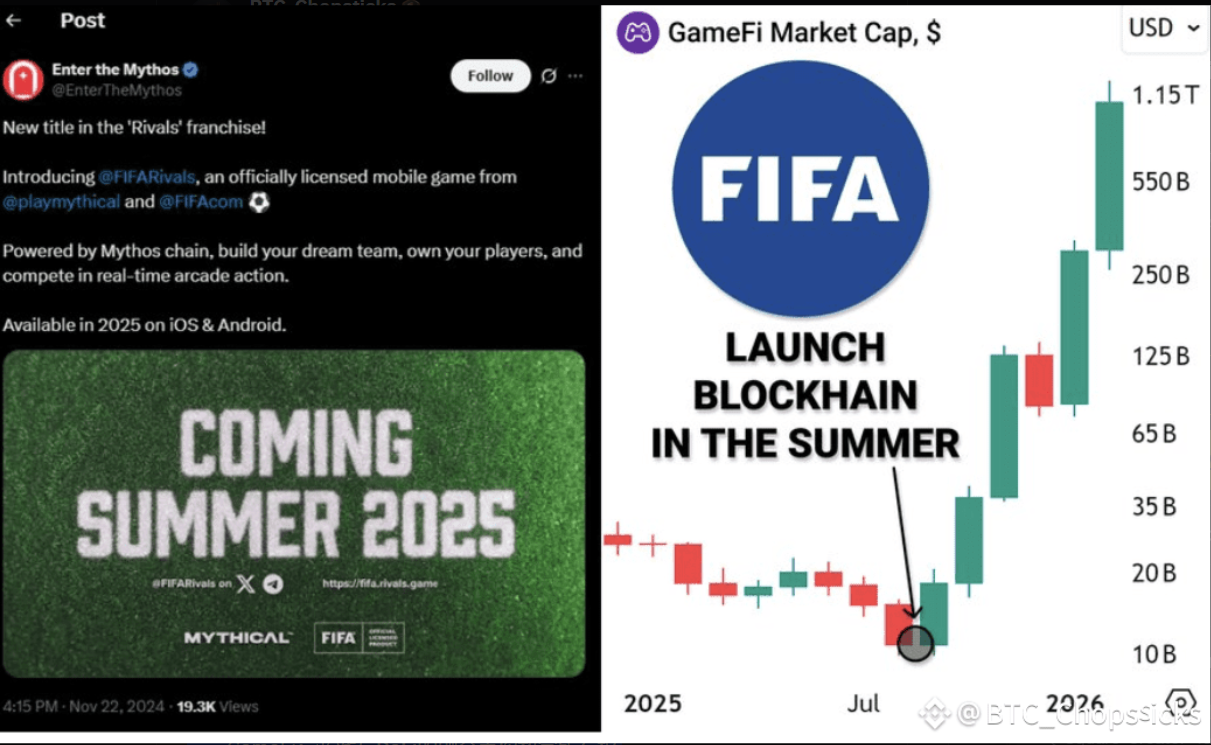
4. FIFA Rivals: The first official FIFA blockchain game will be launched in 2025
FIFA has partnered with Mythical Games to develop a new blockchain game, FIFA Rivals, which is expected to be officially released in 2025:
Players will play the role of club manager, build teams and participate in real-time matches
All game assets (player cards, equipment, stadiums, etc.) will exist in the form of NFT and can be freely traded and transferred
The game runs on the exclusive Mythos chain to ensure transparent and secure transactions
This is not only a deep combination of sports IP and GameFi, but also a large-scale landing experiment of "digital sovereignty" endowed by Web3.
5. Modex cooperation: FIFA's on-chain strategy is more clear
FIFA has also entered into a long-term partnership with Modex to provide infrastructure support for FIFA+ Collect and FIFA Rivals.
Modex will provide services such as smart contracts, security audits, and on-chain data hosting
This cooperation shows that FIFA is building a complete on-chain ecosystem rather than a single point experiment
6. Impact and Outlook: Three Signs That GameFi Is About to Explode
Large user base: FIFA's global influence covers more than 200 countries, with more than 150 million potential users
Real liquidity injection: Official blockchain game + NFT trading market is expected to introduce more than $5 billion in liquidity
Sports IP Effect: When the world's most popular sport is combined with Web3, it is bound to trigger a nationwide GameFi wave
In addition, this trend will also lead other traditional sports organizations such as the NBA, F1, and the Olympics to enter Web3, ushering in a new era of the "sports metaverse."
Summarize:
GameFi’s explosion point is not a fantasy, but an established reality
FIFA's entry marks the official acceptance of Web3 by traditional giants. GameFi is no longer just a niche attempt, but the main battlefield for the next generation of digital interaction.
We will see:
Users become asset owners
Games as investment channels
Sports is no longer just about watching, but an ecosystem that can be “participated in, traded, and co-created”
💡 If you are a crypto investor, now is a critical window to research GameFi and plan your track in advance.
💡 If you are a developer, FIFA’s actions show that the main battlefield of blockchain games will no longer be limited to the pure crypto circle, but will move towards global mass users.