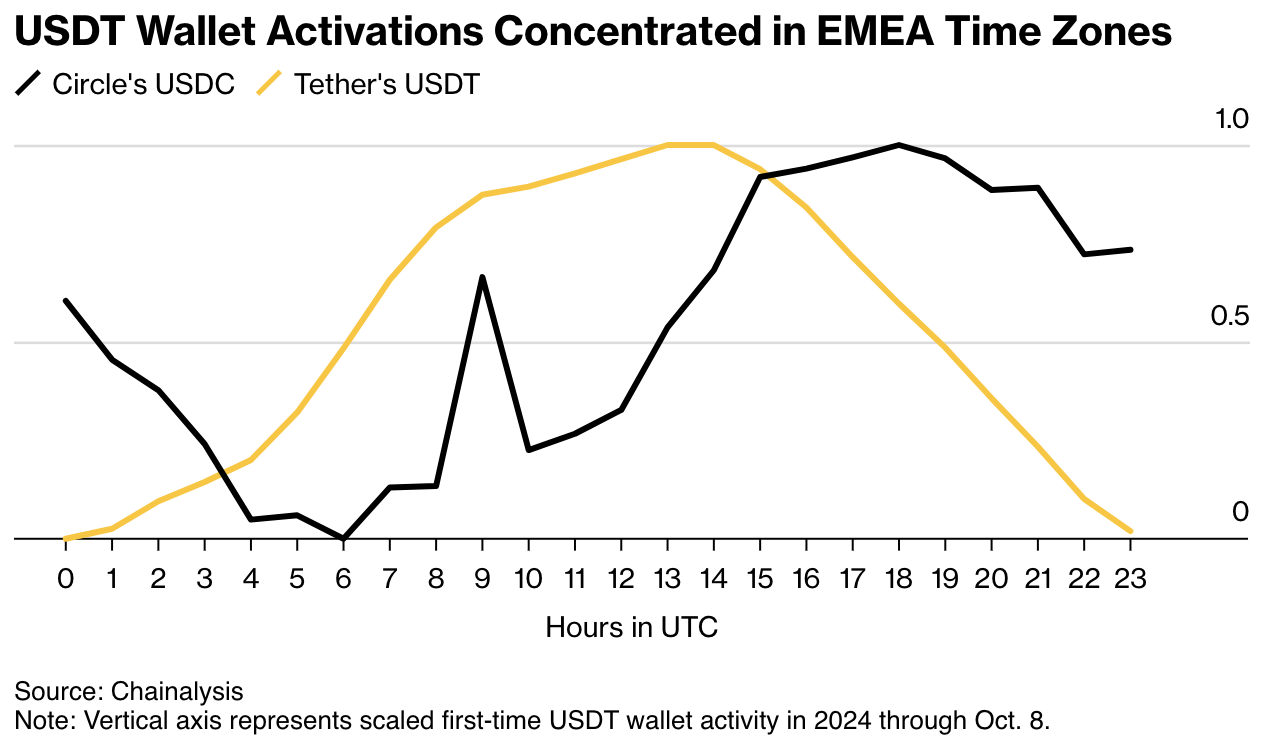
PANews reported on November 1 that according to Bloomberg, research shows that Tether (USDT) usage is shifting to the European, Middle Eastern and African (EMEA) time zones, especially in countries that lack access to the global banking system, such as Russia and Iran. Chainalysis data shows that between January and October this year, newly activated USDT wallets were mainly concentrated between 9 a.m. and 2 p.m. Coordinated Universal Time (UTC), which is consistent with the daytime hours in Moscow, Tehran and Istanbul.
As the United States steps up its investigation into Tether, especially regarding its possible involvement in anti-money laundering and sanctions, the use of USDT is attracting regulatory attention. Philip Gradwell, Tether's head of economics, said that the proportion of USDT activities in the EMEA region is stable, but in emerging markets such as Africa, USDT is becoming an important tool for cross-border payments and value storage.