
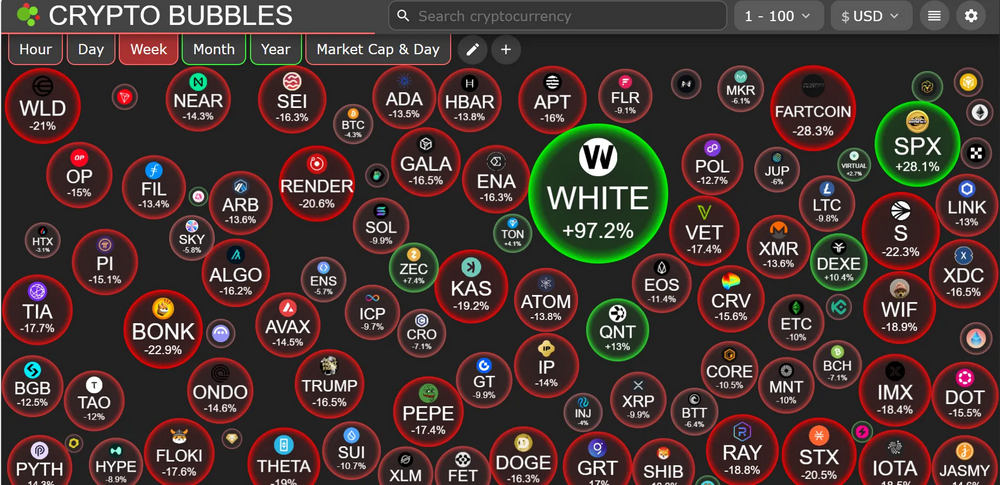
This week, the crypto market fluctuated up and down. Bitcoin was repeatedly hit by a spike due to the hunting caused by James Wynn's open order. Ethereum was relatively strong, and some related targets such as UNI and ETHFI performed well. Trump Media Technology Group's Bitcoin Treasury raised $2.5 billion in private financing to purchase Bitcoin. Pakistan is building a national strategic reserve of Bitcoin. FTX's 5 billion repayment stimulated the market's prosperity at the beginning of this week. However, even though some good news about the SEC's relaxation of pledge supervision came out on Friday, the market still fell across the board. At present, the focus is on the subsequent market trend.
In terms of hot topics, stablecoins are still the main theme of the market and are gradually becoming one of the directions for the US government and global institutions to deploy; although there has been no substantial positive news from the Bitcoin conference, the mainstream views can be paid attention to; with the relaxation of SEC supervision, the time has come for the pledge track and Binance to stride into the US market.
1. The trend of stablecoins becoming US debt
1. Circle IPO
On May 27, after refuting reports that it might be sold to Coinbase or Ripple, the stablecoin issuer Circle made it clear that the company was launching an initial public offering (IPO) and moving towards its plan to be listed on the New York Stock Exchange. Two days later, BlackRock announced plans to subscribe to 10% of Circle's IPO shares.
The key details are as follows:
- IPO Date: The IPO is expected to begin trading on June 5, 2025.
- IPO filing: Circle filed its IPO application (S-1 filing) with the U.S. Securities and Exchange Commission (SEC) on April 1, 2025, and made its prospectus public on May 27.
- Stock Symbol: The shares will be listed on the New York Stock Exchange (NYSE) under the symbol "CRCL."
- Stock issuance: Circle plans to issue 24 million Class A common shares at a price range of $24 to $26 per share. Among them, Circle itself will issue 9.6 million shares and existing shareholders will issue 14.4 million shares. The underwriters have a 30-day option to purchase an additional 3.6 million shares to cover over-allotment.
- Funding target: The IPO is expected to raise about $624 million at a valuation of about $5.65 billion. Taking into account options and other shares, the fully diluted valuation could reach $6.71 billion.
- Investor Interest: Prominent investors such as Cathie Wood’s ARK Investment Management have expressed interest in purchasing up to $150 million of the stake.
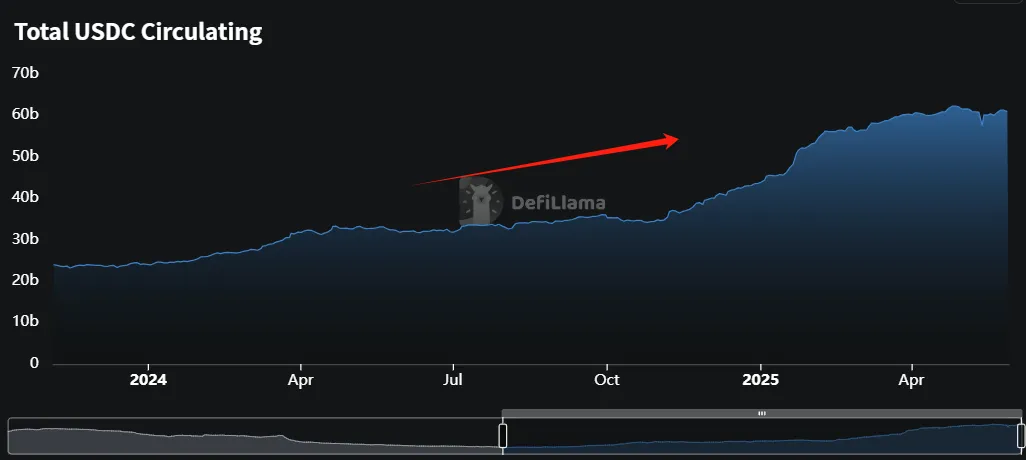
Circle's USDC stablecoin currently has a market value of approximately $60.793 billion, accounting for 24.59% of the total stablecoin market value, second only to Tether's 62.12%. So far this year, USDC's market value has increased by 38.44%, while Tether has only increased by 11.51%.
To understand why Circle is obsessed with IPO (Circle planned to go public through SPAC in 2021, but the plan was terminated in 2022 due to failure of SEC review), it is closely related to its partner Coinbase.
- Successful precedent: Coinbase was listed on the Nasdaq in April 2021 (code COIN), becoming the first major US crypto exchange to be listed, with a valuation of up to US$85 billion at one point.
- Market recognition: Coinbase’s IPO attracted institutional investors (such as ARK Invest and AH Equity Partners III) and enhanced the legitimacy of the crypto industry. Circle’s IPO also attracted investors such as BlackRock. Institutions such as ARK Invest and BlackRock participated in Coinbase’s IPO and also appeared on the list of potential investors in Circle’s IPO.
- Operational model reference: Coinbase has achieved financial stability through diversified revenue sources (such as transaction fees and custody services). Circle has borrowed a similar model and relied on USDC’s interest income and transaction fees to provide a solid financial foundation for its IPO.
Coinbase has a 50% revenue sharing agreement with issuer Circle and receives 100% of the interest earned from USDC products on the Coinbase platform. For Coinbase, USDC has become the largest revenue driver for Coinbase after trading. Coinbase received approximately $900 million in USDC revenue from Circle in 2024, with almost no operating costs, accounting for approximately 25% of its total valuation, highlighting the importance of USDC to Coinbase's finances.
After the IPO, Circle can not only more easily obtain funds from the capital market for innovation, R&D and global expansion with the help of the Genius Act's relaxed regulation, but also attract more strategic investors or partners to further expand its business scope, such as cooperation with traditional banks or international regulators. And because the growth of USDC directly benefits Coinbase's platform revenue and the Base public chain ecosystem, it may drive up the Coinbase stock price (COIN).
2. Tether turns to emerging markets
On May 25, according to Bloomberg, Tether CEO Paolo Ardoino said that despite the United States' advancement of stablecoin legislation, Tether will still focus on overseas markets and pay attention to the impact of the Genius Act on foreign issuers. This is partly because its other assets such as Bitcoin and mortgages may not meet the proposed standards.
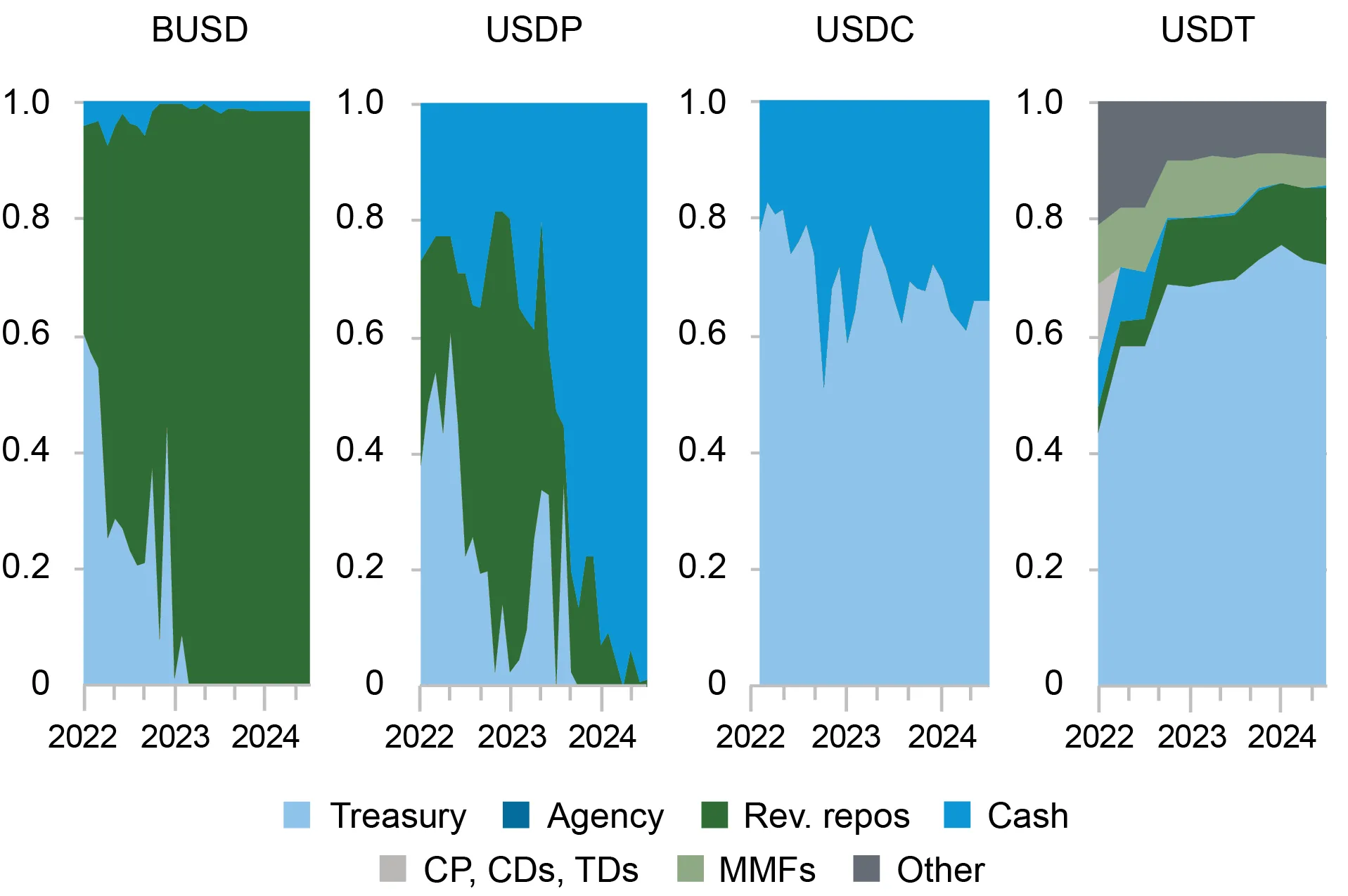
The chart below shows the collateral composition of the four largest stablecoin issuers. The collateral of Binance-Peg (BUSD), Pax Dollar (USDP), and USDCoin (USDC) has shifted from U.S. Treasuries to reverse repurchase agreements and cash; the collateral of Tether (USDT) has shifted from assets with credit risk (such as commercial paper and certificates of deposit) to U.S. Treasuries. Despite this, Tether, the largest stablecoin issuer, reportedly still has 18% of its reserves invested in less liquid and riskier assets, such as other non-stablecoin crypto assets and loans, as of December 2024. (The GENIUS Act's requirement that 100% of reserves be in highly liquid, low-risk assets (such as cash, U.S. Treasuries, reverse repurchase agreements) is not fully consistent.)
3. The close connection between stablecoins and US Treasuries
The business model of stablecoins is extremely favorable to issuers. Stablecoins are usually backed by cash and highly liquid assets (such as short-term U.S. Treasury bonds) in a 1:1 ratio. Unlike banks or money market funds, issuers do not distribute the interest income of reserve assets to holders, but keep the income for themselves, thereby making considerable profits when the interest rate environment and market demand are favorable.
The business model of stablecoin issuers is affecting the global macroeconomy by increasing the structural demand for U.S. Treasuries. Tether and Circle, two major issuers, hold as much as $116 billion in U.S. Treasuries, making stablecoin companies among the top 20 direct holders of U.S. Treasuries, surpassing sovereign countries such as Germany and Mexico.
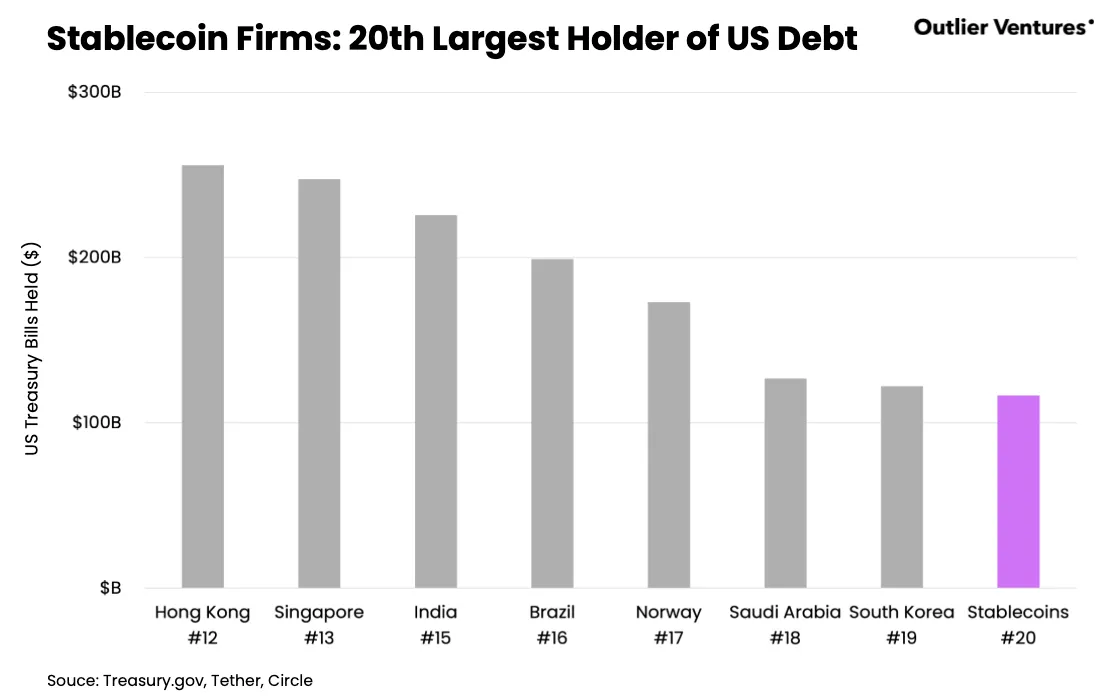
With the upcoming passage of the U.S. Genius Stablecoin Act, more and more stablecoin issuers will become channels for digital dollars to enter the global economy, thereby enhancing the global accessibility of the dollar and expanding the coverage of U.S. monetary policy.
In addition, the US government has made it clear that it will use stablecoins to maintain the dollar’s global reserve currency status. Treasury Secretary Scott Bessent said at the White House Cryptocurrency Summit: “We will maintain the dollar’s status as the world’s primary reserve currency and will use stablecoins to achieve this goal.”
Stablecoins also have similarities with U.S. Treasury bonds in terms of economic functions:
- Security and stability: U.S. Treasury bonds are considered the safest assets, and stablecoins ensure their value stability by holding Treasury bonds. The total market value of the stablecoin market reached $247.252 billion, most of which was composed of stablecoins backed by financial assets, such as Treasury bonds.
- Liquidity: Both are highly liquid, but stablecoins circulate primarily in crypto markets, while treasuries in traditional financial markets.
- As collateral: U.S. Treasuries are often used as collateral in traditional finance, and stablecoins are increasingly used as collateral in DeFi (decentralized finance).
- Revenue sources: Stablecoin issuers earn interest income by holding government bonds, which is similar to how the government bond market works. Tether's profits come directly from the government bond income in its reserves, while Circle's revenue of $1.68 billion in 2024 also comes mainly from government bond interest.
2. Bitcoin Conference
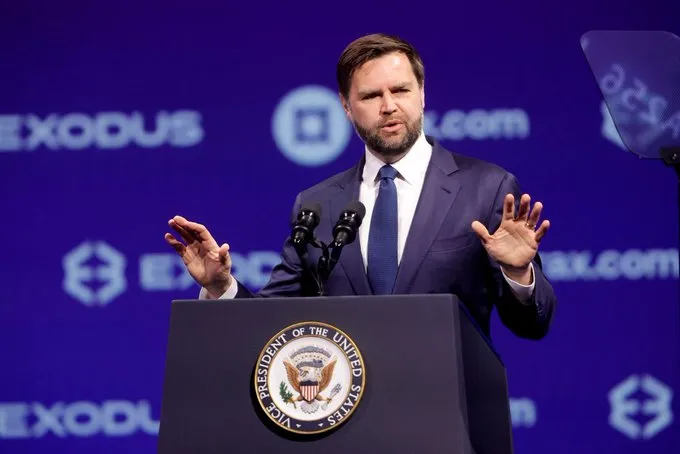
1. Vice President Vance (the current US Vice President made his first public statement at the world’s largest Bitcoin conference)
- Policy shift
Vance announced that the Trump administration has ended the hostile policies of the previous government and cleared previous regulatory obstacles. He promised to establish a national Bitcoin reserve within 100 days to compete for global leadership. In addition, he promoted the GENIUS Act legislation to establish a regulatory framework for US dollar stablecoins, aiming to use stablecoins as a new engine for the US dollar economy.
- Bitcoin’s strategic role
Vance pointed out that 50 million Americans hold Bitcoin, and the goal is to increase it to 100 million. He emphasized that Bitcoin is a tool to fight inflation, policy risks and financial censorship, and specifically mentioned its potential as a strategic asset, especially compared with China's unsupportive attitude.
- Regulation and innovation
The speech mentioned that transparent and innovative digital asset regulations will be formulated to integrate them into the mainstream economic system. Vance criticized the regulatory approach of former SEC Chairman Gary Gensler and promised to continue to remove similar regulators who hinder innovation.
- Community Engagement and Future Outlook
Vance called on the crypto community to continue to participate in politics, especially in the 2026 midterm elections, to promote favorable policies. He also mentioned the synergy between AI and encryption, emphasizing the need to focus on AI development to protect national interests.
2. U.S. Senator Cynthia Lummis
- Importance of the Market Structure Act
Lummis discussed the market structure bill with Paul Grewal, chief legal officer at Coinbase. She noted that “the market structure bill is particularly important to businesses that are part of the Congress because there are a lot of businesses that buy and hold bitcoin, so there are custody services, or companies that lend bitcoin, there are futures markets for bitcoin, and there are a variety of ways that bitcoin interfaces with the U.S. dollar.” She emphasized that this has a greater direct impact on the industry than the stablecoin bill.
- Stablecoin Act
The GENIUS stablecoin bill has entered the final review stage of the Senate. The bill broke the 60-vote threshold last week despite opposition from Democratic leader Elizabeth Warren and others. If passed, it will be the first successful legislation of the Banking Committee in eight years. Lummis hopes to use this to promote broader regulatory legislation for the crypto market.
- Future tax system
Lummis proposed a tax reform proposal, specifically tax exemption for Bitcoin transactions below $600. She mentioned that "the future tax system should exempt Bitcoin transactions below $600, such as buying coffee or dinner", and associated with technologies such as Lightning Network and Strike. She has submitted the proposal to the Finance Committee, aiming to reduce the tax burden on small transactions.
- Bitcoin Strategic Reserve
She suggested that the United States buy and hold 1 million Bitcoins, which could halve the US $37 trillion national debt in 20 years. She explained, "By purchasing Bitcoin as a strategic reserve, we can use inefficient assets without additional borrowing, which will significantly improve the fiscal situation." This proposal sparked extensive discussion at the conference, especially in terms of national debt and fiscal sustainability.
- Regulatory challenges
Lummis pointed out that over the past four years, regulators have been hostile to digital assets, which has hindered policy advancement. She mentioned that "there is no confirmed IRS head, which has slowed down the relevant legislative process," emphasizing the need for a clearer regulatory framework.
- The global strategic significance of Bitcoin
She stressed that Bitcoin is vital to the economy and global defense, describing it as a "deterrent tool against aggression, especially the threat from China." She mentioned that "military generals also support this view," further strengthening Bitcoin's position as a strategic asset.

3. Hester Peirce, Commissioner of the U.S. Securities and Exchange Commission
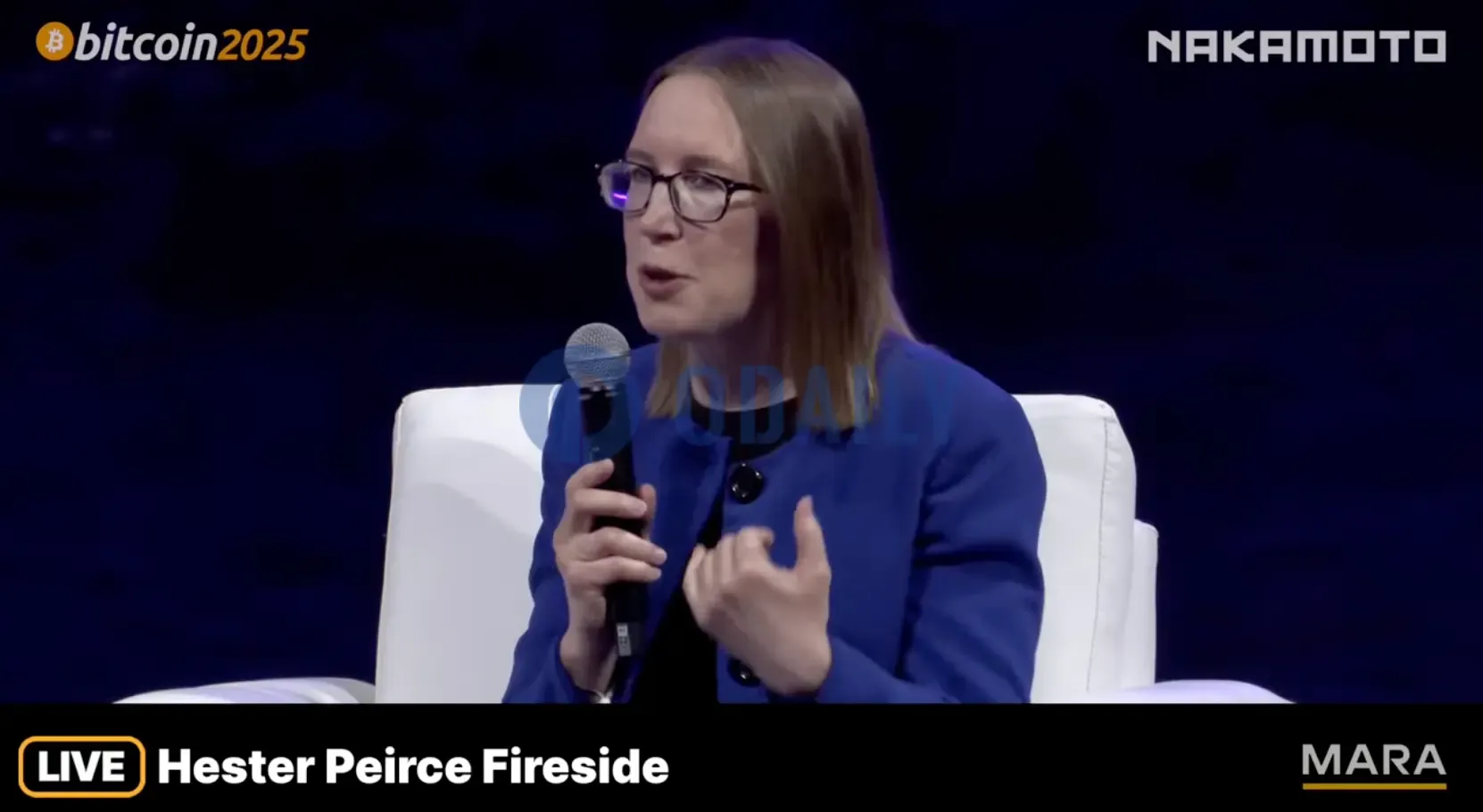
According to the report of Planet Daily, Hester Peirce, Commissioner of the US SEC, said in a speech at the Bitcoin 2025 Conference, "I think Meme coins are more like collectibles. Knowing that participants in Meme coins are not protected by securities laws, I think we will provide more guidance in this regard. I think the Meme Coin Regulatory Committee can be established, and regulatory gaps must be filled."
Previously, on October 10, 2024, the US SEC, FBI and DOJ jointly filed a lawsuit against Meme coin market maker Gotbit and other crypto companies. If the regulatory committee is established, the compliance cost will inevitably have a negative impact on the Meme market in the short term.
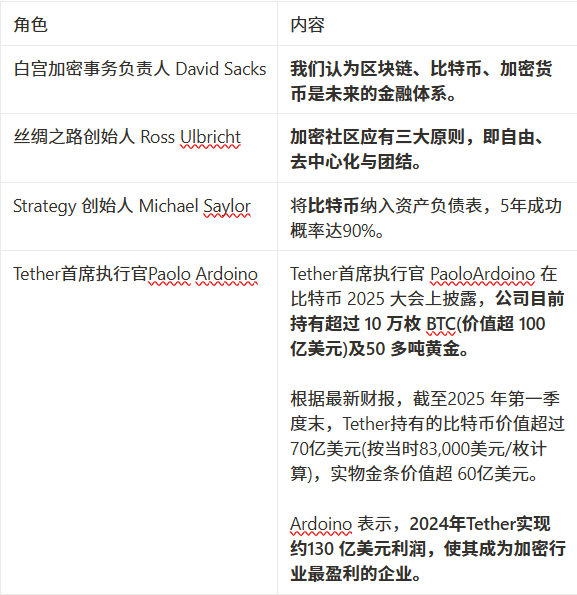
4. Other speeches
III. Policy Supervision
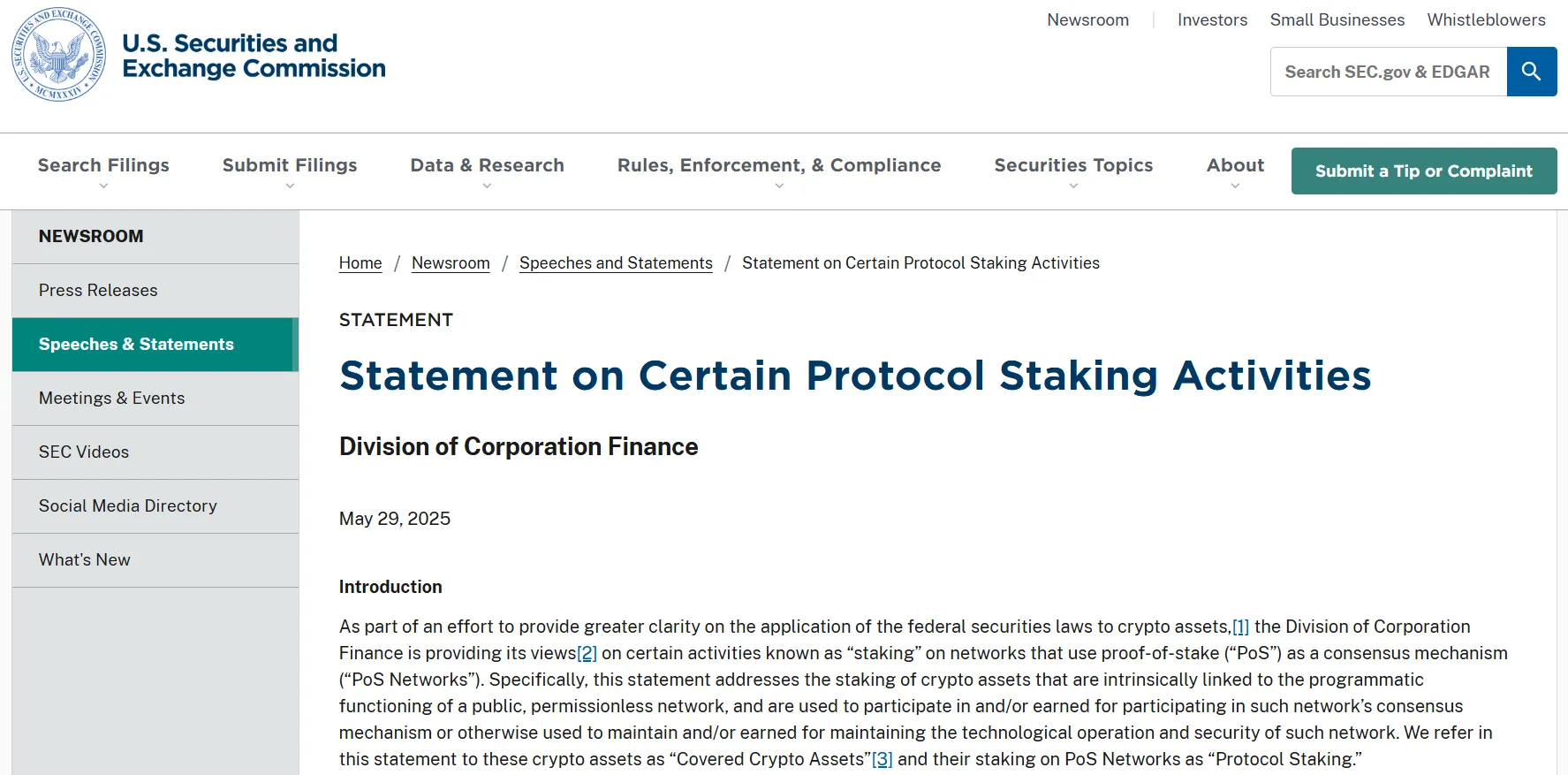
1. [5.29] US SEC policy statement: Three types of PoS network staking activities do not constitute securities issuance
The U.S. Securities and Exchange Commission (SEC) has issued a policy statement on staking activities on the Proof of Stake (PoS) network, clarifying that three types of staking activities do not constitute securities issuance. The policy was released on May 29 and aims to provide regulatory certainty for compliant staking activities while retaining law enforcement authority over security tokens. The policy content is based on the news on the SEC's official website and details the following three types of staking activities that are not considered securities issuance:
- Self-staking: Node operators use their own crypto assets to participate in network validation.
- Third-party non-custodial staking: Asset owners retain control of their assets and only delegate verification rights.
- Regulated custodial staking: The custodian strictly isolates customer assets and does not use them for operations or re-pledge.
The policy also points out that the network rewards obtained from the above-mentioned staking activities are the consideration for verification services, rather than investment income based on the management efforts of others, and therefore do not meet the securities identification standards of the Howey test. The Howey test is a standard used by U.S. courts to determine whether an investment constitutes a security, including four elements: investment of money, common enterprise, expected profits, and reliance on the efforts of others.
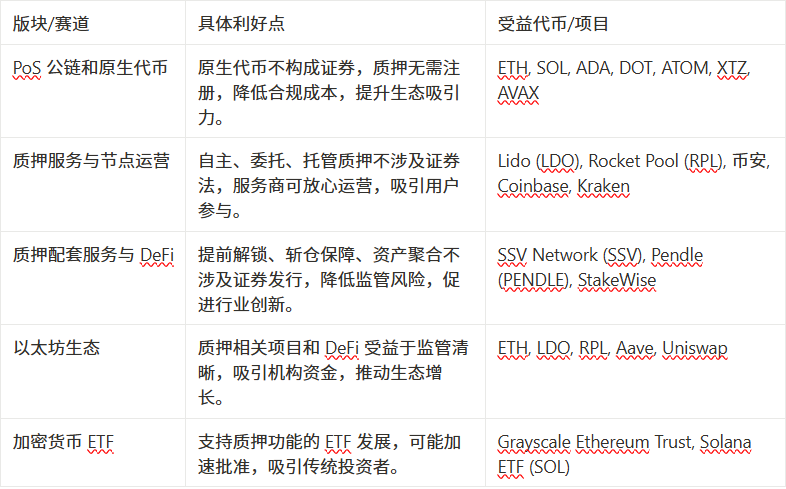
Positive impact
2. [5.29] US SEC applies to the court to withdraw the lawsuit against Binance
According to The Block, the US SEC has submitted documents to the court requesting the withdrawal of the lawsuit against the cryptocurrency trading platform Binance and its former CEO Zhao Changpeng. The US SEC, Binance, and Binance founder CZ's lawyers signed a joint withdrawal agreement and submitted it to the federal court in Washington, DC. They also stated that based on policy considerations, they believed that it was appropriate to withdraw the case. It is worth noting that the SEC explicitly stated that the withdrawal of the lawsuit is "final" (with prejudice). This means that the SEC cannot sue Binance again for the same allegations.
For Binance, the next step may be to actively develop the US market. The Binance ecosystem tokens led by BNB deserve special attention.
Special thanks
Creation is not easy. If you need to reprint or quote, please contact the author in advance for authorization or indicate the source. Thank you again for your support.
Written by: Nora / WolfDAO
Editorial review: Mat / Nora
Thanks to the above partners for their outstanding contributions to this weekly report. This weekly report is published by WolfDAO for learning, communication, research or appreciation only.