As the price of Bitcoin fluctuates at a high of $105,000, a silent cold wave is spreading in the underlying network. On June 9, 2025, the Bitcoin blockchain ushered in a historic moment - the seven-day moving average transaction volume plummeted to 317,000, hitting the lowest level since October 2023. This liquidity crisis not only tore open the fragile veil of the miner's profit model, but also triggered a fierce confrontation between Bitcoin fundamentalists and technical reformists.
1. On-chain activity plummets: ecological alarm behind the data
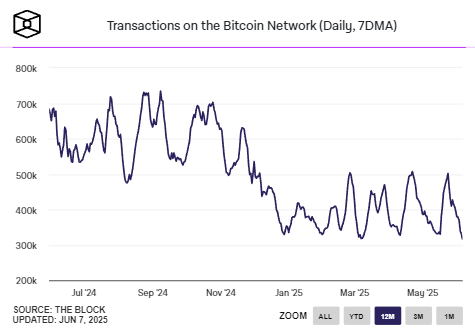
Blockchain browser The Block monitors that the seven-day moving average transaction volume of the Bitcoin network fell to about 317,000 on Friday, the lowest since October 2023, when the number fell to a low of 269,000. It is worth noting that the shrinking transaction volume this time showed the characteristics of "three lows": the number of active addresses fell below the 942,000 mark, the stock of unconfirmed transaction memory pools plummeted by 99% to 3,000, and the median single transaction fee fell below 1 sat/vB (about $0.00001).
The economic model of miners is facing a double stranglehold. Cryptoquant data shows that the average daily fee income of the entire network has dropped sharply from US$4.7 million in October 2024 to US$593,000, and the proportion of fees in the miners' income structure has fallen below the 2% life-and-death line. In the Slipstream private channel operated by the MARA mining pool, there was even an ultra-low bowling transaction with a fee of only US$0.01 that was stranded for 30 days. This "loss-making packaging" behavior exposed the deep crisis of miners' excess computing power.
2. A clash of technical concepts: the principle of anti-censorship vs. the theory of network purification
On June 6, the "Decentralization Manifesto" signed by 31 Bitcoin core developers shocked the community. This document, which is regarded as the "Blockchain Bill of Rights", directly pointed out: "The behavior of nodes filtering low-fee transactions is essentially to establish new censorship barriers." Developer representative Jameson Lopp emphasized in the technical forum that the ultimate value of Bitcoin lies in its anti-censorship, even if it means tolerating certain "non-consensus use cases."
The opposition came from the pragmatic camp led by Samson Mow, the founder of Jan3. In a public statement, they lamented: "Tolerating junk transactions below 1 sat/vB is like allowing bicycles to occupy the highway." The technical faction pointed out that the transaction flood triggered by the Runes protocol in 2024 caused the transaction fee to soar 300 times. Now that the protocol usage has plummeted by 98%, the network urgently needs to establish an anti-abuse mechanism. Behind this debate, it is actually a dispute over the route of Bitcoin's dual identity as a "value store" and a "payment network."
3. Evolution of miners’ survival rules: dark pool trading and computing power game
Faced with the "Hunger Games" of 346,000 transactions per day, leading mining companies have begun to explore unconventional survival strategies. The exposure of Marathon Digital's Slipstream private channel has revealed the tip of the iceberg of miners' "dark pool transactions". This transaction model that bypasses the public memory pool and directly packages allows miners to obtain stable cash flow, but also makes block producers become de facto "on-chain gatekeepers."

It is interesting to note that the ultra-low bowling transaction of 0.1 sat/vB directed by Mononaut, the founder of Mempool, was packaged by miners after being stranded for 30 days. This performance art-like experiment exposed two cruel realities:
1) The current network bandwidth utilization rate is less than 40%, and miners are forced to "eat anything they can get";
2) Technological upgrades such as Segregated Witness (SegWit) have increased the transaction volume that a single block can carry by 400%, which has in turn exacerbated the excess computing power.
IV. Future projection: ecological reconstruction under the ice
This liquidity crisis may become a watershed in the evolution of Bitcoin. Miners may accelerate their transition to an energy arbitrage model, using low-priced electricity during the flood season to digest excess computing power; developers may promote the upgrade of the UTXO management protocol and improve on-chain efficiency through technologies such as batch transactions; and institutional investors are shifting their focus from pure coin price fluctuations to network health indicators.
In this smokeless war of computing power, every participant is redefining the value boundary of Bitcoin. When Vitalik Buterin mentioned in his latest interview that "Bitcoin needs its own ZK-Rollups", this 16-year-old decentralized experiment is standing at the crossroads of technological revolution and ideological persistence. Perhaps as Satoshi Nakamoto said in the white paper: "The robustness of the system does not lie in perfection, but in tolerance of imperfections."