
Author: Lawyer Deng Xiaoyu
Recently, the United States' GENIUS Act was passed.
Hong Kong's "Stablecoin Bill" passed the third reading.
What followed was the interpretation of major institutions on the impact of future stablecoin issuance on the Web3 world, and this topic was widely discussed.
For a time, this year's popular RWA concept was suppressed.
However, many friends have reported to Attorney Mankiw that some media, social platforms, and communities have indeed used "financial innovation" as a gimmick, to attract money, to hype up transactions and appreciation as inducements, and to use concepts such as "stablecoins", "RWA coins", "JD coins" and other variants as names to conduct illegal fundraising and dissemination activities. The main forms include but are not limited to online and offline activities such as training, project promotion, and financing transactions.
As a law firm whose mission is to "ensure that Web3.0 occurs legally in China", it is necessary for Mankiw Law Firm to step forward at this time to provide relevant tips to domestic Web3 practitioners and newcomers!
It is not easy to maintain an account. KOL practitioners should pay attention to new developments in platform supervision.
First, attorney Mankiw found in some Web3 communication communities that many KOLs reflected that the traffic on topics related to them on short video platforms in mainland China seemed to be reduced.
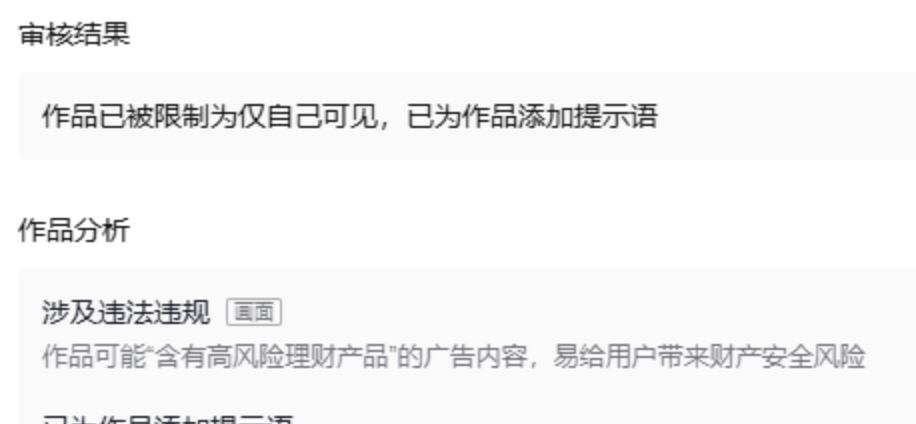
In particular, videos comparing virtual currency and stablecoin topics with traditional financial activities may even receive rectification notices:
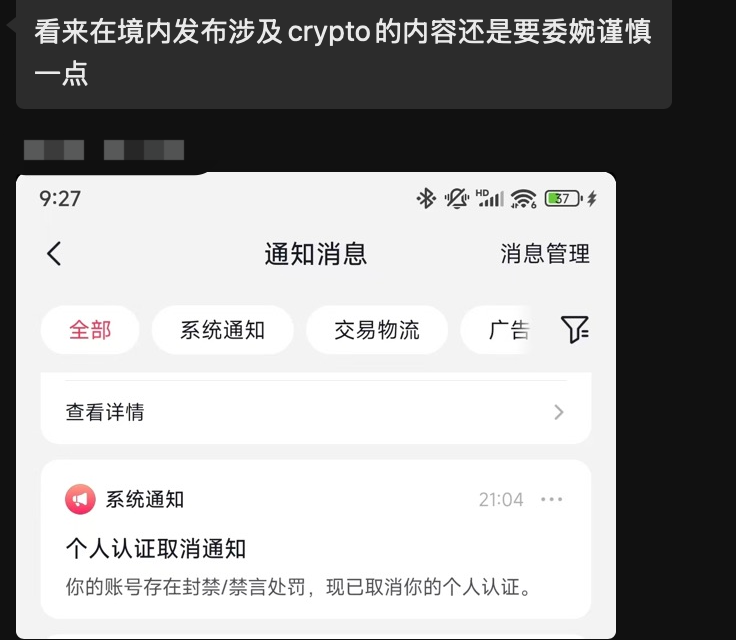
At present, the authorities may just reduce the push through video platforms to reduce the discussion heat. If the hype of related concepts intensifies, it is not ruled out that the authorities will issue risk warnings to remind relevant institutions and individuals to jointly resist and prevent illegal fundraising and dissemination activities in the name of "blockchain", "stable currency" and other variants. I believe this is a picture that domestic Web3 practitioners do not want to see...
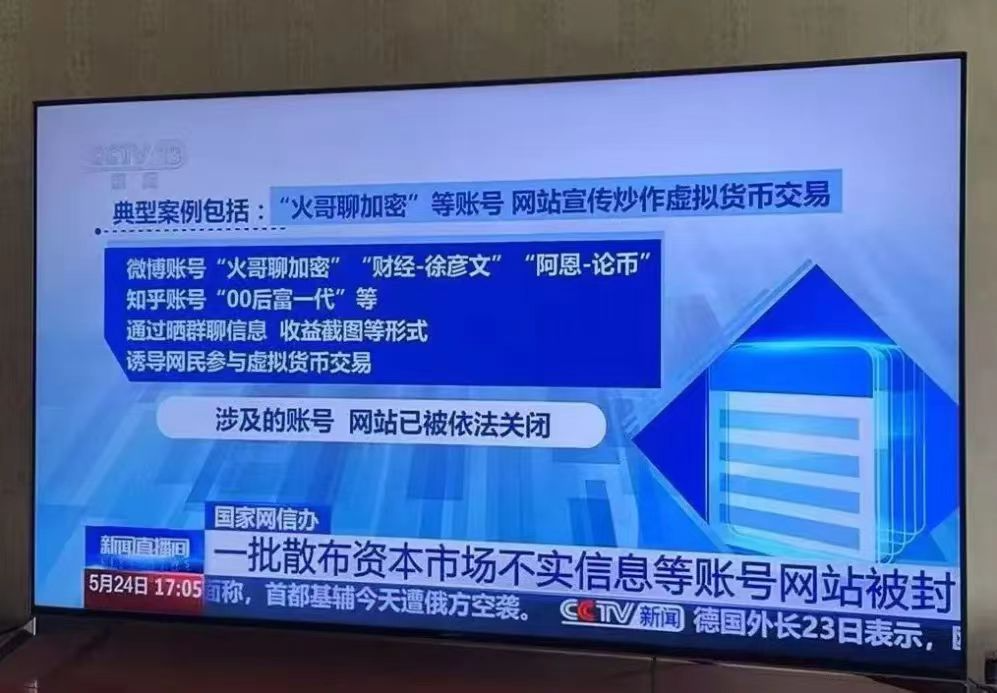
Lawyer Mankiw pointed out that in fact, the government has long been optimistic about blockchain technology and applications, but it has strictly prevented and cracked down on activities that are not truly based on blockchain technology, but take the opportunity to hype the concept of blockchain and seriously disrupt the normal financial and economic order. In China, it is highly recommended not to stand up for specific project parties when promoting Web3, especially at the moment when the concept of stablecoins is being hyped. If community operators and KOLs "bring goods", once the project party is in trouble, they may become criminals.
Entering Web3, beware of becoming a new investor in the stablecoin concept market
Mankiw’s criminal lawyer, Deng Xiaoyu, observed that among domestic crimes involving virtual currencies, crimes using stablecoins (USDT) have accounted for the vast majority.
According to Chainalysis' 2025 Cryptocurrency Crime Report, stablecoins accounted for 63% of all cryptocurrency transactions related to criminal activity last year, which also confirms the observations of Mankiw's criminal front lawyers.
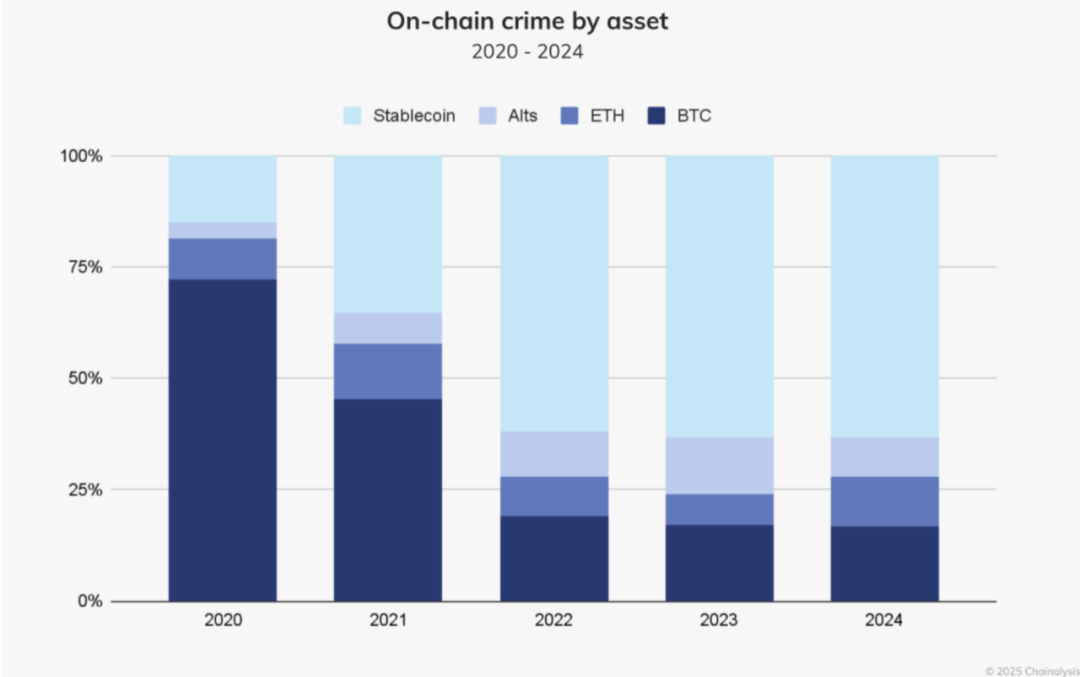
It can be foreseen that concepts such as Hong Kong Stablecoin and JD Stablecoin will become one of the hot spots for criminals to carry out criminal activities against residents who have no knowledge of Web3.
Here, I would like to remind all the friends who are considering entering the Web3 circle because of the passage of the stablecoin bill: as early as last year, the Hong Kong Monetary Authority made it clear that stablecoin issuers and sandbox participants will not raise funds.

Change the tone of the mainland police's propaganda: all projects involving stablecoin investment are scams. Although this sentence is extreme, I hope that Web3 newcomers can keep it in mind. When it comes to the currency circle, watch more, learn more, and do less.
Lawyer Mankiw teaches you how to identify the four characteristics of stablecoin funds
1. Illegality:
Funding schemes are often not approved by financial regulatory authorities in accordance with the law. They use various means to bypass regulation and attract investors. For example, as mentioned above, the Hong Kong Monetary Authority has made it clear that stablecoin issuers will not publicly raise funds. If you see a project under the guise of "Hong Kong Stablecoin" and other concepts, you might as well call the Hong Kong Monetary Authority to see if the policy has changed and whether stablecoin issuers are allowed to raise public funds or provide investment products?
2. Publicity:
Funding schemes usually publicly promote and widely disseminate their so-called "investment opportunities" through media, promotional meetings, WeChat groups, video accounts, etc. Just remember one sentence: "publicity does not mean legality" . Don't think that "this project dares to be publicly promoted, it must be true." Publicity is just a necessary way for fund schemes to gain customers.
3. Inducement:
Ponzi schemes use high returns as bait, promising high returns, such as "doubling in half a year" and "this coin has the potential to increase a thousand times in the long run". These returns are often much higher than the return rate of normal investment channels, using investors' greed to attract their participation. A common Ponzi scheme is: "This stablecoin will be listed in Hong Kong soon. If you subscribe in advance, you will definitely get thousands or tens of thousands of times the return when it is listed." Friends, put yourself in their shoes. This thing is called a stablecoin, so how can you still believe that its returns can be multiplied by thousands or tens of thousands of times?
4. Sociality:
Stablecoins absorb funds from non-specific objects, that is, they are open to the public. They do not conduct strict examinations on the qualifications of investors, and anyone can participate. Generally speaking, all regulated compliance projects generally provide investors with risk warnings (such as securities account opening) and investment capacity examinations (such as domestic securities accounts buying Hong Kong stocks and US stocks), while the funds that use the concept of stablecoins do not set so-called thresholds.
When retail investors enter Web3, they can briefly evaluate whether a project is a Ponzi scheme based on the above four dimensions.
Once the activities of any project party meet the above conditions, they will definitely be regarded as illegal fundraising activities in the mainland and will most likely face criminal prosecution.