Written by: Li Dan
Source: Wall Street Journal
Trump took action on cryptocurrencies after taking office, signing a presidential executive order aimed at promoting the development of the cryptocurrency industry. In addition, the U.S. Congress received good news from the cryptocurrency circle: a congressman who first proposed the establishment of a strategic reserve of Bitcoin in the United States last year was "promoted".
On Thursday, January 23rd, Eastern Time, the White House announced that US President Trump signed an executive order titled "Strengthening America's Leadership in Digital Financial Technology." The order requires the establishment of a presidential "Working Group on Digital Asset Markets" within the National Economic Council, an agency that advises the president.
The working group will be led by David Sacks, the first special adviser on AI and cryptocurrency appointed by Trump. The working group members also include the heads of government departments and regulators such as the U.S. Treasury Secretary, Attorney General, Commerce Secretary, Chairman of the U.S. Securities and Exchange Commission (SEC), and Chairman of the Commodity Futures Trading Commission (CFTC), or their designated personnel.
The executive order also explicitly mentioned that the Trump administration is considering whether to use Bitcoin as the national reserve of the United States. The executive order states that the above-mentioned working group will submit a report to Trump within 180 days after the issuance of the executive order, proposing relevant recommendations on supervision and legislation. The report should focus on: a federal government regulatory framework for the issuance and operation of digital assets in the United States, including stablecoins, considering market structure, supervision, consumer protection and risk management regulations, and
The working group "should evaluate the possibility of establishing and maintaining a national digital asset reserve and propose criteria for establishing such a reserve, which could be derived from cryptocurrency lawfully seized by the Federal Government through law enforcement efforts."
But amid the market's excitement, a key suspense remains: whether the executive order simply establishes a national Bitcoin reserve based on existing funds seized from criminal activities over the years , or whether it establishes a larger reserve that can purchase more Bitcoin over time.
The executive order also explicitly prohibits central bank digital currencies (CBDCs). The executive order reads:
“Except to the extent required by law, agencies are hereby prohibited from taking any action within or outside the United States to establish, issue, or promote a CBDC.”
The executive order requires that any government agency that is conducting plans or initiatives related to the establishment of a CBDC within the United States should immediately terminate and not take further action to develop or implement such plans or initiatives.
Sacks said the new task force will “make America the world capital of cryptocurrency” under Trump’s leadership and that actions on AI will allow the U.S. to “dominate and lead the world in AI.” Trump said of the actions that they “will make a lot of money for the United States.”
U.S. Senate Banking Committee establishes new digital assets committee to focus on legislation such as strategic Bitcoin reserves
Earlier on Thursday, Tim Scott, chairman of the U.S. Senate Banking Committee, appointed Wyoming Senator Cynthia Lummis as chair of the committee’s new Digital Assets Committee. Lummis subsequently issued a statement announcing that the new committee dedicated to digital assets will focus on two areas:
- Pass bipartisan digital asset legislation that promotes responsible innovation and protects consumers, including legislation on market structure, stablecoins, and strategic bitcoin reserves;
- Provide strong oversight of federal financial regulators to ensure that these institutions comply with the law, including ensuring that Operation Chokepoint 2.0 does not occur again.
Operation Chokepoint 2.0 is said to be a coordinated effort by U.S. federal government agencies to cut cryptocurrency companies out of the traditional banking system, but so far no official documentation has been found to exist.
Last July, Trump promised at the Bitcoin 2024 conference that he would list Bitcoin as a strategic reserve asset for the United States. Lummis, as Trump's ally in the Senate, first proposed the Strategic Bitcoin Reserve Act that month to establish the United States' national strategic Bitcoin reserve. The bill requires that without increasing the government deficit, part of the Federal Reserve's gold reserves be sold to purchase 1 million Bitcoins to establish the "strategic Bitcoin reserve" proposed by Trump. Calculated at the price of the currency at the time, it would cost about $90 billion.
In a statement on Thursday, Lummis again mentioned legislation related to the Bitcoin strategic reserve. She said:
“Digital assets represent the future, and if the United States hopes to remain a global leader in financial innovation, Congress needs to urgently pass bipartisan legislation to establish a comprehensive legal framework for digital assets and strengthen the dollar through a strategic Bitcoin reserve. … I look forward to delivering bipartisan legislation to President Trump this year to secure our financial future.”
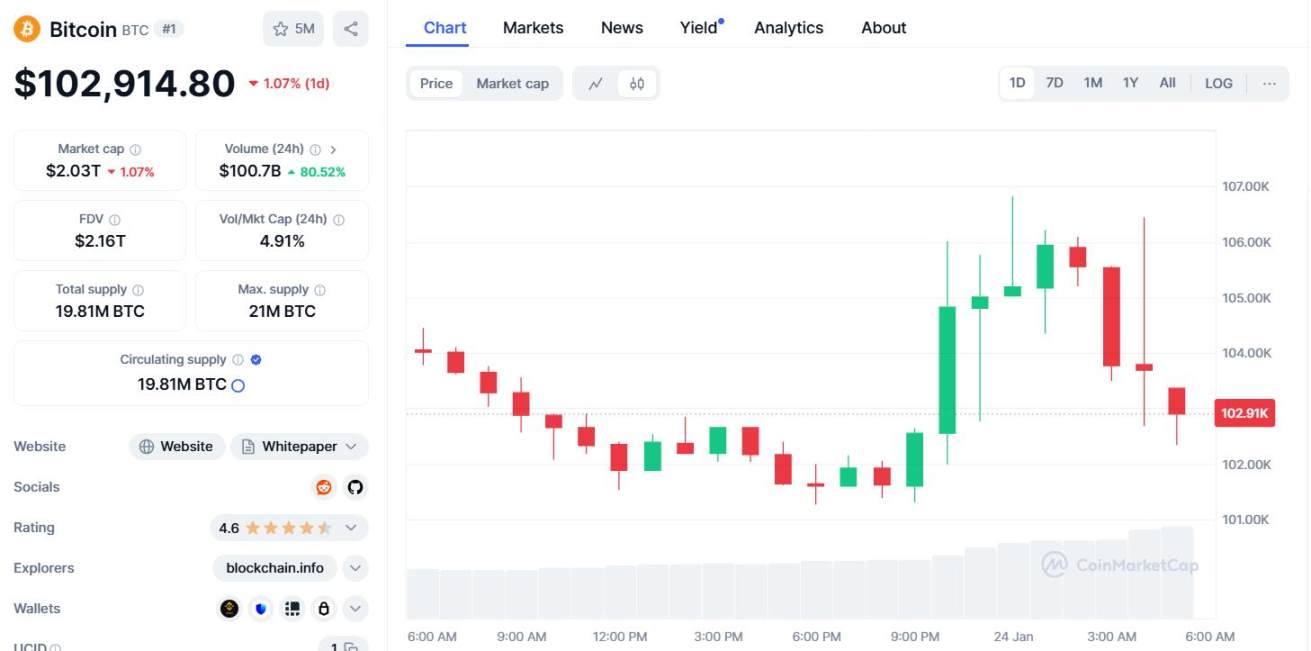
The news of Lummis’s appointment quickly set off a wave of excitement in the cryptocurrency market. Bitcoin (BTC) once rose against the U.S. dollar during intraday trading on Thursday.
According to CoinMarketCap data, the spot price of Bitcoin against the U.S. dollar first fell below $101,300 in the European stock market, hitting a new intraday low, and then rebounded after the U.S. stock market opened, breaking through $106,800 at the end of the morning session, a new intraday high, up more than $5,000 and more than 5% from the intraday low, and began to approach the intraday record high of $109,000 set on Monday. However, the U.S. stock market returned to a downward trend in the late trading, falling below $103,000 after the close, and fell more than 1% in the past 24 hours.