
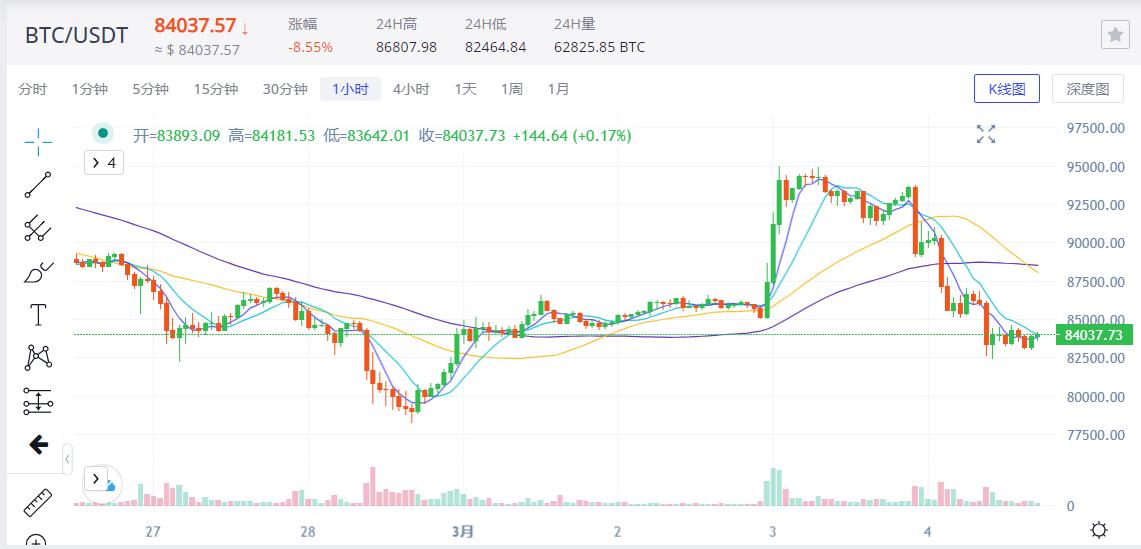
On March 4, the crypto market plunged again. BTC fell sharply from a high of $95,000 to below $83,000, with a 24-hour drop of 10.49%. The altcoin market was even more bloody, with ETH falling below 2,100 and a 24-hour drop of 16.83%, a recent low. After the market rebounded in one day, it fell again, with both long and short positions being killed in an extremely tragic way.
“Multi-currency reserves” test the seriousness of BTC strategic reserves
The day before, amid a generally sluggish market, Trump issued a major statement announcing that cryptocurrencies such as BTC, ETH, XRP, SOL, and ADA would be included in the U.S. strategic reserve, and promised to promote regulatory relaxation. As soon as the news came out, the price of Bitcoin soared from $85,000 to $95,000 in just 3 hours, and altcoins also started a full-scale surge mode.
However, after the excitement, doubts arose. Arthur Hayes, a representative of the bearish faction, bluntly stated that Trump was just talking and the government had no money to buy coins. More widespread criticism focused on the "multi-currency reserve" concept, questioning the absurd practice of using highly centralized projects such as ada and xrp as reserve assets to promote, which would only weaken the seriousness of the BTC strategic reserve itself and further reduce the possibility of the BTC reserve bill being passed at the federal level.
Some analysts also believe that Trump is playing the old routine of "opening high and ending low": first putting forward the radical "multi-currency reserve" idea, and finally retreating to the "Bitcoin single currency reserve" as a compromise solution to win the support of Congress.
Regardless of the truth, it exposes the increasing divergence in the current market. The gap between expectations and reality of Trump's policies has led to investors' negative sentiment towards the industry. Bitcoin rose and then fell, and then began to fluctuate downward.
The tariff stick exceeded expectations and shattered the fantasy
The Trump administration's recent tariff policy against Canada and Mexico has been the focus of market attention. Just last week, Trump was still vague and inconsistent about the timing of the tariffs. The outside world believed that this was a negotiating tactic and that a new agreement would be reached at the last minute, but this hope was officially shattered.
On Monday, Trump announced that he would impose tariffs on Mexico and Canada starting March 4, and made it clear that "there is no room for negotiation." In addition, he will increase tariffs on Chinese goods to 20%, and implement a "reciprocal tariff" policy on the European Union, Japan, South Korea, etc. from April 2. This tough attitude exceeded market expectations. Canada and China announced on the same day that they would take a series of countermeasures, and Mexico also hinted at taking countermeasures, and the tariff war was fully launched.
China, Canada and Mexico account for 40% of the total imports and exports of the United States. The increase in tariffs will undoubtedly push up the prices of imported goods and increase inflationary pressure in the United States. Even the always cautious Buffett rarely spoke out, warning that tariffs are "an act of war to some extent" and may push up inflation and harm consumer interests. At the same time, signs of slowing economic growth in the United States are becoming more and more obvious. The GDPNow model of the Atlanta Federal Reserve shows that the US GDP will shrink by 2.8% in the first quarter, which was previously expected to shrink by 1.5%. Market concerns about the United States falling into "stagflation" are heating up, which has suppressed assets that rely on liquidity and risk appetite.
The first impact was that the three major U.S. stock indexes closed down collectively on Monday, with the Dow Jones Industrial Average down 1.48%, the S&P 500 down 1.76%, the biggest drop of the year, and the Nasdaq down 2.64%, wiping out the gains since the November election. Technology stocks led the decline, with Nvidia plummeting 8.69%, hitting its lowest closing price since September 2024. Since the approval of the spot Bitcoin ETF, the correlation between the crypto market and the U.S. stock market has become extremely strong, and the turmoil in the traditional market has been quickly transmitted to the crypto market and amplified, causing cryptocurrencies to fall again. If the U.S. stock market continues to weaken, the crypto market may face greater adjustment pressure.
Any positive news may become a catalyst for both long and short kills
Amid the depressed market sentiment, investors are pinning their hopes on the first White House Cryptocurrency Summit on March 7, when Trump will convene industry leaders to discuss regulatory policies, stablecoin regulation, and the potential role of Bitcoin in the U.S. financial system, which may set the tone for cryptocurrency regulation in the next four years. The market is eager for more substantive things to be released at the meeting to boost market confidence and drive prices up.
However, in the context of the current macroeconomic environment headwinds, the continued loss of institutional funds, and the exhaustion of retail buying momentum, the market's reaction to the news has become extreme. The crypto summit may bring new policy sparks, but investors need to be wary that any good news may become a catalyst for both long and short kills.