Going back to the last round of market, the Crypto market entered a bull market in 2021, and applications such as DeFi, NFT, and GameFi rose rapidly. At that time, Ethereum exposed its limitations due to transaction congestion and high handling fees. This provided a breakthrough for the new generation of public chains, which gave rise to a large number of public chain projects, such as Solana, BNB Chain, Polkadot, Avalanche, FTM, etc., trying to challenge Ethereum's dominance.
These emerging public chains not only compete with each other in consensus mechanisms, transaction speeds, and expansion plans, but also engage in incentive competition on how to attract developers, build communities, and gain capital favor, which is also known as the "public chain battle."
Although the advantages between chains are constantly shifting in the short term, this public chain competition has not only greatly promoted the advancement of blockchain technology, but also made the entire Crypto ecosystem more diversified, and also laid the seeds for the subsequent rise of new public chains such as Aptos and Sui.
But now, four years after the outbreak of this public chain dispute, it seems that people will never see this grand occasion again. In the past few years, only Solana has climbed out of the trough and has become another public chain leader. In addition, the various problems faced by Ethereum itself even threatened Ethereum’s position. Although there is still a gap of about 60% in market value, the market seems to have greater expectations for Solana.
What about other public chains? We can get an overall understanding through the market value comparison and current status analysis of several popular public chains in the year in the table below.
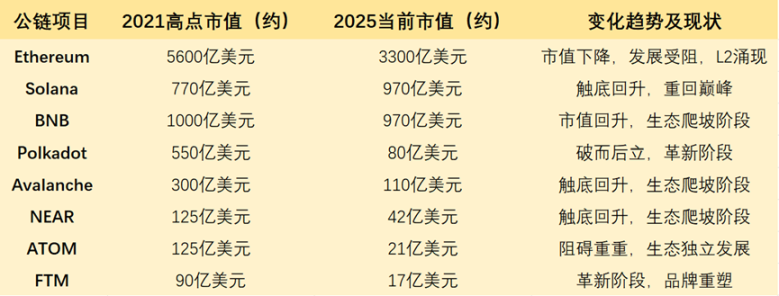
It can be seen that Solana and BNB are still strong in terms of market capitalization, with basically no difference, but other public chains are still "working hard" to climb, including Ethereum.
In the past week, CZ began to frantically hint that BNB Chain will usher in various changes and innovations in 2025. He also tweeted for several consecutive days to promote it, and ushered in a small climax in the name guessing contest of CZ's pet dog Broccoli, and is ready to challenge Solana's glory in the past year.
Of course, in addition to these old public chains working hard to promote themselves, there are also emerging public chains like Sui and Bera that are trying to catch up. But it seems that for the current market, people’s expectations for public chains are no longer just faster and better performance requirements, but have gradually turned into whether they can experience truly applicable products. However, this road is really full of thorns. If there hadn’t been the MEME craze in the past year or so, I wonder what Solana would be like?
After all, when it comes to products, no public chain has yet produced any top-notch applications. In order to create innovative products that meet market demand (PMF) and are popular, apart from stablecoins and individual DeFi applications, other directions are still lackluster. Even Agent, which has been popular for a while, has fallen into a new "death spiral."
Back to the present, for the operators of public chains, the current competition among public chains is no longer limited to the moment of competing in marketing and rewards, but has become a real competition for product polishing. We can also say that MEME is a product form, but pure MEME is not a long-term solution. PVP on the chain will eventually get boring, and ultimately it will have to return to users (community) and the product itself.
Therefore, looking back at the public chain competition in 2021, we may never be able to go back to that summer. What we can hope for is a scene similar to the "Hundred Regiments Offensive" of the Internet back then. In the end, we have to compete for users, operations, and implementation. After all, L2 can also be regarded as a form of public chain, and the competition may be greater than we expected.
Finally, from an investment perspective, some of the selection logic of public chains is still applicable. For example, if Solana is doing MEME, other chains can also do it. If SUI is doing games, other chains can also do it. The market is still large enough. Wherever there is a wealth-creating effect, there are users. Only in this way can there be a probability of the birth of practical products, because the market believes in the logic that prices come first and then products. This trend will not change for a while. After all, summer has not come yet.