Author: Crypto Miao
Public Block chain is a decentralized, distributed ledger technology that allows anyone to participate in transaction verification and network maintenance. Compliance is the key to the widespread application of public chains in regulated industries such as finance, requiring them to comply with legal and regulatory standards such as KYC (Know Your Customer) and AML (Anti-Money Laundering). Compliance not only enhances the trust of users and regulators in public chains, but also effectively reduces the risk of illegal activities such as money laundering and fraud. Globally, public chains must also comply with regulations such as the EU General Data Protection Regulation (GDPR) to ensure legitimacy and sustainable development.
Global public chain regulatory policies and trends
As the core application of blockchain technology, the regulatory environment for public chains is evolving rapidly. From the initial widespread suspicion to today's cautious acceptance, the international community's attitude towards public chains has gradually changed. The decentralization, transparency and immutability of public chains are seen as having revolutionary potential, but they also bring challenges such as market volatility, financial crimes and regulatory difficulties. To this end, global regulators are working hard to develop a framework to find a balance between encouraging innovation and controlling risks.
Regulatory trends: Countries are increasingly strengthening their supervision of public chains and crypto assets. For example, the European Union passed the Crypto-Asset Market Regulation (MiCA) in 2023, becoming the world's first comprehensive legal framework for crypto assets.
Policy differentiation: Regulatory strategies vary significantly between countries. China has completely banned cryptocurrency trading and mining, while the United States and the European Union have gradually regulated through legislation. The European Union implements bank-like regulation on stablecoins and cryptocurrencies to protect financial stability and consumer rights; the United States tends to support stablecoins and maintain the global status of the US dollar.
Innovation and risk go hand in hand: Despite stricter regulation, many countries still recognize the potential of public blockchains in areas such as finance, supply chain, and healthcare. For example, Singapore and Japan reserve space for blockchain innovation while maintaining strict regulation.
The Compliance and Development Paradox
The Web3 industry is unique due to its decentralization and anonymity, but this also makes it face complex compliance requirements in various countries. These requirements are intended to ensure that projects operate legally, but often restrict their free development and global expansion. Compliance not only increases operating costs, but may also bring legal risks, resulting in serious consequences such as lawsuits, huge fines or even imprisonment for project founders or core members.
1. Rising operating costs
Compliance requirements force blockchain projects to invest a lot of resources in legal consulting, compliance audits, and regulatory reporting to ensure compliance with the laws of various countries. This high cost puts direct pressure on the financial status of the project, especially for start-up projects, and may become a heavy burden for development.
Binance: In 2023, Binance was fined $4.3 billion by the U.S. Department of Justice for money laundering and violations of the Bank Secrecy Act. This huge fine not only weakens its financial strength, but may also lead to the loss of market share.
2. Legal risks increase
The complexity of compliance requirements and the inconsistency of regulatory policies in different countries make it difficult for project owners to fully foresee and respond to legal risks. Once regulatory red lines are crossed, projects may face lawsuits, fines, or even business interruptions, which will seriously affect the development process.
Ripple: It went to court with the U.S. Securities and Exchange Commission (SEC) over whether XRP is a security. In 2023, the court ruled in part in favor of Ripple, but still fined it $125 million. During the litigation, Ripple consumed a lot of resources, and XRP's market performance and project ecosystem development were also significantly affected.
3. Market access restrictions
Compliance requirements may result in projects being banned from operating in certain regions, limiting their global presence. If tokens are deemed unregistered securities, they may be delisted from exchanges, damaging their user base and market share.
Solana: In 2022, Solana faced a class action lawsuit because its token SOL was accused of being an unregistered security, which hindered its promotion in some markets.
Polygon: In 2023, the SEC listed MATIC as an unregistered security in its lawsuit against Binance, so it was removed from platforms such as Robinhood, and its market share and user growth were directly affected.
4. Innovation is limited
Compliance requirements may limit the space for exploration of technological innovation and business models. In order to avoid regulatory risks, projects may have to adjust their development direction or abandon certain cutting-edge attempts, thereby weakening their competitiveness and long-term development potential.
Cardano: In 2023, the SEC listed ADA as a security in its lawsuit against Kraken and Binance. This label may limit the application and promotion of Cardano in certain markets, forcing it to adopt a more conservative strategy in ecological construction, and thus slowing down the pace of innovation.
5. Core member risks
Compliance issues not only affect the project itself, but may also affect the founders or core members, exposing them to legal action, fines or even imprisonment. This not only shakes the stability of the project, but may also have a negative impact on the reputation of the entire industry.
Binance founder Zhao Changpeng: In 2023, Zhao Changpeng pleaded guilty and resigned as Binance CEO for compliance issues, and was subsequently sentenced to four months in prison. This incident directly affected Binance's operations and may weaken its leadership in the industry.
6. Other typical cases
Tether
/USDT: Tether settled with the U.S. Commodity Futures Trading Commission (CFTC) for misleading reserve statements, paid a $40 million fine, and continues to face U.S. federal investigations into possible violations. These events pose a threat to its market trust and business expansion.
Compliance requirements for blockchain projects
The development of blockchain has formed many constraints, especially in the key stage of opening up new markets and increasing market share, compliance requirements may become a "tight ring" for blockchain projects. Therefore, while pursuing innovation and expansion, project parties need to attach great importance to compliance challenges and formulate strategies to balance development and compliance.
Suichain supervision status and market position
As a public chain project launched in May 2023, Sui has quickly emerged in the blockchain field with its unique technical architecture and user-friendly design.
Compared to many other public chain projects, Sui has demonstrated remarkable robustness in the nearly two years since its launch, especially in terms of regulatory compliance and network security. To date, Sui has not been prosecuted or charged for any regulatory issues or security incidents, which not only highlights the rigorous attitude of its development team in technology and compliance, but also wins trust and reputation for it in the highly competitive blockchain market.
At the same time, Sui's recent performance has further proved its market potential. With the rapid development of Sui's chain ecology and the continuous increase in community popularity, Sui's market value has soared to more than 11 billion US dollars, ranking in the top 11 of the global virtual currency market value rankings. This market value not only reflects the market's high recognition of Sui's technological innovation and application prospects, but also indicates that it occupies an important position in the competition in the public chain field.
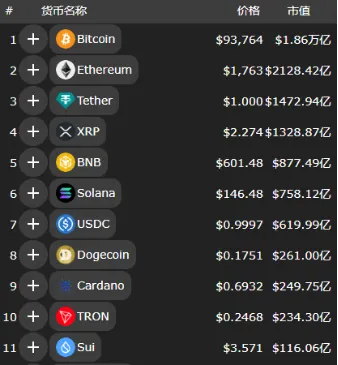
Figure 1 Crypto Market Value Ranking
Among the top ten projects in the world by market capitalization of cryptocurrencies, USDT and USDC as stablecoins, and DOGE as a MEME coin, occupy a unique position. If these three are excluded, Sui ranks 8th in the public chain market capitalization. This achievement is particularly noteworthy because the youngest project in the top ten is Solana, which has been running for 5 years since it was launched in March 2020. Sui, a public chain that was only launched in May 2023, has ranked among the top 11 in global market capitalization in just two years. This achievement is undoubtedly amazing and fully demonstrates Sui's extraordinary development speed and potential in the blockchain field.
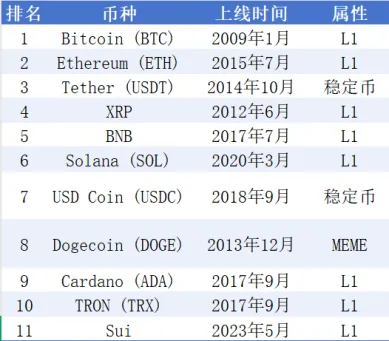
Figure 2 Currency launch time and attributes
So, how did Sui manage to grow quickly and gain a foothold in the fierce WEB3 competition while maintaining compliance?
Sui Chain Features
SuiChain is an emerging L1 blockchain platform developed by Mysten Labs to provide fast, secure and scalable solutions for Web3 applications. It uses the Move programming language, emphasizes high transaction speed and low latency, prioritizes fast and secure transaction execution, and is particularly suitable for real-time applications such as games and finance. Sui provides a familiar user experience, such as logging in with network credentials (zkLogin), and supports large-scale applications by expanding network capacity as needed.
The modular design of the Move language allows developers to organize code into reusable modules and supports formal verification to ensure that smart contract behavior meets expectations. Compared with the more widely used EVM language, the Move language has the advantage of being more advanced and more suitable for the current development of blockchain.
1. Security: Resource Model and Vulnerability Prevention
It has significant advantages in security, mainly due to its resource model. In Move, each data object has clear ownership, ensuring that resources cannot be accidentally or maliciously copied or destroyed.
2. Performance and scalability: parallel execution and high TPS
Another key advantage of the Move language is its performance and scalability. Move supports parallel execution of transactions, while the EVM uses sequential processing, which can cause transaction congestion and increased fees under high load.
3. Developer experience: modularity and learning curve
Move's modular design gives it an advantage in developer experience. Move programs are organized into modules that share resources and functions, making them easy to upgrade and combine.
Just recently, Vitalik, the founder of Ethereum (ETH), also proposed to replace the Ethereum virtual machine with RISC-V. RISC-V and Move language also have many similarities, the most important of which is modularity and scalability. Both RISC-V and Move emphasize modularity and scalability in design, and support user-defined instruction extensions, so that they can adapt to a variety of application scenarios, so as to facilitate their extended use in different blockchain applications. This also further highlights the technical superiority of the MOVE language.
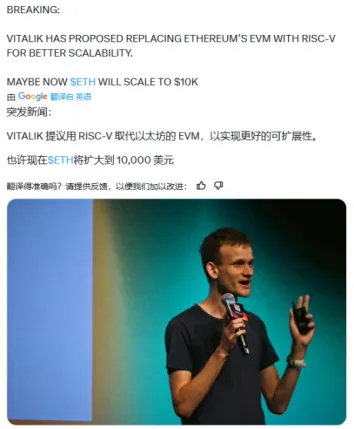
Figure 3: Vitalik proposes replacing the Ethereum Virtual Machine (EVM) with RISC-V
Sui Chain's operational direction
1. Community Incentives
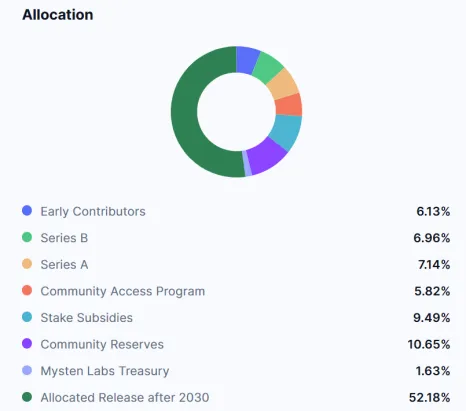
Figure 4: Sui token distribution ratio
From Figure 4 we can see that the distribution model of Sui tokens has three uses to support the construction of Sui ecological community:
Community Access Program: 5.82%
Stake Subsidies: 9.49%
Community Reserves: 10.65%
The tokens used to support the construction of the Sui ecological community account for 26%, reaching 54.37% of the announced release plan (47.82% to be released by 2030), accounting for more than half of the total circulating tokens.
Among them, 5.82% of the community access plan is used for project incentives, supporting on-chain projects, solving the problem of high early customer acquisition costs, and encouraging users to participate in on-chain DeFi. For example, for on-chain lending projects, the early lending pool funds are relatively small, and incentives are issued to encourage users to participate in deposits and loans.
The community reserves 10.65%, focusing more on the long-term construction of the Sui ecosystem, such as funding the development of DApps in the Move language, supporting community governance, or reserving funds for future expansion.
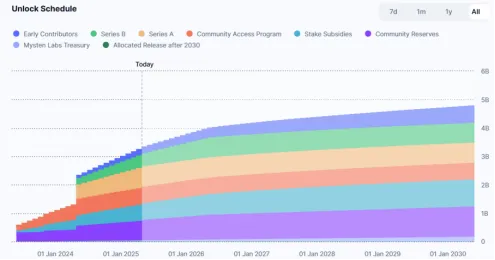
Figure 5: Sui Token Unlocking Plan
In Figure 5, you can see the unlocking plan and unlocking ratio of Sui tokens. Except for the large amount of unlocking in May 2024, the remaining tokens will be gradually unlocked according to their respective allocation ratios, and the unlocking speed will gradually decrease.
When a public chain is first launched, there are relatively few projects and users, so a small amount of tokens will be released first. As the number of projects and users increases, the demand for tokens increases, and the supply gradually increases with the unlocking plan to match the demand. Its unlocking mechanism ensures that the supply and demand remain balanced and the token price is stable.
2. Construction of key projects
In some key projects, such as on-chain infrastructure or projects with large investments and slow returns, Mysten Labs is officially responsible for operation and construction.
For example:
Sui Name Service (SNS): A service that provides human-readable names to simplify wallet address management.
SuiPlay0x1: The next generation handheld gaming device, supporting WEB2+Web3 games.
Walrus: Decentralized storage protocol.
Seal: A decentralized secret management service for protecting sensitive data through on-chain access control policies.
Deep Book: Centralized limit order book (CLOB), parallel execution and low transaction fees, providing high throughput and low latency trading experience.
Mysten Labs officially operates projects such as the Deep Book order book project, which provides liquidity and rapid transaction matching for on-chain transactions; Sui Name Service provides domain name services for the Sui chain, which is more convenient for user interaction and the entry of WEB2 companies; Walrus decentralized storage protocol and Seal centralized secret management service, which make it convenient for builders to store information and encrypt data to protect sensitive data through these two projects.
The SuiPlay0x1 handheld gaming device is related to the hardware design and mass production of the device, and needs to be compatible with games on various platforms and support WEB2+WEB3 games. It is a project with large initial investment and slow results. Without a complete ecosystem and access to WEB2 game manufacturers, it is difficult for WEB3 game companies to develop it (web3 game companies are generally small in scale), so the official has taken the lead in research and development since the beginning of the SuiPlay project.
3. Offline activities
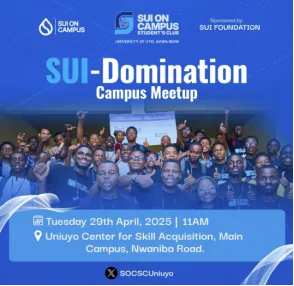
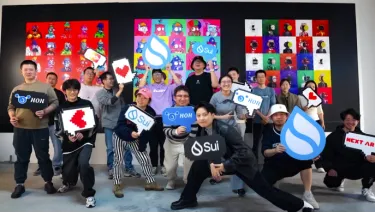
Sui offline activities aim to promote Sui blockchain technology, shorten the distance between WEB3 and WEB2, attract developers, investors and partners to join the ecosystem, enhance community cohesion and enhance brand awareness. With Sui's high performance and scalability to solve traditional problems, it emphasizes education, cooperation and innovation.
The activities are diverse, including global conferences, industry summits, community gatherings, technical workshops and hackathons. The content covers Sui technology progress, Move language education, ecological project display, industry trend discussion and developer practice, helping participants to gain a deeper understanding of Sui, learn development and establish connections. The activities cover North America, Asia and Europe, and jointly promote the development of Sui ecology.

Compliance Solutions
Sui Blockchain has taken several measures to ensure compliance with regulatory requirements, including Anti-Money Laundering (AML) and other legal compliance. However, Sui as a decentralized blockchain itself does not directly enforce AML or KYC, but it provides the necessary tools and infrastructure for projects built on the platform to meet regulatory standards.
1. Compliance and legal requirements
According to Sui's Terms of Service, users must comply with all applicable laws when using the platform, including AML, anti-terrorist financing and sanctions regulations. The terms clearly prohibit engaging in illegal activities such as money laundering, terrorist financing or violations of OFAC sanctions. Users are responsible for their own tax compliance, including maintaining records and reporting transactions to tax authorities. Sui can report user activities as required by law to ensure transparency.
2. Partner Support
Sui's decentralized nature makes it difficult to implement AML/KYC directly like traditional financial institutions, but by providing transparent transaction records and partner tools, it supports projects to meet regulatory needs. For example, Sui Blockchain, through its partnership with Ant Digital, uses its ZAN platform to provide KYC and AML tools to support the compliant tokenization of real-world assets (RWA). ZAN, as Sui's RPC node operator, accesses Sui's infrastructure. This means that ZAN's tools can communicate seamlessly with Sui's blockchain network, enhancing its scalability and security.
In addition, Sui’s terms of service allow for freezing funds or limiting their use to meet legal requirements and ensure overall compliance. (If a $1.46 billion theft of Bybit were to occur on the Sui chain, the stolen funds could be frozen according to the terms).
3. Project-level compliance
Sui itself does not enforce KYC (know your customer) or AML (anti-money laundering) because it is a decentralized blockchain network. Research shows that Sui DeFi tools can usually be used by simply connecting to a Sui wallet, without the need for KYC, bank card or email registration. However, when it comes to fiat deposits or withdrawals, such as selling Sui tokens through an exchange, multi-level KYC verification may be triggered. This shows that compliance is mainly achieved by projects or third parties themselves, and Sui provides support tools rather than direct enforcement.
Specific compliance measures
SuiChain improves compliance and isolates compliance risks through the support of on-chain infrastructure, compliance partners, and project party reviews.
1. Through infrastructure support
Adopt innovative technologies to enhance compliance. For example, Walrus, Seal, and zkLogin have significantly enhanced compliance with the EU General Data Protection Regulation (GDPR). GDPR is an important data protection regulation of the European Union that aims to protect the personal data privacy of EU citizens and requires organizations to comply with strict rules in data collection, processing, and storage, including data minimization, purpose limitation, storage limitation, integrity and confidentiality, as well as ensuring the rights of data subjects (such as access, correction, deletion, etc.).
Walrus: Supporting data deletion to meet the "right to be forgotten"
Walrus is a decentralized storage protocol designed for processing large binary files (blobs), allowing sensitive personal data to be stored on independent sub-chains for quick deletion, meeting the GDPR’s “right to be forgotten” (Article 17 GDPR).
Seal: Secure management of sensitive data
Provides secure storage and access control for sensitive data. Seal ensures that personal data is protected during storage and processing through its security mechanisms, complying with GDPR requirements for data security and privacy.
zkLogin: Privacy-preserving authentication, supporting data minimization
zkLogin is a native feature of Sui that allows users to log in to decentralized applications (DApps) using familiar Web2 credentials (such as Google, Facebook) without having to manage private keys or seed phrases. By not disclosing user credentials and using zero-knowledge proofs, it supports the GDPR's data minimization principle (Article 5 GDPR). It reduces the amount of personal data stored on the chain while ensuring that user privacy is protected. In addition, the design of zkLogin also avoids the complexity of traditional private key management and reduces the risk of data leakage.
2. Collaboration with third parties
Sui Chain works with third parties such as Chainalysis to improve compliance through its community-driven Sui Guardian program. Sui Guardian tracks scams and phishing websites, and Chainalysis's analytical tools are able to monitor and analyze on-chain transactions to identify addresses or patterns associated with known illegal activities. By analyzing transaction patterns, Chainalysis can identify potential victims of phishing attacks and help exchanges and users take preventive measures. This helps Sui comply with AML and KYC regulations around the world, such as the European Union's Fifth Anti-Money Laundering Directive (5AMLD) and the United States' Bank Secrecy Act (BSA).
3. Project party self-discipline
Through various tools, developers can be helped to self-regulate and ensure compliance, such as for geographical restrictions. For example, Sui has worked with Netki to launch DeFi Sentinel, a compliance oracle that provides developers with automated compliance tools, including real-time KYC/AML (know your customer/anti-money laundering), wallet screening, and financial transaction monitoring. These tools can help dApps verify the location of users and ensure that only users in compliant regions can access services.
For example, the Doubleup gambling project is only open to users in gambling-compliant areas.
4. Risk Isolation
In the blockchain ecosystem, public chains usually provide services as the basic layer, while application development is mainly completed by project parties, including Defi, DApp, DePin, etc. Users interact through smart contracts written by project parties, and the stakeholders are mainly project parties and users (contract participants). At present, the parties involved in most legal disputes and judicial precedents are project parties and their participants. Unless there are major vulnerabilities in the public chain that directly lead to user losses, the public chain is rarely listed as a defendant.
For example, Sui recently announced a partnership with xMoney and xPortal to launch a digital Mastercard in Europe that supports SUI tokens. As a technology platform, Sui is mainly responsible for the construction of infrastructure and asset ecology, while the payment side is undertaken by the licensed institution xMoney and the user experience on the application side is managed by xPortal.
Analysis of Suichain’s compliance path
From the practice of Sui Chain, we can see that compliance has been regarded as an important development direction from the beginning of its design and has been integrated into the top-level design of the public chain.
The layout of the public chain should start from the overall perspective and adapt to the future development direction from the underlying logic. As a public chain project, development planning cannot be done from the perspective of a single project. It should take into account the diverse application scenarios and development trends and make good layouts in advance.
Governing a chain is like governing a country. Only when the chain has complete infrastructure construction, takes the lead in developing high-investment projects, and reasonably distributes incentives can it attract more developers and users and gradually develop a rich on-chain ecosystem.
Conclusion
As a rising star in the public chain field, Sui Chain has successfully found a balance between compliance and development through its unique technical architecture and well-thought-out operational strategy.
Compliance has been integrated into the top-level architecture since its design, which not only meets the requirements of global supervision, but also builds a vibrant and robust ecosystem through community incentives, key project construction and offline activities. Its specific measures at the user compliance, partner support and project level, such as cooperating with third parties to provide KYC/AML tools and using innovative technologies to support GDPR compliance, demonstrate its foresight and execution in responding to regulatory challenges.
SuiChain’s practice has proved that compliance is not only a necessary condition for public chains to cope with external pressure, but also a key bridge to promote the deep integration of blockchain technology with the real world. Compliance not only serves supervision, but also serves users on the chain and everyone in the real world.
Although the Web3 world advocates "The code is the law", the excessive jungle law is excluded by the supervision of various countries and mainstream society, which will make Web3 stay in the virtual world. Only by complying with the regulations can we truly cross the boundary between virtual and reality, bring safer and more convenient services to global users, and unleash its revolutionary potential.
Considering how to integrate Web3 with the real world is both the starting point and the end point of compliance.