I. RWA Explosion: BlackRock's BUIDL Fund Becomes a Benchmark for On-Chain Treasury Bonds
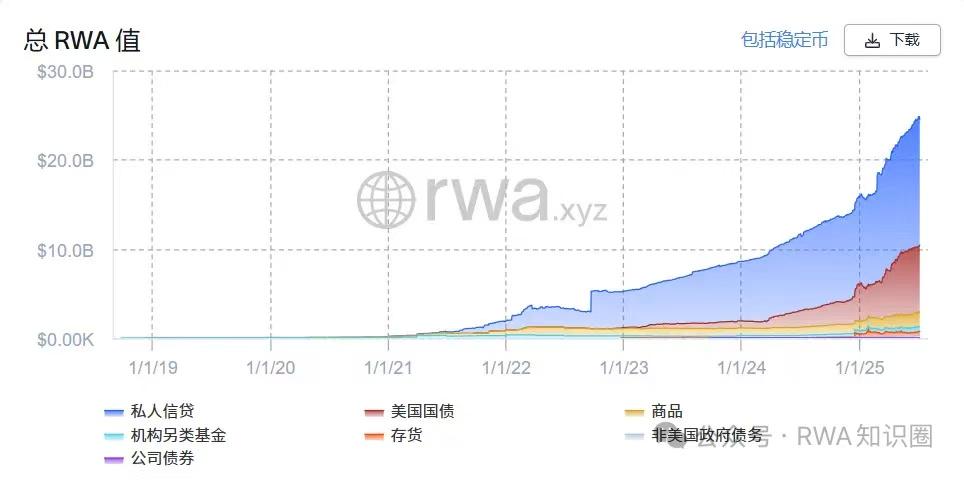
By July 2025, the total market capitalization of RWAs (tokenized physical assets) reached $24.52 billion, a 115.1% surge from $11.4 billion in the same period last year. Among subsectors, private credit led the way with $11.4 billion, followed by Treasury bonds with $7.5 billion. In the Treasury bond market, the BUIDL fund, launched by BlackRock, the world's largest asset management group, has been particularly impressive—with a $2.821 billion fund, it accounts for nearly 40% of the on-chain Treasury bond market. The success of this phenomenal project reflects the common secrets that all RWA projects have for their success.
II. Compliance First: The Survival Bottom Line and Foundation of Trust for RWA Projects
In its March 2025 annual letter, BlackRock stated: "Every asset can be tokenized, which will revolutionize investment." The BUIDL Fund, launched in March 2024, is a pioneering embodiment of this philosophy—investing 100% in a combination of cash, U.S. Treasury bonds, and repurchase agreements, it became BlackRock's first tokenized fund issued on a public blockchain. A successful RWA project must first and foremost have an absolute commitment to compliance. The BUIDL Fund, issued pursuant to Rule 506(c) of the Securities Act of 1933 and Section 3(c) of the Investment Company Act of 1940, strictly limits participation to "qualified purchasers": individuals or family offices must possess at least $5 million in investable assets, with a minimum initial investment of $5 million. They must also pass Securitize Markets' KYC/AML review and be whitelisted. This "compliance-first" approach is the core strength behind attracting institutional clients. The improvement of the global regulatory system has instilled a firm commitment to compliance among more participants. Policies such as the US "Genius" Act, Hong Kong's Stablecoin Ordinance, and the US "CLARITY Act" have paved a clear legal path for RWAs. However, for small and medium-sized enterprises, accurately interpreting complex regulations and adapting to regulatory requirements is not an easy task. Often, lacking a professional team hinders compliance progress, preventing them from progressing projects as quickly as giants.
III. Ecosystem Synergy: Deep Integration of Technology and Resources is the Key to Breaking Through
Compliance is the bottom line, but resource integration is the engine that drives the RWA project's success. The collaboration between BlackRock and Securitize demonstrates an effective model of ecosystem synergy—not a simple Party A/B relationship, but a deeply symbiotic ecosystem partnership.
Securitize plays a core role in the entire tokenization process: serving as the technology platform for digitizing fund units, the transfer agent for issuing and redeeming funds, and the compliance gateway responsible for investor onboarding. Its subsidiary also directly serves as the placement agent. This comprehensive "technology + services + channels" support has given the BUIDL Fund a resource advantage from its inception. More importantly, BlackRock's strategic investment in Securitize and the inclusion of senior executives on the board of directors have completely broken down the barriers to collaboration between the two parties.
Challenges such as integrating with blockchain technology platforms, building KYC systems, and establishing asset mapping channels are often difficult to overcome on their own. The RWA Accelerator can directly connect with Securitize-level technology service providers and even assist companies in strategically investing in high-quality infrastructure companies, replicating BlackRock's ecosystem-building approach and quickly forming a complete, closed-loop issuance cycle.
Four. Model Design: Economic Logic Determines the Project Lifecycle
After the technology is implemented, the economic token model becomes the lifeblood of the RWA project. The design of the BUIDL Fund provides a useful reference:
- The subscription process seamlessly connects fiat currency and on-chain tokens—investors wire US dollars to BNY Mellon. After BlackRock purchases the underlying assets, Securitize mints BUIDL tokens at a 1:1 ratio to a whitelisted address, with on-chain records fully traceable. The redemption mechanism is a groundbreaking innovation: in addition to traditional T+1/T+2 fiat redemptions, the USDC instant redemption channel, developed in partnership with Circle, allows investors to convert BUIDL into stablecoins at any time, perfectly resolving the conflict between traditional financial settlement and the immediacy of DeFi. Etherscan data shows the high frequency of calls to the "Circle: BUIDL Off-Ramp" contract, demonstrating the market value of this design. Of course, the whitelisting mechanism also presents the challenge of balancing compliance and openness. BUIDL cannot directly integrate with permissionless protocols like Aave and must be packaged and integrated through intermediaries like Ondo Finance. Regardless of the asset type, whether it's government bonds, real estate, or minerals, a token model tailored to its specific attributes must be designed. Small and medium-sized enterprises often lack professional teams, making it difficult to independently design models that meet market demands, easily leading to the "launch-and-die" dilemma.
V. Long-Term Perspective: Expanding the Boundaries of RWAs by Building on the Strengths of Giants
From compliance frameworks to ecosystem collaboration and economic model design, every step of the BUIDL Fund's implementation has provided valuable experience for the RWA industry. Its significance goes far beyond a single successful project; it also provides a valuable development path for the entire industry:
- Expanding Asset Categories: Breaking the limitation that "only standardized assets can be tokenized," this demonstrates the scalability potential of non-standard assets such as real estate and photovoltaic facilities, and opens up the possibility of blockchain integration for a wider range of asset types;
- Deepening DeFi Integration: Exploring an innovative "compliance packaging" model, while adhering to regulatory boundaries, allows token earnings to be more flexibly integrated into the DeFi ecosystem, unlocking asset liquidity.
The value of the RWA Accelerator lies in transforming the experience of giants like BlackRock into standardized tools—from compliance templates to technical interfaces, from resource networks to model frameworks. This allows more companies to seize the next wave of RWA dividends without having to learn from scratch, directly at the forefront of the industry.