Author: Vitalik Buterin Institute
On July 30, 2015, the Ethereum mainnet launched.
Bitcoin grew spontaneously like a myth, impersonal and unrewritten; Ethereum, like an unfinished play, its author never leaves the stage.
Vitalik Buterin, a young and famous technological idealist, has spent a decade infusing his personal philosophy, values, and struggles into his code.
From the initial vision of a "world computer" to the governance rethinking during the DAO crisis, from mergers to the profound transformation of the Foundation...every evolution of Ethereum bears the mark of Vitalik's thought.
Ethereum's ten years are also a history of Vitalik's intellectual evolution.
A Genius's Utopia
In 2008, a financial crisis unleashed an unprecedented storm.
Amidst bank collapses and a collapse of trust, Bitcoin emerged, a clarion call for rebellion against the old ways. This emerging technology not only captivated geeks and cryptography enthusiasts, but also changed the life of one young man: Vitalik Buterin.
Heroes are born young, and at an age when most people find love, 17-year-old Vitalik encountered Bitcoin.
In 2011, he learned about Bitcoin from his father, a computer scientist. After giving up World of Warcraft, Bitcoin became Vitalik's new passion.
He began searching online Bitcoin forums until he found someone willing to pay him for his articles in Bitcoin. At that time, he could earn 5 Bitcoins for each post.
Vitalik's articles quickly caught the attention of Romanian Bitcoin enthusiast Mihai Alisie. The two began corresponding and co-founded Bitcoin Magazine in late 2011.
In 2013, Vitalik used the Bitcoin he earned from his articles to travel around the world, visiting Bitcoin enthusiasts in Israel, London, San Francisco, and Los Angeles. Upon returning to Toronto, he was convinced that everyone had completely misunderstood Blockchain 2.0.
They were trying to build complex applications on Bitcoin, but Bitcoin Script was too limited.
Vitalik realized that if he wrote a version of Bitcoin with a Turing-complete programming language, the network could offer all sorts of digital services—replicate social networks on the blockchain, restructure the stock market, and even establish fully digital companies, unregulated by any government entity.
In November of that year, 19-year-old Vitalik turned his idea into a white paper and gave it the name: Ethereum.
This white paper quickly took the crypto world by storm, and for the first time, people realized that blockchain could be more than just a currency; it could be a global, decentralized platform. Co-founders like Joseph Lubin and Gavin Wood joined the team, with Lubin even calling him "a genius alien who brought the gift of decentralization." At that time, Vitalik was a purist idealist. In interviews, he openly stated his dualistic worldview, blaming centralized power for most societal ills. "I view anything involving government regulation or corporate control as pure evil." However, there's always a chasm between idealism and reality. Disagreements first erupted within the team. Some co-founders wanted Ethereum to become a profitable commercial entity, while Vitalik preferred a non-profit, open community model. He even proposed reducing his and other founders' ownership of Ethereum to avoid future concentration of power. The conflict reached a climax in June 2014.
Vitalik asked Charles Hoskinson and Amir Chetrit to leave the team, and that same year, he established the Ethereum Foundation (EF), establishing a non-profit governance direction. That same year, Gavin Wood also left due to disagreements with Vitalik over development priorities and the non-profit direction, and in 2020, he founded Polkadot.
In an interview with TIME, Vitalik acknowledged that Ethereum's transformative vision was at risk of being overwhelmed by greed:
"If we don't make our voices heard, the only things we'll build are those that are immediately profitable, and those aren't often what the world truly needs."
On July 30, 2015, dozens of young developers witnessed the automatic launch of the Ethereum mainnet in a small Berlin office. There were no lavish celebrations, no major media coverage, just a group of idealists quietly watching blocks tick by on their screens.
The vision of a "world computer" went from white paper to reality.
However, behind the halo, young Vitalik wasn't prepared for the more complex and harsh realities of the world.
Fissures in Ideals
In the early years of Ethereum, Vitalik was more of a pure techno-utopian. He firmly believed that the ultimate meaning of blockchain lay in decentralization, emphasizing that anyone could freely build applications on Ethereum without the approval of a central authority.
At Devcon 1 in 2015, Vitalik repeatedly emphasized Ethereum's open and trustless nature, painting an ideal world ruled by code, not power.
But decentralization doesn't automatically mean everything will be perfect. Vitalik, while opposing centralization, inevitably became the ultimate arbiter of community opinion. This subtle power paradox was exacerbated by the subsequent DAO crisis.
In 2016, The DAO, the world's first decentralized investment fund operating on Ethereum, raised over 12 million ETH, valued at $150 million. However, in June, a hacker exploited a smart contract vulnerability and stole approximately 3.6 million ETH.
That year, Vitalik was only 22 years old and had just begun to get used to being called "V God." After the crisis broke out, he worked almost non-stop, communicating with the community, developing solutions, and attempting remedial measures.
The urgent need to protect investor assets clashed with the technological tenets of decentralization. Ultimately, Vitalik chose a compromise and pragmatic approach: advocating for a hard fork to recover the stolen funds, with the entire community voting.
This decision successfully stabilized the market and also led to the split of Ethereum into the ETH and ETC networks of today.
During this crisis, Vitalik lost not only his sleep but also his confidence in the "perfect execution" of smart contracts and his once "perfect" leadership image. It was also because of this incident that the "saint" who believed 100% in technology vanished, and a more pragmatic Vitalik emerged.
After the DAO crisis, Vitalik acknowledged the gap between ideals and reality in his blog post "Thinking About Smart Contract Security." He proposed the introduction of more rigorous security audits and formal verification, and began discussing governance issues in public speeches, emphasizing that "community collaboration," rather than technological absolutism, was the key to Ethereum's success.
The crisis brought reflection, but the market quickly entered a period of speculative frenzy, placing a heavy burden on the network.
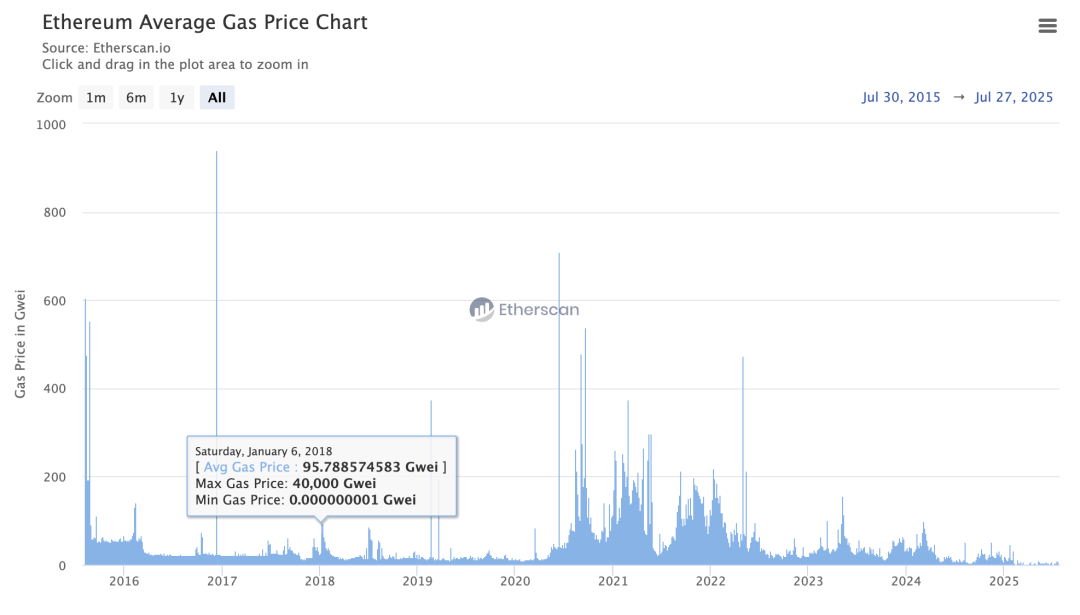
In 2017, ICOs (initial coin offerings) became a phenomenal fundraising method, with projects like EOS, Tezos, and Bancor easily raising hundreds of millions of dollars on Ethereum. At the end of the same year, the NFT game CryptoKitties caused severe congestion on Ethereum due to a surge in users, and the gas fee once exceeded 800 Gwei. Vitalik realized that if the scalability problem was not solved, Ethereum would find it difficult to achieve its vision of universal access.
In the interview, he made no secret of his disappointment with the industry's speculative nature:
"Many projects appear decentralized, but they're just rebranded. We must prove that blockchain's reason for existence truly outperforms traditional technologies (like Excel spreadsheets)."
The hype quickly faded, and the crypto market collapsed in 2018. ETH plummeted from $1,400 to $83, and a large number of ICO projects vanished. During this time, Vitalik constantly pondered how to steer blockchain back towards meaningful goals. In 2018, he co-authored "Liberal Radicalism: A Flexible Design for Charitable Matching," with Harvard scholar Zoë Hitzig and Microsoft researcher Glen Weyl. The paper proposed a quadratic voting mechanism, hoping to ensure that truly valuable public goods receive resources through a public funding model, rather than being dominated by short-term speculation. To address issues such as network congestion caused by insufficient scalability, Vitalik and community developers proposed EIP-1559, which introduced a dynamic gas fee mechanism and pushed Ethereum from Proof-of-Work (PoW) to Proof-of-Stake (PoS) to reduce energy consumption and increase transaction throughput. The DAO crisis, speculative bubble, and price crash induced a profound shift in Vitalik's thinking. He went from a "tech saint" pursuing ultimate decentralization to a builder who must consider security, governance, and social value.
Ethereum remains his utopia, but it's no longer a purely technological paradise. Instead, it's a bumpy road to reality, requiring compromise, trade-offs, and a broader perspective.
In this process, Vitalik gradually found his own pragmatic philosophy.
A battlefield beyond code
If the period from 2015 to 2019 marked a shift from pure technological idealism to pragmatism, then the period from 2020 to 2022 marked another crucial shift in his thinking: he began to confront the complexity of the real world, moving from purely technical ideals to a multidimensional approach that considers social governance, public responsibility, and real-world politics. The Russo-Ukrainian war, in particular, led him to use his influence to confront politics head-on.
In August 2020, in his blog post "Trust Models," he argued that blockchains can never be completely "trustless," and that real-world social contracts and power relations cannot be completely eliminated. This stands in stark contrast to his earlier hope of completely replacing human consensus with code.
In 2021, Vitalik criticized the single-coin voting governance model in his blog post "Moving Beyond Coin Voting Governance," arguing that capital weight should not be the sole decision-making logic. He called for the establishment of a multi-consensus and soft governance mechanism in an attempt to make blockchain more in line with the decision-making logic of human society.
An idealist, further embracing reality.
2022 was a year of great challenge for Ethereum and Vitalik: the merger.
The transition from PoW to PoS consensus mechanism was not smooth. Many former Ethereum community members criticized PoS for further concentrating power in the hands of large capital holders, while some miners and node operators expressed dissatisfaction with the abandonment of the PoW mining model, which they had painstakingly maintained for many years.
Cardano founder Charles Hoskinson even described Vitalik as Ethereum's dictator, criticizing Ethereum as a "dictatorship" and Vitalik's excessive power.
Even so, Vitalik and the Foundation remained steadfast in their pursuit of the merger. On September 15th, Ethereum officially completed the merge, marking the end of PoW.
Vitalik emphasized that this upgrade not only dramatically reduced PoW's energy consumption (by approximately 99.95%), but also paved the way for future scaling steps like Sharding and Rollup, enabling throughput exceeding thousands or even tens of thousands of transactions per second.
In response to the "dictator" accusation, he stated that Ethereum governance relies on community consensus, not the decisions of a single individual, and that all major changes are subject to EIPs, core developer meetings, and public discussion.
In February of the same year, the Russo-Ukrainian War broke out.
Vitalik, a Moscow-born Russian, rarely broke his "neutrality" stance, condemning Putin in Russian on Twitter, calling it a "crime against the Ukrainian and Russian people," and penning the now-famous quote: "Ethereum is neutral, but I am not."
Just weeks later, Vitalik offered his support to Ukraine through crypto donations, donating a total of 1,500 ETH (approximately $5 million) to the Unchain Fund and Aid for Ukraine for humanitarian and military support.
In September of the same year, he traveled to Kyiv to attend the Kyiv Tech Summit and the ETHKyiv Hackathon to express his support for Ukraine.
"I want to see firsthand the Ethereum project, which is still thriving amidst the war, and get to know the developers behind it," he said. "Ukraine could become the next Web3 hub."
"Just focus on building Ethereum. Why get involved in politics?"
Vitalik faced criticism again, but remained unfazed. In an interview with Time, he admitted, "One of the decisions I made in 2022 was to be more adventurous and no longer remain neutral. I would rather Ethereum offend some people than become an empty shell that represents nothing."
This statement also foreshadowed that Vitalik's scope of "offense" was expanding, with social value becoming his core concern. Even the NFT craze that year, which could benefit Ethereum, did not escape Vitalik's sharp criticism.
"If crypto is just about people buying and selling monkey pictures and getting rich quick, then it has lost its purpose."
Especially after the collapse of Luna and FTX, Vitalik believed that the real problem in the crypto world was no longer the security and scalability of the underlying protocols, but how to realize social value at the application layer.
He called on the community to build decentralized applications that can improve public governance, fund public goods, and promote transparent financial instruments.
In his blog post "What in the Ethereum Application Ecosystem Excites Me" that same year, he listed the application directions he most anticipated:
- Scaling solutions centered on Layer 2 and Rollups;
- Privacy protection technology based on zero-knowledge proofs;
- DAOs driven by public goods funding mechanisms;
- Prediction markets and stablecoins that solve real-world problems.
After enduring merger disputes, wars, speculative frenzy, and industry collapse, Vitalik was no longer just a geek behind the code. For the first time, he took the initiative and stepped forward, engaging in public discourse as an activist and thinker.
His ideal nation began to take on a new shape: not just a technical architecture, but a multidimensional laboratory where governance, freedom, and public values coexist.
Dawn Breaks in the Dark
After the Merge was completed, Ethereum's technical path entered a period of stability.
At this moment, the NFT craze has receded, the DeFi hype has faded, and the crypto industry has been caught in a period of anxiety about "no new narrative." During this period, Vitalik has continuously promoted the concepts of public goods funding and information finance:
Supporting open source development and community governance through Gitcoin and quadratic funding mechanisms;
Exploring prediction markets and data finance tools to make information a valuable and incentivized asset;
Advocating for more decentralized applications that focus on social issues and public governance, rather than simply being tools for hype.
At the same time, ChatGPT has driven a global AI wave, and the Silicon Valley tech community is embracing "effective accelerationism" (e/acc), which believes that technology and innovation should be accelerated as quickly as possible, and is optimistic and welcoming of AGI. Vitalik, on the other hand, proposed a prudent approach—"defensive acceleration (d/acc)." He advocated that technological development should prioritize defense and protect democracy and a decentralized order, a move that aligns closely with the original aspirations of Ethereum. In his blog post "My techno-optimism," he warned of the centralization risks of AI: "A government controlled by 45 people could control the fate of billions of people." The awakening brought by AI and the development of Ethereum are intertwined in Vitalik's mind. In "Make Ethereum Cypherpunk Again," he called for Ethereum to reclaim the spirit of its early cryptographic roots: privacy protection, open-source collaboration, and decentralized power. He reiterated this point in interviews, stating that Ethereum is not an institutional tool but an infrastructure for individual empowerment. Its purpose is to resist the centralization of power, not to become a new centralized order. However, there is always a gap between ideals and the market.
In 2024, the crypto market failed to follow Vitalik's lead and instead headed in the direction he criticized. The technical narratives he championed, such as privacy and Layer 2, were ignored by the market, leading to a prolonged slump in ETH prices. Instead, MEME took center stage, and Solana, with its high performance and booming MEME ecosystem, was hailed by some investors as the "new Ethereum."
The market began to circulate with claims that "Ethereum is outdated" and "the foundation has lost its innovative spirit." The Chinese community was intensifying the backlash: the foundation was accused of frequent ETH sales, neglect of developer support, conflicts of interest between researchers and external projects, and Vitalik surrounded by fawning adulation...
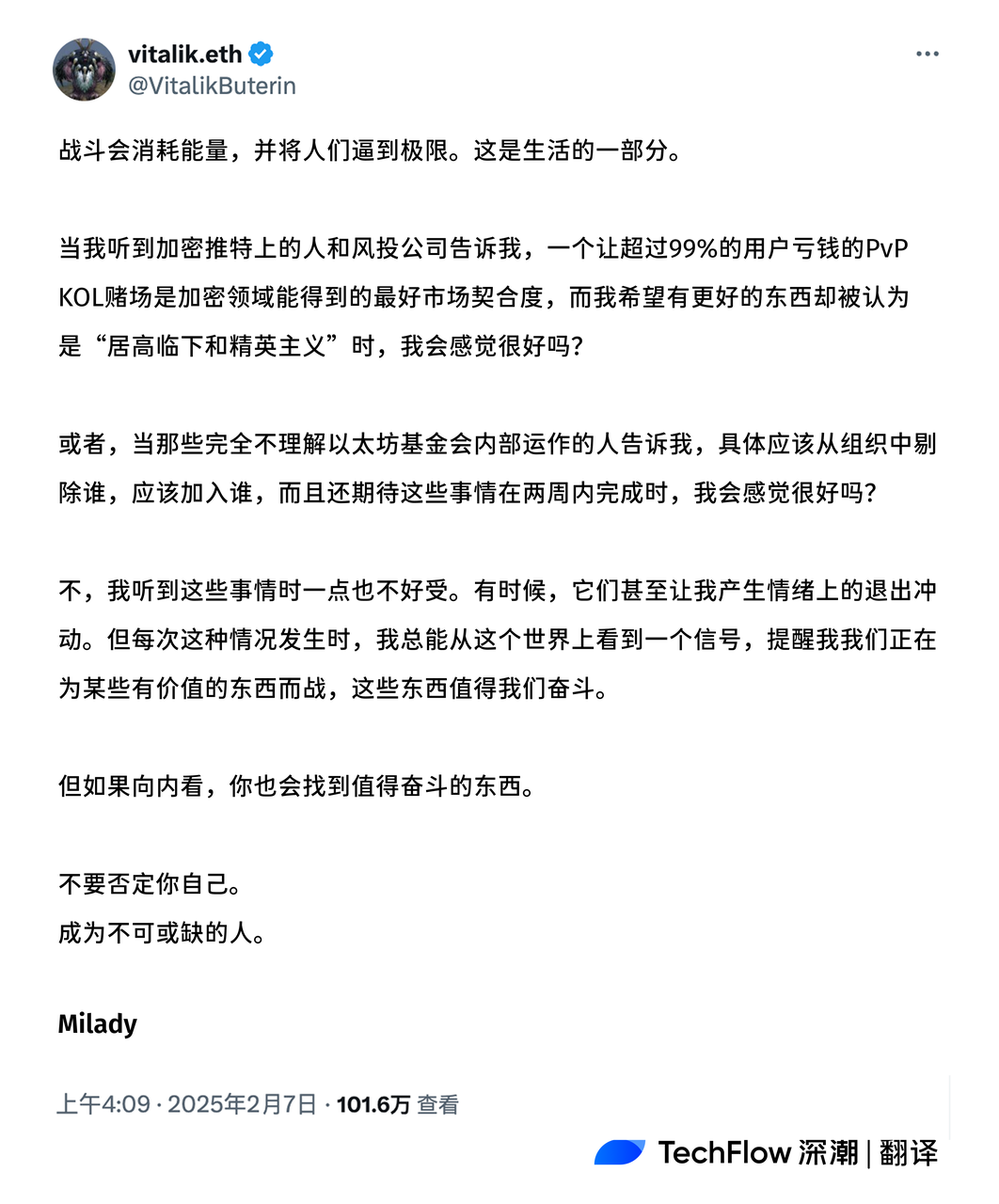
Vitalik didn't hide his frustration at X: Crypto Twitter and VCs considered "a KOL bet where 99% of users lost money" the best product in the industry; while the outside world, unaware of the foundation's internal affairs, demanded a complete overhaul within two weeks. These voices briefly made him want to quit, but every time he felt like giving up, there were always signs reminding him that it was worth fighting on: "Don't deny yourself; make yourself unshakable."
The criticism persists, but change is taking place.
In January 2025, Vitalik announced a major overhaul of the Ethereum Foundation's leadership structure at X. In March, the Ethereum Foundation announced significant personnel changes:
Former Executive Director Aya Miyaguchi transitioned to the role of Foundation Chairman;
Hsiao-Wei Wang and Tomasz Stańczak were promoted to new Co-Executive Directors;
Core researcher Danny Ryan founded Etherealize, a new experimental organization, to accelerate technology adoption.
After a period of decline, with Circle's listing and the rise of stablecoins and RWAs, Ethereum, as a core infrastructure, has once again become a focal point.
Consensys founder Joseph Lubin launched an "ETH reserve" through his US-listed company, SharpLink Gaming (SBET), becoming the "MicroStrategy of Ethereum." Companies like BitMine, Bit Digital, and GameSquare followed suit, and the race for ETH reserves began.
ETH prices have doubled since April, with a 40% monthly increase in July alone. The market seems to have forgotten the skepticism surrounding Ethereum a few months ago.
Vitalik didn't explicitly endorse or disapprove of the "microstrategy" model, but at EthCC in early July, Vitalik Buterin reiterated his industry warning: Web3 stands at a crossroads, and unless developers anchor their work on freedom, decentralization, and privacy, the industry risks betraying its founding principles.
"Ethereum is at a critical juncture," he said. "The decentralization dream that fueled the blockchain revolution is now being eroded by corporate involvement, political attention, and user convenience."
July 30th marks the 10th anniversary of Ethereum's launch.
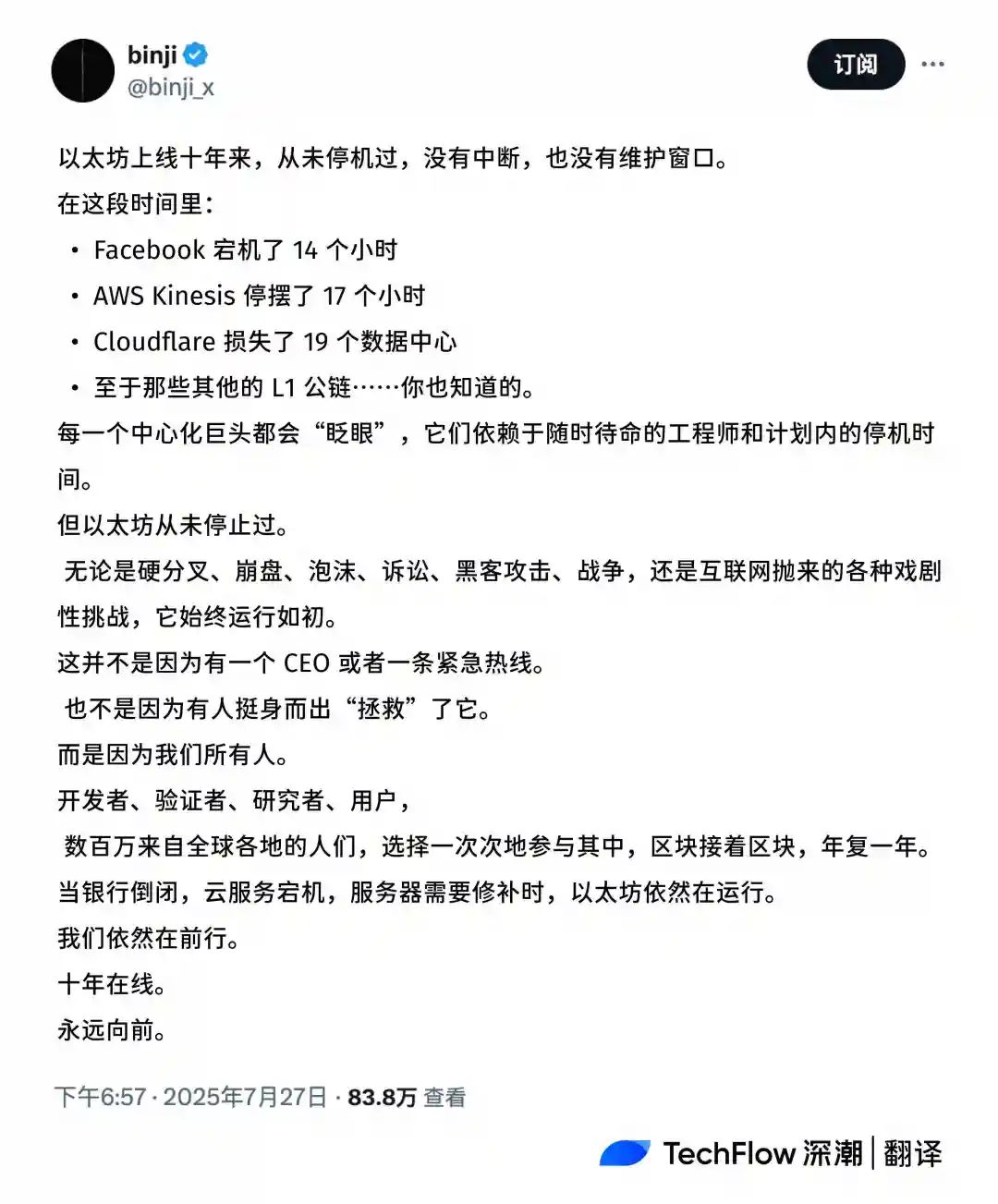
Vitalik X's homepage reposted "Ten Years of Ethereum Reflections" by Ethereum Foundation member Binji:
"When banks collapse, cloud services shut down, and servers are patched, Ethereum continues to run. We continue to move forward. Ten years online, always moving forward."
Interestingly, Vitalik recently reposted another lyrics parody he likes, from S.H.E. The song "Starlight":
If the night weren't dark, why would we yearn for beautiful dreams?
Dawn will be the ultimate reward for those who persevere.
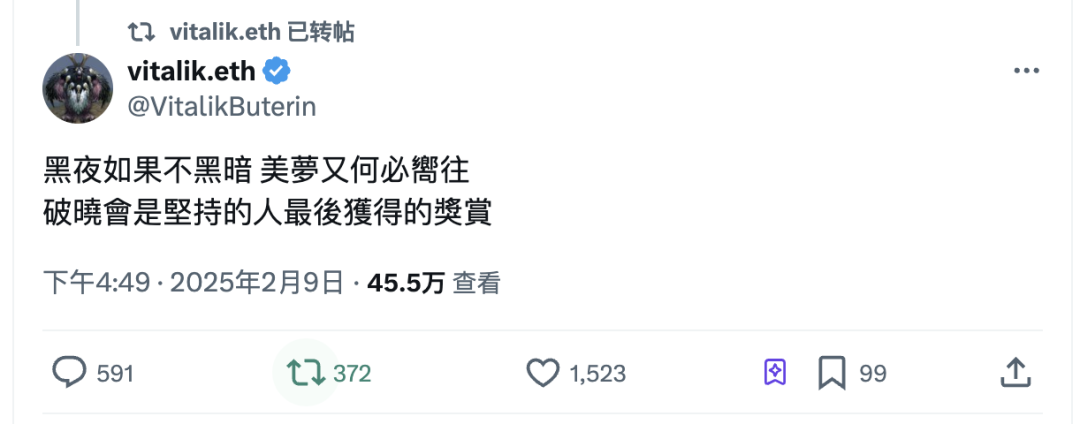
This seems to be the best footnote to the turbulent journey of Ethereum and Vitalik over the past two years: in the darkness, he chose to persevere, waiting for dawn.