
By Donovan Choy, Blockworks
Compiled by: Tao Zhu, Golden Finance
In 2017, investor John Pfeffer published “(Institutional) Investor Perspectives on Cryptoassets,” a seminal paper on long-term investing in crypto tokens.
In retrospect, Pfeffer’s original paper was well ahead of its time. It laid the foundation for investors to think about the magical internet money and made many prescient predictions that still hold up today.
Pfeffer believes that the long-term equilibrium outcome will be a dominant crypto asset as a monetary store of value, and Bitcoin is likely to be one of them. He predicts that BTC's market capitalization will be between $4.7 and $14.6 trillion ($260,000 to $800,000 per BTC).
There are many reasons why Pfeffer believes Bitcoin will solidify its position as the dominant SOV, but the crux of the thesis is that BTC carries the least technical risk. To beat BTC in the SOV game, ETH would require massive intellectual coordination over a multi-year roadmap, with many technical upgrades subject to delays and/or risk of failure.
As Hasu said in an old Uncommon Core podcast, “Not having anything happen to Bitcoin is actually the best thing that could happen to Bitcoin.”
Talking about Ethereum, today ETH bulls tend to argue that ETH is superior to BTC on multiple fronts: Its use as a means of payment in the EVM ecosystem solidifies its value as a SOV (besides the deflationary effects after EIP-1559).
But it’s not clear why this alone makes ETH a valuable SOV.
Pfeffer believes that cryptocurrency participants only need to convert their preferred "store of value into the exact amount they need and in the shortest possible time" through payment channels when making a payment. He likens this to retailers converting bank deposits into physical cash to make payments only when needed.
Pfeffer also presciently noted that Ethereum’s scaling solutions (such as L2 and the move to proof-of-stake) would be “good for adoption/users, but bad for token value/investors.” Given the constant complaints on crypto Twitter about the lack of ETH price appreciation over the last year, this view has proven extremely correct.
So how much is ETH worth?
Today, Pfeffer’s landmark paper is being revisited through a newly published paper he co-authored on the Triton Liquid Fund.
The paper concludes that Ethereum is a technological marvel, but ETH’s risk-adjusted upside is difficult to predict.
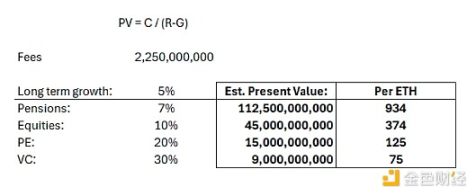
One can try to value ETH as a cash flow asset. But Ethereum’s constant innovation in its protocol and token economics makes DCF analysis “difficult to perform accurately.”
Even so, the paper attempts it based on the generous assumption that issuance is net neutral, plus an average growth rate of 5%. However, no matter what discount rate is used, "ETH appears to be significantly overvalued as a $400 billion cash flow asset today."
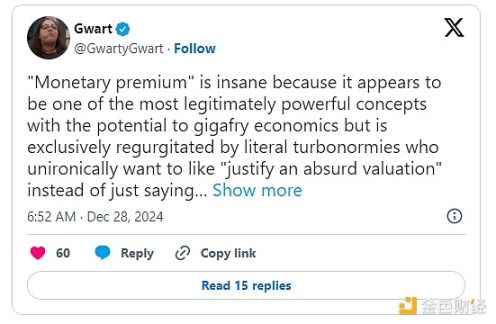
One can then turn to the "money premium" argument for ETH. But contrary to ETH bulls, ETH is not money — it's not even the de facto unit of account in the EVM ecosystem (the dollar is). For example: Ethereum's largest L2 Base started offering USDC instead of ETH to pay for gas fees last month.
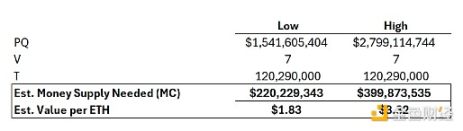
Even if ETH is considered the primary medium of exchange on the chain, trying to justify ETH's valuation of ~$400 billion based on a "monetary premium" is wishful thinking. The paper estimates Ethereum's on-chain "GDP" to be ~$2.8 billion (based on annualized data over the past six months), which is ~1,000x higher than the current valuation.
The strongest argument for ETH as an investable asset is that it is the dominant Internet-native commodity and productive on-chain asset. Holding ETH is not like holding gold bars or oil - people can stake it in DeFi to earn a yield.
However, the paper questions whether Lido’s 3% yield exceeds ETH’s inherent volatility to justify its use as an “internet bond.”
Conclusion: “With a market cap of $400 billion, it’s hard to argue that ETH is a risk-adjusted long-term investment no matter which perspective you use to evaluate it given its current trend… BTC still maintains its position as a solid risk-adjusted bet that can develop into a non-sovereign store of value.”