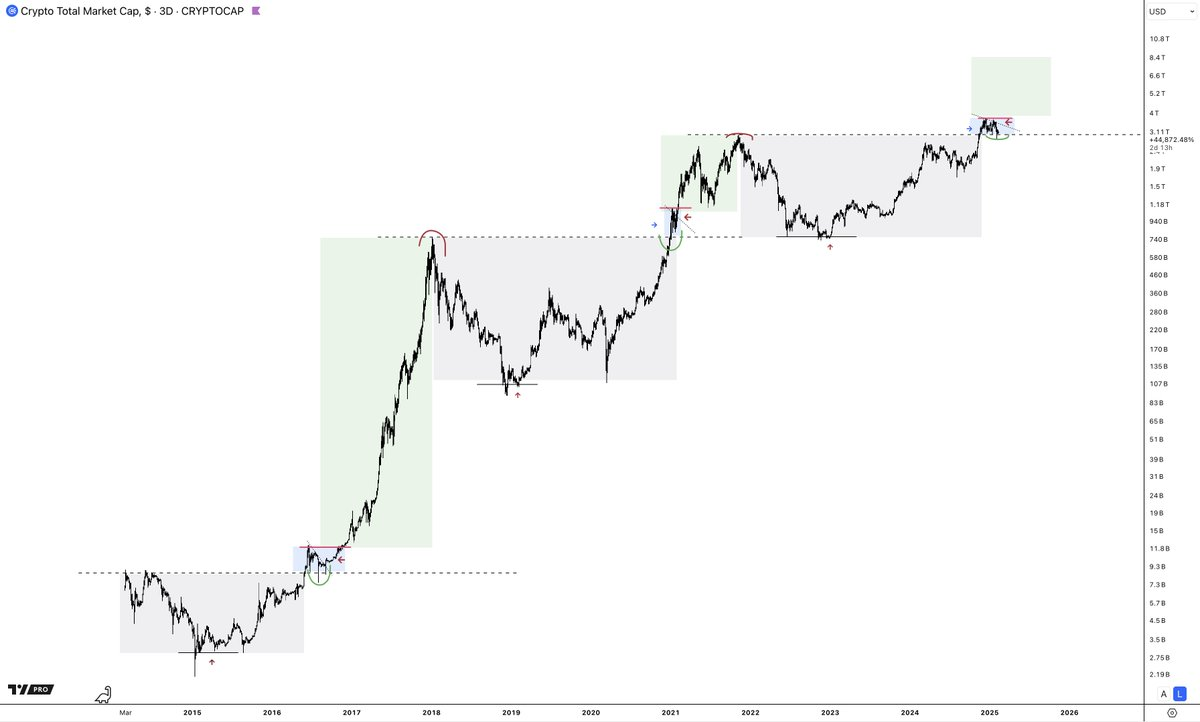
Author: CryptoAmsterdam
Compiled by: TechFlow
Is it true that “without quantitative easing ( QE ), there would be no copycat season”?
Recently, my comments section has been filled with similar sentiments:
“We need QE for a cottage season.”
“Without QE, the copycat season would never have started.”
Let's analyze it.
This is not usually my main research area, but since everyone is discussing QE, I will briefly analyze it.
(Note: I am not an expert in this field. Please correct me if I make any mistakes. To simplify the discussion, we will only start with the charts and do not make too many guesses. Please refer to them with caution.)
1.What are QE and QT?
QE ( Quantitative Easing ) :
Central banks inject money into the market by creating new money
The specific operation is to increase market liquidity by purchasing assets
Increased liquidity = good for risk assets (like crypto)
QT (Quantitative Tightening):
Central banks reduce the money supply in the market
Methods include selling assets or letting them mature to recover liquidity
Less liquidity = bad for risk assets
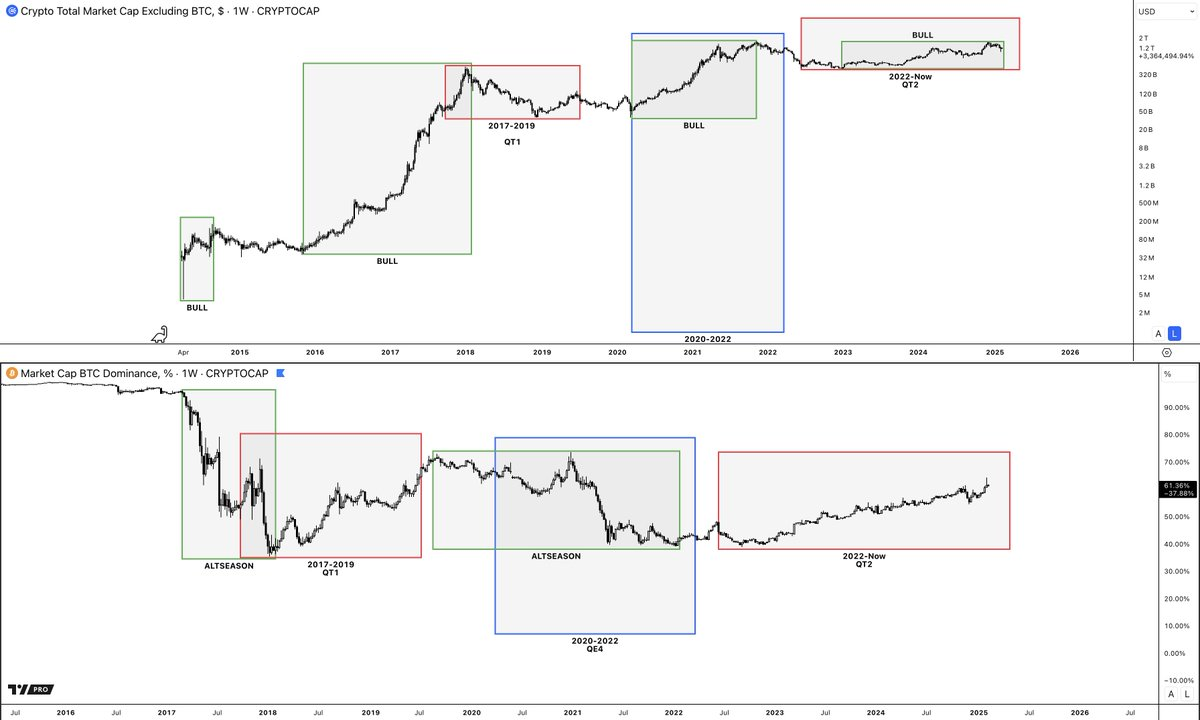
If we overlay the total market capitalization chart of the entire altcoin market with the Bitcoin dominance chart and mark the time periods of QE (good for the market) and QT (bad for the market), we will find that neither of these statements is true.
Even in the absence of QE , crypto markets have experienced significant rallies, bull runs , and alt seasons.
In fact, QE has only coincided with a bull market once, and that was in 2021.
Summary of chart analysis:
The arrival of the copycat season does not depend on QE.
During QT, the total market value of the altcoin market surged from $400 billion to $1.7 trillion.
While QE can boost the market, it is not a necessary condition - other factors may also trigger market growth, such as the launch of ETFs, support from government policies, SBR (possibly referring to some kind of stablecoin reserve mechanism), or an increase in the value of Bitcoin.
Stopping QT would theoretically be good for the market, but the market still achieved growth during QT, which shows that QT is not the decisive factor in market performance.
2. What is Altseason?
In the cryptocurrency market, two main phases can generally be distinguished:
Bitcoin Season
Altcoin Season
Bitcoin Season:
Bitcoin seasons are characterized by an increase in Bitcoin Dominance (the share of Bitcoin in the total cryptocurrency market). This is because funds flow from altcoins to Bitcoin, causing altcoins to perform worse than Bitcoin.
New funds mainly flowed into Bitcoin, and the market share of altcoins declined as a result.
Cottage Season:
Alt season is characterized by a decline in Bitcoin dominance as funds flow from Bitcoin to alts.
The influx of new funds will drive up the market share of copycats, and the total market value of copycats will soar rapidly.
From the historical data, the market is in Bitcoin season most of the time , and the performance of altcoins is usually inferior to Bitcoin. The following are several typical Bitcoin season stages:
Bitcoin in a bear market? It’s Bitcoin season.
Bitcoin bottoming out? It’s still Bitcoin season.
Bitcoin starts its initial rally? Bitcoin Season.
Bitcoin rises to the previous cycle high? Bitcoin Season.
Bitcoin breaks new high? It’s still Bitcoin season.
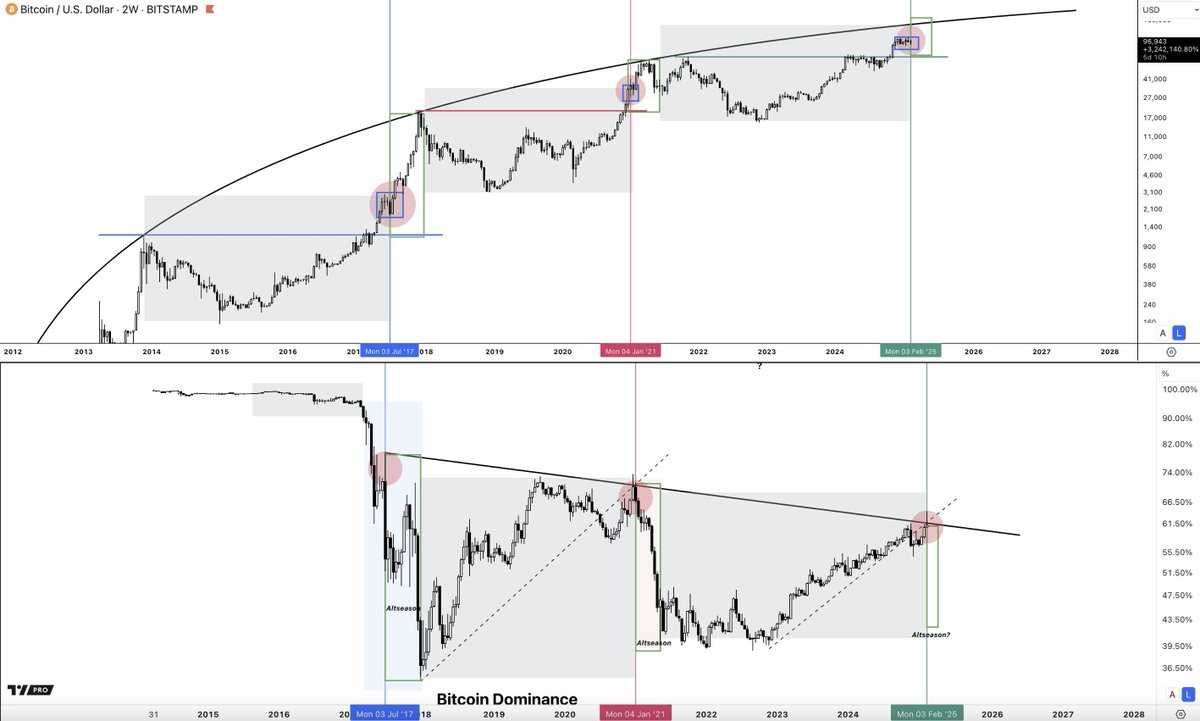
The emergence of the alt season usually has certain rules: it often occurs after Bitcoin breaks through a new high for the first time and enters a consolidation phase. Then, when Bitcoin rises again, the alt season will truly arrive, when Bitcoin dominance begins to decline and the alt market ushers in an explosion.
3. What factors trigger the Altseason?
The alt season is usually triggered by the start of a Bitcoin bull run. (Note that this does not depend on quantitative easing (QE); we are currently in the quantitative tightening (QT) phase. Other possible triggers include the value and cycle of Bitcoin, the stablecoin reserve mechanism (SBR), the launch of a Bitcoin ETF, etc.)
The first step of capital flow is usually an influx into Bitcoin and major alts.
The following results are:
The media hype attracts the attention of retail investors, who may then start buying knockoffs.
At the same time, investors who have made profits in Bitcoin will turn their funds to the altcoin market in pursuit of higher returns.
Judging from historical data, this phenomenon usually occurs when Bitcoin breaks through a new high for the second time. This pattern can be observed from the previous chart.
There is a relatively clear path for capital flow in the crypto market:
Bitcoin → Major Alts → High Market Cap Tokens → Mid Market Cap Tokens → Low Market Cap Tokens
For example, on January 18, 2021, Bitcoin was in a consolidation phase and tried to break through a new high (indicated by the red arrow in the figure), while Total 3 (the total market value indicator of the altcoin market) was still at an intermediate level (indicated by the red arrow in the figure).
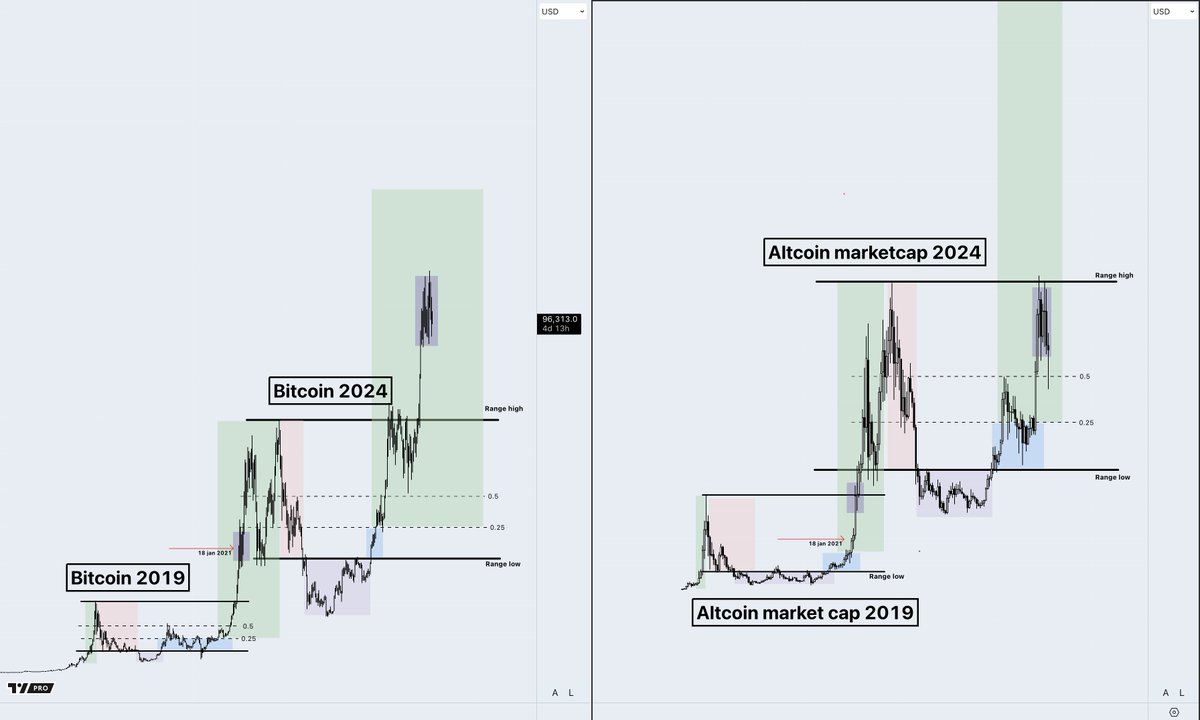
From this, we can see that Bitcoin is usually the starting point for capital flows, followed by the total market capitalization of the major altcoins (Total 3), and finally the rest of the tokens (both high-cap and mid-cap tokens).
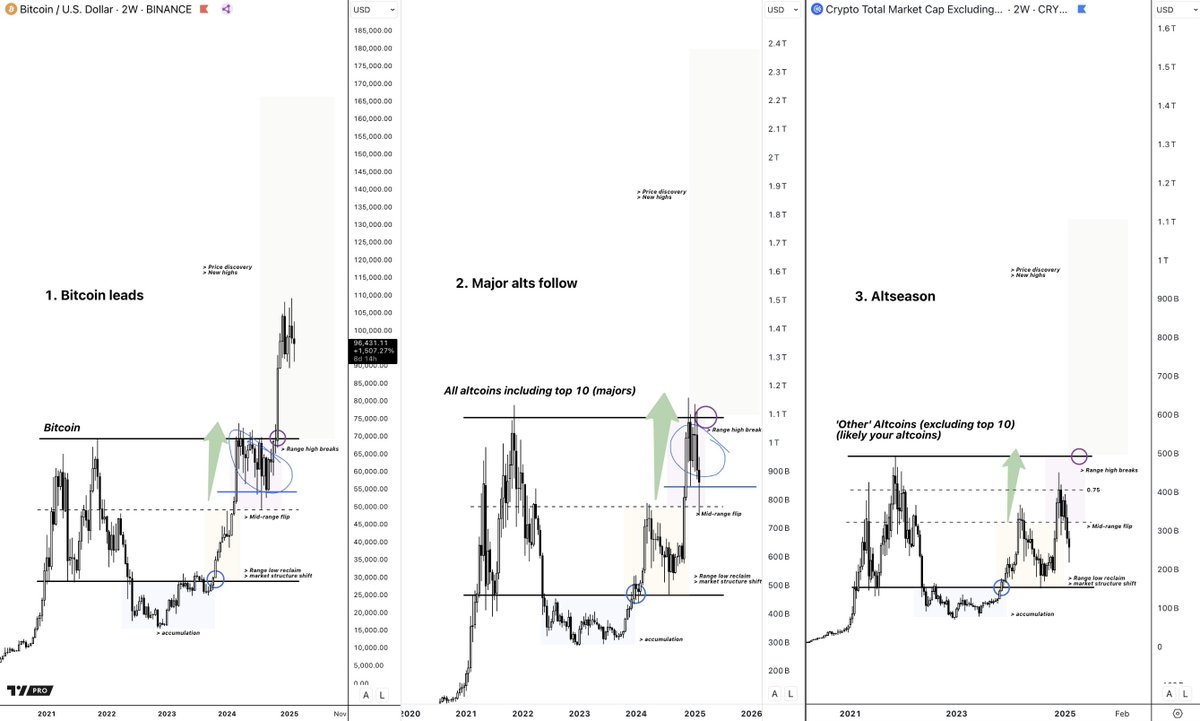
The triggering of the altcoin season does not rely on quantitative easing (QE). (Of course, QE does help the market.)
The key is that a large amount of funds will first flow into Bitcoin and major alts, and then the greedy sentiment in the market will drive funds further to other alts.
This is the trigger mechanism for the alt season. So far, whether it is QE, QT, or other external factors, we are already on the right track. The entire cryptocurrency market (mainly composed of Bitcoin and some major alts, because the alt season has not really arrived yet) has grown from $700 billion to nearly $4 trillion.