DeepSeek has been "famous" for some time. There are many user experience reports about DeepSeek on the Internet, and many Chinese people have high hopes for it. It is said that it has made the American Ai giants panic, and Nvidia's stock price has also plummeted because of it. Some people call DeepSeek "the light of domestic products" and it is a weapon that can compete with world-class rivals.
However, there are different voices on the Internet. Some people say that DeepSeek used ChatGPT's data for training, and even worry whether DeepSeek will be the "Hanxin No. 1" of the new era.
Since Lawyer Liu is not a professional in technology, it is difficult for him to make any useful analysis of DeepSeek from a technical perspective. From the perspective of user experience alone, DeepSeek is indeed the best AI in China. In addition, it can be used without climbing over the firewall, so it is very convenient as a work assistant. As a web3 lawyer, Lawyer Liu focuses on the legal level, taking the personal information privacy that everyone pays more attention to as the starting point, and compares the similarities and differences between DeepSeek and ChatGPT in terms of user privacy policies to see which one can better protect user privacy.
The following nine-dimensional analyses were all conducted using the DeepSeek account registered by Lawyer Liu. This is intended to be “objective and fair” to a certain extent, although the results were a bit surprising to me.

01. Scope of data collection
DeepSeek :
Data provided by users when using search, conversation or other services may be collected, such as query content, device information, IP address, etc.
If personalized services are involved, user preference data may be collected.
ChatGPT :
Collect user input conversation content, device information, IP address, usage frequency, etc.
If a user logs in through an OpenAI account, account-related information may be collected.
Difference : The two may be similar in the scope of data collection, but the specific details may vary depending on the type of service. For example, ChatGPT focuses more on the collection of conversation data, while DeepSeek may focus more on search behavior data.
02. Data Sharing and Third-Party Cooperation
DeepSeek :
Data may be shared with partners to optimize services or advertising.
Data may be provided to government agencies when required by laws and regulations.
ChatGPT :
OpenAI has made it clear that it will not use user data for advertising.
You may work with third parties, such as cloud service providers, to support the operation of your services, but their use of data will be limited by contract.
Difference : ChatGPT explicitly states that it will not use user data for advertising, while DeepSeek may use data for advertising or other commercial purposes.
03. User Control and Transparency
DeepSeek :
Privacy setting options may be provided to allow users to control the use of some data.
Privacy policies can be quite technical and may be difficult for the average user to fully understand.
ChatGPT :
Provide privacy settings options so users can choose not to save conversation records.
OpenAI's privacy policy is generally clear, emphasizing transparency and user right to know.
Difference : ChatGPT may focus more on user experience in terms of user control and transparency, providing clearer privacy settings and instructions.
04.Data security and protection measures
DeepSeek :
Encryption technology may be used to protect data transmission and storage.
There is a data breach response mechanism, but the specific measures may not be disclosed in detail.
ChatGPT :
Employ industry-standard security measures such as encryption, access controls, etc.
Have a clear data breach response policy and promptly notify affected users.
Difference : Both focus on data security, but ChatGPT may disclose its security measures and response mechanisms more openly and transparently.
05. Privacy Policy Updates and User Notifications
DeepSeek :
The Privacy Policy may be updated periodically and users may need to actively check for updates.
Users may be notified via announcements or emails after updates.
ChatGPT :
When the privacy policy is updated, users will be notified via email or on-site notification.
Users will need to re-agree to the updated privacy policy.
Difference : ChatGPT may be more standardized in terms of update notifications and user consent, ensuring that users are informed and agree.
06. Cross-platform and internationalization
DeepSeek :
If the service covers multiple countries or regions, the privacy policy may be adjusted according to the laws and regulations of different regions.
ChatGPT :
Comply with global privacy regulations (such as GDPR, CCPA, etc.) and adjust privacy policies based on regional differences.
Difference : Both may adjust policies based on regional regulations, but ChatGPT may be more mature in international compliance.
07. User education and privacy awareness
DeepSeek :
Instructions on privacy protection may be provided, but user education resources may be limited.
ChatGPT :
OpenAI provides detailed privacy protection guides to help users understand how to protect their data.
Difference : ChatGPT may be more proactive in user education and provide more privacy protection resources.
08.Legal Liability and User Relief
DeepSeek :
The privacy policy may contain legal liability provisions, but the user's remedies may not be detailed.
ChatGPT :
Clarify users' rights and remedies, such as complaints, data deletion requests, etc.
Difference : ChatGPT may be more complete in terms of user relief and provide clearer explanations of legal responsibilities.
09. Enforceability of the Privacy Policy
DeepSeek :
The enforcement of a privacy policy may rely on internal monitoring mechanisms, but the specific implementation may not be made public.
ChatGPT :
There is an independent supervision mechanism and third-party audits are accepted to ensure the implementation of the privacy policy.
Difference : ChatGPT may be more transparent and strict in policy enforcement and supervision.
Last words
All of the above content is analyzed by DeepSeek, but I can feel that ChatGPT is slightly better in the 9 aspects of analysis. DeepSeek also made a summary, saying:
DeepSeek : May be more inclined towards commercial purposes in terms of data collection and sharing, and the transparency and user control of the privacy policy may be weaker.
ChatGPT : It pays more attention to user privacy protection, explicitly states that data will not be used for advertising, provides clearer privacy settings and user education, and performs better in international compliance.
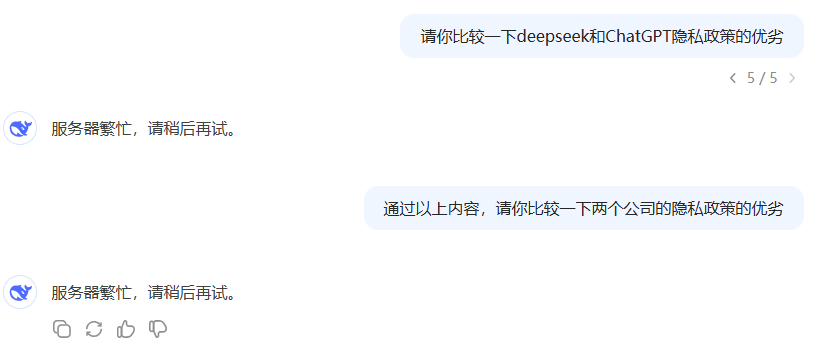
These conclusions drawn by DeepSeek have a flavor of "killing relatives for the sake of justice". After I downloaded the privacy policies of DeepSeek and ChatGPT, uploaded them to the DeepSeek platform and asked it to read, analyze and compare them, it started to say "server is busy". Considering that DeepSeek was recently attacked by hackers, it may indeed affect its operation.
Through the above comparison, it seems that ChatGPT's privacy policy is more user-friendly for the time being. If there are new developments in the future, Lawyer Liu will write another article for analysis.