
Author: Lesley
Source: MetaEra
Key Insights
• Compared to a simple coin holding strategy, mining as a strategic path to Web 3.0 offers three advantages: strong resilience to volatility, stable cash flow resilience, and the potential for synergistic asset growth.
• Cangu doesn't view mining as its ultimate goal; rather, it uses it to build long-term capabilities for controlling power resource costs and optimizing efficiency, laying the foundation for the company's long-term development.
• The essence of traditional companies entering Web 3.0 is to exchange physical resources for on-chain value anchoring. Only by achieving breakthroughs in technological innovation, compliance development, and economic model optimization can they truly leverage their strengths, minimize their weaknesses, and achieve long-term success.
The Web 3.0 strategies and plans of listed companies have become a hot topic of increasing public attention. Against this backdrop, MetaEra has officially launched the "High-Level Dialogue" series of interviews with crypto-related executives. We will speak with business leaders who are pioneering digital transformation. Through the perspective of decision-makers, we will delve into their strategic plans, business innovations, and financial innovations, providing forward-looking insights for industry participants.
In November 2024, Cango Inc. (NYSE: CANG), a New York Stock Exchange-listed company with years of experience in auto finance, decisively announced its entry into Bitcoin mining to address growth bottlenecks in its traditional core business and become a pioneer among listed companies exploring the Web 3.0 market. On July 23, 2025, Cango announced the completion of its secondary acquisition and the simultaneous appointment of a new management team with extensive blockchain industry experience, marking the official completion of the company's transformation into a Bitcoin mining company.
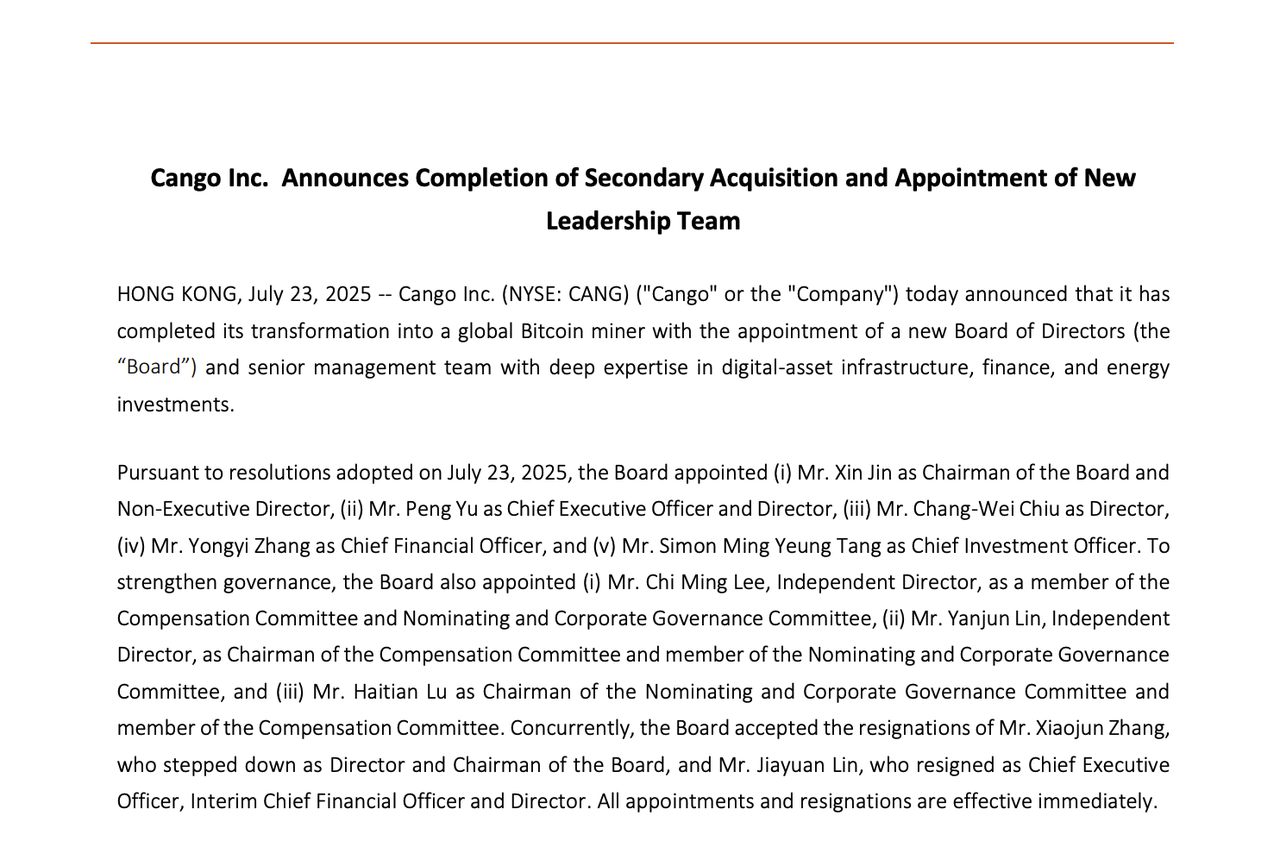
Cangu Announces Completion of Secondary Acquisition and Appoints New Management Team
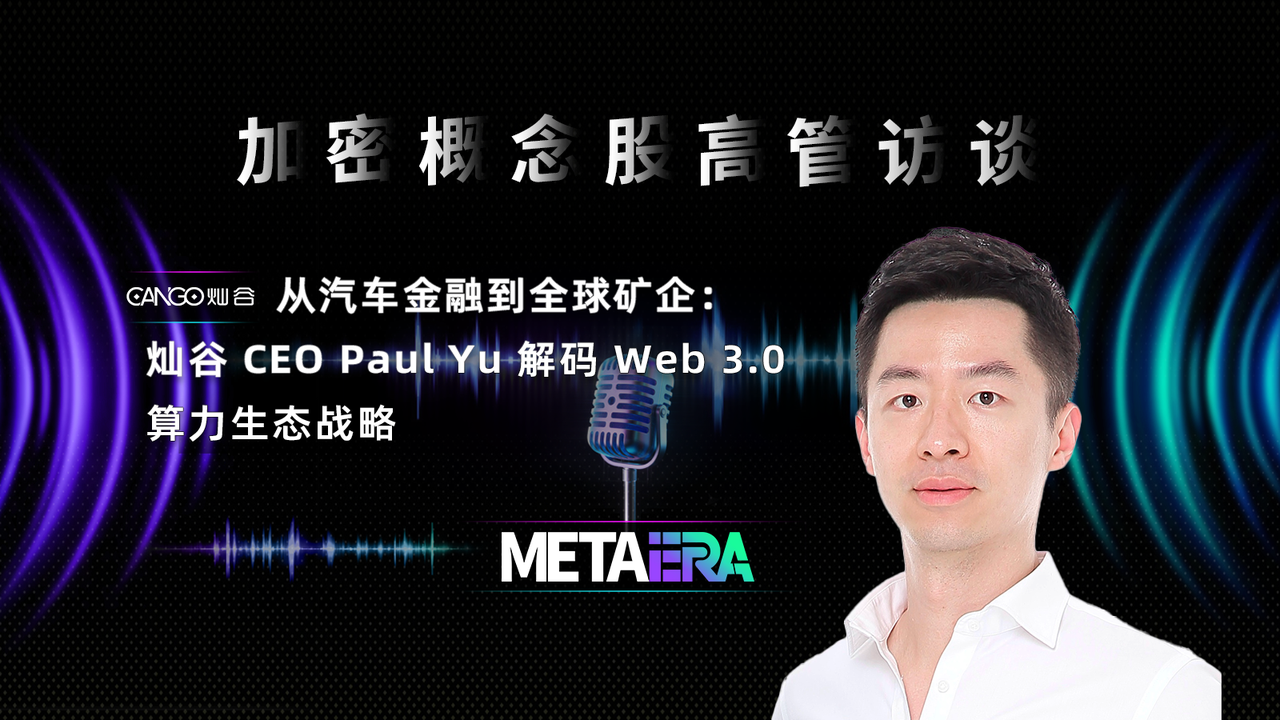
In this interview, MetaEra spoke with Paul Yu, the new CEO and Director of Cangu. This veteran builder and entrepreneur with over 18 years of experience in Bitcoin mining, energy infrastructure, cross-border M&A, and asset management is leading Cangu on a new growth trajectory.
From Auto Finance to Global Mining Company: Cangu's Remarkable Transformation
Looking back on its development history, Cangu was once a major player in China's auto finance sector. In 2018 In 2020, the company successfully listed on the New York Stock Exchange, becoming the first Chinese company to ring the bell on Wall Street. However, with the changing landscape of internet finance and facing bottlenecks in its traditional business, Cangu urgently needed to find new growth engines.
In November 2024, Cangu officially entered the crypto space, fully transforming into a Bitcoin mining company, rapidly expanding its business to North America, the Middle East, South America, and East Africa. On July 23, 2025, Cangu announced the appointment of a new board of directors and executive team with expertise in digital asset infrastructure, finance, and energy investment, officially completing its transformation into a Bitcoin mining company.
As a veteran in the blockchain industry, why did Paul Yu join Cangu as CEO and Director now? MetaEra conducted an exclusive interview with him.
Cango Announces the Appointment of Paul Yu as CEO and Director.
Speaking about his decision to join Cango, Paul Yu stated that he was impressed by the company's transformational strategy. "As a long-time Bitcoin mining veteran, I deeply admire Cango's strategic transformation," he said. "In just nine months, the company increased its computing power from zero to 50 EH/s, the second-highest globally, through a combination of cash acquisitions and equity swaps. This efficient execution aligns perfectly with my commitment to industry development."
He noted that Cango's successful transformation was driven by its precise market timing: "In 2024... When the deal was finalized in 2020, Bitcoin (BTC) was still at a cyclical low, mining machine prices were low (the cost-effective S19 XP model was selected), and computing power competition had not yet intensified, laying the foundation for a low-cost advantage for subsequent profitability. He cited data showing that in the fourth quarter of 2024, the company's Bitcoin mining revenue reached 653 million yuan (approximately US$89.5 million), with total quarterly revenue reaching 668 million yuan (approximately US$91.5 million), a year-on-year increase of over 400%, completely reversing the decline in the automotive business.
Paul Yu is confident in Cangu's future, specifically because Cangu's Q1 2025 financial report demonstrated strong financial resilience. He explained, "As of the end of the first quarter of 2025, the company held a total of RMB 2.5 billion (approximately US$346.7 million) in cash, cash equivalents, and short-term investments, and a cumulative holding of 2,475 Bitcoins."
He noted that his joining Canggu coincided with favorable policy developments: "Many US states have included Bitcoin in their fiscal reserves, pushing its price above $120,000 and opening a window of profit for mining companies." Against this backdrop, Paul Yu stated, "With the trifecta of business foundation, capital strength, and industry opportunities, I look forward to leading the team in achieving the leap from transformation and exploration to global leadership."
Canggu's transformation is not only a reorientation of its business direction; it is also a true reflection of how listed companies are building a new growth trajectory in the crypto era.
Planning for the Future: How is Canggu Building a Global Computing Power Ecosystem?
Traditional companies enter the crypto market in different ways. Some choose to hold Bitcoin or invest in blockchain technology, while others enter this emerging field through mergers and acquisitions, cross-border collaborations, and other channels. However, facing increasingly fierce competition in the crypto market, Cangu chose to enter the market through Bitcoin mining, aiming to build a global computing power ecosystem.
Strategic Direction: Why Mining Over Holding Coins?
When considering strategic choices for crypto companies, the question of whether to hold coins or mine remains a core issue. While mainstream US-listed companies generally adopt a "buy and hold" strategy, Cangu decisively chose the "mining and production" track early on.
Paul Yu believes that compared to a simple coin holding strategy, mining as a strategic path to Web 3.0 offers three advantages:
・Volatility resistance: Dynamically adjusting the mining machine operating rate can hedge against price fluctuations, keeping the average BTC holding cost within a manageable range;
・Cash flow resilience: At its current 50 EH/s hash rate, Cangu produces over 20 BTC daily, providing the company with stable cash flow;
・Asset synergy: Mining machines, as physical assets, can be collateralized for financing, forming a dual-leverage structure with BTC liquid assets.
At the same time, geopolitical factors have also strongly driven this strategic choice. "The Trump administration's policy support for cryptocurrencies has created an unprecedented strategic window for us," Paul Yu noted. "In particular, policies such as promoting the repeal of SAB 121 and encouraging state governments to include Bitcoin in their fiscal reserves are substantially improving the operating environment for mining companies." Cangu is leveraging this policy momentum to accelerate its expansion into North American and global markets.
Paul Yu revealed that to better implement its global strategy, Cangu is planning to establish a US team and headquarters, demonstrating its global presence and its commitment to the North American market.
However, Paul Yu also emphasized that mining isn't the end game, but rather the starting point for Cangu's entry into the era of computing power. Under his leadership, Cangu is steadily expanding its business and establishing new growth areas in Web 3.0 and energy-based computing power.
Strategic Goal: From Mining to a Future of Elastic Computing Power
Cangu's future strategy isn't simply horizontal expansion, but a systematic upgrade based on a deep understanding of the relationship between energy and computing power.
"Cangu started with Bitcoin mining and is building large-scale computing power operations capabilities. Our core goal is to accumulate experience in energy acquisition and management, such as selecting areas with low electricity prices and engaging in dynamic electricity arbitrage," Paul Yu explained. Cangu doesn't view mining as its ultimate goal, but rather uses it to build long-term capabilities for controlling electricity resource costs and optimizing efficiency, laying the foundation for the company's long-term development.

Cangu's computing power has reached 50 EH/s, ranking second globally.
Based on the above vision, Paul Yu's strategic blueprint clearly divides Cangu's development path into three phases: from efficiency release to energy integration, and ultimately to a leap forward in positioning as a computing power scheduling platform. Based on this, Paul Yu explained Cangu's future goals to MetaEra.
・Short-term Goal: Unleash the value of 50 EH/s of computing power through operational efficiency improvements, including machine upgrades, and selectively acquire mining farms with low electricity costs to reduce the cost per coin. BTC costs.
・Medium-term Strategy: Build a dual-engine "energy + computing power" strategy. Pilot "green electricity + energy storage" projects in renewable energy-rich areas to reduce electricity costs for some mining sites to near zero and convert surplus electricity into a revenue stream. Simultaneously, reuse mining facilities to provide HPC (high-performance computing) services to AI companies, creating a secondary growth trajectory.
・Long-term Positioning: Become a flexible computing power scheduler, dynamically allocating resources to BTC mining and AI computing, forming a complex business model of "mining revenue + AI service fees + green electricity trading."
Regarding Canggu's future positioning, Paul Yu summarized the advantages of its current strategy: "Canggu will focus on upgrading energy value. Through green power infrastructure, we will achieve zero marginal cost power supply for some mining sites. We will also gradually provide HPC services to AI customers, ultimately creating a flexible computing power pool, significantly improving asset utilization and resilience."
With global computing power demand surging and the convergence of AI and crypto infrastructure becoming increasingly clear, Canggu's strategic layout not only reshapes the traditional mining model but also promises to gain a decisive advantage in cross-cyclical growth.
The Coming Wave of Crypto-Stock Convergence: A Second Growth Curve for Traditional Listed Companies?
Against the backdrop of the increasingly deep integration of crypto assets and traditional finance, listed companies are becoming key drivers of this historic transformation.
The Structural Advantages of Traditional Listed Companies in Web 3.0
Compared to crypto-native companies, traditional listed companies have demonstrated unique structural advantages in the Web 3.0 transition. Paul Yu cites Canggu's practice as a powerful example of this perspective. He believes Canggu's core advantages lie in three dimensions. First, its compliance DNA. "Our 2018 listing on the New York Stock Exchange has enabled us to develop a mature compliance system," he explained. "From SEC disclosure standards to cross-border regulatory responses, this comprehensive compliance framework is being fully integrated into Canggu's new business." This compliance capability is particularly valuable in the current environment of tightening regulations. Second, its asset-light approach. Canggu quickly entered the industry by acquiring used mining machines, avoiding the market constraints of tight supply and high prices for new machines. This allowed Canggu to quickly achieve industry-leading operational efficiency with relatively small capital investment. "The depreciation cost per coin for the S19XP model we use is only $13,000, far lower than the cost of a new machine in the same period," Paul Yu pointed out. "More importantly, we have established strategic partnerships with key industry players, including Bitmain and Antalpha, to ensure steady development." The third is strategic focus. "We always prioritize cash flow quality and focus on building strong computing efficiency and energy infrastructure," Paul Yu emphasized. This focused strategy enables Cango to maintain a clear development direction in the complex and volatile crypto market and invest limited resources in areas with the greatest long-term value. "In our view, the essence of traditional enterprises entering Web 3.0 is to exchange physical resources for on-chain value anchoring," Paul Yu concluded. "Only by achieving breakthroughs in technological innovation, compliance development, and economic model optimization can we truly leverage our strengths, minimize our weaknesses, and achieve long-term success." It is important to note that in the context of the convergence of cryptocurrencies and stocks, the valuation logic of listed companies is also being redefined. Paul Yu bluntly stated that the trend of cryptocurrency-equity integration will change corporate valuation methods. The valuation of listed companies will need to combine traditional discounted cash flow (DCF) models with on-chain asset value (such as BTC holdings and computing power). This shift places higher demands on listed companies: they must establish transparent and efficient information disclosure mechanisms to bridge the gap in traditional investors' understanding of Web 3.0 assets.
Cangu on Stock Tokenization: Optimistic but Not Yet Entering the Game
Talking about the major trend of stock tokenization, Paul Yu expressed both recognition and restraint.
"We recognize the potential of stock tokenization to increase liquidity, lower investment barriers, and optimize capital efficiency. Investors can enjoy 24-hour global trading and real-time on-chain dividends. These innovations inject the efficiency of blockchain into traditional finance."
"While industry innovation is exciting, Cangu has not yet initiated any substantive exploration of stock tokenization," Paul Yu admitted. "Our strategic priorities are clearly focused on two key areas: maximizing computing power efficiency and developing energy infrastructure. These two pillars are at the core of Cangu's transformation from a 'mining company' to a 'comprehensive green energy service provider.'" Paul Yu stated that Cangu's current strategic focus remains on the two core areas of computing power and energy. This strategic determination to "do what is right and what is not" precisely reflects a mature company's profound understanding of efficient resource allocation. In a world where opportunities abound in the Web 3.0 sector, companies that resist temptation and focus on their core businesses are often more likely to build long-term competitive advantages. Summary: Traditional Finance and Web 3.0 are converging. Cangu's remarkable transformation from an "auto finance company" to a "Bitcoin mining company" reflects another path for traditional listed companies seeking a second growth curve. Against the backdrop of an increasingly friendly policy environment and a continued influx of institutional capital, more and more traditional companies are incorporating digital assets into their strategic considerations, and the "coin-stock integration" is moving from concept to reality.
But the success of this transformation was no accident. Canggu's rise to become a leading global mining company in just nine months was due to precise timing, efficient resource allocation, and a clear strategic positioning. This reminds us that the Web 3.0 transformation tests not only a company's foresight but also its execution and risk management capabilities.
As the Web 3.0 industry continues to flourish, long-term builders are gradually replacing short-term speculators and becoming the dominant force in the industry's development. Canggu's transformation is undoubtedly a crucial part of this transformation.