

I. Global Launch: Regulatory Restructuring and Paradigm Revolution
The global regulatory landscape is reshaping cryptoasset rules at an unprecedented pace. With the EU's MiCA regulations taking effect, the US's GENIUS Act passing, and the Hong Kong Monetary Authority launching the Ensemble sandbox... Behind the rush of countries to introduce stablecoin legislation lies a struggle for digital financial sovereignty. A deeper reason lies in the fact that the "stablecoin + RWA + DeFi" model is disrupting traditional financial infrastructure and becoming a key magnet for attracting trillions of dollars in assets to blockchain. For small and medium-sized enterprises (SMEs) with assets but struggling with financing efficiency, the core value of this financial revolution lies in addressing three major pain points: difficulties in accessing global funds, difficulty pricing non-standard assets, and high cross-border settlement costs.
II. Stablecoins: The "Value Anchor" for Bringing Trillions of Dollars of Assets to the Blockchain
As the cornerstone connecting the real world with the on-chain ecosystem, stablecoins provide the core value measure and circulation medium for the RWA system. While the RWA sector's TVL reached a new high of $12.863 billion, it remains a tiny fraction of the $800 trillion in real-world assets globally. The bottleneck lies in the lack of stablecoins—a particularly critical issue for B-side businesses facing a double dilemma:
-
Liquidity fragmentation: Traditional cross-border payments take 3-5 days to settle, with annualized friction costs exceeding 4%
-
Asset pricing blind spots: Non-standard assets such as charging pile income rights lack a global valuation benchmark
-
There is already hope for its potential to empower the real economy: BlackRock's BUIDL Treasury bond fund tokenization enables 24/7 trading of interest-bearing assets; Longxin Group uses blockchain technology to tokenize charging pile income rights, opening up financing channels for operators lacking collateral.
When stablecoins become a reliable on-chain base currency, small and medium-sized enterprises' non-standard assets (such as accounts receivable and equipment revenue rights) will gain momentum on-chain. Tokenized private credit and government bonds account for 92% of the RWA market, with its scale surging 260% to $23 billion in the first half of 2025, heralding the advent of a wave of business-side asset migration to blockchains.
III. DeFi Engine: The "Financial Operating System" Driving the Value Fission of RWAs
After stablecoins establish the value foundation and RWAs complete asset digitization, DeFi protocols become the core engine for unlocking value. This "automated financial factory" integrates RWA and DeFi modules through composability, directly addressing three major financial pain points for small and medium-sized enterprises:
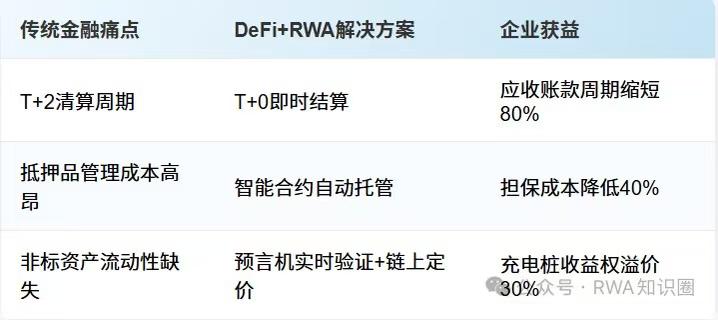
Smart contracts are reshaping the credit system: Figure, a US company, converted $12 billion in mortgages into on-chain eNotes, replacing paper bills. This reduced the cost of each loan by over 100 basis points and shortened settlement time from weeks to days (95% of loans are processed through this system). Small and medium-sized enterprises (SMEs) with limited technical expertise are being held back from this efficiency revolution due to high technical barriers such as smart contract development and oracle deployment. This predicament reveals the key battleground for breakthroughs in the next phase: how to inject liquidity into non-standard assets, dismantle cross-border barriers, and overcome technical compliance challenges.
IV. The New Financial Landscape: Pathways to a Breakthrough and Future Vision
As the efficiency revolution driven by the synergy of stablecoins, RWAs, and DeFi reshapes financial infrastructure, the liquidity constraints of non-standard assets, high cross-border settlement costs, and high technical compliance barriers faced by SMEs are being systematically addressed. The traditional financial system's low collateralization ratio for assets like charging station income rights is being disrupted by the 33% premium offered by compliant tokenization. The transition of cross-border payments from 3-5 day settlement and 4%-6% friction costs to second-by-second T+0 settlement and 0.5% smart contract costs is unleashing unprecedented efficiency dividends. Hong Kong's profits tax exemption and Singapore's improved KYC framework have further reduced the technical compliance threshold from tens of millions of yuan to an affordable level.
The asset tokenization revolution predicted by BlackRock CEO Larry Fink has reached a critical point. Stablecoins form the foundation of settlement, RWAs carry asset value, and DeFi activates financial efficiency—Small and medium-sized enterprises simply need to leverage professional expertise to achieve technical integration and regulatory compliance, transforming physical assets into trusted nodes in the global capital market. As cross-border trade settlements are compressed from days to seconds, and as billion-dollar settlements are automatically executed by smart contracts, this transformation driven by this trinity architecture is permanently reshaping the very fabric of the financial system.




