
Author: Tindorr , Crypto KOL
Compiled by: Felix, PANews
In just over a year, USDe has grown into one of the largest crypto-dollars, with a current supply of nearly $6 billion and near all-time highs.
But perhaps this isn’t surprising.
Every design choice made by Ethena Labs and its founders is focused on building a system that can scale exponentially.
- Build products that scale to billions of dollars by accessing CEX liquidity.
- Leveraging perpetual contract funding rates as a revenue engine: This is one of the few sources of revenue that can sustain a multi-billion dollar scale and an annualized yield of over 10%.
- The custody method is designed so that large capital allocators can also hold USDe with confidence. USDe has withstood the test of multiple major liquidation events and Bybit hacker attacks.
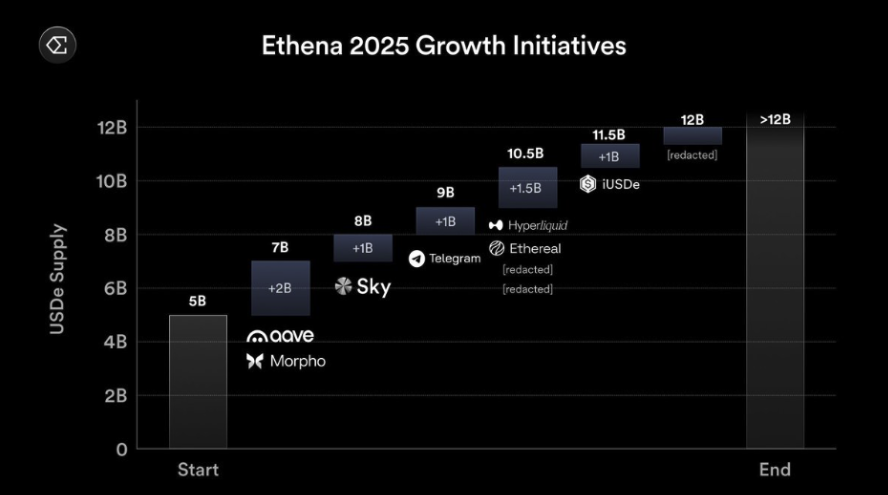
As USDe grows into a blue-chip asset, the team is already planning the next phase of product decisions, aiming to scale USDe to tens of billions of dollars, attract millions of new users, and unlock new waves of crypto-native and external capital.
With foundational integrations complete, Ethena is targeting all major stablecoin demand channels in its next round of growth.
Ethena plans to target four key areas in the coming years to gain market share:
1. Telegram integration: unlocking one billion users
One of Ethena’s most impactful launches to date: integrating USDe directly into the Telegram app, which has over 1 billion users.
Ethena has partnered with Telegram’s official blockchain TON to natively deploy USDe and its yield-generating version tsUSDe (TON-collateralized USDe) in Telegram’s wallet ecosystem.
To this end, Ethena launched a 16-week incentive program with an annualized yield of 18% for tsUSDe, part of which was provided by the TON Foundation.
In addition, the protocol revenue also provides a basic yield of approximately 8%, and early Telegram users can even get double-digit returns.
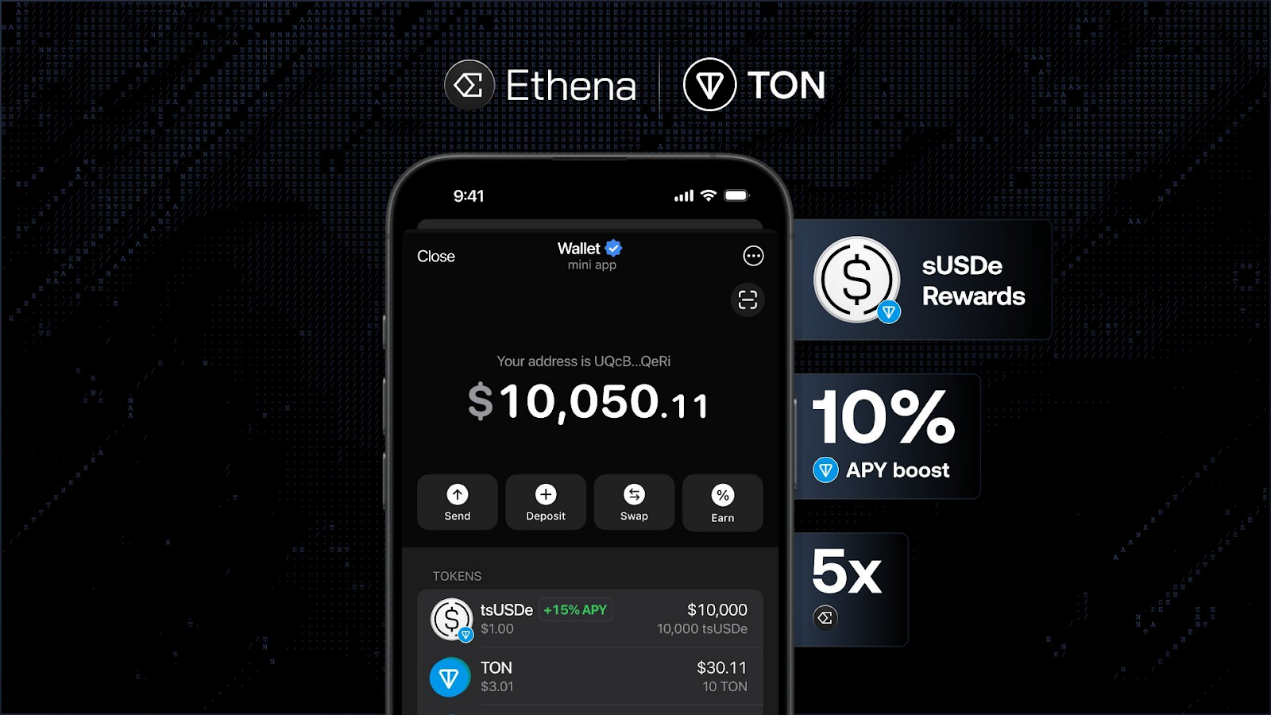
This integration brings frictionless USD savings to everyday users, especially in emerging markets where Telegram already has strong penetration: Asia, Africa, and Latin America.
In regions where access to dollar savings tools can stabilize and change lives, Ethena’s strategy is simple: engage with users where they already are.
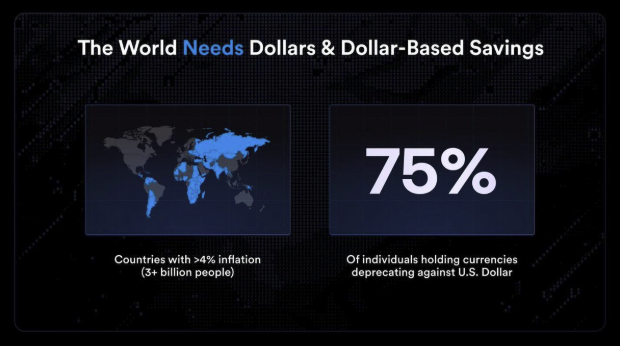 Today, Telegram users can easily obtain USDe, stake it as tsUSDe with one click, and send it to friends as easily as sending a message.
A seamless and familiar user experience can greatly lower the barrier to entry for cryptocurrency savings, especially for non-DeFi native users.
More importantly, this integration opens up a new channel for stablecoin demand: potentially hundreds of millions of people will use USDe to send, spend, and save within Telegram.
By meeting the usage needs of existing users, Ethena can capture a considerable portion of the stablecoin share used by retail investors, which has previously been ignored by some stablecoin projects.
This mainstream influence could give Ethena a differentiated advantage in expanding its user base far beyond the typical DeFi user base.
2. Converge : Bringing TradFi to the Chain
Converge is its way of unlocking the potential of traditional financial institutions.
Converge is a new blockchain built in partnership with Securitize that aims to bring TradFi capital on-chain, bridging the world of tokenized assets and regulated stablecoins.
Securitize has brought over $2 billion in real-world assets on-chain (clients include BlackRock, Apollo, and KKR), and these tokenized assets (such as USDtb) and new KYC-enabled stablecoins (iUSDe, an institutional-grade sUSDe) will run natively on Converge.
Ethena believes that there are two long-term use cases for blockchain:
- Settlements for speculation
- Storage and transfer layer for stablecoins and tokenized assets
The second use case may be a bigger opportunity in the next decade, and Ethena and Securitize have unique advantages in this area.
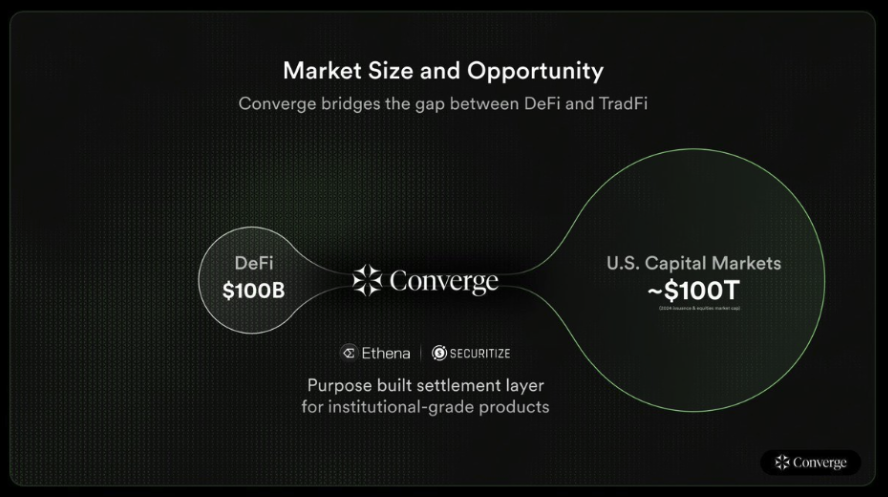
Converge aims to bring billions of dollars of TradFi capital onto the chain and promote the integration of RWA and DeFi.
Ethena and Securitize have a combined total locked value/AUM of nearly $10 billion, making Converge likely to become one of the largest blockchain networks.
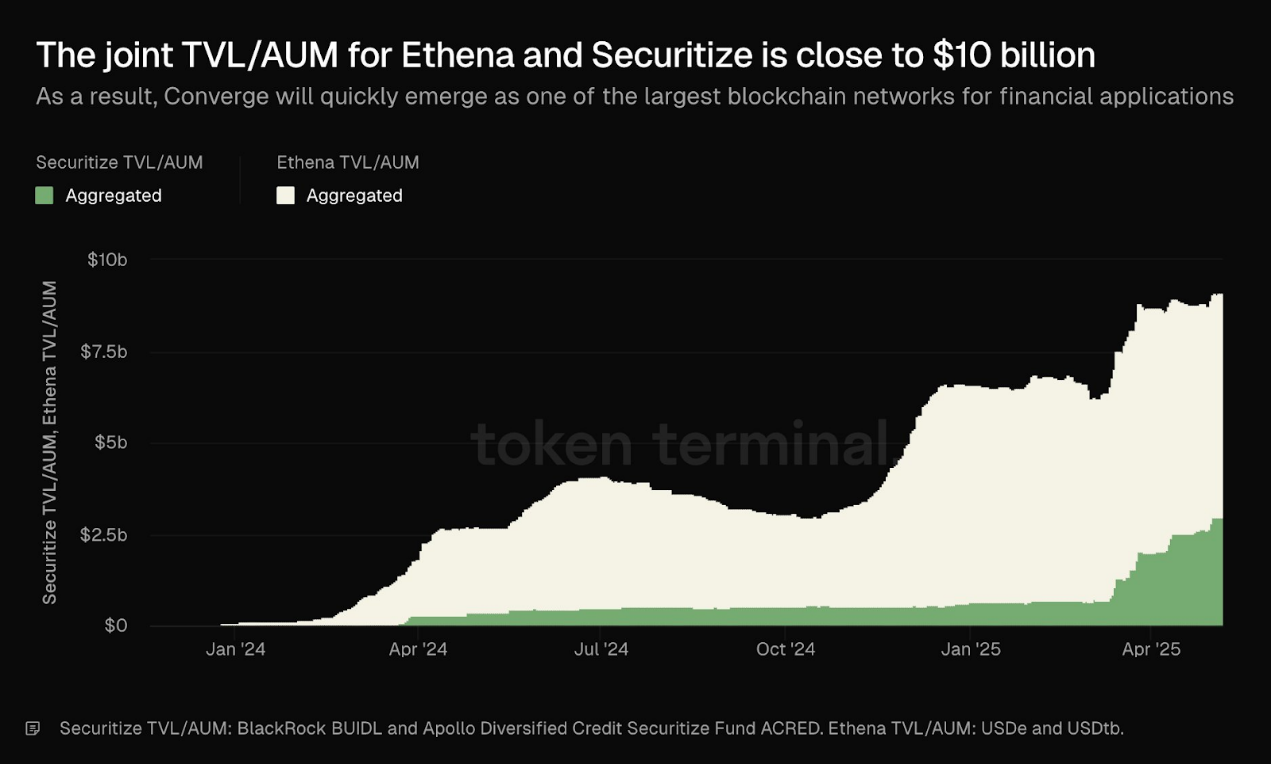
Every iUSDe or every dollar of real-world asset tokenized on Converge ultimately adds value to the Ethena ecosystem.
There are currently 5 protocols that have committed to supporting Converge by building and distributing institutional-grade DeFi products on it:
- Pendle
- Morpho
- Maple
- Ethereal
- Aave
Converge will run on a network of validators secured by sENA, and validators will need to stake $ENA.
Both operators and delegators can earn protocol fees and ecosystem rewards. This creates a direct link between institutional trading volume and value appreciation for $ENA holders.
With the success of Circle’s IPO, institutional demand for stablecoins and crypto products is growing. The key now is to build the infrastructure that these institutions can actually interact with in a compliant manner.
Converge is committed to solving this problem and is looking to capture one of the biggest opportunities in the entire industry.
3. DeFi integration drives growth
Ethena is based on DeFi, and over the past year it has been deeply integrated into the DeFi stack.
Ethena x Pendle x Aave DeFi Stack
Integration with protocols such as Pendle and Aave has become a core driver of $USDe demand and supply expansion.
Ethena’s last big surge was in November 2024, and it was almost entirely driven by two DeFi integrations:
- Over $1.2 billion in sUSDe delivered to Aave
- Pendle peak usage exceeds $2.3 billion
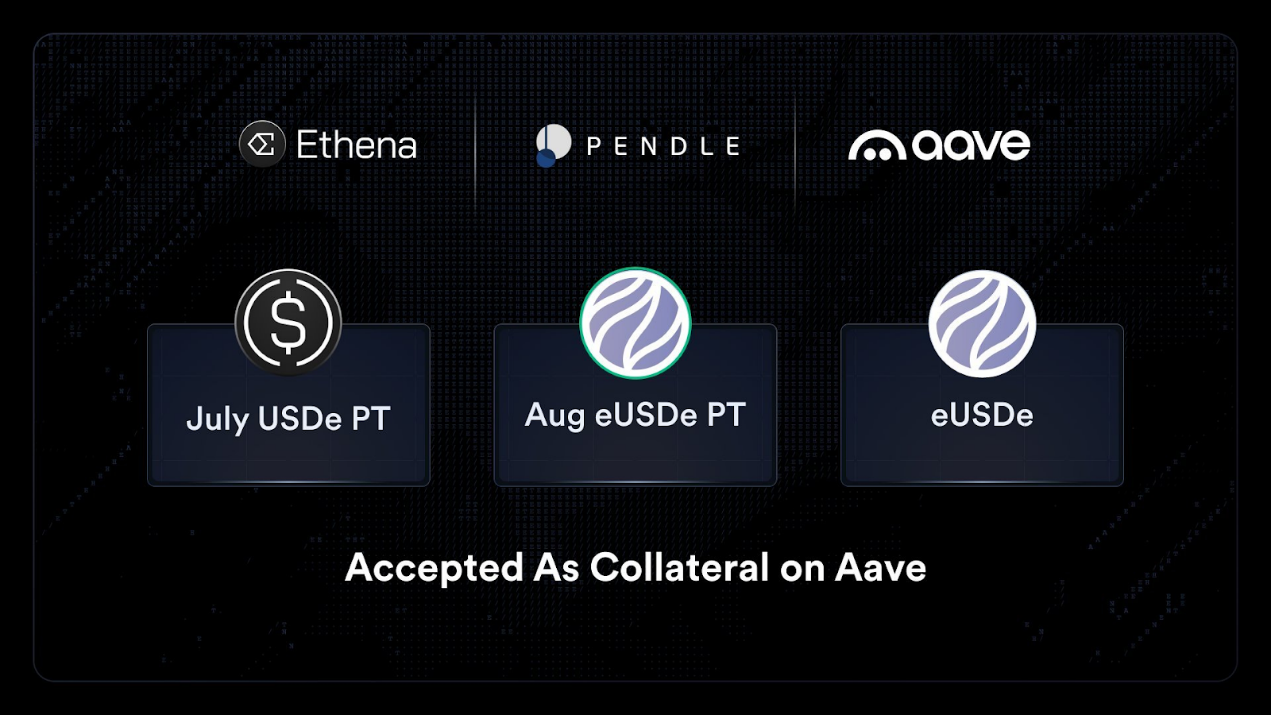
And this growth momentum has not slowed down. In just one month, Aave has added more than $1.5 billion in trading volume to USDe by integrating Pendle's PT token, with a yield of about 8%.
As of now:
- Pendle platform transaction volume reaches $2.6 billion
- Aave platform transaction volume reaches $2.2 billion
- Spark/Sky platform transaction volume reaches $600 million
4. Exchange Adoption: Bybit and the $ 60 Billion CEX Opportunity
Another key lever for Ethena’s expansion is centralized exchanges (CEX).
Ethena x Bybit : USDe as margin collateral
Ethena’s first major move was to integrate with Bybit to make USDe eligible as margin collateral, and the early results are promising.
The Bybit integration went live in May 2024, allowing traders to use USDe as margin and earn yield while trading.
Unlike USDT or USDC (which have zero returns), USDe has an average annual interest rate of 11% and is paid daily. Users only need to hold USDe as collateral to offset transaction fees or funding rate costs when going long.
In just a few months, the USDe balance on Bybit soared to over $700 million, surpassing USDC on the platform and capturing a significant share of Bybit’s stablecoin market.
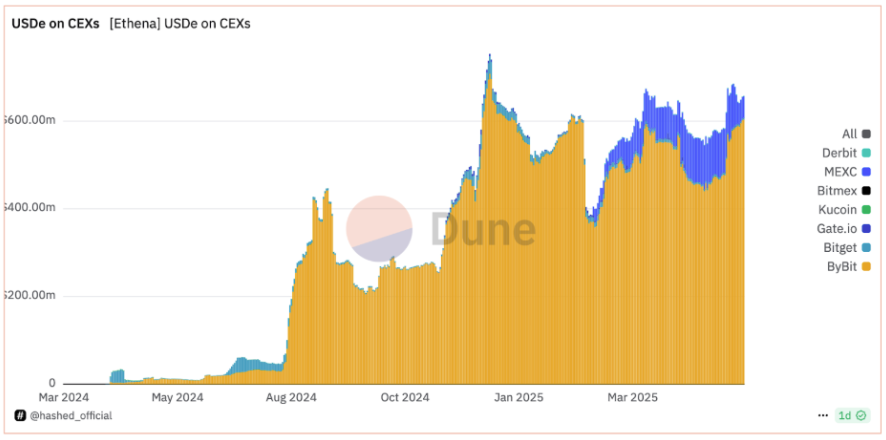
The success achieved on Bybit provided a template for other major exchanges to replicate this model.
CEXs like Binance, OKX, and Kraken hold over $60 billion in stablecoins, but USDe currently only accounts for about 1% of that.
If it can achieve Bybit-level share (10%) on other exchanges, that alone could unlock $5-6 billion in new USDe supply.
To support this initiative, Ethena has partnered with Chaos Labs and other validators to launch a real-time proof of reserves system to publicly verify USDe reserves in real time.
The move is intended to provide exchanges and users with additional confidence in USDe’s solvency and peg to the U.S. dollar, even during periods of market volatility.
USDe’s integration with major global exchanges is one of Ethena’s biggest growth levers.
While these integrations take time, clear user benefits will surely drive adoption. Bybit’s success story provides a model for other exchanges to promote, and each new exchange integration not only adds a new user base to USDe, but also brings Ethena closer to becoming the leading margin token in the CEX perpetual contract market.
in conclusion
With each advancement on Ethena’s 2025 roadmap, coupled with its existing DeFi integrations, Ethena’s path to becoming the tool that drives the convergence of TradFi, DeFi, and CeFi becomes clearer.
Telegram and Converge have attracted new users and funds from retail investors and traditional finance to enter the crypto space, respectively, while DeFi and CEX have helped USDe become the industry's benchmark collateral asset.
Related reading: Beyond Stablecoins: How does Ethena build an on-chain financial engine?