I. Gold Tokenization: A New Paradigm for Solving the Dilemma of Corporate Gold Assets
As a core store of value, gold has been favored by central banks worldwide amid geopolitical conflicts and the Federal Reserve's interest rate cut cycle. Stablecoin bills in multiple countries require pegging to fiat currency or gold, further fueling demand. However, medium-sized companies with gold mines face a dilemma: high gold prices make it difficult for mining and retail gold to enter national reserves, posing high storage, insurance, and maintenance costs. More importantly, as a "negative holding asset," physical gold lacks consistent returns (such as dividends or coupons) and carries significant opportunity costs, making it less attractive than cash-flow-generating assets. Furthermore, a lack of market transparency and frequent instances of gold defaults further undermine consumer trust. Gold tokenization is becoming a win-win for both supply and demand—reshaping the value of gold assets through fractional ownership, seamless transactions, and high accessibility. II. The Core Proposition of Gold RWAs: Designing a Differentiated Economic Model Any RWA issuance requires in-depth economic model design, especially in the gold sector. The core pain point of physical gold is holding costs: Investors pay an average annual storage fee of approximately 1%, significantly eroding returns over the long term. Retail investors face even higher costs and limited options. Furthermore, the physical gold liquidation process is cumbersome, with settlements taking days to weeks, a stark contrast to the instant transactions of modern finance.
Existing solutions, such as gold ETFs, offer investment exposure (globally exceeding $220 billion), but their annual management fees are 0.20%-0.50%, and investors only receive the right to benefit from price fluctuations, deviating from gold's core role as a hedge against geopolitical risk and a barrier to inflation.
Therefore, gold RWAs need to break away from traditional frameworks and build a complex economic model that integrates collection, trading, payment, and investment to truly differentiate themselves from futures and ETFs.
III. Dual-Currency Model: An Innovative Architecture that Balances Liquidity and Asset Ownership
To meet the needs of all parties, a dual-currency model combining NFTs and RWA tokens is necessary. This model requires the two digital assets to complement each other's functions: one token focuses on liquidity and payment scenarios, anchoring the value of the underlying asset while maintaining price flexibility to facilitate high-frequency trading and daily settlement; the other NFT emphasizes asset uniqueness and long-term value, corresponding to the ownership of a specific underlying asset and embedding traceability information to enhance collectible attributes and trust. At the same time, a conversion mechanism between the two must be established, enabling value exchange through rules such as destruction and staking. This ensures both short-term circulation efficiency and long-term holding needs. Third-party audits and transparent reserve management should be implemented to strengthen trust and expand diverse application scenarios to form a closed ecosystem. In the digitalization of gold assets, IPMB Group, which owns and holds a majority stake in a Ghanaian gold mine (with an annual output of 110 tons), has explored this approach by designing two digital assets, the GPRO token and GEM NFTs, in an attempt to build a gold tokenized ecosystem:
GPRO Token
- Nature: An ERC-20 fungible token deployed on the Polygon network, with multi-chain support planned.
- Gold Backing: 1 GPRO is pegged to 1 gram of 22K rough gold (Dore). Its price is linked to the value of gold and has a natural lower limit.
- Core Function: Ecosystem payment tool for purchasing goods/services and staking GEM NFTs to enjoy discounts; supports instant transactions and cross-chain transfers, suitable for short-term gold price speculation.
GEM NFTs
- Nature: Non-fungible token, corresponding to a specific physical 24K gold (gold bar/coin), with metadata including traceability information such as origin and purity.
- Gold Backing: 1:1 backed by LBMA-certified 24K gold, independently audited by Grant Thornton.
- Core Function: Represents fractional ownership of gold, supports long-term holding (zero custody fees for the first 5 years), free physical redemption for gold over 100 grams, and tradable on the NFT market.
Through complementary functions and a linkage mechanism, these two digital assets jointly form a gold tokenization ecosystem that balances liquidity and long-term value, encompassing payment transactions and asset ownership confirmation. This architecture leverages the efficiency of blockchain technology while preserving the stability of gold as a store of value. It innovates and optimizes the traditional gold investment model, providing a practical reference for small and medium-sized enterprises to issue RWAs with collectible properties.
Fourth: Breaking the Trust Dilemma: Full-Chain Transparency Practices
Of course, in addition to designing the economic model, the core challenge of issuing gold RWAs lies in the full-chain obstacles to building market trust: independent and authoritative audits of reserve assets are required to verify sufficient collateralization, address the efficiency issues of real-time data transmission and synchronization across all links to ensure transparency, and establish a comprehensive asset traceability system from mining to storage to address the provenance ambiguity and compliance risks caused by supply chain fragmentation. Current mainstream projects offer practical references:
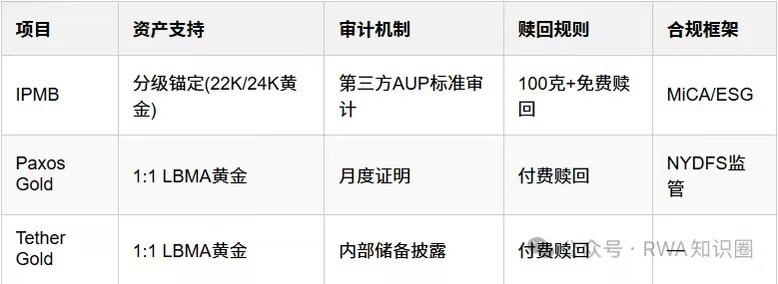
The differing approaches of these projects in reserve verification, redemption rules, and compliance implementation highlight the complex path to building trust in gold RWAs. They also clarify the key areas that need to be addressed for companies promoting RWA issuance.
V. From Cognition to Practice: New Infrastructure to Seize the RWA Market
Behind the market landscape of global central banks holding over 32,000 tons of gold and projected demand of 4,800 tons in 2023 (a 3% year-on-year increase), lies a structural contradiction common to the entire RWA market: the supply side is constrained by the inefficiency and high barriers to entry of traditional asset circulation, while the demand side continues to expand due to the wave of digitalization. This contradiction is particularly acute for small and medium-sized enterprises: they face the common dilemmas of poor asset liquidity and high holding costs, while also being constrained by compliance barriers, insufficient technical capabilities, and limited ecosystem resources, making it difficult to break free from the shackles of traditional models.
"The Golden House of Books" - More important than analyzing individual cases of gold tokenization is extracting universal logic from specific practices and establishing a systematic understanding of the RWA market:
- Is it suitable for issuance? → Diagnosing market opportunities
- How to design a model? → Designing an economic architecture
- How to achieve compliance? → Global regulatory pathway
- How to connect with resources? → Connecting with ecosystem partners
The RWA Accelerator helps companies complete the entire process, from "whether to issue" to "how to issue," effectively revitalizing the value of gold assets and promoting the digital upgrade of various asset classes within the RWA market.