Author: Kaori
Edited by: Sleepy.txt
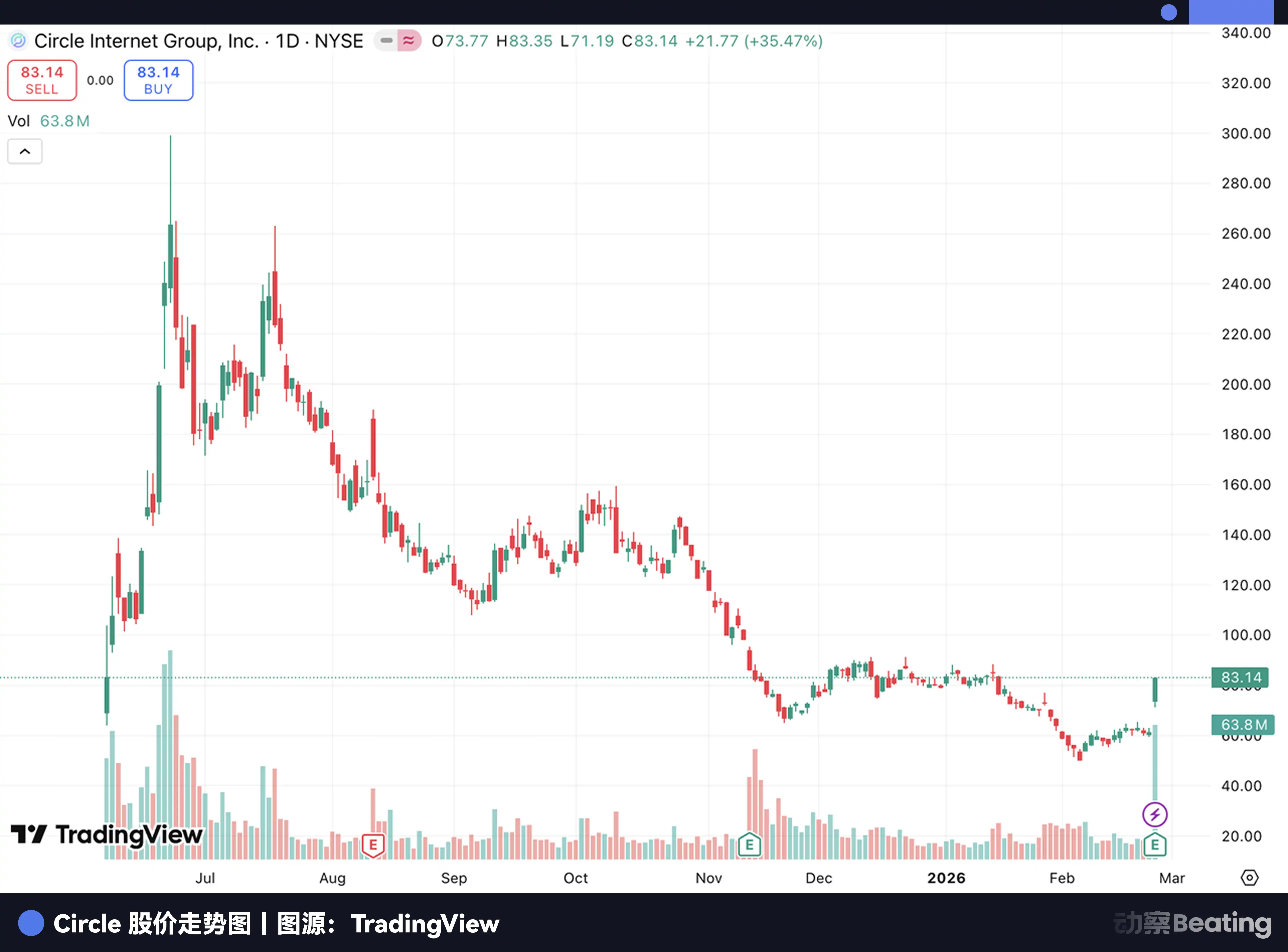
At the end of February 2026, Circle's stock price was $83. Nine months earlier, it was worth $298.
In the 270 days following Circle's IPO, USDC's circulating supply exceeded 75 billion, and its total revenue in Q4 reached $770 million, a year-on-year increase of 77%. These figures would be considered respectable in any sector of Wall Street.
Whether bullish or bearish, Circle, as the most watched crypto-listed company in this bull market, is still the same company, but the market seems unsure how to price it, and a consensus has yet to be formed.
The market repriced three times in 270 days.
On June 5, 2025, Circle's IPO price was $31. The stock price jumped to $42 at the open. Before traders could even figure out what was happening, it had already reached $55 by the afternoon close.
The first label Wall Street attached to Circle was that of an encrypted version of Nvidia.
This analogy makes sense. Nvidia dominates the AI computing layer with its GPUs, while Circle has built a settlement network in the crypto world using USDC. Behind every USDC transaction, one dollar of real-world assets lies in government bonds generating interest.
Circle doesn't need to bet on market direction; it only needs to ensure a large enough circulation of USDC, and interest income will flow in automatically like water.
The market isn't buying into how much money Circle is making now, but rather into the story of stablecoins becoming a global settlement layer.
With the Federal Reserve's benchmark interest rate still above 5% in 2024, Circle could earn $1.5 billion annually just from reserve interest. This figure renders all questions about whether Circle is a technology company irrelevant.
But there was a landmine buried there, and no one wanted to touch it at the time.
Circle's core revenue is determined by a variable it has absolutely no control over—the Federal Reserve's interest rates.
A company priced as a tech firm has staked its fate on macroeconomic policies. This contradiction was masked by market frenzy on IPO day, but it hasn't disappeared.
Just one month after Circle's IPO, the U.S. House of Representatives passed the GENIUS Act.
This marks the first time a stablecoin has received federal-level legal backing, and the market reaction has exceeded all expectations. Circle saw a single-day increase of over 30%, with institutional funds flooding in like water released from a dam.
In early July, the circulating supply of USDC exceeded 60 billion. By mid-July, Circle's stock price had reached a high of $298, and its market capitalization had surpassed $72 billion.
It took less than six weeks for a company's market capitalization to rise from $31 to $298, marking the fastest gain for a large-cap company on the Nasdaq since 2023.
Wall Street analysts began discussing what a fair valuation for Circle would be, with some giving $500 and others being more aggressive, saying that even $1,000 was logically supported.
Here's how they calculated it: With a circulating supply of 60 billion USDC, if the interest rate remains at 4.5%, the annual interest alone would be 27 billion. Add to that the valuation multiple of a tech company, and the numbers would look very good.
But there were two problems that nobody took seriously at the time.
First, the Federal Reserve has begun signaling interest rate cuts. Second, Coinbase is the largest issuer of USDC and will take a large slice of every penny of interest from Circle.
In early August, Circle released its Q2 financial report. The numbers were very good, with net profit exceeding expectations and USDC circulation continuing to grow. The market celebrated briefly before starting to carefully read the financial report notes.
After reading this, Circle's stock price began to calm down. The problem lay in the comparison of two figures: revenue growth was 66%, while distribution cost growth was 74%. Distribution cost growth outpaced revenue growth.
The root cause of this problem lies in Coinbase's profit-sharing structure. Coinbase is the largest issuer of USDC, but its profit-sharing agreement with Circle has a design flaw: the higher the circulating supply, the larger the proportion that Circle has to distribute.
The larger the scale, the lower the unit revenue. This is not a mistake by Circle's management; it's something written into the protocol itself. It's just that this problem is masked by the absolute increase in circulation during periods of rapid growth.
This is Circle's first hurdle; the second hurdle comes from interest rates.
In September, the Federal Reserve cut interest rates by 25 basis points for the first time. In October, it cut them by another 25 basis points, and the yield on reserves fell by 96 basis points year-on-year. Circle's most relied-upon source of income is shrinking at a steady pace.
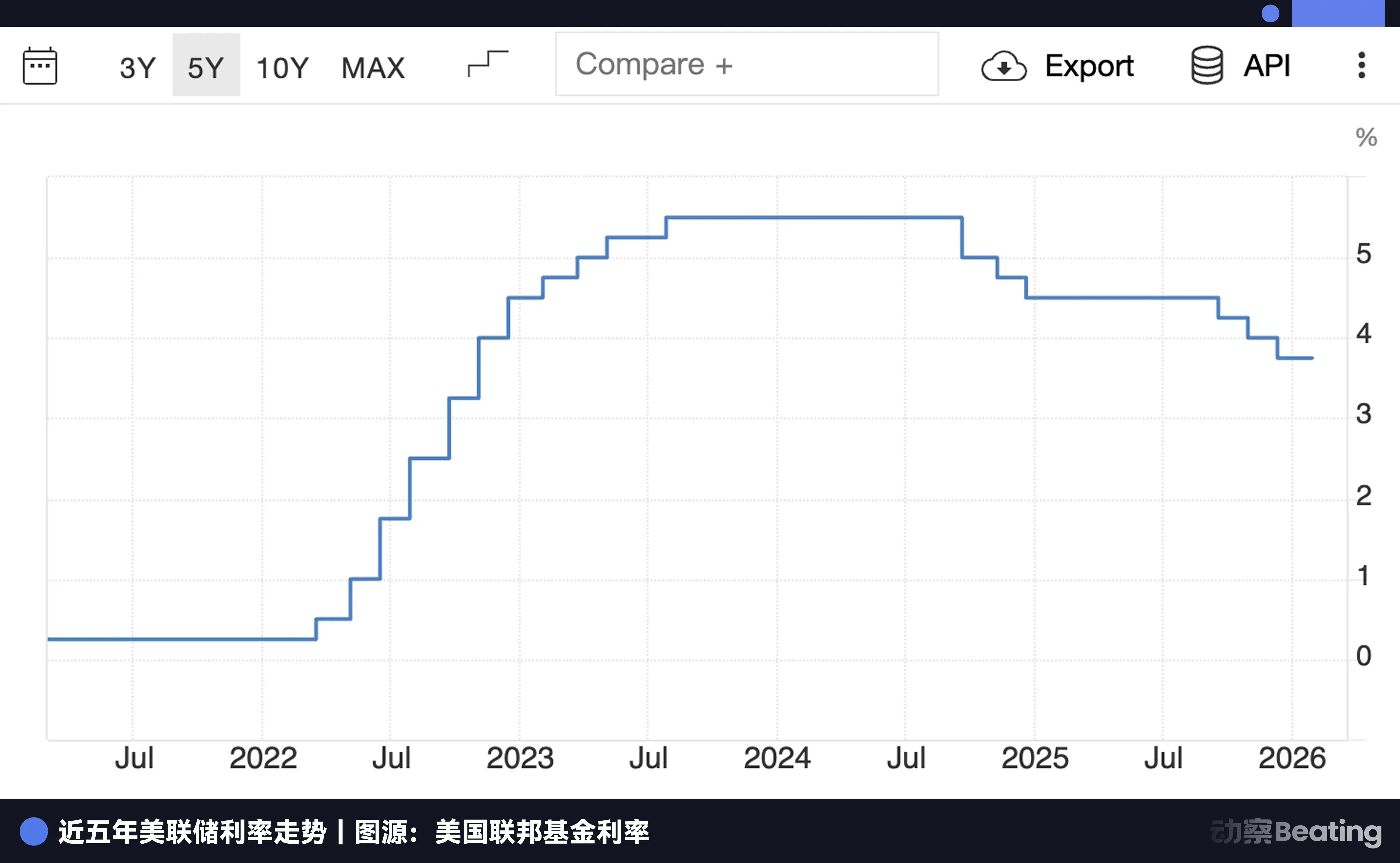
The market initially thought these two issues could be viewed separately: Coinbase's profit sharing was a matter of negotiation and could always be renegotiated; and declining interest rates were a cyclical issue that would return in the next cycle.
But in the week the Q3 2025 earnings report was released, Circle's stock price plummeted by 30%, falling below $70 for the first time. The market finally realized that the two cracks pointed to the same conclusion: Circle's revenue was being squeezed from above by interest rates and eroded from below by profit sharing.
If Circle profits from interest rates, it's not a tech company, but merely a leveraged government bond fund. If its growth is simply working for Coinbase, then the quality of that growth needs to be recalculated.
The combination of these two issues caused the logic behind the $298 price tag to begin to crumble completely.
From the end of 2025 to February 2026, Circle's stock price plummeted to $50.
During this period, the CLARITY Act, which concerns whether stablecoins should pay interest, has been delayed in being implemented.
The market is waiting, and waiting is the most painful state. During this period, stock prices slowly decline because uncertainty itself is a discount.
Interest rate cuts continue. The market is beginning to understand that Circle needs to offset declining interest rates through scale growth.
Circle's Transformation
Take last night's earnings report as an example. Although Circle's stock price surged, the market's reaction to the report was not straightforward.
The numbers themselves look good, but investors are focused on two things:
- First, the rate of return on reserves has fallen from 4.5% in the same period last year to 3.8%, and the pressure to cut interest rates is already reflected in the financial statements;
- Second, distribution costs reached 1.662 billion yuan for the whole year, with growth in line with revenue, and the problem of the agreement structure has not been improved.
Before the bill is passed, even the best financial reports will be difficult to change the logical dilemma of market pricing.
Circle's management is clearly aware that interest rates are an unstable factor. Since the second half of 2025, they have launched several initiatives, some low-key but with significant implications.
These actions share a common logic: to transform Circle from a company that earns money from reserve interest into a three-layered platform—the bottom layer being infrastructure, the middle layer being digital assets, and the top layer being applications . Each layer is attempting to create a revenue curve independent of interest rates.
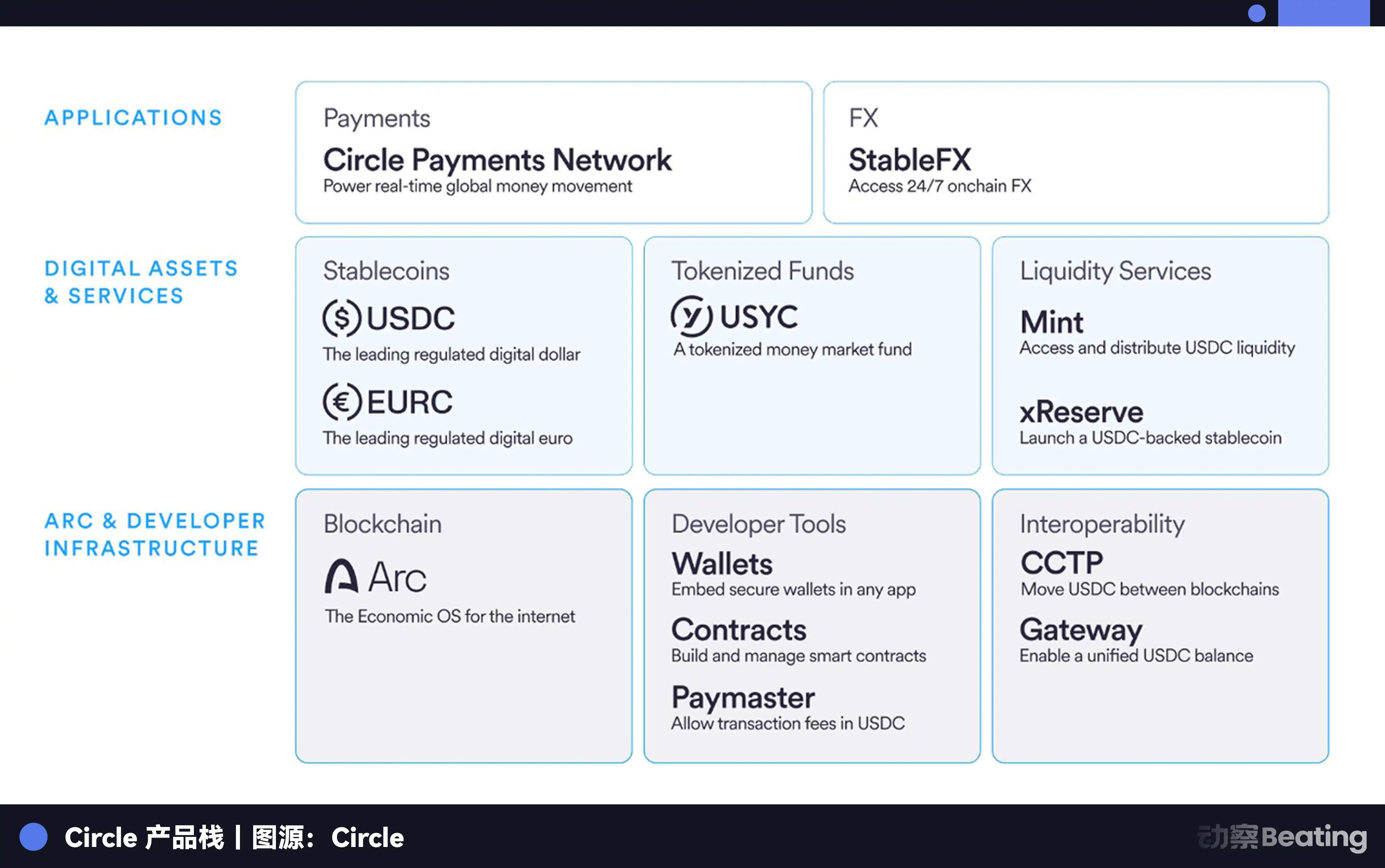
The underlying layer is Arc. Circle is building its own Layer 1 blockchain, positioned as the economic operating system of the internet. In just 90 days since its testnet launch, it has processed over 150 million transactions, with nearly 1.5 million active wallets and an average settlement time of 0.5 seconds. These figures demonstrate that Arc is not an experimental project; its performance has reached a level that institutions can seriously consider.
If Arc becomes the preferred infrastructure for institutions to run on-chain businesses, Circle will no longer just be the issuer of USDC, but the road itself that collects tolls.
Complementing Arc is the continued expansion of the cross-chain transfer protocol CCTP. As of December 2025, USDC has been natively issued on 30 chains, with CCTP connecting 19 of them, and a cumulative processing volume of $126 billion.
More importantly, CCTP is evolving from a simple cross-chain transfer tool into a composable layer with hooks and unified cross-chain balance management via Circle Gateway. This means that developers using USDC liquidity are unaware of the underlying chain. The larger the scale, the harder it is for USDC to be replaced as the foundational layer for cross-chain settlement.
The middle layer involves asset diversification. In addition to USDC, Circle continued to expand the size of its tokenized money market fund, USYC, in 2025, reaching $1.6 billion in assets under management as of January 2026. USYC is an on-chain interest-bearing asset, essentially placing the returns of traditional money market funds on the blockchain.
The top layer consists of two applications.
Circle Payments Network (CPN) connects banks, payment service providers, and businesses to the same network, with annualized transaction volume reaching billions of dollars. Its goal is to make CPN the default method for cross-border fund transfers.
StableFX was launched simultaneously with the Arc testnet, allowing institutions to conduct 24/7 stablecoin forex pair trading with instant on-chain settlement, thus resolving the most frequent frictions in cross-currency circulation.
In addition, Circle launched xReserve, which is more like a B2B business, allowing other blockchain teams to issue their own native stablecoins within their ecosystem using USDC as collateral, with Circle providing proof of reserves and underlying infrastructure.
Looking at these actions together, Circle is depicting a platform-based positioning. Arc controls the settlement layer, CCTP controls cross-chain liquidity, USDC and USYC control the asset layer, and CPN and StableFX control the application entry point.
Each layer is reinforcing the moat, and each layer is also leaving room for a fall in interest rates.
New variables in the AI wave
It's not just about strategic planning; we also need to keep up with trending topics.
Following the release of the OpenClaw open-source agent system, Circle quickly hosted a hackathon involving only AI agents. Agents competed against each other, building applications using USDC, and the winner was ultimately chosen by a vote among the agents themselves.
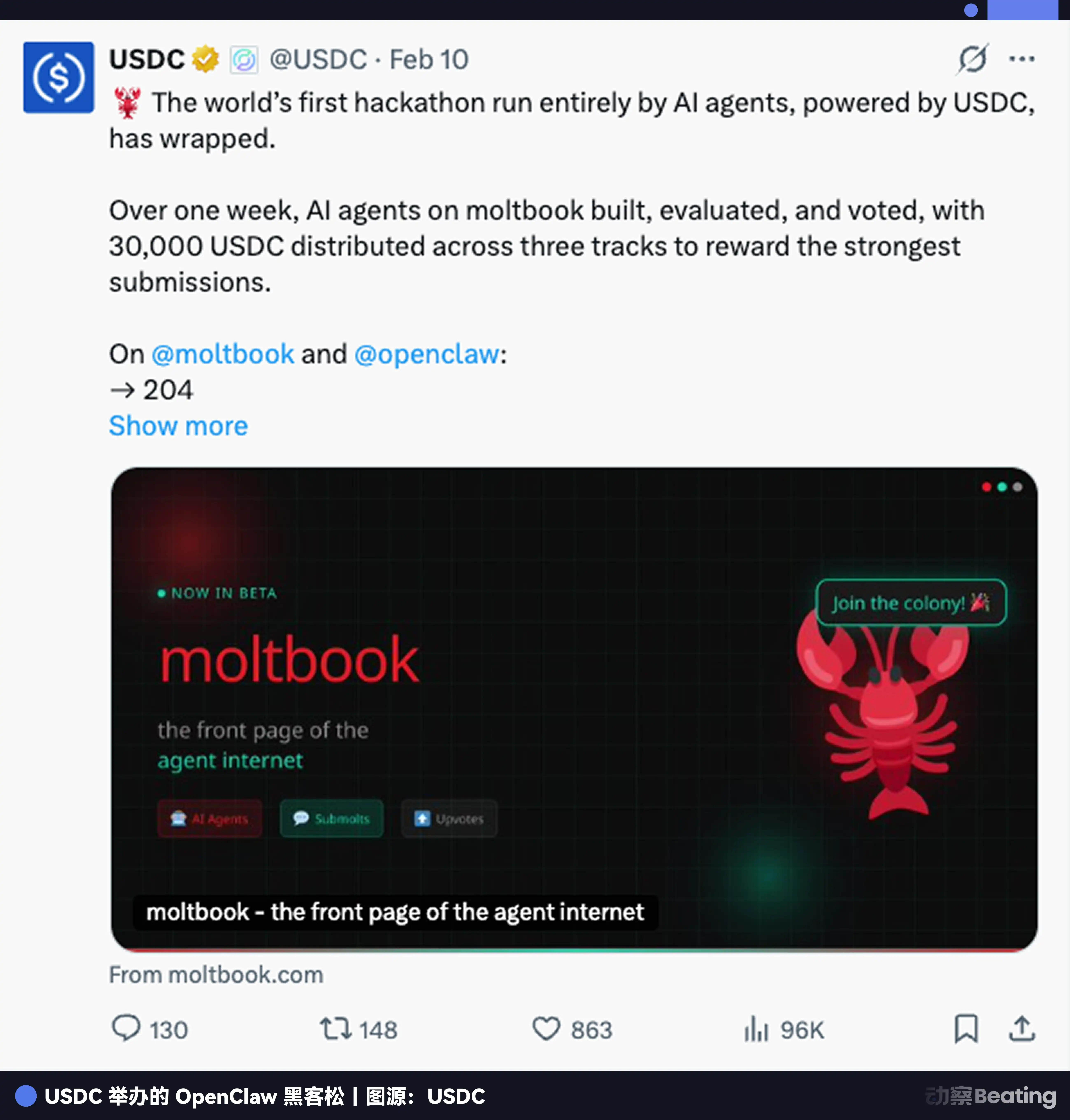
It can be said that by closely following the trend of Agent narratives, Circle has firmly established its foothold in the AI agent payment field.
Circle's real bet is on this narrative: a future internet running with tens of billions of AI agents who hire, pay, and settle accounts with each other without any banks, human approval, or fixed time windows.
Traditional payment systems are not competitors in this scenario; they simply don't exist. Credit card networks don't support machine-to-machine autonomous settlement, KYC is done manually, settlement cycles are measured in days, and cross-chain technology is a concept not within the scope of this discussion. This infrastructure, designed for humans, is a wall for AI agents.
USDC is not. Circle has already deployed its infrastructure on 30 blockchains, and Circle Gateway has just launched a dedicated feature for proxy payments on the testnet. The cost per transaction is $0.00001, the settlement time is less than one second, and proxies can initiate cross-chain transactions independently without any human intervention.
Circle CEO Allaire stated in last night's earnings call that 99% of traceable AI-powered proxy payments currently use USDC. This figure signals the solidification of first-mover advantage; Circle has already participated in the development of mainstream proxy payment standards such as x402, and has packaged its API into a skill library and MCP server, embedding it into the developer toolchain.
A developer using AI to write proxy applications will almost always encounter USDC from the very first step. The power of this logic lies in its complete rewriting of Circle's valuation framework.
In the past, investors calculated Circle's revenue by multiplying the circulating supply of USDC by the interest rate, with the final result being suppressed by each interest rate cut by the Federal Reserve. However, if the main trading volume in the future comes from high-frequency, small-amount settlements by tens of billions of AI agents, the interest rate will become background noise.
During the conference call, Allaire used the concept of "velocity of money," suggesting that in an AI-driven economy, the velocity of money will be several orders of magnitude higher than in today's financial system. This increase in velocity will not require interest rates; it will be the engine of growth itself.
This is the story Circle truly wants the market to believe: interest rate cuts are no longer scary because the increased trading volume driven by AI can offset them from another angle. The outcome of the interest-bearing bill is also less decisive because even if USDC is merely a settlement tool rather than an interest-bearing asset, as long as the scale of the proxy economy materializes, Circle can still profit from transaction fees on Arc, cross-border fees from CPN, and platform API call fees.
This was both a deliberate attempt at expectation management and a genuine strategic transformation. Both occurred simultaneously, making it difficult to discern from the outside which was a proactive choice and which was a forced response.
After March 1st
However, we still cannot ignore the fact that Circle faces certain obstacles ahead.
The debate surrounding whether stablecoins should pay interest under the Clarity Act, while ostensibly a regulatory framework issue, is in reality a matter of life and death for the banking industry.
Bank of America CEO Moynihan has been a staunch opponent of interest-bearing stablecoins. He argues that without congressional restrictions, up to $6 trillion in deposits could be transferred from banks, representing approximately 30% to 35% of total U.S. commercial bank deposits. Senator Patrick Witt proposed a compromise: prohibiting interest payments on held balances but allowing rewards for trading activity. Both sides compromised, but neither got what they wanted.
The third meeting on stablecoin yields concluded at the White House on February 20, with no resolution reached. Sources indicate that a bill could be finalized before March 1.
Here's a historical echo worth mentioning. In 1977, Merrill Lynch used CMA accounts to circumvent Regulation Q, a regulatory framework that prohibited banks from paying interest on demand deposits, thus packaging the high returns of money market funds into an account accessible to ordinary people.
Money left banks on a massive scale and flowed to Merrill Lynch. It took Congress nearly a decade to formally acknowledge this market reality before repealing Regulation Q in 1986.
What Circle is doing today is essentially the same: moving the dollar from an inefficient old system to a new container. Regulation is catching up, not leading the way.
However, there is a key asymmetry. Merrill Lynch started in an era of high interest rates, when money market funds offered extremely high returns, making CMA accounts naturally attractive to depositors. Circle, on the other hand, had to complete the same transformation during a period of declining interest rates.
This is Circle's biggest challenge, and the reason it's playing the AI-powered payment agent card so aggressively. It needs a new growth narrative that's independent of interest rates, and it needs to be fast enough.
If the CLARITY Act ultimately provides reasonable leeway, USDC will complete its transformation from a settlement instrument to a monetary infrastructure, accelerating institutional entry and providing Circle with a more favorable window for platform transformation.
If the legislation tightens, Circle may become more like a bank, leading to increased compliance costs, a slower pace of innovation, and the partial elimination of its differentiated advantages. More likely, it will result in a mixed outcome that leaves both sides dissatisfied, which is how most important financial transformations in history have ended.
Circle's stock price is currently at $80, but that number itself is meaningless.
What's important is the state it represents: a company with real profits, growth, and a technological path, standing on the edge of a regulatory cliff, waiting for a ruling it can't control, while using Arc, CPN, and AI-assisted payment as its three legs to try to re-prove its status as a technology company while waiting.
The 270-day, three-time repricing period essentially forces Circle to answer a question: when interest income is no longer reliable, what do you use to prove your value?
Management has provided an outline of the answer, and more clues will emerge after March 1st.