Author: Deep Tide TechFlow
TAO suddenly dropped 15% today, and is now around $277, with a downward trend.
A sudden drop in prices could be caused by an open letter.
The letter was written by Sam Dare, founder of Covenant AI. Bittensor is currently the highest-valued project in the AI+Crypto sector, and Covenant AI is the most important subnet team within its ecosystem.
Last month, this team accomplished something big: using civilian hardware from more than 70 contributors, they ran a large model with 72 parameters, Covenant-72B, which is touted as the largest decentralized AI training in history.
A month ago, this incident made TAO the brightest story in the entire crypto community, giving him a sense of being the beacon of AI.
Nvidia CEO Jensen Huang has publicly praised it, and renowned Silicon Valley investor Chamath specifically mentioned it on his podcast, noting that $TAO even rose by 90% in a month, which is quite remarkable in the current bear market environment.
But today, Sam Dare announced that he and his team are leaving Bittensor, thus dismantling the very foundation of this narrative.
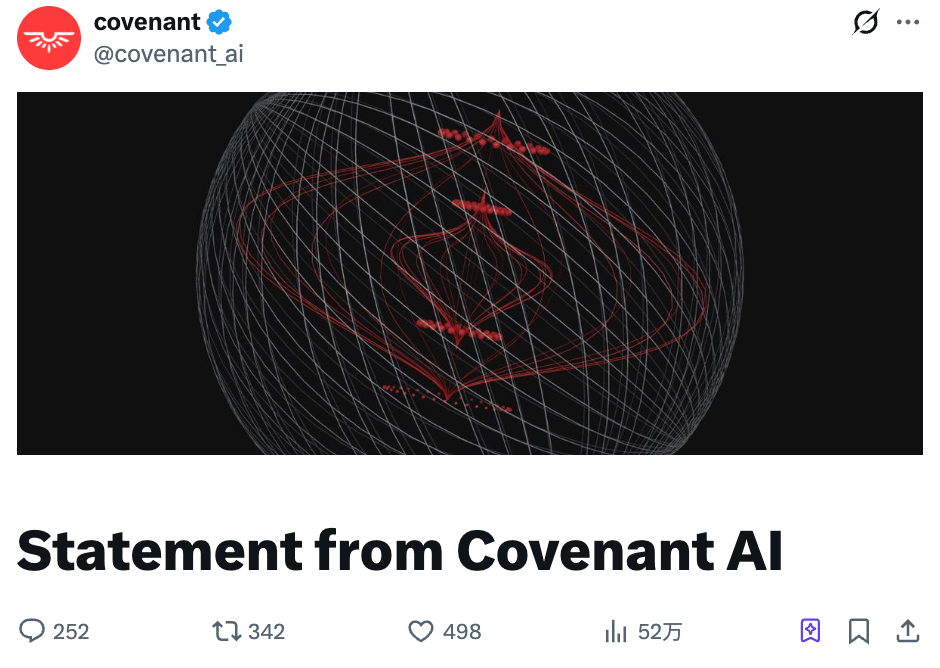
Sam Dare's open letter is long, but the core accusation is just one thing:
Bittensor founder Jacob Steeves (known as Const in the industry) controls the entire network by himself; decentralization is just a facade.
In his letter, he listed a series of actions, the two most ruthless being: first, directly suspending the emissions of the Covenant subnet, which was equivalent to reducing the team's income to zero; and second, conducting a large-scale token sell-off during the conflict to exert pressure and force compliance through market means.
The whistleblower website Tao Papers, which launched today, provides even stronger evidence. According to on-chain data disclosed on the website, Bittensor underwent 41 network upgrades between 2023 and 2026. Of these, 38 upgrades, from proposal to signing to deployment, all originated from infrastructure controlled by Const. The other two signatories co-signed within minutes of each upgrade, with no public discussion records.
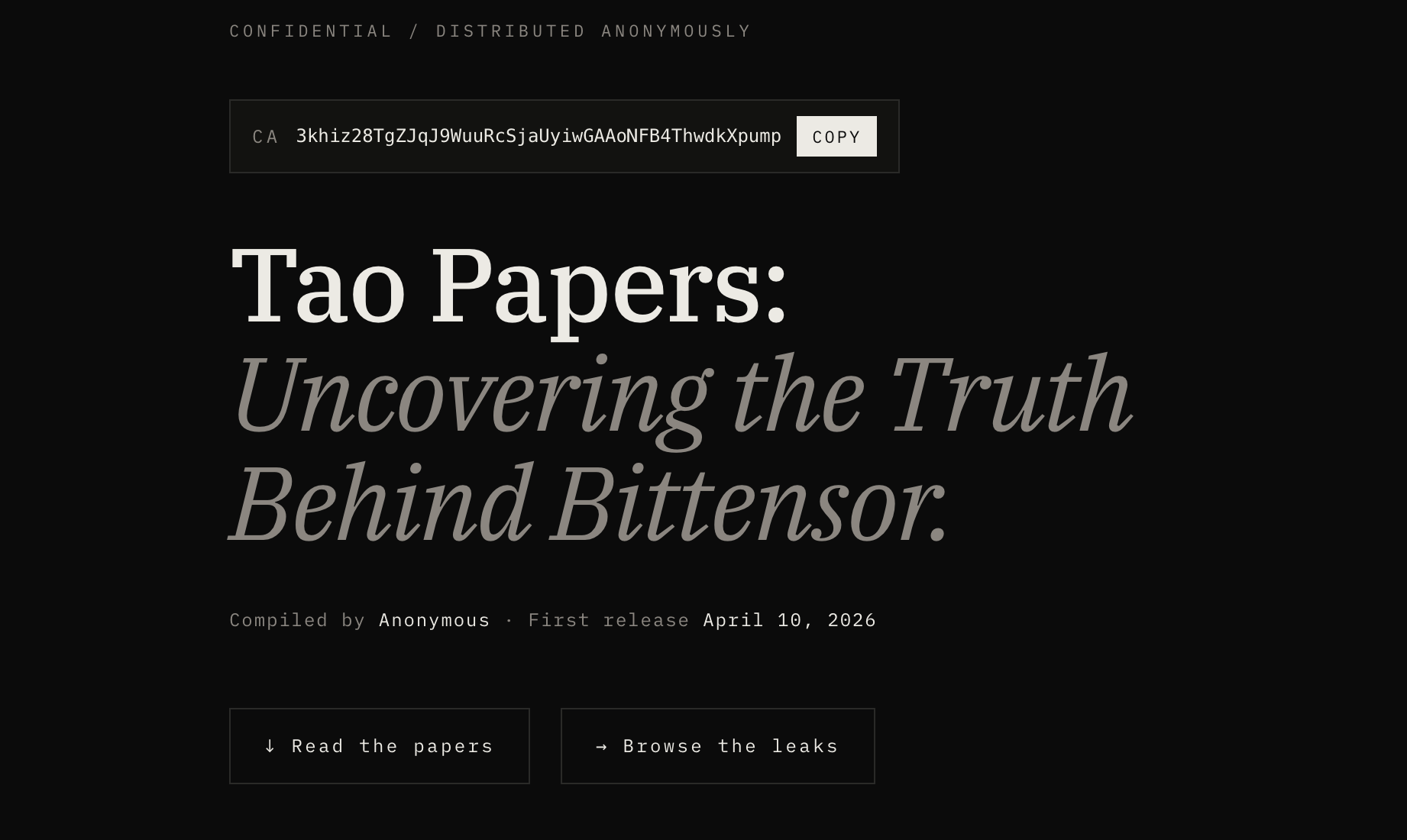
The so-called three-person "governance committee" is actually just one person making decisions and two people affixing their seals.
The fact that Sam launched the open letter and the whistleblower website on the same day clearly indicates that it wasn't a spur-of-the-moment decision.
In contrast, just two months ago, Bittensor's founder, Const, announced his resignation as CEO of the Opentensor Foundation (the development foundation behind Bittensor), stating that he was pushing for decentralization.
Meanwhile, after Sam announced his departure with the team, on-chain data showed that he sold all 37,000 TAO tokens, triggering more FUD in the market.
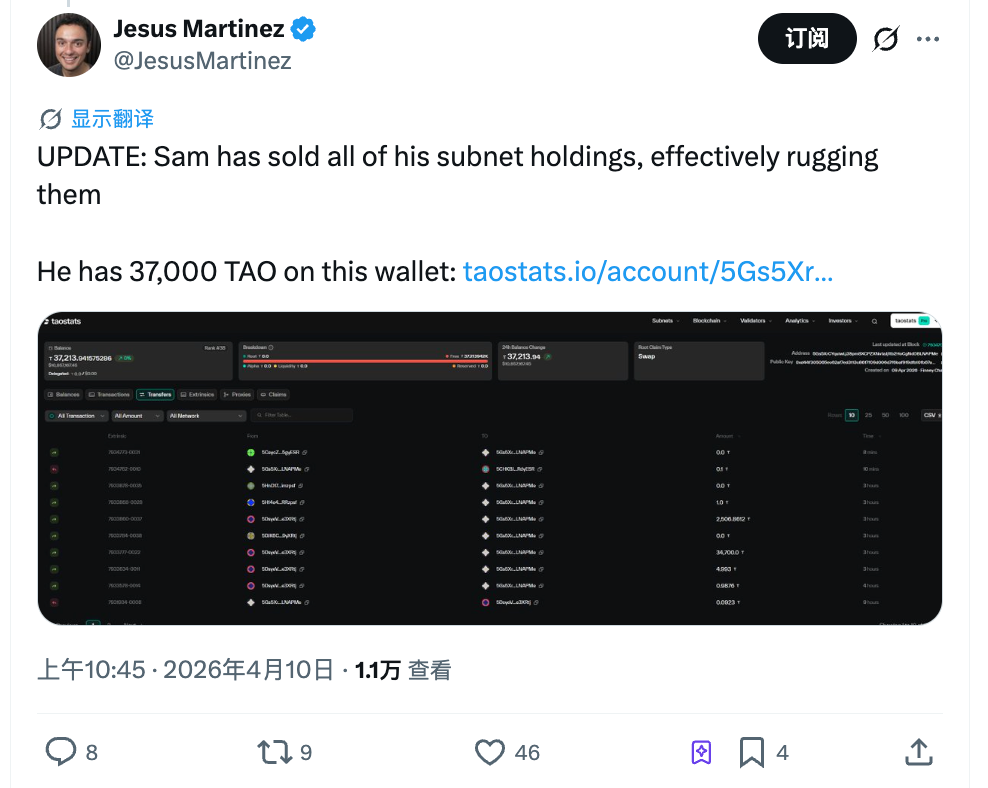
To date, Const's only response to all of this is one sentence, which essentially means that Covenant's departure is actually a good thing, as it will give rise to subnets that operate automatically without relying on any team.
As for the accusations listed by Sam Dare, he didn't respond to a single word. But whether it's a feud or a contribution, it's already been priced in by the market.
In March, TAO nearly doubled, rising from approximately $170 to $337. According to The Block, TAO surged over 50% in the two weeks following the release of Covenant-72B, making it the single largest catalyst for the entire 90% price increase.
ConvenantAI is linked to the subnets templar, basilica, and grail (sn3, sn39, and sn81). The subnet tokens are linked to TAO through a staking mechanism. When news of Covenant-72B came out, the subnet tokens rose by as much as 400%, and TAO was also boosted.
So, those who buy TAO are ostensibly buying a decentralized AI network with hundreds of subnets, but the price structure tells a different story; nearly half of the price increase is tied to a single team.
"Covenant made us, and Covenant destroyed us." This saying is mentioned by many people today, but most people only see the surface meaning.
What's even more thought-provoking is why a network claiming to have 125 subnets would rely on a few subnets to drive up prices during bull runs and on the same few subnets to cause dramatic price drops during bear runs. The other subnets were practically invisible in these two market cycles.
Bittensor's decentralized narrative has been in place for three years, yet its pricing structure has consistently appeared centralized. As for who is right and who is wrong in this conflict, I don't think that's the point.
Every ecosystem has star teams, and every star team may leave.
The difficult part is, what do you do about this?
In a bear market, infighting among crypto project teams is nothing new. When the market lacks hot topics, whether a project rises or falls depends entirely on whether there's a narrative to hype. Covenant-72B is one of the best narratives this year: Jensen Huang gave it a thumbs up, TAO doubled in value, and everyone in the community felt that decentralized AI had finally produced a viable contender.
However, narrative-driven price increases have an inherent problem: those who create the narrative can also destroy it. When it rises, it's seen as a beacon of hope for crypto; when it falls, it's seen as a team fleeing. For those who bought TAO, the 90% you earned and the 15% you lost today both stem from the same source.
This may be the most realistic investment dilemma in crypto right now. Prices always follow narratives that appear out of nowhere, and these narratives are tied to certain key figures.
As long as people are alive, the story continues; once they're gone, you might not even be able to find a counterparty.