Author: Zackary Skelly (Talent Manager at Dragonfly)
Compiled by: Deep Tide TechFlow
Deep Dive: Dragonfly released its 2026 Crypto Industry Talent Insights Report, revealing a fundamental shift in recruitment logic. While the industry saw a net layoff of 472 people in 2025, compliance positions surged by 340%, and data science positions grew by 74%. The most crucial change is that candidates are no longer driven by bull market impulses; they demand clear value explanations and certainty. If you can't clearly articulate "why this position is important," conversion rates will plummet.
1/
We have entered the first quarter of 2026, and the hiring situation in the cryptocurrency sector is completely different from any previous cycle.
We just released our latest Talent Insights report, which breaks down in detail how we got to this point and what it means for founders and talent teams.
2/
TL;DR
2025 didn't kill crypto hiring; it matured it.
The company no longer hires based on price, but on actual needs.
This shift has become the new benchmark heading into 2026.
3/
This year was clearly divided in two.
The first half of 2025 (25H1) was turbulent, and with the macroeconomic shock, the optimism of the pro-crypto sentiment quickly reversed.
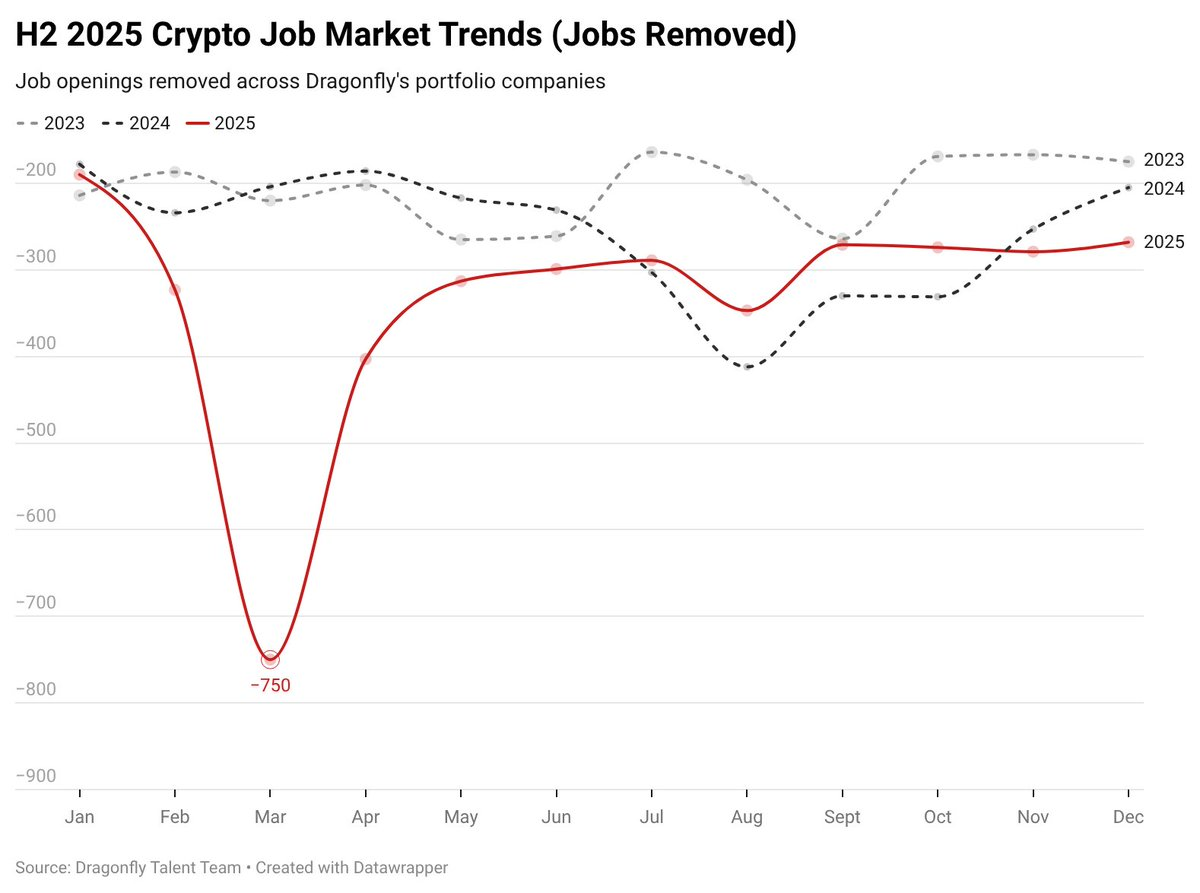
Job removals surged in March (750), with most of the losses concentrated in the first half of the month.
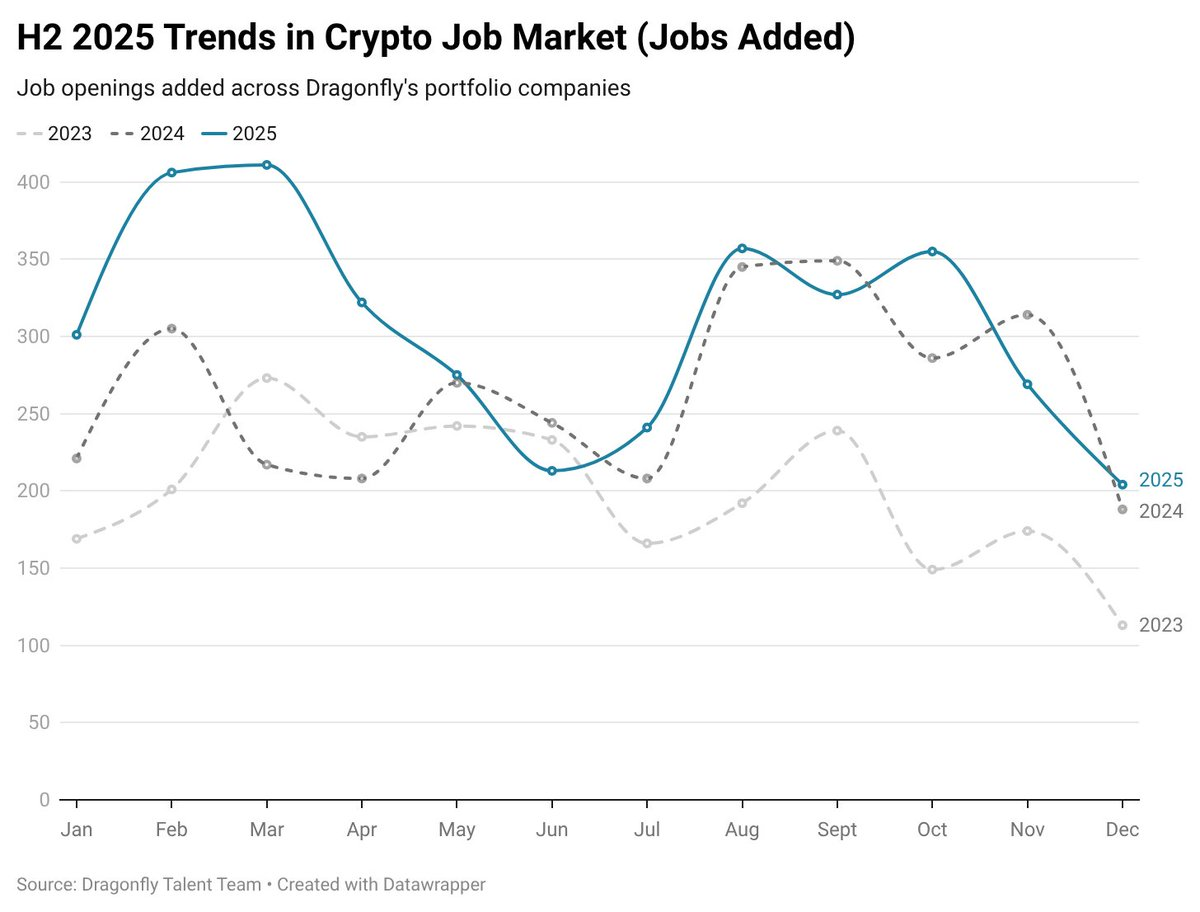
Approximately 3,700 new jobs were added throughout the year, while approximately 4,100 were removed, resulting in a net decrease of 472 jobs.
4/
The second half of the year (H2) brought discipline and recovery.
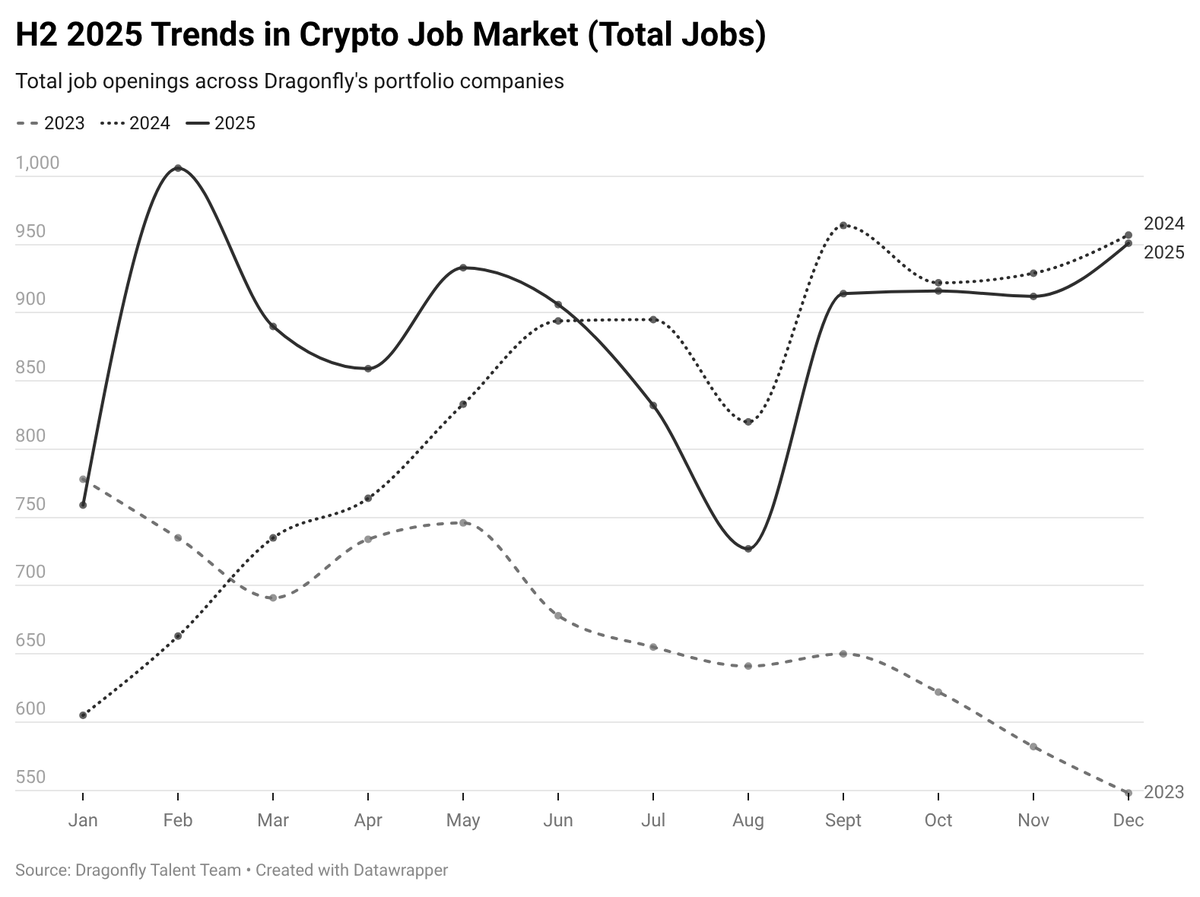
The overall job trend line for H2 is largely consistent with that of 2024, only at a lower overall level.
The system was reset in July, bottomed out in August, reopened in September, and stabilized in the fourth quarter.
The more dramatic reset in the spring is the main reason why 2025 is generally lower than 2024.
5/
In our 25H1 report, we made some predictions. Now let's score them:
✓ Late Q3 rebound (September job openings +26%), Q4 slowdown, compliant hiring started ahead of schedule
✗ Underestimated the degree of differentiation between traffic and application volume; overestimated the resilience of legal positions relative to compliance positions.
6/
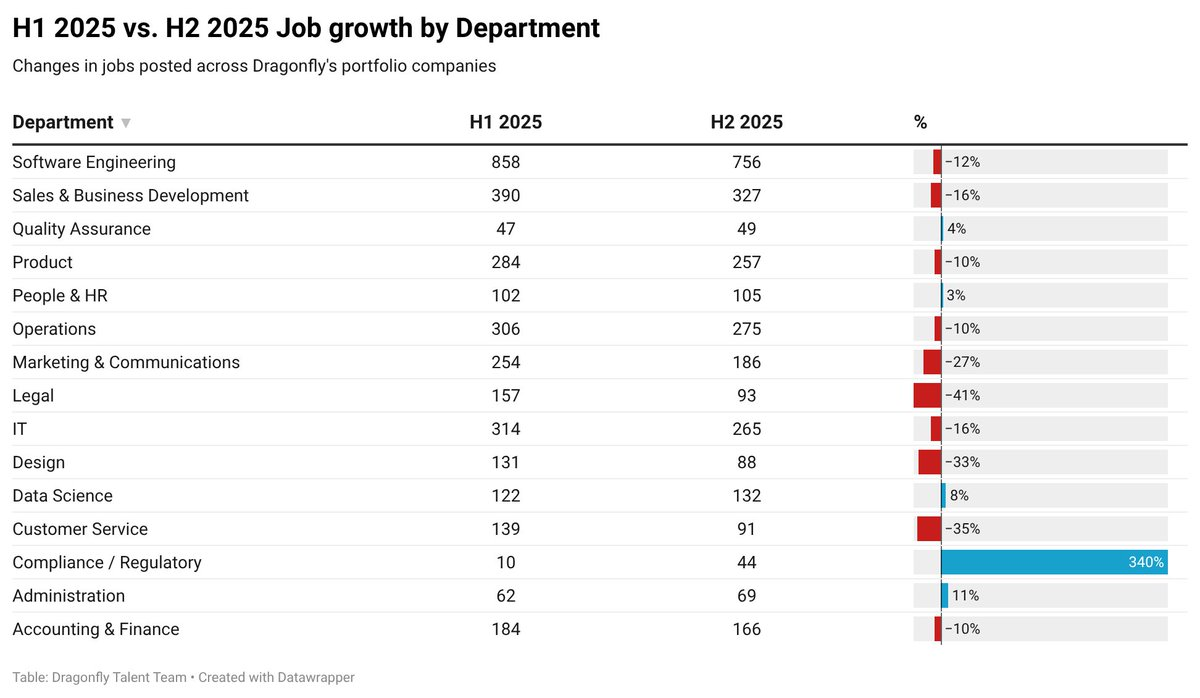
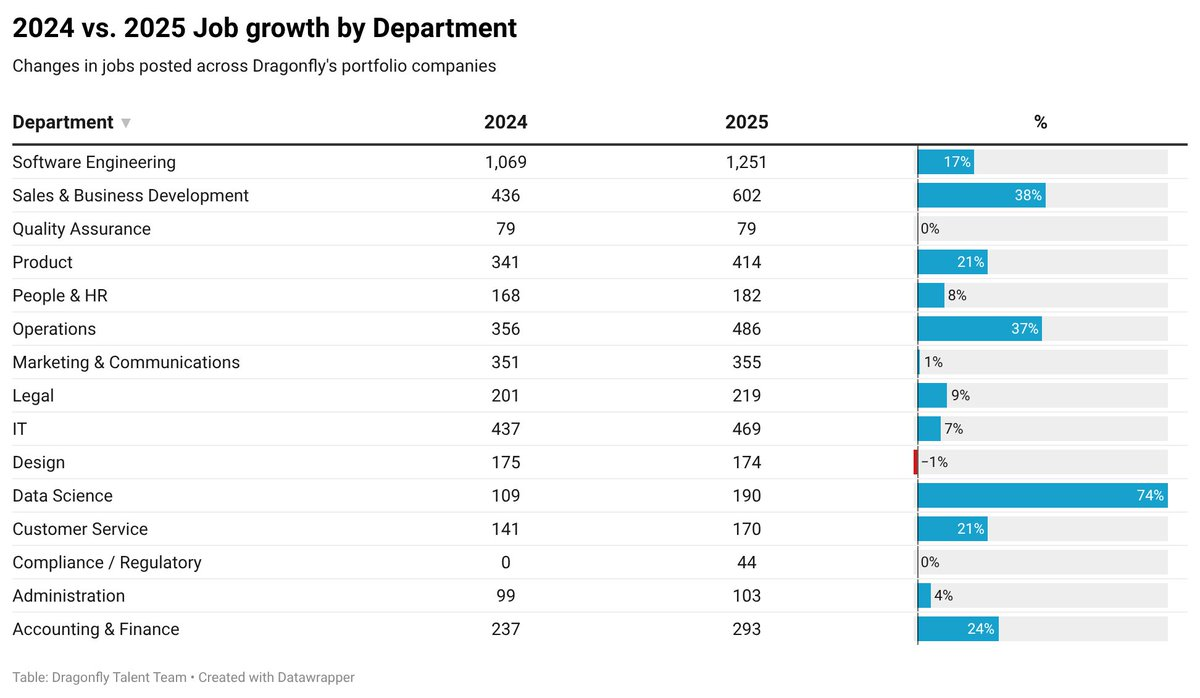
From 2025H1 to H2, the real shift wasn't about how many people the company hired, but rather what roles they were hiring for. Prioritize core employees; win the right to expand first.
→ Engineering: -12%, still the anchor point → Marketing: -27% → Design: -33% → Customer Service: -35% → Sales & Business Development: -16% → Legal: -41% → Compliance: +340%
7/
Data science was the biggest winner of the year, up 74% year-over-year. (Thanks to AI?)
8/
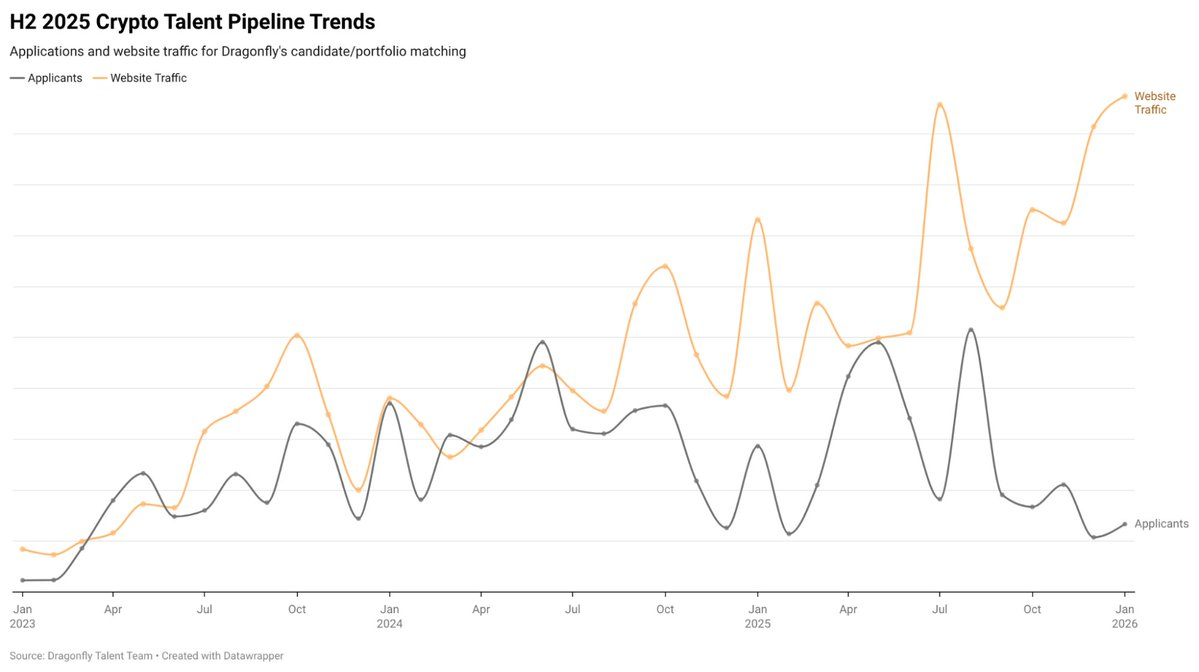
Interesting changes have also occurred on the candidate side.
Traffic remained stable in the second half of the year, while the number of applications decreased by about 26%.
People are still browsing, but they no longer submit applications so easily.
9/
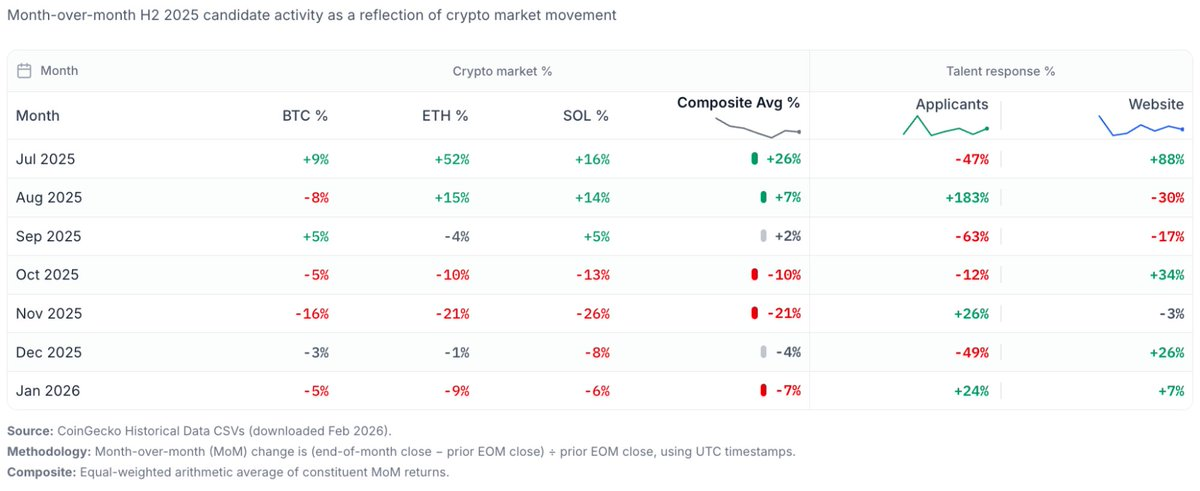
In the early stages of the cycle, market euphoria drove most of the hiring: salaries rose and applications poured in.
This mechanism is failing.
Stronger months can still drive pageviews, but attention conversion rates are not as high as before.
10/
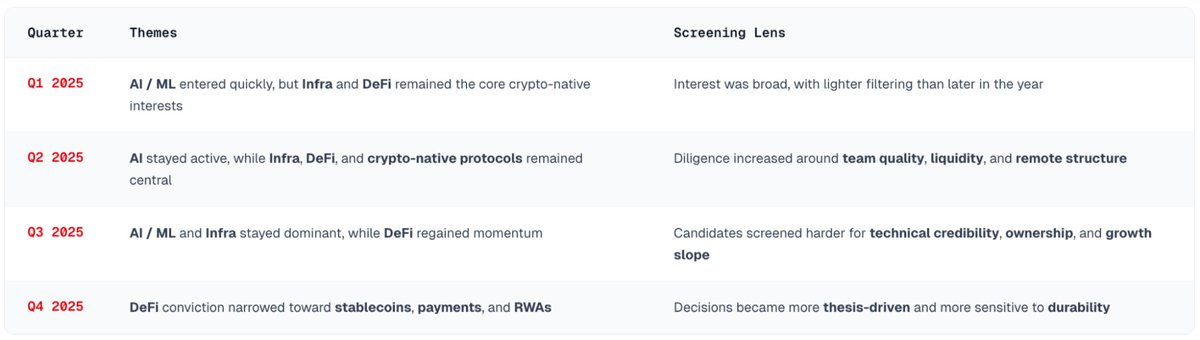
Why? Partly because candidates have become more cautious.
They conduct more rigorous screening of companies based on their durability, ownership clarity, team quality, and technical credibility: proof of open source, product depth, hardcore issues, and GTM roadmap.
General category narratives are no longer effective.
11/
Areas where belief is focused: Infrastructure, DeFi, L1 and L2 remain core, but interest in DeFi is narrowing to stablecoins, payments and RWA.
Fintech-related and institutional use cases have received significant attention. AI remains a key area of interest.
12/
Stage preferences also tell an interesting story.
Seed and Series A stages remain the most attractive to candidates, with high demand for founder and first employee roles. However, larger, more established companies continue to attract interest.
13/
The most common factor that causes candidates to leave is not salary, stage, or size, but ambiguity.
If you can't clearly explain why the company is important, what specific scope they will have, and why the opportunity is sustainable, conversion rates will drop significantly.
14/
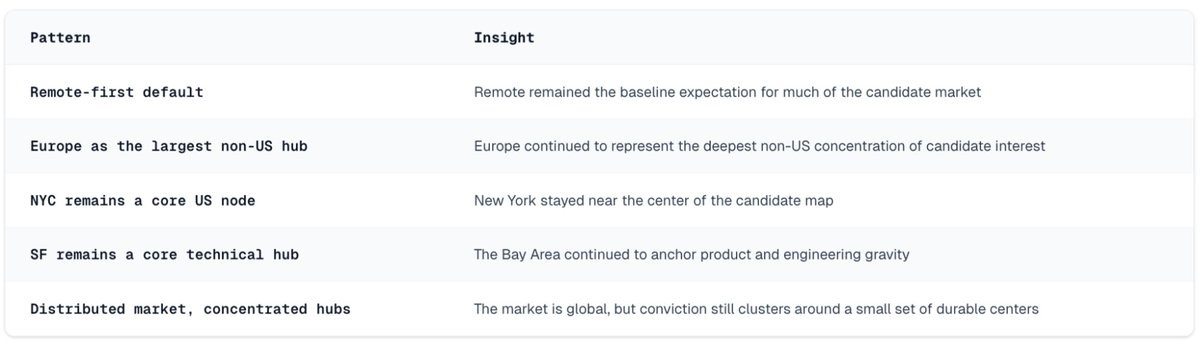
Geographically, remote work remains the norm, but the most active recruiting teams are concentrated in New York and prefer in-person work.
Talent remains globalized, but the New York + Bay Area remains dominant. Europe is the largest non-US hub.
(Note: Geographically specific hiring = smaller TAM, longer hiring cycle.)
15/
Another factor shaping the current landscape is that hiring is increasingly focused on later-stage teams, and significantly on the verticals in which candidates are most interested.
We expect hiring for the remainder of 2026 to be driven more by acquisitions, transformations, and integrations than by pure new growth.
16/
So what should the founder do?
Hire based on milestones—product launches, revenue, partnerships, regulatory progress—rather than market cycles or calendar schedules.
Companies that do well in recruitment in the second half of 2025 are able to clearly articulate and insist on the reason for the existence of each role.
17/
Knowing that teams are diverse, it is essential to carefully plan the personnel sequence:
→ Prioritize core builders (engineering, security, data/protocols) → BD explores fit → Product flexibility based on type (earlier consumers, leaner infrastructure) → Compliance, finance, risk → Marketing/support scaled after leverage emerges
18/
Keep channels open for scarce talent.
Supply of engineering, AI/ML, and security positions is severely constrained, making it impossible to restart from scratch every cycle. Even if specific needs are closed, relationships should remain warm.
19/
Recognize that the way roles are sold has changed.
Candidates want runway clarity, clear ownership for the first 30–60 days, and a transparent upside mechanism.
You must sell differentiation. You're not selling your category, you're selling why you'll win and what specific role they can play.
20/
You also need a real AI story. Not just "We are an AI company".
The candidate wants to know:
→ How AI is used internally → How it changes products → Does it create a real advantage?
Vague answers will lead to the loss of talent.
twenty one/
Specific recommendations for talent teams:
Place your strongest candidates at the beginning of the process (first impressions are important), keep the interview cycle tight, and provide clear feedback.
twenty two/
An open question: Will AI make 2026 more difficult to predict?
People can do more with fewer people. Better tools will allow some people to start their own businesses. Some people may go directly into AI work.
At the same time, higher output per employee means faster scaling, and encrypted positioning is more widespread than ever before.
twenty three/
Our current view on the impact of AI: deceleration signals outweigh acceleration signals until a clear AI × Crypto use case solidifies.
twenty four/
Our baseline forecast for 2026: flat to moderate growth, led by engineering, AI/data, and security. Consolidation will continue.
Regardless of whether it's a bull market, a benchmark market, or a bear market, this is a year that emphasizes quality development.
25/
The teams that win over talent will be those with the most credible stories, not the loudest voices.
Disciplined execution, a sustainable business model, and a good explanation of both are all essential.