
Author: Arthur Hayes
Compiled by: Deep Tide TechFlow
Deep Dive: BitMEX founder Hayes made a rare admission that he barely traded in the first quarter. He believes the market is teetering on two precipices: AI could destroy American white-collar jobs and trigger a deflationary collapse, while a war with Iran could completely rewrite the dollar's hegemony. Bitcoin may fall initially, but will ultimately outperform all major assets.

(This article represents the author's personal views only and should not be used as the basis for investment decisions or as advice for investment transactions.)
Want to learn more? Follow the author on Instagram, LinkedIn, and X.
Because trading in Maelstrom funds was extremely thin in the first quarter, many brokers would occasionally contact me to ask for my market views and what they could do for us. My answer was: "This is a no-trade zone." Apart from slowly increasing our long positions in Hyperliquid, we did almost no trading in the first quarter. The combination of these two factors created a trading dead zone, at least for our purely long positions.
The surge in AI agents will shatter the career prospects of ordinary knowledge workers in Western developed economies (primarily the US) with flexible labor markets, triggering a deflationary financial collapse. I wrote about this topic in my article "This Is Fine." Since that article was published, US President Trump, with the support of Israeli Prime Minister Netanyahu, has launched a selective war against Iran in an effort to turn it into the latest dumping ground. The war has been going on for nearly seven weeks, and the only significant question remains how the flow of goods and cargo through the Strait of Hormuz will be arranged.
I always state when expressing opinions on war or geopolitics that I'm just a casual skier and a crypto enthusiast who dances to house music. I have no inside information about what wars or global leaders will do. But I can read mainstream propaganda narratives and use AI agents to perform simple calculations using publicly available information. I try to detach myself from the noise and focus on what's important to my portfolio. Fortunately, I don't live in the Levant or the Middle East, so my life and freedom are not at risk.
In my simplified worldview, there are three scenarios to consider; actually, there are four, but the fourth, nuclear war, is not investable and therefore unnecessary to include. I will present each one and then delve into how they might affect the price of Bitcoin. I don't know the probability of each scenario. But what I'm trying to figure out is whether there exists a portfolio allocation that, in the best-case scenario, outperforms the prices of hydrocarbons and their derivatives such as food and fuel, and in the worst-case scenario, while underperforming hydrocarbon prices, outperforms all major asset classes.
Scenario 1: Returning to Normal
In this scenario, the war ends immediately, and the pre-war status quo is restored. However, the long-term trend of replacing expensive digital symbols that manipulate knowledge workers with cheaper and more efficient AI agents continues. The US economy is most vulnerable because approximately 70% of its GDP is driven by consumer spending. Consumers finance materialistic consumption with bank credit, which becomes assets on bank balance sheets. If ordinary knowledge workers lose their ability to repay their debts, these banks will effectively become insolvent, requiring central banks to print massive amounts of money.
Scenario 2: Tehran toll station
In this scenario, the US military is unwilling or unable to prevent Iran from restricting ship passage through the Strait of Hormuz. Iran honors its promises, allowing "friendly" vessels to pass through the strait for a payment of $2 million in yuan, cryptocurrency, sanctioned dollars, or other diplomatic arrangements. The worst-case scenario for US financial hegemony is that countries must now find ways to acquire yuan. Given that most countries have trade deficits with China, the only way to raise yuan on a large scale is to sell dollar assets (such as US Treasury bonds or US tech stocks), buy physical gold, and then sell the gold through the Shanghai or Hong Kong gold markets in exchange for yuan. Among the top ten economies by GDP, only Brazil and Russia have trade surpluses with China; they are the ninth and tenth largest economies, respectively. In contrast, the US has the largest trade deficit of all economies, financed by an equally large capital account surplus. However, when countries sell dollar assets to raise yuan or make up for commodity shortages in the spot market at extremely high prices, the empire's capital surplus must mathematically decline. The financialized US economy needs foreign capital to finance government spending; without it, the books don't work. Eventually, falling bond prices or rising yields, and falling stock prices, will require printing money to finance the government.
Scenario 2.5: Stars and Stripes Blockade
Interestingly, after US and Iranian negotiators failed to reach a permanent ceasefire agreement, on Sunday, April 12, Trump announced that the US Navy would blockade all ships entering and leaving the Strait of Hormuz. Perhaps this blockade will escalate into a robber baron toll system, with ships forced to pay double tolls to both Iran and the US, then shout "God is great!" and "Hallelujah!" Or perhaps too many exemptions will be granted to this or that country afterward, and the blockade will just be a moldy piece of Swiss cheese. The above argument still holds true: if holding dollars doesn't guarantee your ship won't be sunk by pirates, why hold dollars at all?
Scenario 3: The Empire's Counterattack
In this scenario, the U.S. Air Force and Navy did what they were supposed to do, destroying the Islamic Revolutionary Guard Corps' ability to disrupt shipping in the Strait of Hormuz through punitive long-range bombing. The strait reopened, and any ship could pass safely without additional costs. The restoration of a powerful imperial hegemon eliminated the need for countries to use any currency other than the dollar, nor to compete for expensive goods on the spot market, at least for days. The problem is that ending Iran's control of the strait could very well mean the utter destruction of the country. Or, as Trump put it, "send them back to the Stone Age." Many Americans, raised from birth to believe that Iran is the most evil country on earth, cheered this tough stance against their number one enemy. However, destroying Iran in this way means that, on its last breath, they will fulfill their promise to take other goods and energy production in the Gulf region to their graves. Spices will absolutely not circulate, and global central banks will have no choice but to print money to save the global financial system as commodity prices soar.
If you live in some dilapidated country, your local currency will experience hyperinflation against the dollar or ruble. The US and Russia will be the only remaining large, volatile producers capable of filling the gaps left by the scorched earth of the Middle East. Famine and widespread social unrest will occur. So, while your Bitcoin may be some kind of worthless fiat currency with infinite value, your well-being will be seriously at risk if you don't escape in time.
Before I go on to discuss how Bitcoin performs in each case, let’s take a quick look at some chart porn to provide visual evidence for my text.
Return to normal
Given that I wrote about this situation in detail in my article "This Is Fine," let me repost some of the charts and tables provided in that article:
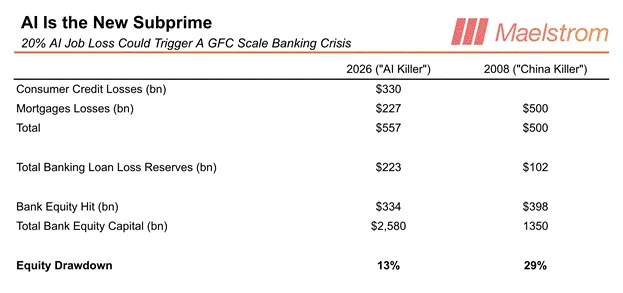
In short, the deflationary collapse of AI agents is as severe as the 2008 US subprime mortgage crisis.
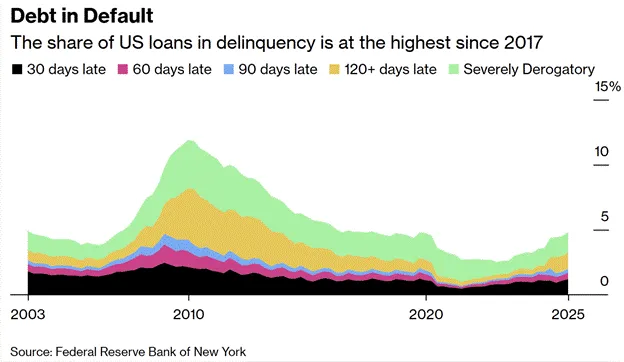
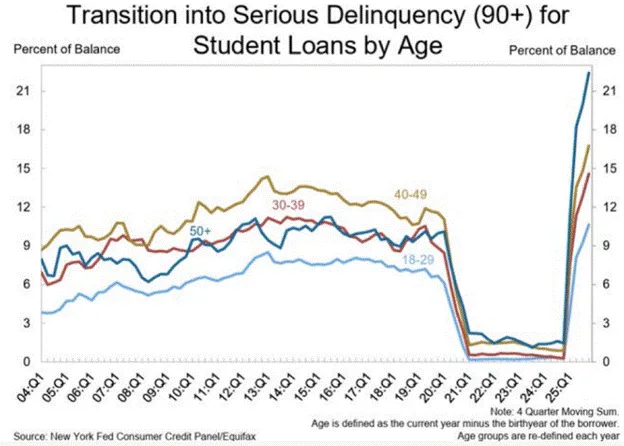
Consumer credit delinquency rates have already risen, and the layoff party hasn't even really started yet.
Tehran toll plaza
Essentially, if this happens, it signifies the end of the petrodollar and the rise of a new global reserve currency or basket of currencies. Currently, the Islamic Revolutionary Guard Corps is very flexible on payment terms. But if they consolidate their power over the Straits, why would they continue to accept dollar payments when the US is doing everything it can to restrict their ability to use the dollar? Ultimately, I believe they will not allow payments in dollars. The renminbi and gold are likely to become the two main currencies in sovereign trade.
Why save in dollars if goods can't be shipped without paying in yuan? Given that most major economies have trade deficits with China, the only way to raise yuan is to sell dollars, buy gold, and then buy yuan. From now on, countries must save their trade surpluses in gold, not in US Treasury bonds or stocks.
To highlight the growing use of the renminbi in trade, I'd like to look at a few charts posted by Luke Gromen that show a quasi-renminbi-gold standard quietly emerging.
Step 1: Sell US dollar assets (Treasury bonds) and buy gold.
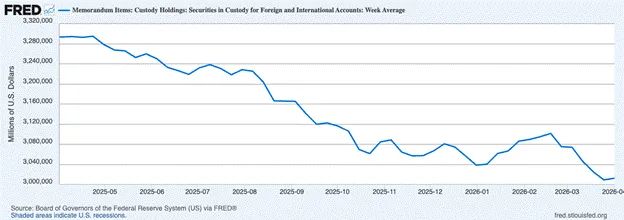
Since the start of the war, foreign holdings of securities at the Federal Reserve have decreased by a net $63 billion. I use this as a directional proxy for foreign holdings of Treasury bonds and other dollar-denominated securities such as stocks.
What did the seller do with those dollars?
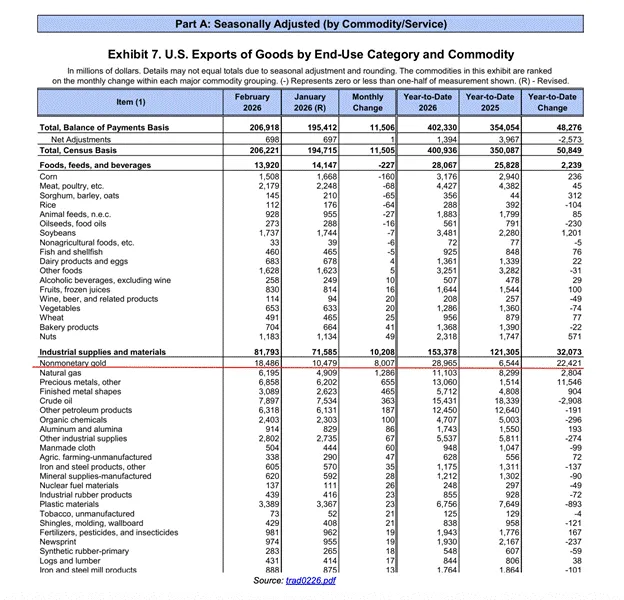
Non-monetary gold has been the largest U.S. export commodity in four of the past five months, up 342% year-on-year.
They used those dollars to buy gold and shipped it out of the US. That's how the American manufacturing renaissance ended; the only thing leaving America was the remnant of barbarity. Apologies to all Trump supporters who thought they could get back high-paying factory jobs. Yet another US presidential term has resulted in blue-collar workers being exploited without lubrication.
Step 2: Sell gold for RMB
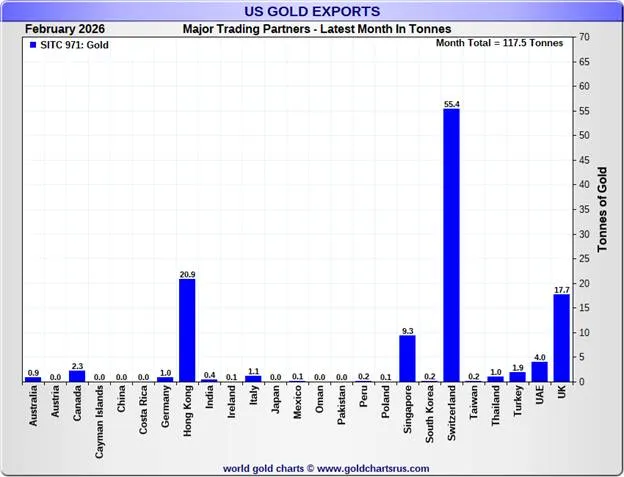
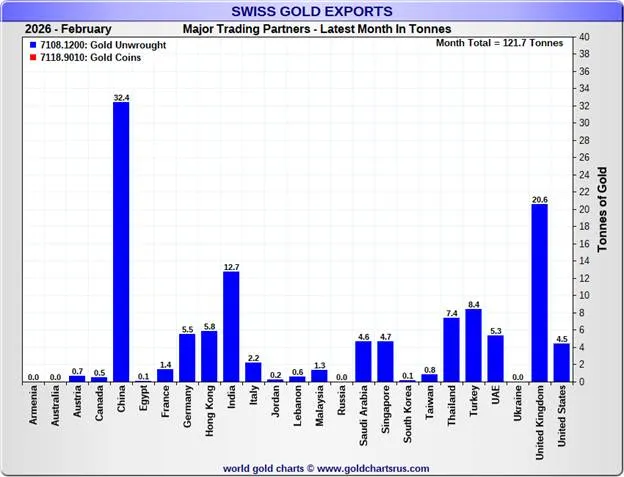
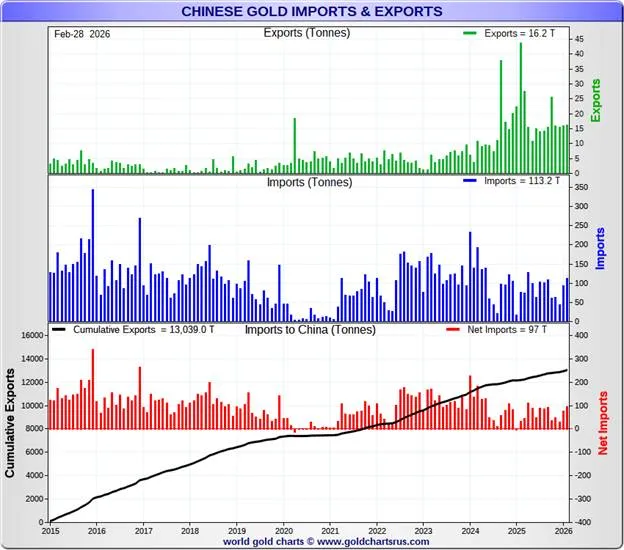
Swiss refineries received gold from the United States and recast it into gold bars suitable for delivery to China.
Step 3: Pay the Tehran toll.
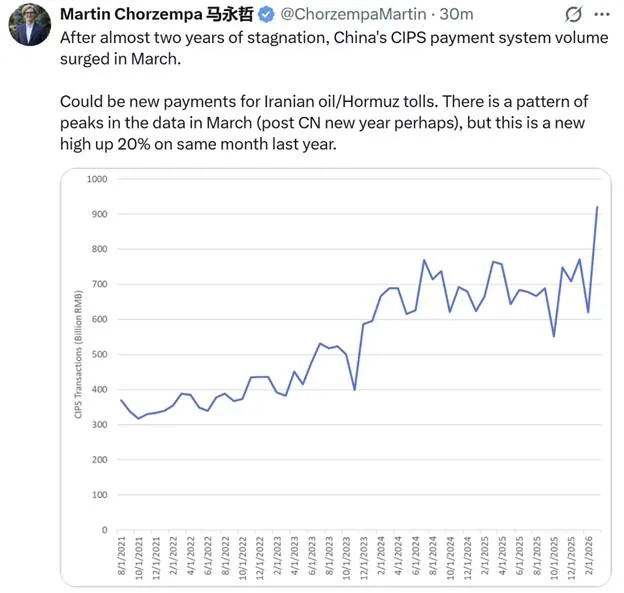
When Finance Minister Bessant said, "Either use the dollar, or face sanctions again," he was serious. Due to sanctions imposed by the US approximately fifteen years ago, Iran is unable to use the SWIFT payment network. Transferring yuan into the dirty hands of the Islamic Revolutionary Guard Corps requires using China's fiat currency, the CIPS messaging system. As you can see, transaction volumes increased dramatically after the start of the war.
This series of charts shows the flow from selling dollar assets to buying gold, ultimately funding yuan payments to Tehran or other suppliers. It doesn't matter that the dollar remains the dominant currency used in trade. Markets are forward-looking, so the accelerating use of the yuan in global trade is more important than its low absolute usage relative to the dollar. By dumping dollar assets before consensus accepts the existence of a new monetary system, investors can protect their portfolios. The pound sterling was technically the global reserve currency until the Bretton Woods Agreement of 1944, but the dollar effectively replaced it in the early 20th century as the US economy became the world's most productive. In 2026, the US will have trade deficits with the most productive economies: China, Japan, South Korea, Germany, Taiwan, etc. Most countries will have trade deficits with China. Let me reiterate: what the hell is the point of holding dollars if you have to pay those Stone Age turbaned people for goods?
Stars and Stripes Blockade and Imperial Counterattack
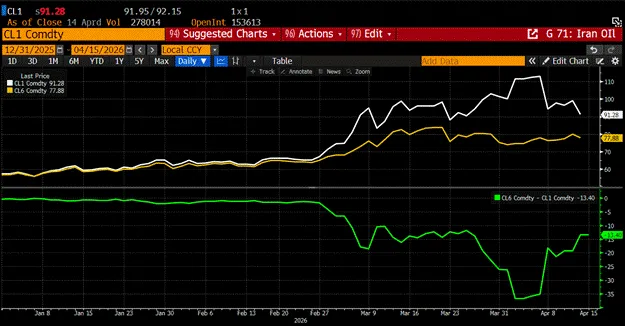
To determine whether the Strait is open or closed, you can refer to the chart above, or generate a similar version using your preferred charting tool. The top panel displays the WTI futures prices for May 2026 (CL1, white line) and October 2026 (CL6, gold line). I used WTI because this benchmark price is most relevant to US gasoline consumers. Trump will only truly de-escalate the situation if gasoline prices remain high until the November midterm elections. The bottom panel shows the spread between the two contracts (far-month minus near-month); the curve is inverted. Because the price increase in the far-month contract is not as high as that in the near-month contract, the market expects a significant increase in oil flow through the Strait. If this happens, the spread will widen because the near-month price will plummet. However, if the spread narrows due to the rise in the far-month price, the global economy will be thrown into chaos. Ignore the war of words between Trump and the Iranian Revolutionary Guard and focus on this chart.
The quantity and price of money
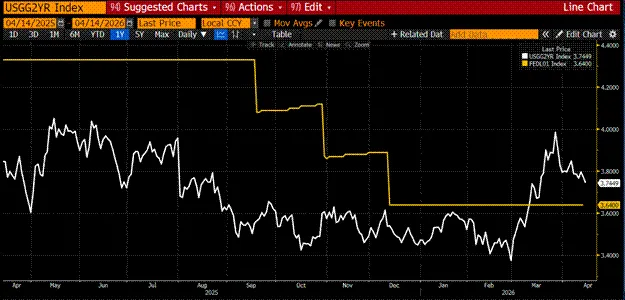
After the war began, the yield on two-year Treasury bonds (white line) surged far above the effective federal funds rate (gold line). This indicated that the market believed the Federal Reserve would raise interest rates to combat rising energy inflation.
Making this judgment is important because I believe we may be entering a situation where major central banks, including the Federal Reserve, are likely to print money while raising interest rates, either directly or through the commercial banking system. As war causes food and energy prices to soar, capable politicians will subsidize the major input costs of the economy. Not doing so could trigger social unrest or famine. But to prevent inflation from spreading to all goods and services, central banks must destroy demand by raising interest rates, suppressing activity in the credit-sensitive parts of the economy. Any entity that borrows money to buy goods and services will reduce spending if credit costs rise.
If central banks stop here, my prediction for Bitcoin will be straightforward. In an environment where people cut back on all spending except food and energy, the price of Bitcoin will fall. But whether allies or adversaries in a US-led peace order, every country must increase defense spending and stockpile essential commodities. Do you want your country to be like Australia, almost 100% dependent on imports of refined hydrocarbons from China? When the war started, China halted all exports, and Australia's reserves were less than a month's supply. They had to turn to Singapore, and I believe they paid exorbitant prices for jet fuel; otherwise, all those Australian bumpkins would have been stuck at home indefinitely! I know some of you will cheer for this outcome, especially Japanese skiers.
Manufacturing bombs, especially nuclear bombs, to protect themselves from being turned into a junk country by the "skinny tie prophet," and hoarding goods, both require governments to significantly increase borrowing. If domestic private investors are unable or unwilling to buy these junk government bonds, the central bank and/or the commercial banking system will print money to buy them, thereby increasing the fiat currency supply.
When reading my predictions for Bitcoin's price movements under various scenarios, keep this dynamic in mind. You must determine whether the quantity or price of a currency is more important. Otherwise, you will be unable to understand the seemingly contradictory price movements of different risky assets.
Return to normal
Bitcoin may see a slight rebound once the situation returns to pre-war levels. However, the AI-mandated deflationary bomb is still ticking beneath the surface. Bitcoin won't see a significant rise until the Federal Reserve provides the necessary liquidity to fill the black hole created on bank balance sheets by consumer credit defaults. This isn't to say it's impossible for it to surge to $80,000 to $90,000, but for me, injecting new fiat currency requires a full-blown signal from the Fed. Given that I'm already heavily long, as I operate a purely long account, seeing higher net worth figures on the screen would make me feel better, but the risk-reward ratio isn't enough to warrant going all-in and shifting my portfolio to the highest risk level.
I don't know how long it will take for the banking system to collapse. But every week I read stories of companies laying off large numbers of knowledge workers because AI agents are more efficient than humans, and other stories of rising consumer credit delinquency rates.
Here's an anecdote. I recently chatted with an entrepreneur friend who runs a successful crypto gaming company. He's an OG. We started discussing how AI could impact his business. As someone with computer engineering training, during the Christmas holidays in 2025, he sat down to try and create something using the latest Claude model. He was so amazed at how quickly he could produce deliverable code that a few months later, he took his best engineers to an out-of-town meeting to discuss how AI would affect the business. He asked them to create a workflow that allowed AI agents to code around the clock. They automated everything, including code reviews, so that every morning when they woke up, there was usable, tested code waiting for senior engineers to review. One person completed his six-month roadmap in four days, supported by a team of AI agents. After this meeting, my friend decided his company had to immediately change its workflow. As a result, 50% of his staff would be laid off within the next few weeks. In the age of AI agents, ordinary engineers are redundant, but with AI agents, the productivity of top talent will increase by 10 to 100 times.
As models acquire more domain-specific expertise, all mediocre knowledge workers face the risk of unemployment. Unfortunately, despite unemployment insurance, the median annual maximum benefit across U.S. states, according to data from the BLS and the St. Louis Fed, is approximately $28,000, dwarfing the median wage of knowledge workers at $85,000 to $90,000. They have no choice but to default on consumer credit payments to banks. The sham fiat currency fractional-reserve banking system ends here.
Bitcoin (gold line) and the US Software SaaS ETF IGV (white line)
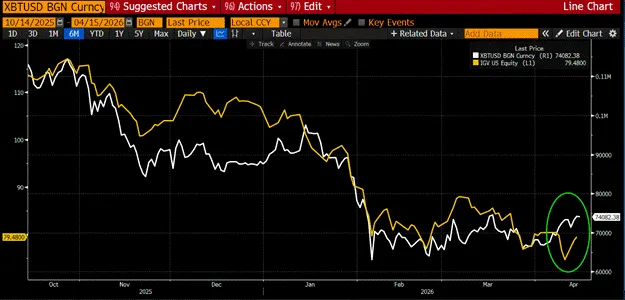
That said, after the ceasefire, US SaaS software stocks resumed their downward trend, but Bitcoin held its ground and rebounded. This is a welcome breakthrough in correlation, but for me, it's too early to assert that Bitcoin has seen through the deflation of AI-related knowledge workers and to predict a significant surge.
Tehran toll plaza
As countries sell off dollar assets to raise yuan to pay tolls, government bond and stock prices will fall. This could be a slow process, as there are currently other payment options besides the yuan. However, due to the leverage embedded in the system, even a small snowflake could trigger a financial avalanche, as the sell-off leads to further selling, increased volatility, and a market freeze. Then monetary officials must intervene by printing money. A key indicator to watch is the MOVE index, which measures volatility in the US bond market. When the index rises above 130, some form of money printing occurs.
With increased volatility and falling prices for major U.S. tech stocks, Bitcoin will struggle to rebound significantly. As investors reduce portfolio risk due to higher volatility and lower prices, they will sell Bitcoin to meet margin calls. Bitcoin will only rise when conditions are dire enough, as expectations of a bailout become the consensus.
Wait for Bessant and/or whoever is the Fed chairman to press the printing press button. Trying to get ahead of this scenario is not worth the risk-reward ratio. I hope Bitcoin can hold $60,000 during any full-blown TradMarket financial crash. If Bitcoin tests and holds that level a second time, I would generally be inclined to increase my risk.
Stars and Stripes Blockade and the Empire Strikes Back
As oil futures prices surge to catch up with spot or near-month prices, the global economy will suffer a severe blow. At some point, demand destruction will impact government bonds and US stock prices. As before, the initial reaction will be a drop in Bitcoin. Once the over-leveraged Western financial system collapses, the printing presses will be activated. If the blockade eventually ends with punitive bombing of Iran, followed by Iran destroying all energy production in the Persian Gulf, this could lead to the destruction of the Iranian state. A Bitcoin rally fueled by money printing is likely to be short-lived, as the destruction of the Iranian state significantly increases the likelihood of World War III.
Portfolio construction
As a pure long investor without leverage, Maelstrom allows time and compounding to work their magic. Bitcoin's slight outperformance relative to IGV over the past few days has been very encouraging. This will prompt me to reassess my bearish stance on Bitcoin's price, despite the accelerating financial deflation brought about by AI knowledge work. Currently, the only assets I'm willing to increase risk on are gold and $HYPE (Hyperliquid's governance token). HIP-4 will launch in a few weeks, and I predict it will steal significant market share from Polymarket and Kalshi in the prediction market vertical.
In addition, I will pray to Satoshi Nakamoto every day, hoping that they can influence the minds of our global political elite and persuade them to take psychedelics instead of dropping bombs.
Want to learn more? Follow the author on Instagram, LinkedIn, and X.
Access the Korean version: Naver
[1] The trade data used are from 2024 to 2025.
[2] IRGC - Iranian Revolutionary Guard