
Written by: Stacy Muur
Compiled by: Chopper, Foresight News
In the crypto market, a steady and conservative investment approach can sometimes feel out of place. During market frenzies, even a tenfold increase in assets can feel unsatisfying. However, this profit-driven mentality also harbors significant hidden dangers.
In the past, countless people have lost everything in pursuit of short-term windfall profits. For example, according to data from the Pump.fun platform in March 2026, only about 4% of the 1.37 million trading wallets made a profit of more than $500.
This chaotic phenomenon of blindly pursuing high returns is not limited to the Meme coin sector. The stablecoin investment market is similarly rife with a herd mentality driven by profit-seeking. Some projects relentlessly tout unsustainable, extremely high annualized returns, ultimately leading to the collapse of most of them, leaving users burdened with debt or unable to withdraw their funds.
Extremely high returns are never sustainable in the long run.
Funds are shifting towards stable returns.
While ordinary investors are risking high returns in pursuit of 100x returns, institutional funds are making contrarian moves. The circulating supply of stablecoins and the size of tokenized US Treasury assets have both reached record highs.
- Canada's $160 billion sovereign wealth fund, AIMCo, invested $219 million in RWA's real asset protocol, Strategy RWA.
- Bullish acquires Equiniti for $4.2 billion to build tokenized securities infrastructure.
- Revolut opens up access to Maple Finance's syrupUSDC and SkyEcosystem's USDS for over 50 million retail users.
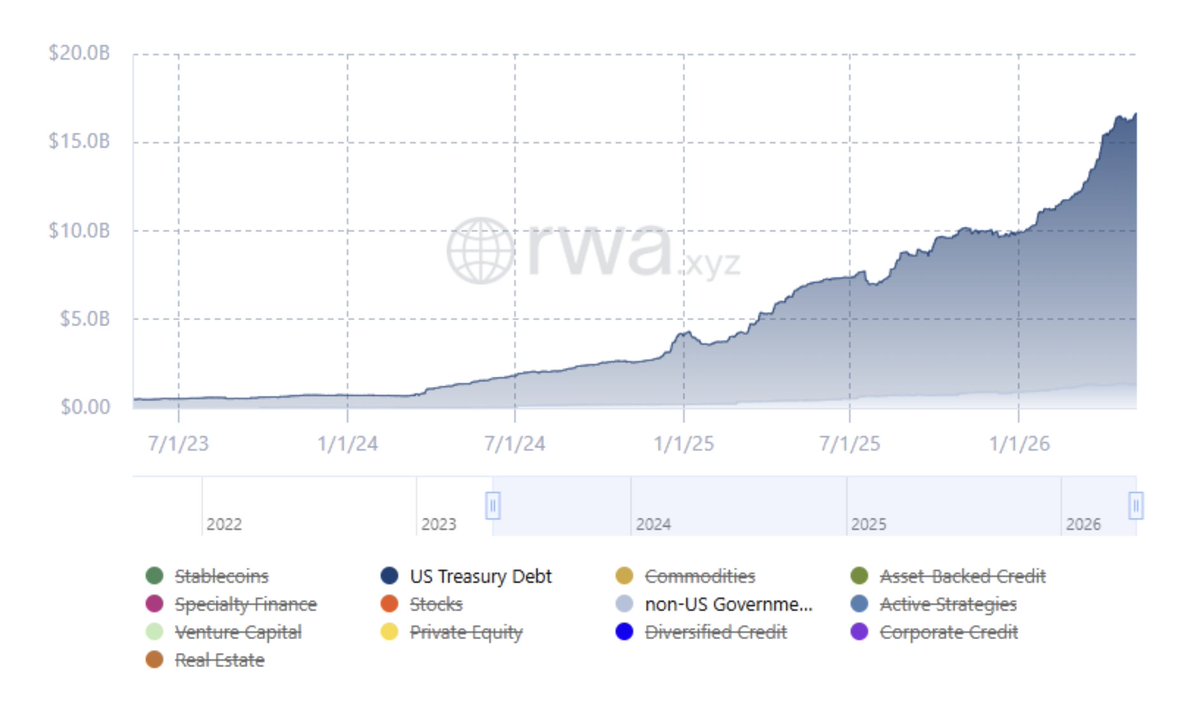
A low-key and steady profit-generating strategy has made those who succeeded in this cycle the winners. However, this kind of stable approach doesn't attract as much attention as stories of getting rich quick, and it's rarely discussed on the crypto community's Twitter account.
Today, the infrastructure for "stable wealth management" is vastly different from what it used to be. Five years ago, the only option for so-called stable returns was Coinbase's ultra-low annualized interest rate of 0.05%; now, the market has developed a mature wealth management market with multiple risk levels, reasonable returns, and controllable risks.
Below, we will break down the various channels through which ordinary investors can currently allocate stablecoin funds.
Risk level classification
Extremely low risk
Essentially, it involves entrusting funds to a centralized institution, making it suitable for beginners who are not yet accustomed to on-chain self-custody, as it is the simplest to operate.
- Coinbase (USDC) offers an annualized yield of up to 3.5%, and lending USDC through the platform's Morpho protocol can yield close to 10% annualized.
- Binance (USDC/USDT): USDC offers a maximum annualized return of 5.68%, while USDT offers a maximum annualized return of 5.18%.
- Kraken (USDC/USDT) offers an annualized return of up to 4%.
Low risk (3%-6% annualized return)
This category is entirely based on tokenized U.S. short-term Treasury bonds, which are backed by sovereign short-term bonds, making them among the safest assets in traditional finance. The risks primarily stem from operational and regulatory aspects, rather than credit risk.
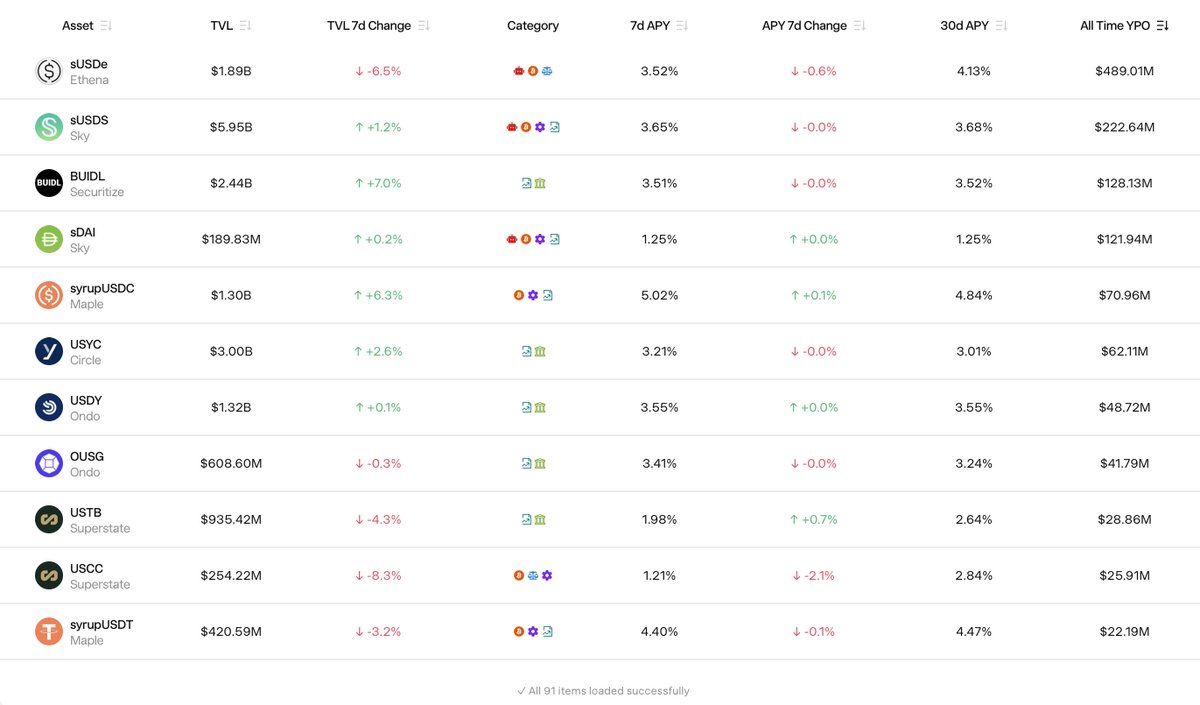
- Securitize (sBUIDL): $2.44 billion locked in, 30-day annualized return of 3.52%. This is the on-chain encapsulated version of BlackRock's BUIDL fund, managed by BlackRock, and is the strongest institutionally backed asset in the tokenized US Treasury sector.
- Ondo Finance (USDY): $1.32 billion in locked funds, 30-day annualized return of 3.55%, limited to non-US residents. It is the most convenient channel for non-US retail investors to allocate US Treasuries, with no minimum institutional threshold, no complicated whitelist, and monthly publicly released asset verification reports.
- Circle (USYC): $3 billion in locked funds, 30-day annualized return of 3.11%, limited to non-US residents. Requires Circle identity verification and wallet whitelisting. Utilizes the same compliance system as USDC to create its yield products, resulting in higher entry barriers but top-tier custody and security capabilities in the industry.
Medium risk (4%-7% annualized)
This tier, in addition to the underlying asset risks, also carries protocol risks. It no longer only bears the risks of government bonds or centralized custody, but also faces multiple hidden dangers such as lending market volatility, changes in governance rules, and smart contract vulnerabilities.
- Maple Finance (syrupUSDC): $1.3 billion in locked funds, 4.81% annualized return over 30 days. User USDC funds are lent to fully collateralized institutional borrowers, with returns derived from interest payments from these institutions. Credit and counterparty risks exist, making it less secure than pure US Treasury products.
- Sky Ecosystem (sUSDS): $6.03 billion locked in assets, 30-day annualized return of 3.70%. The oldest wealth management product on the list, it has withstood multiple extreme market tests, smoothly navigating the Black Thursday crash in March 2020, the 2022 bear market, and the USDC de-pegging incident.
- Aave (sGHO): $265 million in locked funds, 5.70% annualized return over 30 days. Aave lending protocol has a solid reputation, and GHO's savings logic is clear and easy to understand. However, due to the influence of DeFi mechanisms, community governance, and protocol incentive rules, it is classified as a medium-risk platform.
- Ethena Labs (sUSDe). $1.9 billion in locked funds, 4.12% annualized return over 30 days. Returns are based on a delta-neutral strategy using crypto-asset collateral and perpetual contract short hedging. It is one of the most important innovative experiments in the stablecoin sector, but its risk structure is completely different from US Treasury-backed products.
- USDai Official (sUSDai) has $260 million in locked funds and a 30-day annualized return of 6.83%. Its asset structure combines US Treasury allocations with exposure to AI/GPU credit assets, resulting in a more diversified source of returns. Its weaknesses lie in its nascent legal framework and credit system, which lack maturity.
Higher risk (8%-15% annualized return)
These returns are substantial, but come at the cost of the project's historical foundation and stability. They are mostly from smaller protocols, emerging operating mechanisms, and have a short history of market experience. They can be used for small-scale allocations, but are not suitable for holding most stablecoin assets.
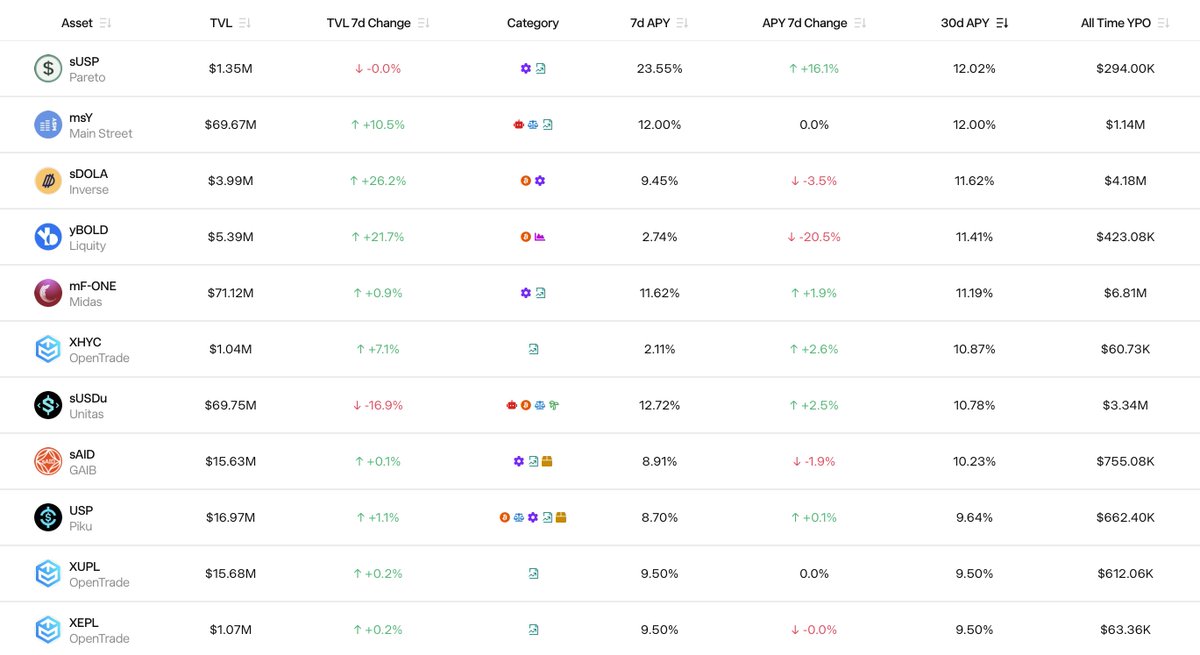
- MidasRWA (mF-ONE): $71.12 million locked in, with a 30-day annualized return of approximately 11.61%. It boasts the highest return on the list, with a robust underlying strategy based on real private credit assets. Compared to top-performing projects, it has a smaller team and a newer ecosystem, thus bearing additional project risks.
- Unitas Labs (sUSDu): $69 million in locked funds, with a 30-day annualized return of approximately 10.59%. It generates returns through a market-neutral strategy using a basket of assets, similar in concept to Ethena but with a shorter launch time and lower maturity.
- infiniFi (siUSD): $76 million locked in assets, with a 30-day annualized return of approximately 8.26%. It is a yield-generating investment product based on the native stablecoin of InfiniFi. The structure is simple and clear, but all collateral is concentrated in a single protocol, which essentially bets that the project has no long-term security risks.
How to make good use of this reference guide
Classifying risk levels is not simply about ranking returns, but about helping you understand how much additional risk you have to take for every additional percentage point of return.
- Extremely low risk: Deposit and withdraw at any time, funds are flexible and not locked up.
- Low risk: The first choice for ordinary users to allocate stablecoin yields
- Medium risk: Only invest after understanding the agreement logic and being able to accept the project risks.
- High risk: Suitable for small capital allocation for short-term high returns.
My stablecoin investment strategy is that instead of gambling on quick riches with meme coins and other high-risk new projects, it's better to be patient and follow the steady investment direction of institutional funds. In the long run, steady progress will ultimately yield value.