Author: David , Deep Tide TechFlow
Hollywood is searching the entire internet for a Chinese person. But the person they're looking for didn't even leave a usable contact method.
On the evening of May 10th, PJ Ace, founder of the Los Angeles AI film studio Genre.ai, shared an AI short film called "Zombie Cleaner" on X. PJ Ace is probably one of the most influential figures in the AI video industry, with his own content garnering over 300 million views across all platforms.
He spoke highly of the film, saying, "It's one of the best short films I've seen in recent years."
The short film's premise is roughly that a robot cowboy rides an ostrich through a post-apocalyptic wasteland, fights zombies, and falls in love with a plastic mannequin. Besides its cyberpunk and fantasy theme, the visuals and music also have a blockbuster feel.
(Viewers who haven't seen it can click here to experience it)
PJ's post reached 5 million views within hours of being published.
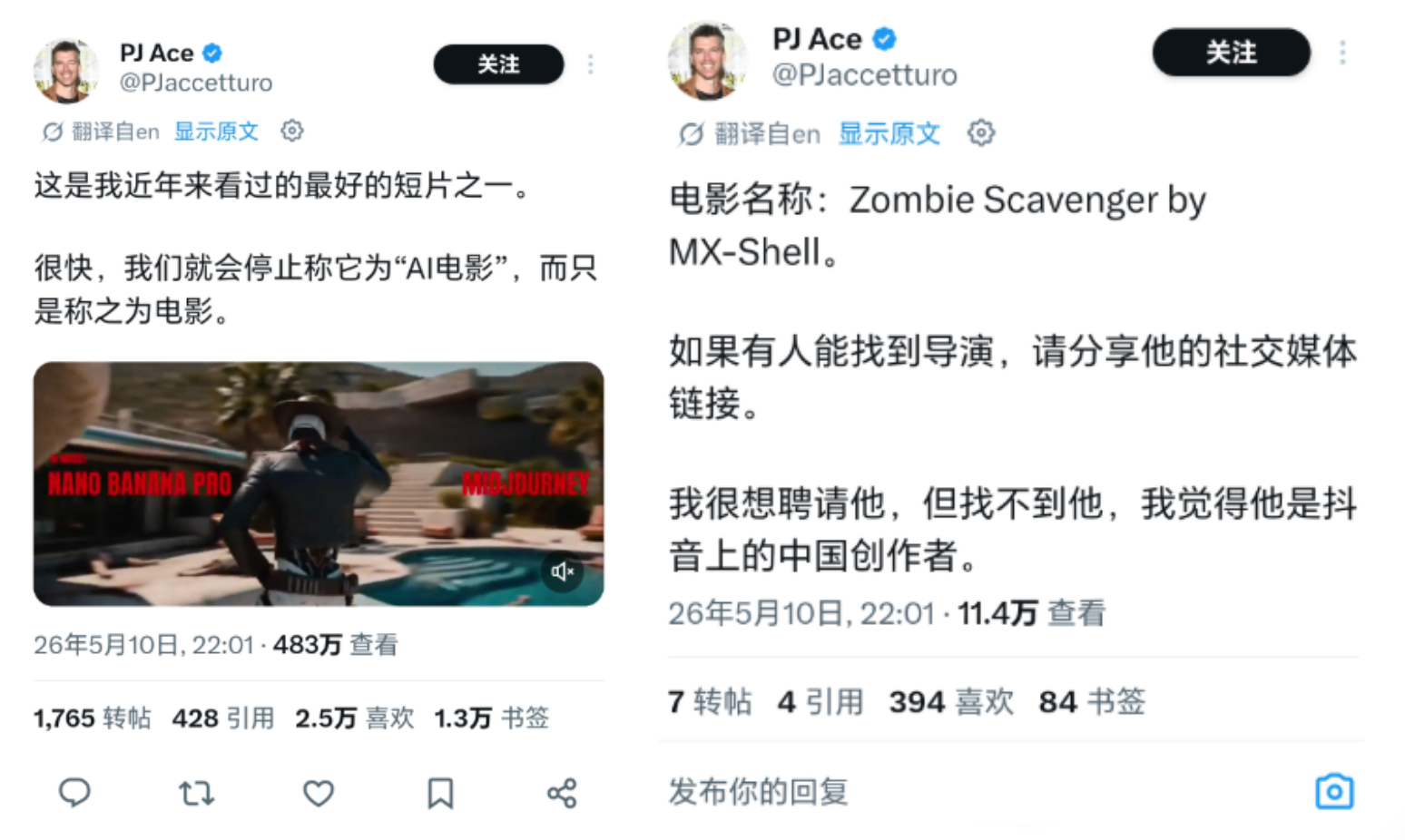
He then posted a missing person notice: "I really want to hire the director of this film, but I can't find him. I think he is a Chinese creator on TikTok."
Someone with Hollywood content production resources is posting a lost and found ad on Twitter like they're looking for a Chinese person? I think the image itself is more surreal than the short film...
His reasoning was that, before the advent of AI, this level of quality would have cost at least $500,000 and taken at least six months to produce, while this author had achieved this level solely through his own creation. The post quickly became a search ground, with some searching for the author's ID, MX-Shell, and others finding clues on Bilibili.
And so began a massive cross-platform search for the missing person, spanning from Hollywood to the comment section of Bilibili.
However, on the same day that PJ Ace frantically posted a missing person notice on Twitter, the short video hadn't yet made a splash on Bilibili and Douyin, lying quietly in the news feed.
A short film made by Chinese people using Chinese AI tools needs to first go viral on the other side of the Pacific before being seen by its own people. This large-scale cross-server search and transmission back to China has itself become an export-to-domestic re-import.
Make hobbies visible
The person PJ Ace is looking for describes himself on Bilibili as an amateur enthusiast.
The author, Mx-Shell, claims in the comments section to be a graduate of a vocational school in Yunnan, who never attended university or worked for any film or television company. His Bilibili profile states "a non-professional amateur," but his seriousness doesn't seem like modesty.

It is reported that "Zombie Cleaner" was made by him using Seedance 2.0, an AI video tool under ByteDance. He did it all by himself, without a team or investment, from conception to completion, and even composed the background music himself.
The production cycle takes about 10 days, and the cost of the token is approximately 3,000 yuan.
Then comes what I consider to be the most exciting part of the whole thing.
PJ Ace's missing person post was seen by millions of people on X, but Mx-Shell himself couldn't see it and had no idea that a Hollywood director on the other side of the Pacific was looking for him.
When the news finally reached China, the comment section under the video exploded. However, Mx-Shell himself neither understood English nor had the channels to communicate with overseas media. He even posted his QQ email address, asking netizens to help forward it to the other side.
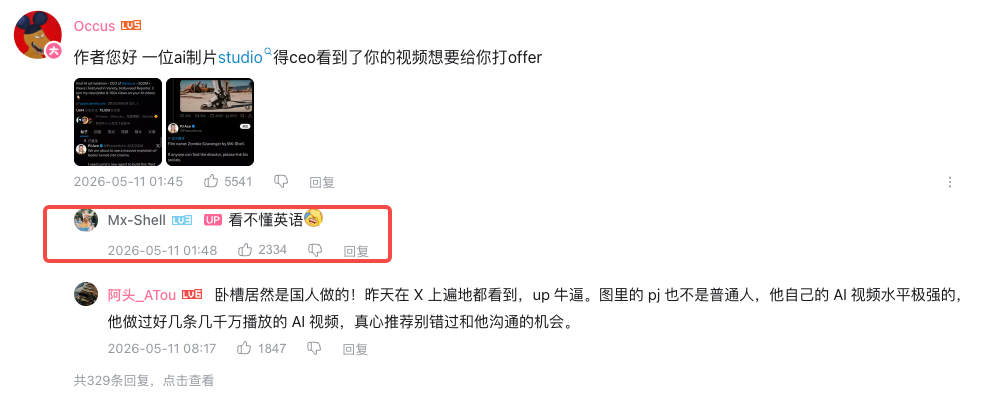

Hollywood contacted him on Twitter in English, while he contacted Hollywood via QQ email in the comments section of Bilibili. This cross-platform dialogue had a positive ending thanks to the matchmaking efforts of netizens.
PJ has already sent him an email. In the email, PJ Ace said that he runs a film studio in Los Angeles and that the short film had over 4 million views on the day it was shared. Then he asked, "Are you interested in becoming a Hollywood director?"
An amateur enthusiast received an offer from Hollywood, which may be a wonderful coincidence and a discovery of talent in the AI era.
Talent goes overseas, then is sold domestically.
Let's get back to why this show was quiet on Bilibili at first, but exploded when it was uploaded to X.
On Bilibili, a short video labeled "contains AI-generated content" might have to compete with professional animations, game playthroughs, and popular fan-made content from creators with millions of followers for the same feed. Mx-Shell, at the time, only had a few thousand followers and no featured placement; he was like a grain of sand falling into the desert.
X is a completely different world. The overseas AI creator community has developed its own ecosystem over the past two years, with top bloggers, consensus on evaluation, and a mature dissemination network.
PJ Ace is a core node in this ecosystem. When he watches "Zombie Cleaner," he sees the work itself; AI is merely a tool. His fan base then relayed the message, causing it to go viral within hours.
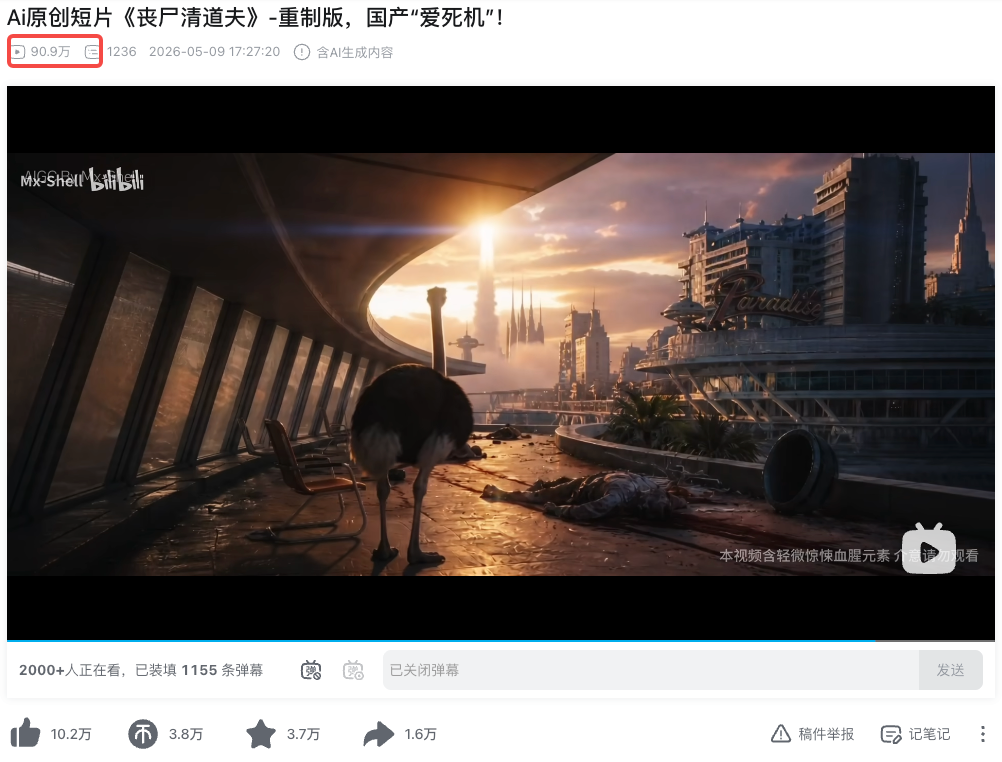
Subsequent data from the return of viewers confirmed this, with domestic audiences readily acknowledging its value; the video garnered over 900,000 views and 100,000 likes on Bilibili. In the AI era, content is never the primary issue; the issue is whether it reaches the right audience.
This reminds me of a similar phenomenon: the overseas expansion of tokens.
China's large-scale model sells computing power globally via APIs; the electricity never leaves the Chinese power grid, but value is delivered across borders through tokens. The Mx-Shell story is a creative version of the same logic: talent and aesthetics never leave the computer, but the work is delivered across borders through a short film. Seedance belongs to ByteDance, the computing power comes from Chinese data centers, the creators are from Yunnan, and the first large-scale audience to see this film is on the other side of the Pacific.
If exporting tokens is like exporting electricity, then exporting "Zombie Cleaner" is like exporting talent.
Why did this path succeed starting in China? Probably because China had two things at the same time. The world's most competitive AI video tool market, where ByteDance, Alibaba, and Kuaishou were scrambling to drive production costs to rock bottom. Mx-Shell used Seedance 2.0, which had relatively lower costs.
And a large number of creative people who previously had no outlet, with aesthetic sense and ideas, who just lacked a suitable tool.
The former gave the latter a key, and once the door was opened, the global market was outside.
AI is a great shovel, but you have to dig for yourself.
The story isn't over yet.
After Mx-Shell connected with PJ Ace, it published a lengthy response to public concerns. Thirteen points, each substantial, are worth reading carefully.
He said that the style of "Zombie Cleaner" is called atomic punk, a retro science fiction style. The creative inspiration came from Pixar's "WALL-E," and it was made according to the standards of the popular "Love, Death & Robots" series on Netflix.
One of the original intentions was to show overseas audiences the level of AI production in China.

Camera control relies on the script, which is mostly handwritten. Post-production is done by one person. Even the background music is original. Looking at these details together, you'll find that Mx-Shell is definitely not just " lucky to have encountered AI tools ".
Possesses visual aesthetics, with a background in photography. Possesses auditory aesthetics, an independent musician. Has a narrative sense, setting high standards for himself according to Illusionist standards.
AI tools gave him productivity, but aesthetics and judgment are his own.
Therefore, I believe that the statement "AI makes it possible for everyone to make movies" is only half true. AI has indeed lowered the barrier to entry for filmmaking to the ground, but while computing power can be bought, aesthetic sense cannot.
Anyone can use Seedance 2.0, so why did Mx-Shell create something that prompted Hollywood to post missing person notices? Tools are equal, but the people who use them are vastly different.
This leads to another interesting perspective.
The extent of ByteDance's investment in Seedance 2.0 is unknown to outsiders, but the best advertisement for this tool so far was probably created by a vocational school student from Yunnan.
ByteDance's marketing department couldn't have orchestrated such a story, because the persuasiveness of a story lies precisely in its spontaneity, its wildness, and its unplanned nature.
The strongest proof of a platform product is always that users create things that exceed the platform's expectations. Taobao's early benchmark story was a rural woman earning millions a year selling local specialties; YouTube's benchmark was a bedroom boy creating programs better than those on television. Seedance 2.0's benchmark story is more creators like Mx-Shell.
According to DataEye data, the overseas AI short drama and animation market is projected to reach $650 million in 2026, a six-fold increase year-on-year. Currently, there are two main paths in this market:
One route is industrialization. Domestic teams mass-produce AI-generated short dramas, featuring zombies, werewolves, and underdog stories, wrapped in genres familiar to Western audiences, and monetized through TikTok streaming. Reports indicate that several works have already garnered tens of millions of views. This route relies on capital, teams, and production capacity, somewhat resembling the short video factories of yesteryear.
The other path is the one taken by Mx-Shell. One person, one computer, no need for traffic generation or scale; the content itself is the power to spread. Tokens cost a few thousand dollars and take less than two weeks to generate revenue, but instead of platform revenue sharing, Hollywood comes knocking on their door.
Both paths are viable, but I believe the second one deserves more attention.
The barrier to the first path is money; if you have money, you can do it, and it doesn't have much to do with the creator personally. The barrier to the second path is people, aesthetic sense, and the ability to judge content. AI can't give you these things, and you can't buy them with money.
He won't be the last person to take this path.
China has a large number of creators with aesthetic sense, ideas, and a desire to express themselves. Previously, the barriers were equipment, funding, teams, and academic qualifications. Now, AI tools are dismantling these barriers one by one. The only remaining question is how to be seen.
Mx-Shell's answer was a QQ email address and a group of helpful netizens. The next person might have a different approach.
However, before the domestic ecosystem for AI-generated content truly takes shape, this detour of shifting from export to domestic sales will likely take some more time.