
Original author: Mustufa Khan
Compiled by: Peggy, Rhythm
Editor's Note: In addition to the meeting between the Chinese and American leaders, what is more noteworthy about Trump's visit to China is the list of American business executives accompanying him: Musk, Cook, Huang, Larry Fink, as well as heads of companies such as Boeing, Goldman Sachs, Blackstone, and Citigroup are all present in the delegation.
Why are these CEOs coming? The reasons aren't complicated. Tesla needs the Chinese market and its Shanghai factory; Apple needs to maintain its Chinese supply chain; Nvidia needs to reopen the Chinese AI chip market; Boeing is waiting for large orders from China; and Wall Street institutions are concerned with licenses, asset management, and access to capital markets. They belong to different industries, but they all point to the same reality: for many leading American companies, China remains an irreplaceable market, production base, and regulatory gateway.
Therefore, this article is not really about the pomp and circumstance of a diplomatic visit, nor about a few potential orders, but rather about the structural dependence of American companies on the Chinese market.
The following is the original text:
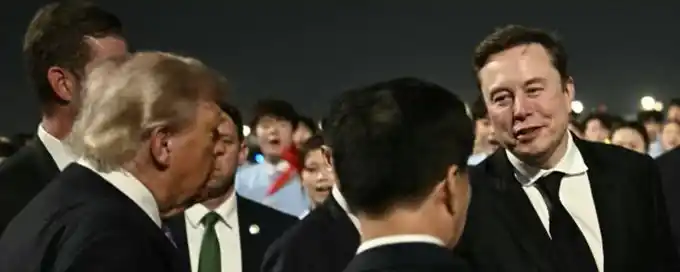
Yesterday, Trump arrived in Beijing, accompanied by Elon Musk, Tim Cook, Jensen Huang, Larry Fink, and several other top American business CEOs. The business empire behind this delegation is staggering: these entrepreneurs have a combined net worth of approximately $1.07 trillion, exceeding the GDP of most economies globally, with only a handful of countries.
This visit has been described by outsiders as a summit.
However, judging from the signals released at the scene, it was more like a board meeting of global business power: China was the chairman of the board, Trump was one of the directors, and the accompanying US corporate CEOs were like a business team brought to the scene to endorse the final deal.
Over the past 70 years, the core narrative of American power has been repriced. However, many observers remain focused on protocol, slogans, and short-term deals, failing to see the truly changing structure.
The brass band on the tarmac, the uniformly dressed Chinese children, and the series of meticulously planned welcoming ceremonies could easily be interpreted as routine pomp and circumstance at a diplomatic event. But what truly matters is not the visuals themselves, but who is setting the pace for this visit.
Almost every item on the publicly announced agenda for this visit was arranged by the Chinese side. This means that China holds the reins of the agenda, and Trump is more responding to a predetermined agenda than actively shaping it. Trump arrived, and China hosted him. This alone constitutes the most important political and business signal of the week.
A country with real leverage typically doesn't reveal its desires before entering the meeting room; conversely, a country with diminishing leverage often compensates for its lack of negotiating power with a more high-profile public narrative. When the US president arrives in Beijing, he is followed by some of the most influential CEOs of American companies, and before he even lands, a press release has already outlined every key item on the agenda.
By Friday evening, the visit will likely yield some concrete results: a few Boeing orders, some quietly progressing chip export licenses, and several agricultural and trade commitments. These will all be packaged as diplomatic victories. But what's truly worth watching this week is not these surface-level achievements, but rather the composition of the delegation itself.
Let's see who's on this plane and what each of them needs from Beijing.
Elon Musk: The Shanghai factory remains Tesla's lifeline
Tesla's Shanghai Gigafactory began production in 2019. By 2026, the factory will contribute nearly half of Tesla's global vehicle production, with 213,000 vehicles delivered from this single site in the first quarter alone. Musk has invested billions of dollars in the Shanghai production system, including a $2 billion Gigafactory and a $200 million Megapack energy storage factory.
The Chinese market contributes about a quarter of Tesla's revenue. Over the past two years, Musk has repeatedly warned of the risks posed by authoritarian states and the inevitability of a decoupling between the US and China on the X platform. However, this week, he boarded Air Force One to Beijing, one of his core objectives being to ensure the continued stable operation of the Shanghai factory.
This is precisely the contradiction Musk must confront: one of the most public critics of China in the American business world, yet also one of the American CEOs most dependent on Beijing's policy environment. This contradiction is no longer merely a matter of public stance, but a real issue that requires him to personally go to Beijing, to deal with it in front of Xi Jinping and on camera.
Tim Cook: His Last China Diplomacy Before the End of His Term
Tim Cook will retire on September 1, and John Turners will succeed him as Apple CEO. For Cook, this trip to China is likely to be his last major diplomatic occasion as CEO, and it is at this moment that he must deal with the most difficult part of the Apple story to fully explain.
For the past five years, Cook has consistently emphasized to Congress, shareholders, and the media that Apple is moving iPhone production out of China. This claim is not without basis. Currently, most iPhones sold in the US market are assembled in India. In May 2025 alone, Foxconn invested $1.5 billion in its Indian subsidiary.
Diversification is happening. But the problem lies in the world outside the US market.
Apple's iPhones sold in approximately 200 other countries and regions still heavily rely on China's assembly system. This means that even though Apple has begun to shift some of its supply chain, its global supply system remains deeply tied to China's manufacturing network.
This week, Cook sat in the Chinese government building, not to prove that Apple had broken free from China, but to ensure that the supply chain system, which has not yet completed its transfer, can continue to operate stably, at least enough to hand the problem over to the next CEO.
Jensen Huang: Trump personally called the person who invited him to board the plane.
Jensen Huang was not originally on the delegation's list. He had planned to skip the trip because his presence could trigger a renewed scrutiny within the Republican Party regarding Nvidia's chip sales to China. On Tuesday morning, Trump personally called Huang and asked him to join the delegation. Less than 24 hours later, Huang flew to Alaska and boarded Air Force One.
Trump needed Huang Renxun to be present, primarily because of the H200 chip issue.
Nvidia's H200 AI accelerator was banned from sale to China during the Biden administration and was subsequently replaced by the H20 with reduced performance. However, the H20 was again restricted in April 2025, leading Nvidia to write off a $5.5 billion impairment charge. In late 2025, Trump approved the re-export of the H200 to China, imposing a 25% tariff levied through U.S. Customs. Beijing, meanwhile, privately notified customers to suspend purchases.
Six months have passed since the White House gave the green light, but not a single H200 has been delivered to a Chinese buyer. During this period, Nvidia's market share in China has plummeted from 95% to near zero.
Therefore, Jensen Huang's appearance in Beijing this week was one of the most crucial corporate negotiations of the entire visit. He is the only person on both sides of the negotiating table who truly understands the boundaries of the chip industry: which chips can be sold, which technologies cannot be shared, and how to maintain revenue in the Chinese market without allowing China to acquire the computing power foundation sufficient to completely overtake Nvidia.
Neither the Treasury Secretary nor Trump could come up with this figure. The person who truly understands the boundaries of technology and its commercial costs is Jensen Huang. In other words, he is the key player in this negotiation, while the president is more like the one who brought him into the room.
Larry Fink: Managing $11 trillion in assets, yet still unable to circumvent the issue of Chinese licenses.
BlackRock's assets under management surpassed $11 trillion in 2024 and have continued to grow since. Larry Fink's business operations in China have long been at the center of political controversy in the United States.
In 2023, the U.S. House Select Committee on China investigated BlackRock and MSCI, accusing them of directing U.S. investor funds to some Chinese companies that were blacklisted for alleged military or human rights issues.
Subsequently, BlackRock closed its offshore China equity fund, and Tang Xiaodong, head of its China operations, resigned. Around the same time, several of BlackRock's onshore China funds also suffered losses.
Fink boarded the plane this week because a Chinese license is virtually unavoidable for BlackRock if it wants to maintain its position as the world's largest asset manager by 2035. And these licenses are controlled by Beijing.
The same congressional committee that investigated him three years ago is closely watching this visit. He must obtain sufficient results from Beijing to demonstrate the commercial viability of remaining in the Chinese market, while simultaneously avoiding the perception that he is sacrificing U.S. national security interests for market access.
Of all the things Fink had to do on the entire trip, this was probably the narrowest eye of a needle he had to pass through.
Kelly Ottberg: Boeing CEO who has been waiting for Chinese orders for nearly a decade
Since securing a purchase commitment of over $37 billion for 300 aircraft during Trump's visit to China in 2017, Boeing has not received any truly significant orders from China.
The two 737 MAX crashes in 2018 and 2019, the pandemic, the trade war, and Boeing's own long-term production crisis have combined to freeze Chinese orders for nearly a decade.
Reports indicate that the deal on the negotiating table this week may include 500 737 MAX aircraft and approximately 100 wide-body aircraft. If finalized, this would be one of the largest single aircraft orders in Boeing's history. Ottberg, in an interview with Reuters last month, also acknowledged that Boeing is relying on the White House to push for this order, which had previously been hampered to some extent by the tariff dispute over engine spare parts.
In the first four months of 2026, Boeing secured 284 net orders, its best start to the year since 2014. However, the company's production capacity and delivery schedule remain under pressure.
A massive Chinese order may not immediately change Boeing's 2026 earnings guidance, but it's enough to boost market valuations of the company's stock and provide Ottberg with the long-awaited operational validation the board has been waiting for. He was on the plane because Boeing has waited nine years and can't afford to leave empty-handed again.
David Solomon: Gatekeeper of Goldman Sachs' wholly-owned China business
Goldman Sachs acquired full ownership of its China securities business in 2021, becoming one of the few U.S. financial institutions with wholly-owned domestic securities business in China.
For Goldman Sachs CEO David Solomon, the core objective of this trip to Beijing was to ensure that the license continues to have real commercial value. Over the past three years, China's regulatory environment for foreign financial institutions has continued to tighten, making the growth potential of foreign banks in domestic investment banking, asset management, and wealth management more uncertain.
Goldman Sachs' onshore investment banking, asset management, and wealth management businesses, targeting Chinese clients, are key areas for building long-term revenue streams. If Beijing determines that foreign banks are no longer suitable for these key areas, then Goldman Sachs' strategic path built around the Chinese market over the past 15 years will need to be reassessed.
What Solomon needs to do in Beijing this week is to ensure that such a revaluation does not occur.
Stephen Schwarzman: The Business Politician Who Has Connected Washington and Beijing for 20 Years
Stephen Schwarzman is one of the most senior business politicians in the delegation. Blackstone's assets under management surpassed $1.3 trillion in the first quarter of 2026, making it the first alternative asset management firm to reach that scale.
He founded the Schwarzman Scholars program at Tsinghua University in Beijing, attempting to cultivate bridge-building leaders between China and the United States in a manner similar to the Rhodes Scholarship. For many years, Schwarzman has publicly argued that the future of the US and China is more likely to be characterized by coexistence within "spheres of influence" rather than outright confrontation.
He spent 20 years cultivating relationships with China’s top leadership, a resource that most other members of the delegation did not possess.
The value of Schwarzman's trip lies not in what he can directly obtain from Beijing, but in his ability to privately inform Trump how Xi Jinping will interpret the atmosphere, which concessions are possible, and which conditions will not cause either side to lose face.
In a sense, he was the member of the US delegation closest to a "Kissinger figure." More importantly, he was the only one on the plane who consistently viewed US-China relations as an investment proposition, rather than a quarterly issue.
Jane Fraser: Citigroup CEO still awaiting Chinese license
Citigroup has withdrawn from its early joint venture arrangement in China and has been awaiting approval from Beijing for its wholly-owned securities brokerage license. However, this application has yet to be approved.
Meanwhile, Citigroup is also embroiled in a dispute with a Zhejiang-based fuel company. Fraser accompanied the group because Citigroup's strategy in China remains stalled, and she needs Chinese regulators to expedite the long-delayed license application.
In the current context of US-China confrontation, Citigroup is one of the most squeezed US financial institutions. Mastercard, Visa, and Citigroup are all vying for access to payments and capital markets, rights that remain in Beijing's hands.
Among the CEOs of several major financial institutions, Fraser has the least leverage at the negotiating table, but her needs are likely the greatest.
Other companies on the plane
The delegation also included executives from Meta, Mastercard, Visa, Micron, Illumina, Cargill, Coherent, and GE Aerospace. While each addressed different issues, the underlying logic was remarkably similar: all relied to some extent on market, licensing, supply chain, or regulatory resources controlled by Beijing.
Mastercard and Visa want to pay for market access. Micron wants to lift export restrictions on memory chips. Illumina has been placed on the Chinese government's "unreliable entities" list. Cargill needs soybean orders from China. GE Aerospace supplies engines for Boeing aircraft that China may purchase.
These companies are included in the delegation because Beijing controls certain key resources that will be difficult for them to replace in the next five years.
Common theme: American companies' dependence on China
Eight CEOs, representing eight different forms of dependence on China.
Each of them boarded Air Force One this week because their respective companies have developed a structure heavily reliant on the Chinese market or supply chain over the past few decades. For these companies, Chinese market access, regulatory licenses, manufacturing systems, order commitments, and policy signals are no longer just growth options, but increasingly approaching strategic necessities.
The person who holds these keys is the very person they flew halfway around the world to meet.
Since around 2010, the American corporate class has been constructing a narrative for itself that it can operate above ordinary political and governance frictions. Founders speak directly to users, boards of directors often endorse the CEO's decisions, and regulators are always chasing after distorted business models.
Many institutions in the United States have attempted to challenge this narrative, but with limited success.
Over the past 20 years, the Senate has subpoenaed these CEOs time and again, but rarely has it managed to put them all at the same table on the same day. Antitrust investigations often last for years, by which time the technology cycle has already changed. Many Americans watch the hearings on YouTube, but few can say which piece of legislation these hearings ultimately led to truly transforming the industry landscape.
But Beijing accomplished something else: it brought these American business leaders halfway around the world to sit at the same table, with Chinese schedules, Chinese cities, and Chinese protocol.
This is the truly alarming aspect of this week. The leverage that can mobilize the American power structure no longer exists entirely within the American political system. At least for now, it exists in Beijing and is openly on display.
By 2026, the most binding force on the behavior of U.S. companies may no longer be congressional hearings, judicial investigations, or regulatory agencies in Washington, but rather the market exclusion power held by China's regulatory state.
The lever is simple and effective: gain access, or lose access.
The real changes will not be written into the joint statement after the summit.
The visit will conclude on Friday. At that time, the two sides will most likely release a joint statement and announce some concrete results regarding Boeing orders, agricultural procurement, and certain industrial collaborations.
American media might interpret these results as proof of pragmatic engagement; Chinese media, on the other hand, would see them as evidence of China maintaining its central role in the global economy. Neither narrative is entirely wrong, but both could overlook the structural changes that have truly emerged this week.
What's really important is that the American business class has openly acknowledged that key decisions that will influence their revenue and growth path over the next decade are increasingly taking place in a room chaired by Xi Jinping.
The CEOs aboard Air Force One represent the first concentrated demonstration of this model. In the future, any American company hoping to gain exposure to the Chinese market will likely have to come to Beijing in a similar manner and accept similar conditions.
The scene on the tarmac is not merely a display of American power. It demonstrates who has the ability to summon American power and, when needed, bring it across the Pacific to their doorstep.
While Washington is still explaining why such a power shift is impossible, the levers have already been quietly shifted.
Whether the outside world is willing to admit it or not, a new boardroom is being built in Beijing.