
Written by: Thejaswini MA
Compiled by: Saoirse, Foresight News
There was a time when we traded cryptocurrencies simply by entering SOL, selecting USDC, and clicking exchange. Those were simple, pure times; the only thing everyone cared about was getting the best possible exchange rate.
Times have changed, and the industry landscape has become more complex. The crypto market is shifting from grassroots, amateur projects to a professional, institutional trading system. Wall Street financial institutions are entering the fray, building up the underlying infrastructure, while ordinary retail investors are gradually losing their initial enthusiasm. Now, we must ask: where do these seemingly favorable prices come from? And who are the counterparties in each order?
If cryptocurrencies are to gain a foothold and develop sustainably in the fintech sector, the entire industry needs to maintain this level of caution and skepticism.
You might think that buying and selling stocks on a brokerage platform is like being in a public trading market, but that's not the case. You're actually in a private trading network. Today's trading software for retail investors uses a rather controversial order routing mechanism. This mechanism originated in the 1980s, with Bernie Madoff, a pioneer in electronic trading, being one of the first large-scale users. Madoff discovered that by paying compliant rebates to retail brokers, he could preemptively obtain client orders and complete them before they reached the public exchange.
This model has given rise to private intermediaries that act as intermediaries between traders and the public ledger, profiting from the bid-ask spread on each transaction.
The original purpose of cryptocurrency was to completely eliminate centralized intermediaries.
The core principle of decentralized finance (DeFi) is transparency and openness, with all transactions being traceable. However, in the past year, the Solana public chain has taken a completely different development path.
Jupiter is the core trading hub within the Solana ecosystem, but the underlying logic supporting the platform's trading operations has been completely changed. Now, most platform trading is completed through private trading pools. This article will unveil this hidden "black box" in the Solana trading market.
Early Automated Market Makers (AMMs) were completely transparent. Essentially, they consisted of a pool of two tokens with publicly available calculation formulas. Anyone could view the code on GitHub and clearly understand how their funds were being transferred. Trading on platforms like Raydium and Orca was like using a completely transparent device; the operational logic was crystal clear.
However, Prop AMM (Automated Market Maker) operates on a completely different model. Its trading prices are generated by servers belonging to a private company; the contract deployed on the Solana chain is merely a shell, acting only as a data gateway. User trading orders are directly forwarded to off-chain servers, where the final transaction execution is completed by algorithms from a private institution. "Prop" stands for proprietary and private; these institutions never disclose their profit model to the public.
Just a year ago, this model seemed out of place, but now it dominates Solana's spot trading market.
HumidiFi launched in June 2025. By December 2025, HumidiFi alone handled 57% of the total transaction volume on the Solana aggregator network; during the same period, Raydium's share fell to 2%, Orca accounted for 5%, and Tessera accounted for 12%. By late January 2026, Prop AMMs collectively handled approximately 92% of the order routing business on the Jupiter platform.
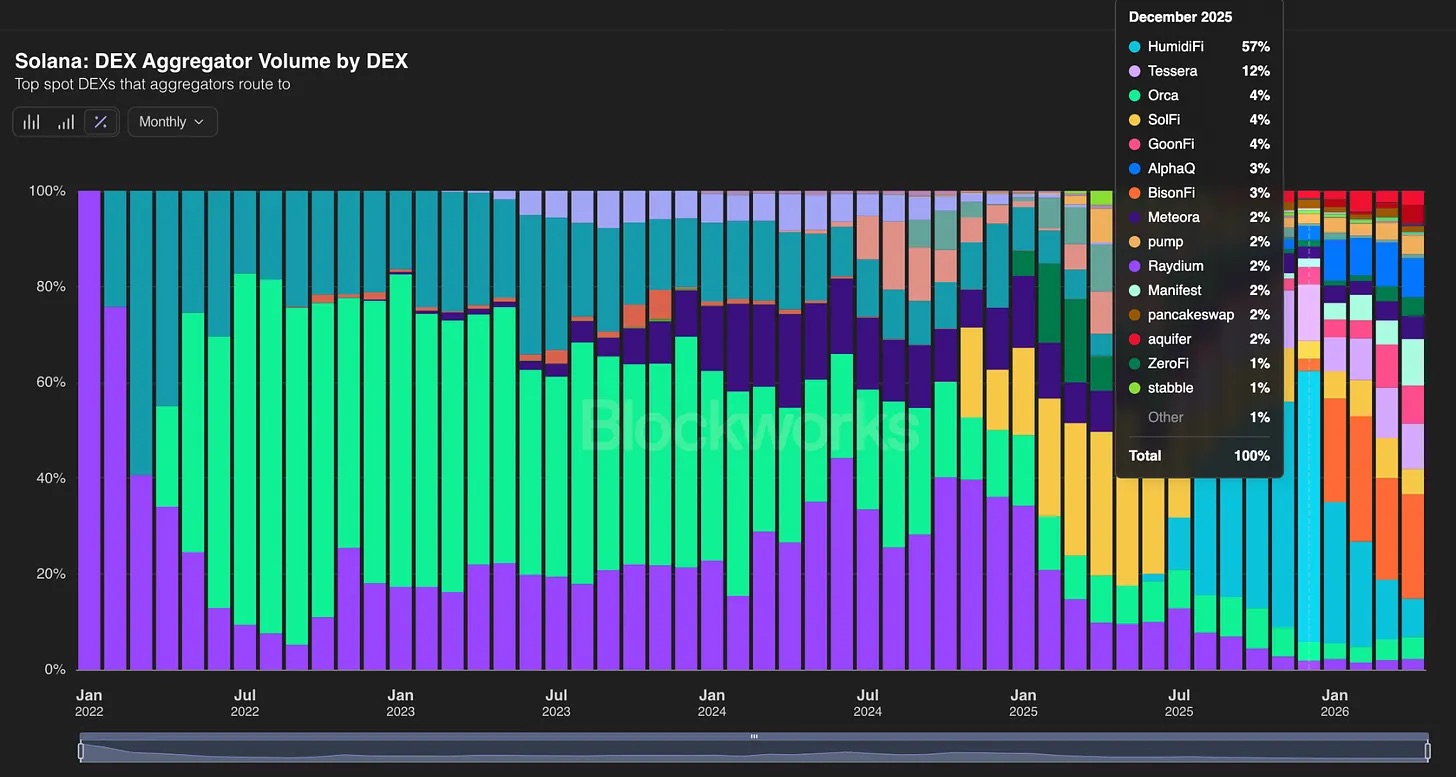
Changes in the composition of transaction volume routed by Solana's on-chain DEX aggregator. Source: @blockworks.com
Jupiter handles 75% to 80% of the trading volume on the Solana aggregator. In other words, once Prop AMM takes control of Jupiter, it effectively controls the entire Solana spot trading market.
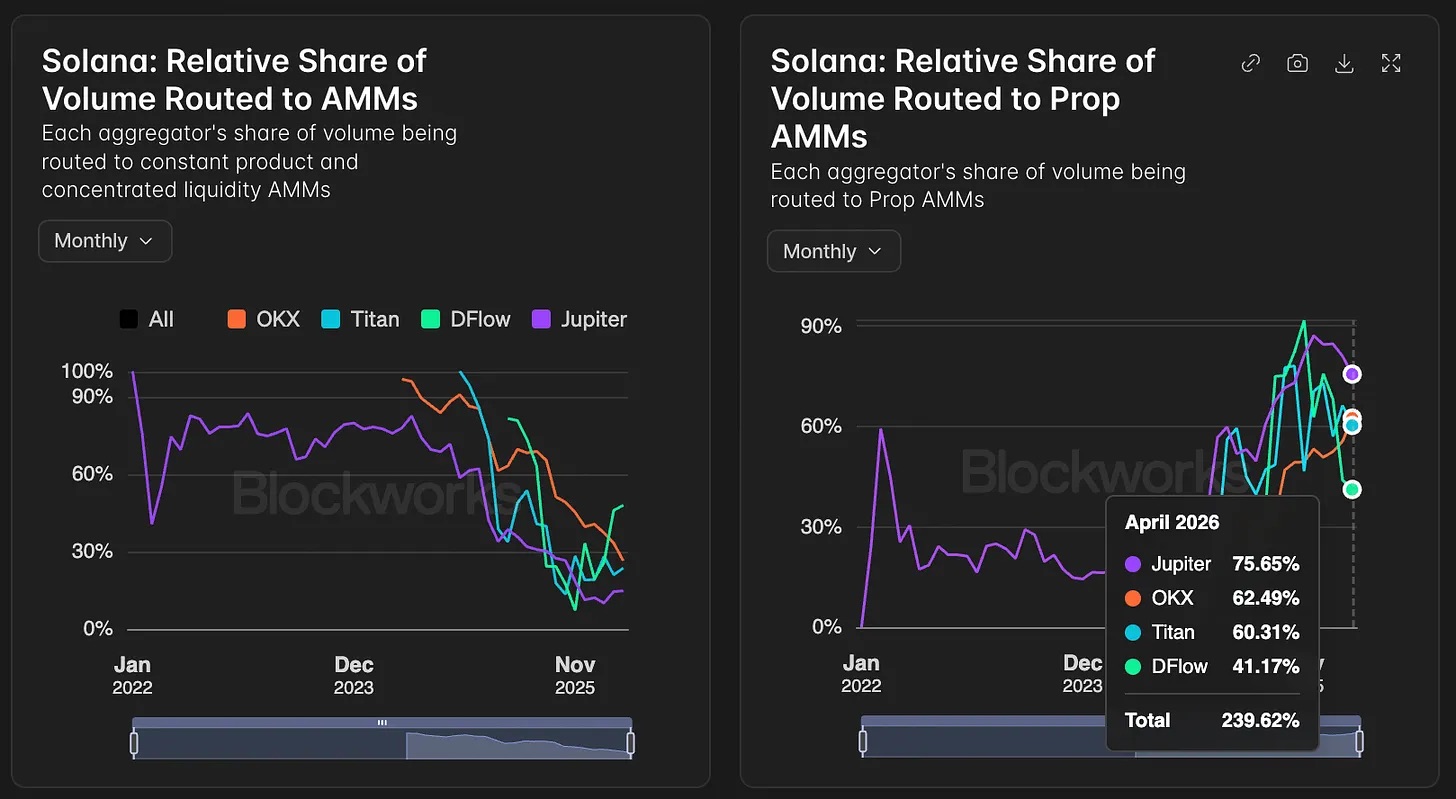
Trading volume share of AMM (left side, 2022-2025) and trading volume share of Prop AMM (right side, 2022-April 2026), Source: @Blockworks
The spread is the core underlying factor, representing the hidden fees traders indirectly pay to market makers to complete trades. The financial industry typically uses basis points (bps) as the unit of measurement for spreads, with one bp representing one ten-thousandth. Even in regular trading, this cost accumulates significantly over time. According to Dune data, private trading platforms like HumidiFi and Tessera offer extremely low spreads.
In contrast, using traditional public liquidity pools to complete token swaps is significantly more expensive. The lower transaction costs make private market makers the preferred choice for users. Jump Research's research also confirms that regular transactions on these private platforms often yield better prices than those on leading centralized exchanges like Binance and Coinbase.
So, who exactly is the operating entity behind it? TesseraV is operated by Wintermute, an organization that has been providing market-making services to platforms such as Binance and Coinbase for five years.
SolFi is owned by Ellipsis Labs, a quantitative trading team backed by Paradigm. HumidiFi is operated by Temporal, which controls a significant portion of Solana's Manageable Value (MEV) infrastructure. Both are professional trading teams with dedicated legal and compliance personnel, and utilize sophisticated financial tools such as the Bloomberg Terminal.
In the traditional financial markets where these institutions originally operated, they had to register with the U.S. Securities and Exchange Commission (SEC) and strictly comply with various regulatory rules: prohibiting preemptive execution of customer orders, rigorously investigating fraudulent trading activities, and requiring trading algorithms to be audited. This comprehensive regulatory system was used to ensure the institutions' compliant operations.
This is similar to Citadel paying Robinhood hundreds of millions of dollars every year, which, although there is currently no evidence that this behavior harms users, still leaves people with reservations.
Within the Solana ecosystem, all regulatory rules are rendered meaningless. These established trading institutions continue with their existing trading models without being subject to the constraints of exchanges and securities regulators. Over 90% of Solana aggregator orders flow through Jupiter to these private institutions.
DeFi is often labeled as "anonymous," but this is a misconception. Those entering the market are well-known professional trading teams; their move to the on-chain market is primarily due to its less stringent regulations and constraints.
The top spot in the industry changes hands frequently.
The competitive logic in this market is highly anomalous: an institution can capture 68% of the market share within five months, only to lose the majority of that share in a mere thirty days. In December 2025, HumidiFi held a 68% share of trading volume in the Prop AMM sector, but this share plummeted to 26% just one month later, solely due to competitors offering more favorable prices.
From January 10 to 13, 2026, HumidiFi's daily trading volume plummeted by 80%, but the institution did not provide any explanation.
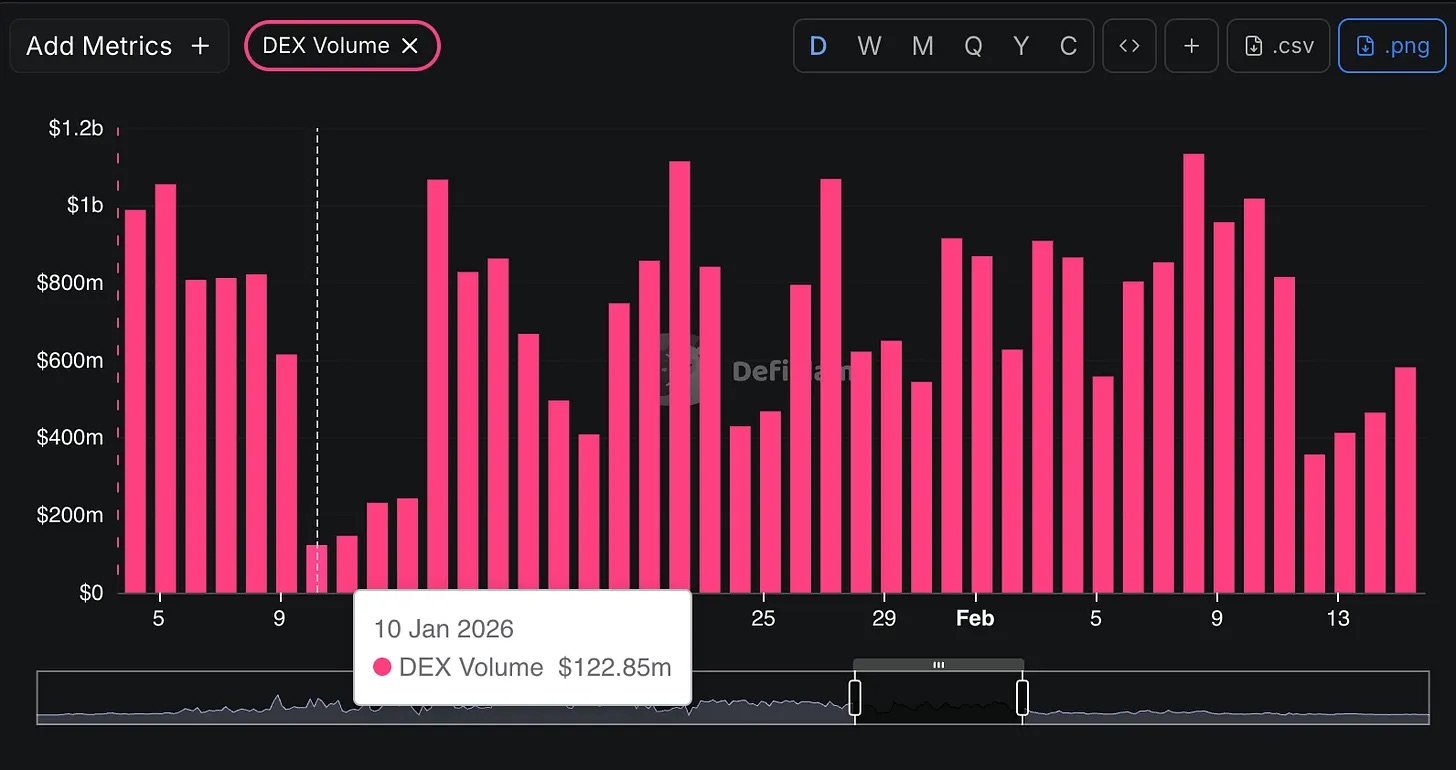
Bar chart of daily trading volume from January to February 2026. Source: @defillama
BisonFi seized the opportunity and rose rapidly. In just three weeks, its daily trading volume soared from $180 million to $1.43 billion, and its total seven-day trading volume reached $11.5 billion.
By early February, BisonFi held a 34% to 35% share of the Prop AMM routing business, while HumidiFi maintained a 26% share. BisonFi thus secured its leading position in the industry and has maintained this advantage ever since.
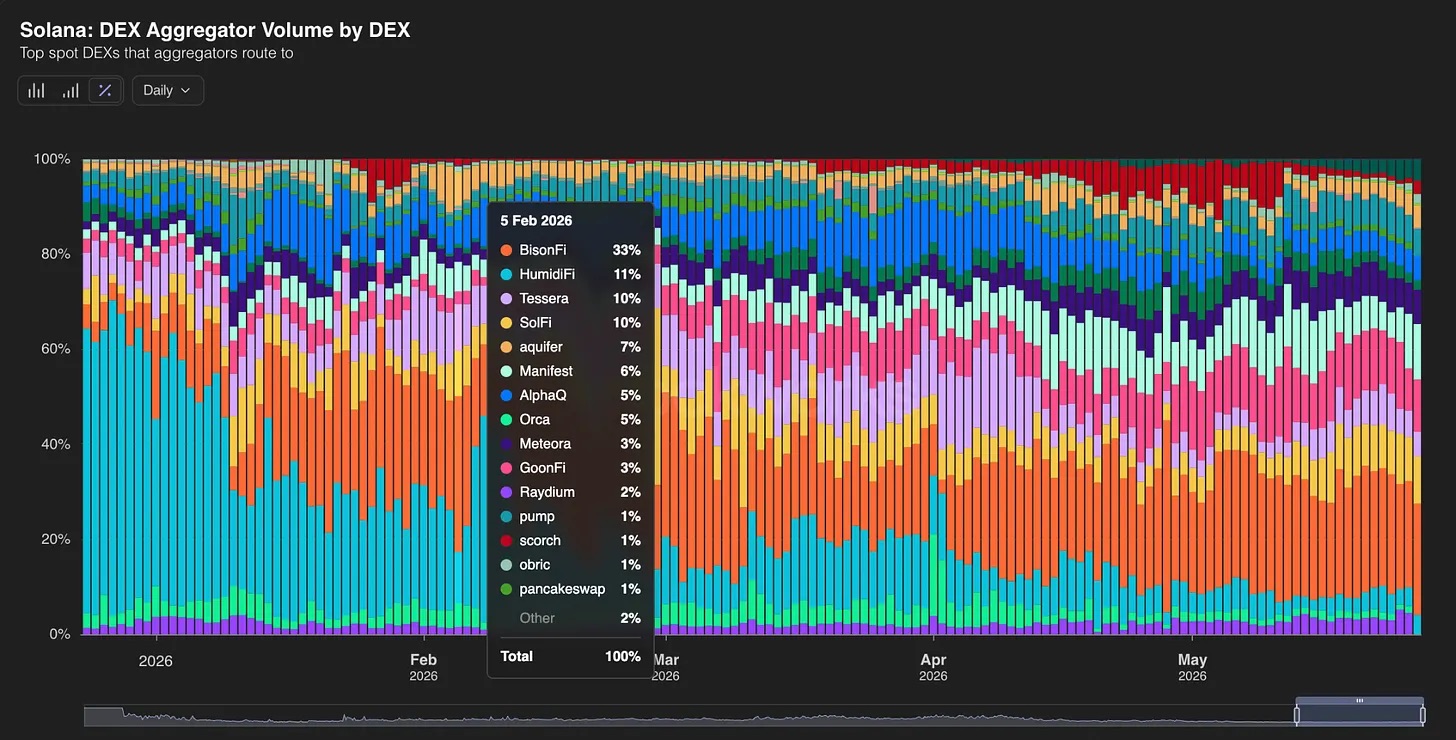
Changes in the share of transaction volume routed by Solana on-chain DEX aggregators from the beginning of 2026 to May. Source: @Blockworks
BisonFi was initially launched in late 2025 by the publicly traded company Forward Industries, whose chairman is Kyle Samani of Multicoin. However, during a surge in trading volume, Forward Industries issued a statement claiming that BisonFi was not one of their projects. The project's official website domain is now also listed for sale. The fact that a leading project in Solana's largest order flow market has become so enigmatic is truly intriguing.
In this field, no one can hold the top spot forever. Jupiter initiates a bidding auction in each block, selecting the institution with the best current bid in real time and allocating the order to them. This mechanism encourages institutions to provide bids that align with the market's median price as quickly as possible. Globally, only about twenty teams possess this kind of technical capability, and even the leading players can be replaced by other quantitative trading teams within weeks.
On January 28, DFlow, Solana's second-largest decentralized exchange aggregator, suspended its connection to HumidiFi, with its founder stating it was just routine maintenance. At the time, HumidiFi's on-chain contracts were still running normally, but trading volume was significantly impacted. Users who had been using this channel for a long time received no notification whatsoever, and Jupiter directly diverted order flow to other platforms.
Jupiter is a legitimate company with government assets, platform tokens, full-time employees, and complete financial statements. Every exchange transaction processed through the routing contract incurs a fee, with higher fees for ultra-fast trading. JUP token holders can participate in a fee sharing program. Jupiter's core competitiveness lies in providing Solana users with industry-leading trade execution services, which explains the continuous influx of massive trading volume.
Jupiter has absolutely no incentive to change the current situation where private, closed-source institutions control the majority of Solana's spot trading. Abandoning the Prop AMM would lead to a decline in trade quality, a shrinking overall trading volume, and losses for all stakeholders. Even if these institutions were removed, the Jupiter platform could still function, but the trading experience would be significantly degraded: slippage would increase dramatically, instantaneous best quotes would disappear, and the entire ecosystem would lose its core competitiveness.
Currently, the industry generally believes that the fact that the various risks mentioned in the article have never materialized means that such risks will never occur. However, throughout the history of financial development, the market has always held this mindset before every systemic risk event.
Looking back at the 1998 collapse of Long-Term Capital Management (LTCM): This fund was managed by a top-tier quantitative team on Wall Street, relying on highly secret mathematical models to generate returns. Its long-term stable operation led the market to mistakenly believe that risks had been completely mitigated by the models. However, when a sudden global crisis struck, its internal algorithms completely failed, private liquidity evaporated instantly, and the entire trading system collapsed completely within days.
If a private application connected to Jupiter has a pricing loophole, users often only realize it after their assets have been damaged. In contrast, open-source projects like Raydium have a completely transparent and open process for fixing high-risk vulnerabilities; similar vulnerabilities in Prop AMM are often completely concealed.
Traditional financial markets strictly prohibit market makers from preemptively trading client orders and are subject to strict regulations. However, within the Solana ecosystem, private trading teams have complete control over their pricing strategy and can stop providing quotes at any time. Due to Solana's trading ranking mechanism, it is impossible to verify whether these institutions are engaging in betting against users, while the possibility cannot be ruled out.
Despite the numerous risks, the entire ecosystem has embraced this model. The reason is that while open-source liquidity pools can meet the trading needs of basic crypto tokens, they cannot handle on-chain stocks, forex, and other real-world assets. If only simple passive formulas are used to price tokenized US stocks and forex assets, high-frequency traders can exploit time differences to steal assets from the liquidity pool.
Prop AMM solves this problem by off-chaining complex risk calculations. Private servers continuously push high-speed, real-time quotes to the Solana custom program, enabling rapid responses to real-world market information and clearing obstacles for traditional Wall Street assets to be traded on-chain. However, this also creates a huge hidden danger: if a private institution's server goes down, the program malfunctions, or incorrect data is pushed during a market panic, the liquidity of the relevant assets will disappear instantly, and the entire on-chain trading market will come to a standstill.
The original tenet of DeFi was that the code was open and accessible to everyone.
Although the platform interface now indicates that orders are routed through channels such as TesseraV and SolFi, the actual pricing and transactions are still handled by traditional financial institutions such as Wintertermute and Ellipsis Labs.
The players involved in this field are far more than just the aforementioned few; the entire industry is gradually evolving into a clandestine trading network comprised of multiple private institutions. For example, the Bebop platform directly connects with 12 to 15 private market makers to obtain quotes. There are also low-profile protocols like Lifinity, ZeroFi, and Obric, which are "dark pool automated market makers" that do not publicly disclose their services. They have no official website, no advertising, and no community; they simply integrate with Jupiter through code to intercept user order flows. Traditional trading teams like Wincent are also constantly competing in this clandestine auction of quotes.
I'm not asserting that users have been treated unfairly. Objectively speaking, compared to most memecoin liquidity pools, professional institutions like Wintertermute are indeed more reliable trading partners. Prop AMMs compress trading spreads to near zero, objectively contributing to the maturation of the entire market. Perhaps this is an inevitable path for the development and growth of an industry.
The inclusiveness of the crypto market lies in the fact that if you adhere to the concept of decentralization and reject private, closed-source technologies, you can completely bypass aggregators and complete token exchanges directly in open and transparent traditional liquidity pools.
However, the fact that private transaction networks can occupy such a large market share is enough to prove that the core demand of the vast majority of users is simply to pursue the lowest possible transaction costs.
We have long criticized traditional finance for being controlled by Wall Street algorithms, a closed system lacking transparency. But when the crypto industry had the opportunity to build a new system from scratch, it ultimately replicated the model of traditional finance—simply because this model is faster, cheaper, and more efficient.
Ultimately, every participant needs to make a choice: do you value low transaction costs more, or decentralization and transaction transparency?