Written by: Trend Research , DeepTrend TechFlow
On June 1st, Goldman Sachs released its daily Asia-Pacific stock review, "The 720," with a long list of names on the cover, including Samsung, SK Hynix, Kioxia, MediaTek, Lenovo, and BYD. It appears to be a comprehensive shopping list, but upon closer inspection, one finds a crucial element: memory chips.
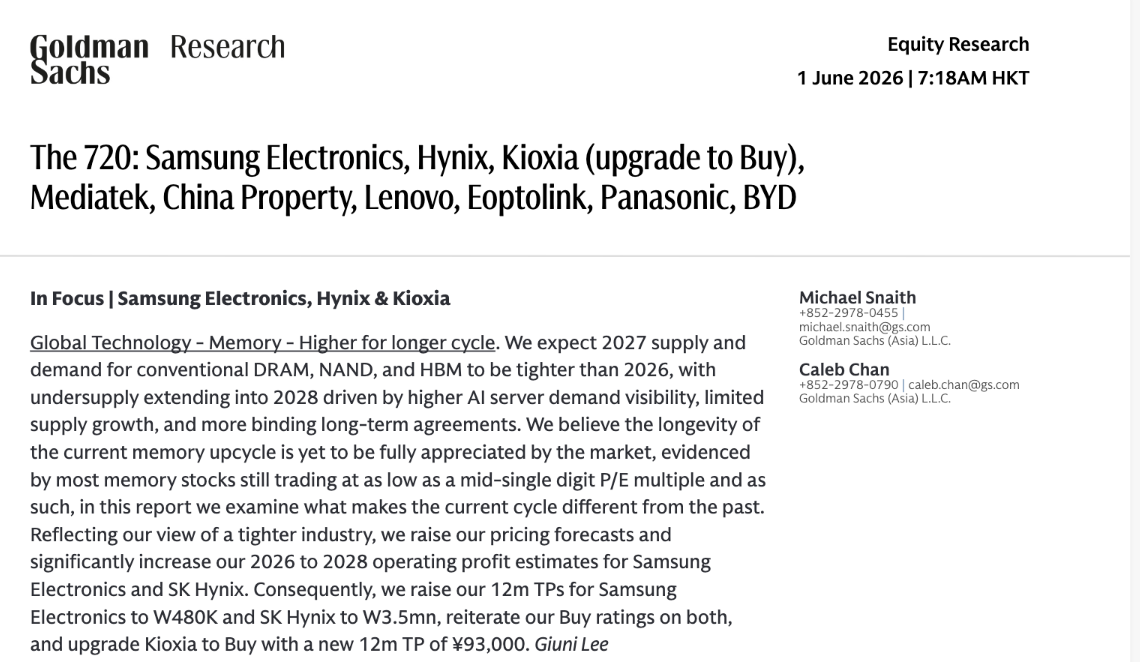
Goldman Sachs' most significant prediction this time is that the current storage upswing cycle "will last longer," with shortages extending into 2028, and the market is significantly underestimating its length. The evidence lies in valuations: most storage stocks are still trading at mid-single-digit P/E ratios, as if the market believes this is just another ordinary cyclical rebound—a view Goldman Sachs disagrees with.
The following sections are broken down by importance, and a quick overview of the targets is attached at the end.
The main event: Storage shortages are expected to last until 2028, with three companies collectively raising their prices.
Goldman Sachs compared this cycle with past ones and concluded that this one is different. They cited three reasons: higher visibility of AI server demand, limited supply growth, and increasingly rigid long-term supply agreements (locking in orders and prices). These three factors combined will result in a tighter supply and demand situation for DRAM, NAND, and HBM in 2027 than in 2026, with shortages extending into 2028.
The most intuitive example is Goldman Sachs' DRAM supply and demand chart. Negative numbers represent supply shortages; the deeper the gap, the stronger the price support. Goldman Sachs has lowered all its forecasts for 2026 to 2028 into a deeper shortage range, with the 2027 forecast revised from -2.5% to -5.9%, almost doubling. In simpler terms, Goldman Sachs believes that memory manufacturers will face increasing shortages next year and the year after, meaning that price increases can last longer.
When it comes to specific companies, three were collectively targeted:
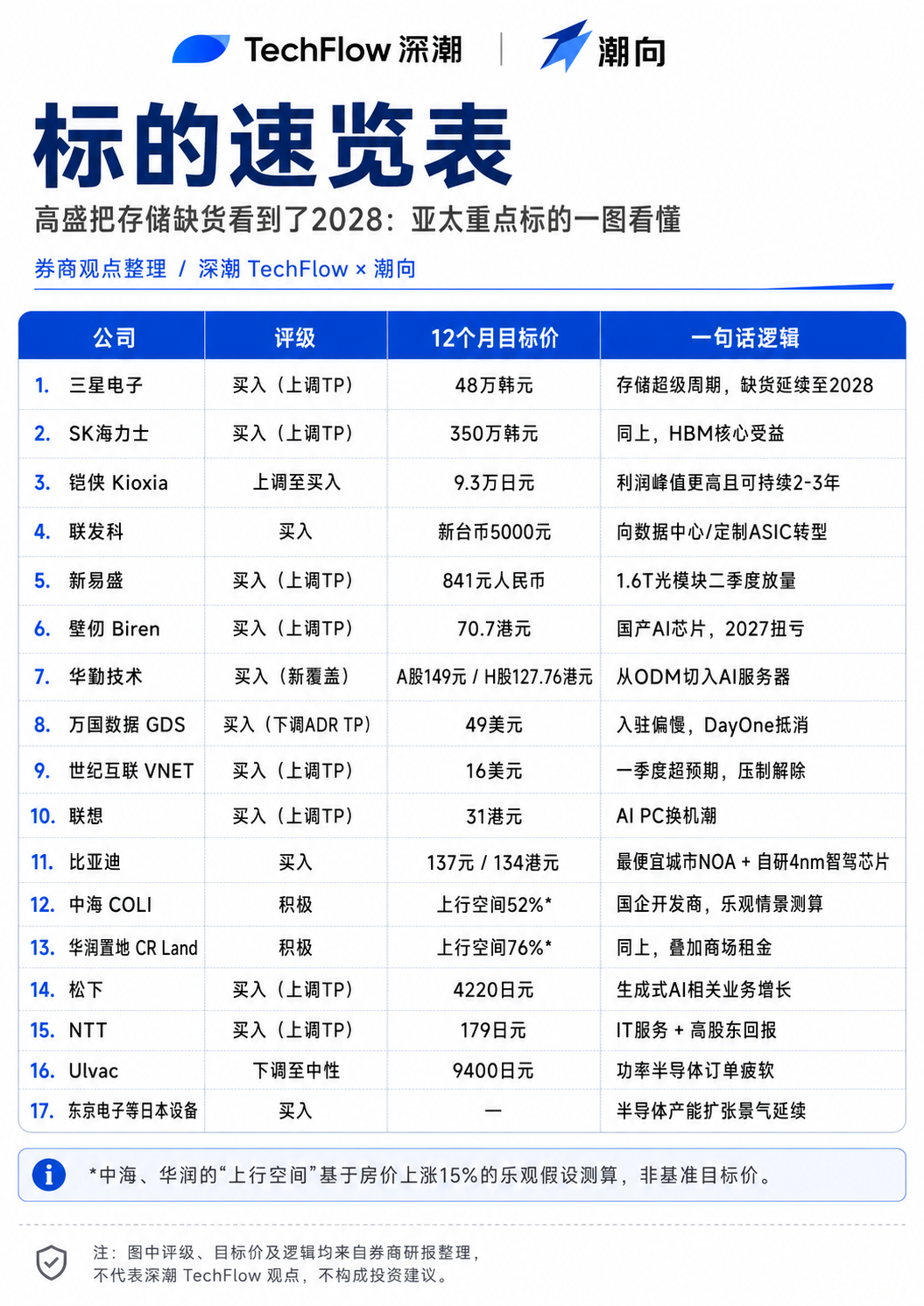
- Samsung Electronics : Raises 12-month target price to 480,000 won, maintains buy rating.
- SK Hynix : Raises 12-month target price to 3.5 million won, maintains buy rating.
- Kioxia : Upgraded from Hold to Buy, with a new target price of 93,000 yen.
Kioxia was the only company to receive a rating upgrade this period, and Goldman Sachs' reasoning deserves separate consideration: they believe the peak profit of this cycle is higher than previously anticipated and can be sustained for two to three years, rather than a sudden surge followed by a decline. Based on this, Goldman Sachs raised its operating profit forecasts for Kioxia for fiscal years 2027 to 2029 by 16% to 48% in one go, and expects gross margins to remain at a high level of around 80%. Giving a judgment that high profits can be sustained for three years for a company in a highly cyclical business like storage is a very strong statement.
AI computing power supply chain "full package": from chips to optical modules to data centers
Beyond storage, this episode covers almost the entire AI hardware supply chain in China and Asia, all unified by a single main theme: global cloud vendors (hyperscalers) are accelerating their capital expenditures, and money is flowing down this chain.
- MediaTek : Buy, target price NT$5,000. The key point is its transformation from mobile chips to data center and custom ASICs (AI chips tailored to specific customers). The company aims to achieve $2 billion in data center/AI ASIC revenue by 2026 and capture 10% to 15% of the $70-80 billion ASIC market by 2027.
- Eoptolink : Buy, target price raised to RMB 841. It manufactures optical modules, a key component for high-speed data transmission in AI data centers. Goldman Sachs is optimistic about its 1.6T optical module production ramping up from Q2, accelerating in the second half of the year, and its capacity expansion in Thailand. Goldman Sachs has raised its earnings forecasts for 2027 and 2028 by 5% and 6%, respectively.
- Biren : Buy, target price raised to HK$70.7. A domestic AI chip manufacturer, its subsidiary Bili166 has received a Level 1 security and reliability rating. Goldman Sachs expects it to turn a profit in 2027 as its products migrate to AI chips with higher computing power and become more expensive, and has raised its revenue forecasts for 2026 to 2030 by 4% to 28%.
- Huaqin Technology : Buy, a new addition to this coverage list. The target price for its A-shares is RMB 149, and we are initiating coverage of its H-shares with a target price of HKD 127.76. The rationale is that it has transitioned from consumer electronics ODM to AI data centers, and is projected to achieve a CAGR of 32% in revenue from 2025 to 2027.
- Data center giants : GDS (Gross Data) maintains Buy rating, but ADR target price is lowered to $49 (slow onboarding speed and lower monthly service revenue, partially offset by higher valuation of overseas DayOne business); 21Vianet (VNET) maintains Buy rating, but target price is raised to $16 (better-than-expected Q1 results, strong capacity ramp-up execution, and relief from pressure from strategic investors).
- Lenovo : Buy, target price raised from HK$27 to HK$31. This is based on the AI PC replacement cycle. Goldman Sachs predicts its laptop market share will expand to 28% by 2028, with AI laptop penetration reaching 66%, driving up the overall average price. Its earnings forecasts for Lenovo in fiscal years 2027 and 2028 are 22% and 25% higher than the Bloomberg consensus estimate, respectively, indicating a significant divergence.
Not part of the main AI theme, but still mentioned as a target.
- China's real estate sector (COLI and CR Land) : Goldman Sachs is assessing whether the current rebound in the real estate sector is sustainable. It assumes an optimistic scenario where 15 key cities follow the recovery in housing prices in Shanghai and Shenzhen, with prices rising by 15% by the end of 2028. Under this premise, it estimates that COLI and CR Land's cash profits could expand by more than 30% and 50% respectively by 2028. Based on sum-of-the-parts valuations, Goldman Sachs gives COLI 52% and CR Land 76% upside potential and maintains a positive view on these two stronger state-owned developers. It's important to note that this is a calculation based on an optimistic assumption, not a baseline forecast.
- BYD (BYD) : Buy, target price RMB 137 / HKD 134. The highlight is its intelligent strategy launch event, where it made the "God's Eye B" City Navigation Assist (NOA) a standard option for all models at RMB 12,000, lowering the price of the entry-level model equipped with NOA to RMB 78,800, making it the cheapest city NOA car in China. Simultaneously, it released its first self-developed 4nm intelligent driving chip, "Xuanji A3," which is already in mass production. Goldman Sachs believes these engineering capabilities will increase the penetration rate of advanced intelligent driving, reduce costs, and improve profit margins.
- Japanese semiconductor equipment : Goldman Sachs maintained its buy ratings on Lasertec, Ebara, Disco, and Tokyo Electron. The only contrarian move was downgrading vacuum equipment manufacturer Ulvac (6728.T) from buy to neutral, lowering the target price to 9400 yen, citing weak orders for high-margin power semiconductors and slower-than-expected gross margin expansion.
- Panasonic (HD) : Buy, target price raised from 4,000 yen to 4,220 yen, optimistic about generative AI-related businesses (backup power supplies, copper clad laminates (CCL), high-performance capacitors).
- NTT : Buy, target price slightly raised from ¥176 to ¥179, based on domestic IT service demand and the safety margin provided by a total shareholder return of approximately 5%.
A central theme: The AI boom collides with the energy crisis.
What connects these individual stocks is Goldman Sachs' macroeconomic assessment: emerging markets are being torn in two by two forces. On one hand, there's the AI investment boom; on the other, there's the energy supply contraction caused by the blockade of the Strait of Hormuz.
Technology-exporting economies like South Korea and Taiwan benefit from surging exports and current account surpluses; while energy-importing countries face rising inflation, weakening currencies, and fuel subsidies straining their finances. Goldman Sachs predicts that the average Brent crude oil price will be $90 per barrel in the fourth quarter, continuing to put pressure on economies heavily reliant on imported oil, and recommends overweighting stocks in China, South Korea, Brazil, and South Africa. This trend aligns with the recent macroeconomic backdrop of the Iranian situation and oil prices.
Two other points that directly impact the liquidity of A-shares:
China’s imports surged 23.6% year-on-year in the first four months of this year, but Goldman Sachs believes this is a highly concentrated phenomenon, with gold and semiconductors accounting for about 65% of the increase in imports, and does not indicate a continued deterioration in the external balance.
Goldman Sachs estimates that the semi-annual rebalancing of the CSI and CNI indices will bring more than $48 billion in two-way passive fund flows, with the technology hardware and semiconductor and capital goods sectors seeing the largest inflows ($3.1 billion and $1.4 billion respectively), while healthcare and banking sectors will see the largest outflows. Newly added stocks specifically mentioned as "expected to receive the largest net inflows of passive funds" include HGTECH, Yuanjie Technology, Hua Hong Semiconductor, GigaDevice, and VeriSilicon. This is a sure sign for funds seeking arbitrage opportunities related to index rebalancing.
Finally, Goldman Sachs, as usual, included a bonus: their 2026 World Cup winning probability predictions, with Spain leading at 26%, followed by France at 19%, Argentina at 14%, Brazil at 8%, and England at 5%. The model penalized defending champions Argentina, so take it with a grain of salt.
Target Quick Overview
Please note the following three points when reading:
1. Target price is an analyst's expectation for a future period (usually 12 months). It is a forecast rather than a commitment and will be repeatedly adjusted according to company performance and market conditions.
Second, sell-side research reports tend to be more prevalent. It's common for securities firms to give "buy" ratings to the companies they cover, and some of these companies have investment banking or other business relationships with the securities firm. A list dominated by "buy" ratings should be read with this in mind.
Third, the value of a research report lies in its core logic and the underlying assumptions, not in a specific target price. Only when the core logic holds true can the logic of the related stocks hold true; once the core logic is proven false, the entire group of stocks will falter. Focus on the logic, not just the price.