Author: Biteye
Currently, SpaceX's IPO pricing is initially set at $135 per share, with a planned fundraising scale of approximately $75 billion, corresponding to a fully diluted valuation of approximately $1.77 trillion, which has essentially secured its position as the largest IPO in the history of the capital market.
If this scale is ultimately realized, Musk's net worth will surge by more than $220 billion, making him the world's first trillionaire.
However, with great power comes great responsibility. The SpaceX IPO is attracting so much attention not only because it may become the largest IPO in history, but also because the capital market is already debating its valuation.
Is SpaceX really worth $1.77 trillion? With an extra $220 billion in his pocket, can Musk sleep at night?
Bullish: Underwriters use Starlink, rocket launches, and AI to tell a long-term story.
Many believe that betting on SpaceX is not just about being optimistic about the rocket company, but also about preemptively positioning oneself for the future of space infrastructure.
A $1.77 trillion valuation may seem high, but if Starlink, low-cost launches, and AI businesses continue to deliver, $135 has a long-term story to support it.
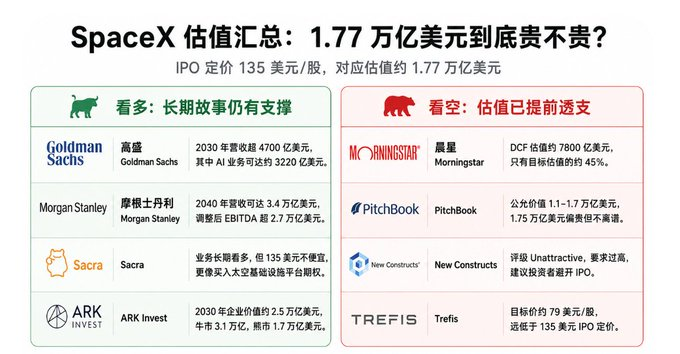
1. Goldman Sachs @GoldmanSachs | X Followers: 1.132 million | XHunt Ranking: 12015 | Top global investment bank, one of the core underwriters of SpaceX IPO.
Key takeaway: SpaceX's valuation should not be understood solely in the traditional sense of a space company; rather, it should be integrated into a long-term growth model, encompassing Starlink and future AI businesses.
Goldman Sachs projects SpaceX's revenue to be approximately $160 billion in 2028 and over $470 billion in 2030.
The AI division is considered the most aggressive part of the company. Goldman Sachs predicts that SpaceX's AI-related business will generate approximately $322 billion in revenue by 2030.
2. Morgan Stanley @MorganStanley | X Followers: 742,000 | XHunt Ranking: 32049 | Top global investment bank, one of the core underwriters of SpaceX IPO.
Key takeaway: SpaceX's long-term value comes from the compound growth of "space + AI", and its future revenue ceiling is far higher than that of traditional aerospace companies.
Morgan Stanley also projects SpaceX's revenue to be approximately $160 billion by 2028.
Even more aggressive is the long-term forecast: Morgan Stanley expects SpaceX's revenue to reach $3.4 trillion by 2040, with adjusted EBITDA exceeding $2.7 trillion.
If you're buying into the gateway to space infrastructure for the next decade or so, $135 is an undervaluation, but it will take a long time to realize its potential.
3. Sacra | An independent research firm focusing on unlisted technology companies, primarily conducting in-depth company research and valuation analysis.
Key takeaway: The business outlook is bullish in the long term, but $135 is not an undervaluation price; it's more like buying an option to transform SpaceX from an aerospace company into a space infrastructure platform.
Sacra estimates SpaceX's revenue at approximately $18.7 billion by 2025, with Starlink contributing $11.4 billion, making it the company's most important profit center.
It believes that SpaceX's core advantage lies in vertical integration: building its own rockets, launching them itself, deploying its own satellites, and controlling its own terminals and ground networks, thus creating a cost advantage that is difficult for competitors to replicate.
If you only consider the current Starlink and rocket launch businesses, $135 isn't cheap. This price is more acceptable if you believe SpaceX can expand from a space company into a comprehensive platform covering satellite internet, low-cost launches, and more space infrastructure.
4. ARK Invest @ARKInvest | X Followers: 816,000 | XHunt Ranking: 1637 | An innovative technology investment institution under Sister Wood, focusing on disruptive technology assets.
Key takeaway: While SpaceX's $1.77 trillion valuation is high, it is not entirely without support when considering its long-term potential up to 2030.
ARK Invest's open-source valuation model for SpaceX projects a company value of approximately $2.5 trillion by 2030. According to their model, the bull market scenario yields a valuation of around $3.1 trillion, while the bear market scenario projects around $1.7 trillion.
ARK's core logic is that SpaceX's value comes not only from rocket launches, but also from Starlink's global satellite internet network, low-cost launch capabilities, and future space infrastructure businesses.
According to ARK's prediction, the IPO subscription price of $135 still has some room to rise.
Bearish: Independent institutions believe IPO valuations are already severely overvalued.
Those who are bearish on SpaceX do not deny that it is the world's most scarce commercial space asset, nor do they deny the long-term value of Starlink.
However, they believe that the $1.77 trillion IPO valuation has already factored in too much future growth, especially given the significant uncertainty surrounding the AI business.
1. Morningstar @MorningstarInc | X Followers: 238,000 | XHunt Ranking: 98209 | A globally renowned independent investment research institution that commonly uses fundamental and DCF models to assess company value.
Key takeaway: SpaceX is a good company, but its IPO valuation is significantly too high.
Morningstar's DCF model gives SpaceX a fair value of approximately $780 billion, only about 45% of its IPO target valuation of $1.77 trillion.
In Morningstar's breakdown valuation, SpaceX's core launch business plus Starlink business is valued at approximately $611 billion, while xAI/AI-related businesses are valued at approximately $170 billion after probability weighting.
Morningstar also highlighted two risks: Musk is a key figure at SpaceX, and the company's valuation includes a significant "Musk premium." Furthermore, after the IPO, the expiration of the lock-up period could lead to selling pressure from early shareholders and employees.
Morningstar believes that the price of 135 is obviously too expensive and not suitable for rushing to buy. There may be a better buying opportunity after the IPO.
2. PitchBook @PitchBook | X Followers: 48,000 | XHunt Ranking: 49,174 | Global private equity, venture capital and unlisted company data platform, covering a large amount of valuation and financing information for unlisted companies.
Key takeaway: A price of around $1.5 trillion is acceptable, while $1.75 trillion is expensive, but not entirely irrational.
PitchBook uses the Sum-of-the-Parts model to estimate SpaceX's fair value to be between $1.1 trillion and $1.7 trillion, primarily focused on its launch business and Starlink, and not entirely reliant on the xAI narrative.
The price of 135 is close to or even slightly higher than the upper limit of PitchBook's valuation range. It's not cheap, but if we look at the long-term realization of Starship and Starlink, it can't be said to be completely outrageous.
3. New Constructs @NewConstructs | X Followers: 5675 | XHunt Ranking: - | Independent stock research firm focusing on financial quality, valuation risk, and inverse DCF analysis.
Key takeaway: SpaceX is not worth participating at its $1.75 trillion valuation; investors are advised to avoid the IPO.
New Constructs rated SpaceX as Unattractive. They believe that the $1.75 trillion valuation implies excessive future growth and profit requirements, and SpaceX would have to become one of the highest-revenue and most profitable companies in the US stock market to justify the price.
SpaceX faces risks including inadequate internal accounting controls, virtually no voting rights for public investors, the potential use of substantial IPO proceeds to repay debt, misleading non-GAAP accounting practices, and related-party transaction risks.
To support its $1.75 trillion valuation, SpaceX may need to reach $1.1 trillion in revenue by 2035, equivalent to an average annual growth of about 50% over the next decade. Fortune believes that such a growth rate is virtually unprecedented.
New Constructs' assessment is the most straightforward: the risk-reward ratio at this price is not worthwhile, and participation in the IPO is not recommended.
4. Trefis @Trefis | X Followers: 2661 | XHunt Ranking: - | Independent US stock valuation platform that derives company target prices by breaking down business models.
Key takeaway: SpaceX is a very rare company, but the offering price of $135 is clearly too high.
Trefis acknowledges SpaceX’s long-term advantages in commercial spaceflight, Starlink satellite internet, and low-cost launches, but believes these advantages do not mean investors should ignore prices.
Trefis has set a target price of approximately $79 per share for SpaceX, well below the $135 IPO price.
In conclusion
Whether you're bullish or bearish, most people acknowledge that SpaceX is one of the world's rarest commercial space companies.
The real controversy lies in whether the price of $135 provides any safety margin.
Many believe that SpaceX is buying into the long-term story of Starlink, low-cost launches, AI, and future space infrastructure.
Those who are bearish believe that $135 has already priced in the full expectations.
The current IPO subscription multiple for $SPCX has reached 4 times, indicating that despite the significant controversy surrounding its valuation, investor enthusiasm for SpaceX remains high.
So here's the question: Will you participate in the $SPCX IPO? Do you think Musk is taking that $220 billion with a clear conscience, or is he feeling uneasy about it?