
Source: variant.fund
Compiled by: Zhou, ChainCatcher
If the core value of cryptocurrencies lies in providing new financial pathways, then the lack of widespread adoption of on-chain options is perplexing.
In the US stock market alone, daily trading volume for individual stock options is approximately $450 billion, representing about 0.7% of the total market capitalization of the $68 trillion US stock market. In contrast, daily trading volume for cryptocurrency options is approximately $2 billion, representing only 0.06% of the approximately $3 trillion market capitalization of cryptocurrencies (relatively 10 times lower than stocks). Although decentralized exchanges (DEXs) currently handle over 20% of cryptocurrency spot trading volume, almost all options trading is still conducted through centralized exchanges (CEXs) such as Deribit.
The difference between traditional options markets and on-chain options markets stems from early design limitations and the lack of infrastructure that enabled them to meet two key elements of a healthy market: protecting liquidity providers from bad order flows and attracting good order flows.
The infrastructure needed to address the former is now in place—liquidity providers can finally avoid being devoured by arbitrageurs. The remaining challenge, and the focus of this article, is the latter: how to develop effective market entry strategies (GTMs) to attract high-quality order flows. This article argues that on-chain options protocols can thrive by targeting two distinct sources of high-quality order flows: hedgers and retail investors.
The Trials and Tribulations of On-Chain Options
Similar to the spot market, the first on-chain options protocol draws on the order book, a market design that dominates traditional finance.
In the early days of Ethereum, transaction activity was sparse and gas fees were relatively low. Therefore, order books seemed like a reasonable mechanism for options trading. The earliest example of options order books can be traced back to EtherOpt in March 2016 (EtherDelta, the first popular spot order book on Ethereum, was launched a few months later). However, in reality, on-chain market making is very difficult; gas fees and network latency make it challenging for market makers to provide accurate quotes and avoid losing trades.
To address these issues, next-generation options protocols employ Automated Market Makers (AMMs). Instead of relying on individuals to conduct market transactions, AMMs obtain prices from either the internal token balance of liquidity pools or external price oracles. In the former case, the price is updated when traders buy or sell tokens in the liquidity pool (changing the pool's internal balance); the liquidity provider itself does not set the price. In the latter case, the price is updated periodically when a new oracle price is published on-chain. Protocols such as Opyn, Hegic, Dopex, and Ribbon adopted this approach from 2019 to 2021.
Unfortunately, AMM-based protocols have not significantly increased the adoption of on-chain options. The reason why AMMs can save gas fees (i.e., prices are set by traders or lagging oracles rather than liquidity providers) is precisely because their characteristics make liquidity providers vulnerable to losses from arbitrageurs (i.e., adverse selection).
However, what truly hinders the widespread adoption of options trading is perhaps that all early versions of options agreements (including those based on order books and automated market makers) required short positions to be fully collateralized. In other words, sold call options had to be hedged, and sold put options had to be cash-backed, making these agreements capital inefficient and depriving retail investors of a crucial source of leverage. Without this leverage, retail demand diminishes as the incentive disappears.
Sustainable Options Exchanges: Attracting High-Quality Order Flows and Avoiding Low-Quality Order Flows
Let's start with the basics. A healthy market needs two things:
- Liquidity providers' ability to avoid "bad order flows" (i.e., avoiding unnecessary losses). "Bad order flows" refer to arbitrageurs profiting at the expense of liquidity providers, thus gaining virtually risk-free profits.
- The strong demand stems from the need to provide a "high-quality order flow" (i.e., to make money). A "high-quality order flow" refers to traders who are not price-sensitive and who, after paying the spread, generate profits for the liquidity provider.
A review of the history of on-chain option protocols reveals that their past failures stemmed from the failure to meet both of the above conditions:
- Early options protocols' technological infrastructure limitations prevented liquidity providers from avoiding bad order flows. The traditional method for liquidity providers to avoid bad order flows was to update quotes on the order book for free and frequently, but delays and fees in the order book protocol in 2016 made on-chain quote updates impossible. Migrating to Automated Market Makers (AMMs) also failed to solve this problem because their pricing mechanisms are relatively slow, putting liquidity providers at a disadvantage in competition with arbitrageurs.
- The requirement for full collateral eliminates the option function (leverage) valued by retail investors, which is a key source of high-quality order flow. Without other on-chain option usage solutions, high-quality order flow is impossible.
Therefore, if we want to build an on-chain options protocol by 2025, we must ensure that both of these challenges are resolved.
In recent years, numerous changes have demonstrated that we can now build infrastructure that enables liquidity providers to avoid bad order flows. The rise of application-specific (or industry-specific) infrastructure has significantly improved market design for liquidity providers across various financial application areas. Among the most important of these are: speed bumps for delayed order execution; order placement-only prioritization; order cancellation and price oracle updates; extremely low gas fees; and censorship resistance mechanisms in high-frequency trading.
With the help of innovation at scale, we can now build applications that meet the requirements of a good order flow. For example, improvements in consensus mechanisms and zero-knowledge proofs have made block space costs low enough to enable sophisticated margin engines to be implemented on-chain without full collateralization.
Solving the problem of bad order flow is primarily a technical issue, and in many ways, it's actually "relatively easy." Admittedly, building this infrastructure is technically complex, but that's not the real challenge. Even if the new infrastructure enables the protocol to attract good overflow traffic, it doesn't mean that good order flow will magically appear. Instead, the core question, and the focus of this article, is: assuming we now have the infrastructure to support good order flow, what kind of marketing strategy (GTM) should the project employ to attract this demand? If we can answer this question, we have a chance to build a sustainable on-chain options protocol.
Price-insensitive demand characteristics (good order flow)
As mentioned above, a good order flow refers to price-insensitive demand. Generally, price-insensitive demand for options mainly consists of two types of core customers: (1) hedgers and (2) retail customers. These two types of customers have different goals, and therefore use options in different ways.
hedge funds
Hedgers are institutions or businesses that believe risk reduction is valuable enough and are willing to pay a certain amount above market value.
Options are attractive to hedgers because they allow them to precisely control downside risk by choosing the exact price level at which losses are stopped (the strike price). This differs from futures, where hedging is either/or; futures protect your position in all circumstances but do not allow you to specify the price at which protection takes effect.
Currently, hedgers account for the vast majority of cryptocurrency options demand, and we expect this to come primarily from miners, who are the first "on-chain institutions." This is evident from the dominance of Bitcoin and Ethereum options trading volume, and the fact that mining/validation activity on these chains is more institutionalized than on other chains. Hedging is crucial for miners because their income is denominated in highly volatile crypto assets, while many of their expenses—such as salaries, hardware, hosting, etc.—are denominated in fiat currency.
retail
Retail investors refer to individual speculators who aim to profit but lack experience—they typically trade based on intuition, belief, or experience rather than models and algorithms. They generally prefer a simple and easy-to-use trading experience, and their driving force is getting rich quickly, rather than rationally considering risks and rewards.
As mentioned above, retail investors have historically favored options due to their leverage. The explosive growth of zero-day options (0DTEs) in retail trading exemplifies this—0DTEs are widely regarded as a speculative leveraged trading instrument. In May 2025, 0DTEs accounted for over 61% of S&P 500 index option trading volume, with the majority of that volume coming from retail users (especially on the Robinhood platform).
Despite the popularity of options in the financial trading world, retail investor acceptance of cryptocurrency options is virtually zero. This is because there is a better cryptocurrency tool for retail investors to leverage long and short positions, which is currently unavailable in the financial trading world: perpetual contracts.
As we've seen in hedging, the biggest advantage of options lies in their level of sophistication. Options traders can consider going long/short, timeframe, and strike price, making options more flexible than spot, perpetual, or futures trading.
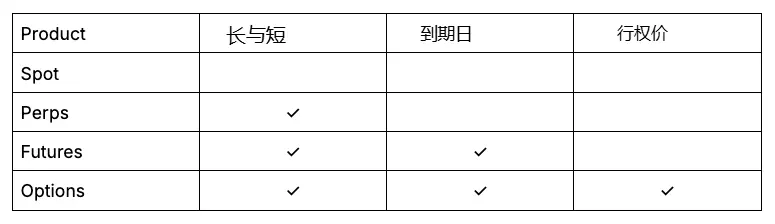
While more combinations offer greater granularity, which is exactly what hedgers desire, they also require more decision-making, often overwhelming retail investors. In fact, the success of 0DTE options in retail trading can be largely attributed to the fact that 0DTE options improve the user experience of options by eliminating (or significantly simplifying) the time dimension (“zero day”), thus providing a simple and easy-to-use leveraged tool for going long or short.
Options are not considered leverage tools in the cryptocurrency space because perpetual contracts are already very popular and are simpler and easier to leverage for long/short positions than 0DTE options. Perpetual contracts eliminate the factors of time and strike price, allowing users to continuously leverage long/short positions. In other words, perpetual contracts achieve the same goal as options (providing leverage for retail investors) with a simpler user experience. Therefore, the added value of options is significantly reduced.
However, options and cryptocurrency retail investors are not entirely without hope. Beyond simple long/short operations using leverage, retail investors crave exciting and novel trading experiences. The sophisticated nature of options means they can deliver entirely new trading experiences. One particularly powerful feature is allowing participants to trade directly on volatility itself. Take, for example, the Bitcoin Volatility Index (BVOL) offered by FTX (now closed). BVOL tokenized implied volatility, allowing traders to directly bet on the magnitude of Bitcoin price fluctuations (regardless of direction) without managing complex options positions. It packaged trades that typically require straddles or straddles into a tradable token, making volatility speculation easy and convenient for retail users.
Marketing strategies targeting price-insensitive demand (good order flow)
Now that we have identified the characteristics of price-insensitive demand, let’s describe the GTM strategies that the protocol can use to attract good order flows to the on-chain options protocol for each characteristic.
Hedgers GTM: Meet the miners where they are.
We believe the best marketing strategy to capture hedging flows is to target hedgers, such as miners currently trading on centralized exchanges, and offer a product that allows them to own the protocol through tokens while minimizing changes to their existing custody setup.
This strategy mirrors Babylon's user acquisition approach. When Babylon launched, a large number of off-chain Bitcoin hedge funds already existed, and miners (some of the largest Bitcoin holders) were likely already able to leverage these funds for liquidity. Babylon primarily built trust through custodians and staking providers (especially in Asia), catering to their existing needs; it didn't require them to try new wallets or key management systems, which often require additional trust assumptions. Miners' adoption of Babylon indicates their emphasis on the autonomy to choose custody options (whether self-custody or choosing another custodian), gaining ownership through token incentives, or both. Otherwise, Babylon's growth would be difficult to explain.
Now is an excellent time to leverage this global trading platform (GTM). Coinbase's recent acquisition of Deribit, a leading centralized exchange in the options trading space, poses a risk to foreign miners who may be unwilling to deposit large sums of money in US-controlled entities. Furthermore, the improved viability of BitVM and the overall improvement in the quality of Bitcoin bridges are providing the necessary custodial guarantees for building an attractive on-chain alternative.
Retail Marketing Promotion: Providing a Brand New Transaction Experience
Instead of trying to compete with criminals using the same tricks they use, we believe the best way to attract retailers is to offer them novel products that simplify the user experience.
As mentioned above, one of the most powerful features of options is the ability to directly observe volatility itself without considering price movements. On-chain options protocols can create a vault, allowing retail users to trade long and short positions on volatility through a simple user experience.
Traditional options libraries (such as those on Dopex and Ribbon) were vulnerable to arbitrage by arbitrageurs due to their inadequate pricing mechanisms. However, as we mentioned earlier, recent innovations in specific infrastructure applications have provided clear reasons why it's possible to build an options library free from these problems. Options chains or options aggregations can leverage these advantages to improve the execution quality of long/short volatility options libraries while also enhancing order book liquidity and order flow.
in conclusion
The conditions for the success of on-chain options are finally gradually being met. The infrastructure is becoming increasingly mature, sufficient to support more efficient capital utilization schemes, and on-chain institutions now have a real reason to hedge directly on-chain.
By building infrastructure that helps liquidity providers avoid bad order flows and by constructing on-chain options protocols around two price-insensitive user groups—hedging clients seeking precise trades and retail investors seeking entirely new trading experiences—a sustainable market can ultimately be established. With this foundation, options can become a core component of the on-chain financial system in unprecedented ways.