Author: Leon Abboud
Compiled by: Deep Tide TechFlow
The crypto industry is handing over young talent to other fields, such as artificial intelligence (AI). This phenomenon is a heavy blow to the future of the industry.
When young talents begin to look to other industries for opportunities, this situation is similar to the phenomenon of young people in a country leaving their hometowns in pursuit of better career prospects.
You have lost the minds that should have been driving the future forward.
Economists call this phenomenon "brain drain".
I grew up in Lebanon, a country that suffers greatly from a "brain drain." Almost everyone I knew who had the opportunity to study abroad at university chose to leave without hesitation. And the result? Not a single one of them came back.
They all stayed abroad, where they started businesses, developed their careers, and built families.
All the talent that could have been used to build the nation has been lost forever.
This kind of problem is now playing out in the crypto industry.
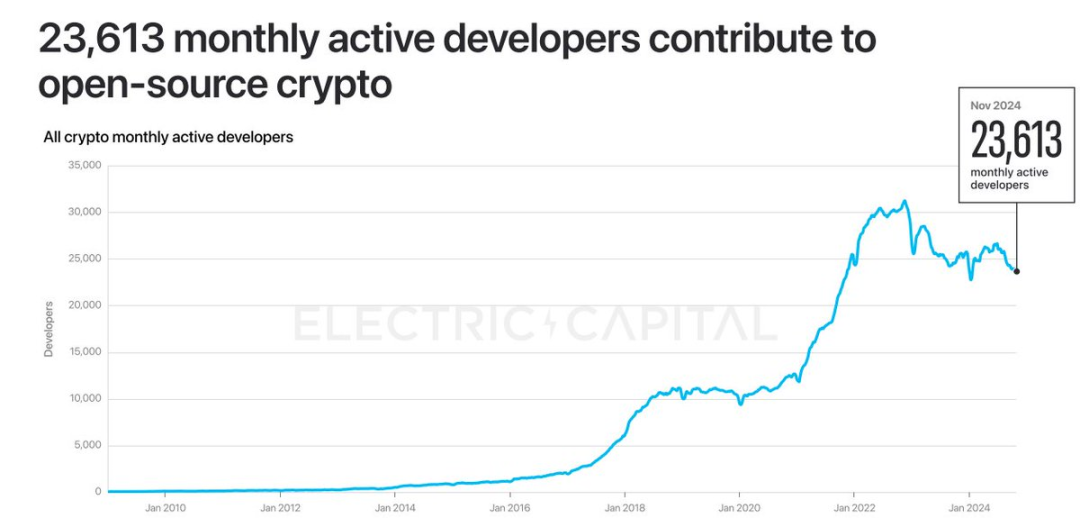
We are sending talent to industries like artificial intelligence (AI). The reason isn't that these industries offer higher salaries, but rather that they tell a more compelling story.
Recent graduates often pursue a story rather than a salary. Full of passion and energy, they aspire to build their careers in an industry that can shape the future.
This used to be the story of the crypto industry. In the last cycle, the crypto industry had a completely different narrative: privacy, self-sovereignty, censorship resistance, the future of finance…
These ideas have attracted a group of minds eager to get involved and want to be a part of this story.
But now, we are losing this narrative, and we are also losing the identity that makes this industry unique.
At the same time, AI is providing young people with the stories they crave.
AI tells young people that they can redefine how humans think, work, create, and communicate. They can develop tools that will change civilization...
The crypto industry, however, is drifting in a completely different direction. Its mission has become unclear.
This industry has gradually lost its "sports" feel and is more like the lobby of the Bellagio casino in Las Vegas.
Nowadays, few people can tell a story that makes a 22-year-old feel the call of adventure.
We used to have that story, but then we became a casino, a huge online casino.
Casinos don't incentivize talent; they only attract tourists. It's important to note that casino-like behavior isn't the root of the problem; it's merely a symptom.
We become casinos because we lose our own stories, not the other way around.
Young people are flocking to AI not because it's morally superior, but because it feels incredibly meaningful. It makes them feel like they're participating in a larger cause, that history is being written in real time, and that anyone can pick up a pen and write their part in it.
The crypto industry used to give people that feeling, but not anymore.
The good news is that stories are not static; they can be rewritten.
The renaissance of the crypto industry will not be written by institutions, ETFs, or multi-billion dollar foundations, but by people like you and me who have truly shaped this field.
It is our young, persistent, and imaginative minds.
If we want this industry to have a prosperous future, we need to make it more attractive to young people. And to do that, we must offer them a story worth traveling across oceans for.
Here, I present a completely new story:
Crypto Twitter is lost
Crypto Twitter has lost its way. The energy that once bound us together is dissipating because the shared story that sustained us has vanished.
In the past, this was a community connected by shared values among "early participants," "rebels," and "misunderstood individuals," but now it has slid into endless mediocrity.
Standards are declining because profit has replaced mission. Many people are starting to attract attention by creating dramatic conflicts and spreading fake news, even calling this behavior "culture."
Some people have turned their accounts into "traffic farms," with content creators hiring so-called "response-boosting" users to create interaction and pretend no one will notice. Everyone is "manipulating rankings" in the most obvious ways, and what's worse, we all pretend it's normal.
The root of all this is that encrypted Twitter, as a community, has lost the story that once sustained it.
The window of opportunity remains open, but it won't stay open forever.
The Identity Crisis of Crypto Twitter
Anyone active on Crypto Twitter has likely noticed the industry's culture is rapidly deteriorating. There are two main reasons behind this.
The first reason is the industry's excessive incentive mechanisms; but a deeper reason is that encrypted Twitter has lost the story it once told itself.
Before this bull market, the core of crypto Twitter was a group of people who considered themselves "early adopters." They saw themselves as rebels, standing at the forefront of a misunderstood cutting-edge industry.
This group was able to see the potential of NFTs when the rest of the world thought they were a scam. Because these people make up the core of crypto Twitter, a unique culture has emerged—a culture of rebels, a culture of early builders, a culture that believes it is shaping the future of the internet.
However, this rebellious industry culture gradually disappeared during this bull market.
When institutions begin investing billions of dollars, being involved in or working in the crypto industry is no longer a symbol of rebellion.
When even US presidents started issuing memecoins, and my uncle invested in them with ETFs, we lost our identity as "rebels" and ceased to be a "different" group.
As a result, encrypted Twitter has lost its identity.
Every community needs to reinvent itself.
To survive, Crypto Twitter needs a new story; it needs to redefine itself. Like Apple—in the 1980s, Apple was a product for rebels, but as it moved into the mainstream, it had to reinvent itself, no longer solely targeting rebels, because it was no longer that niche brand.
Apple has repositioned itself as a "guardian of creativity against conformity." Even as an industry giant, "Think Different" remains its new slogan.
Each community reinvents itself by replacing the old with new myths and stories, and this is the reality that crypto Twitter must confront. We are no longer “early adopters” or “rebels”; we need a new narrative.
When you think about the impact of the crypto industry, whether it's the penetration of memecoins, Bitcoin, institutional investment, and mainstream culture in this bull market, or the involvement of NFTs, Bored Apes, and celebrities in the last bull market, there's one thing we can agree on: the crypto industry knows how to create culture.
We stand at the forefront of the internet and the forefront of technology. We have witnessed many crypto-native founders and creators go mainstream, and we have also witnessed mainstream stars launch their projects through the crypto industry.
The crypto industry is an undeniable bridge to culture. And one of the narratives we can all agree on is that we are the factories that manufacture culture.
We need a new "enemy" to fight.
No community can survive without a common enemy. For Crypto Twitter, our past "enemies" have been the U.S. Securities and Exchange Commission (SEC), the government, and those agencies that have tried to ban us, take away our jobs, and disqualify us from making a living.
However, these "enemies" have now been defeated and have even joined our ranks. We have lost our external adversaries, so we have begun to fight amongst ourselves and instead attack each other.
We need a new "enemy" to fight. While I can't give a definitive answer right now, I believe encrypted Twitter can fight to save the internet—against the "Dead Internet Theory." The internet is gradually dying, and soon comment sections will become unusable, and the public internet will be overwhelmed by bots.
Encryption and NFTs are the only solutions to this problem. This is the "villain" I can imagine, and also the target our entire industry can fight together.
The only way forward for encrypted Twitter is to write a completely new story for itself—a story we all believe in, and to relentlessly push it forward before anyone else does. This story may seem crazy at first, but our task is to prove to the world that it isn't.
So, I ask you again: What is our new story?
Until this answer is found, encrypted Twitter is destined to continue its downward spiral.