
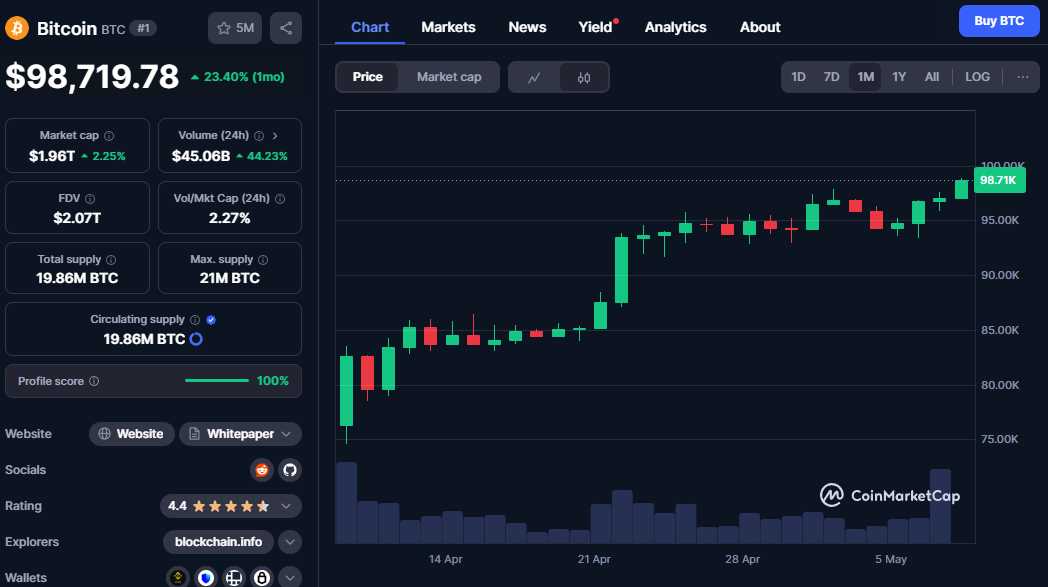
 In May 2025, the price of Bitcoin (BTC) was like a wild horse that had run away from its reins. It once sprinted to a nearly two-month high of $97,900, then took a short breath near $94,000, and quickly rebounded to around $97,000. This price carnival ignited the passion of the crypto market, and investors began to ask: What is driving this wave of gains? Is it Trump's high-profile trade declaration, or the direction of the Federal Reserve's monetary policy? Or is it the accelerated embrace of crypto assets by Wall Street giants? The answer may be a combination of the three. This article will tell the story in a narrative way, sorting out how the recent news has ignited the spark of Bitcoin, deeply analyzing the delicate pulse of on-chain data, and looking forward to the opportunities and concerns of the market, striving to be both fascinating and professional.
Trump's trade gamble: a catalyst for market sentiment
On May 8, Trump announced that he would make a major announcement in the Oval Office the next morning, regarding a trade agreement with "a highly respected power." The New York Times later revealed the answer: the agreement was with the United Kingdom. This news was like a spark, quickly igniting market speculation. Trump's trade policy has always been a weathervane for the global financial market, and this time is no exception. He also announced that he would announce a "very big news" before his visit to the Middle East next week, further stirring investors' nerves.
Trump's trade moves have already caused a stir several times in 2025. When he announced a 145% tariff on China in early April, the price of Bitcoin fell to $77,730, and global stock markets fell into the most violent shock since 2020. However, on April 10, he unexpectedly suspended some tariffs for 90 days, and market sentiment quickly turned around, with Bitcoin soaring 7% in a single day to $82,350. Today, a trade deal with the UK is seen as a potential positive that could ease global trade frictions and boost the appeal of risky assets. JPMorgan strategist Bram Kaplan keenly captured this trend and advised investors to buy S&P 500 call options, saying Trump's announcement could push the market higher. This optimism quickly spread to the crypto field, and a wave of capital inflows followed.
The Fed’s delicate chess game: the catalyst for rate cut expectations
On the same day, Federal Reserve Chairman Jerome Powell dropped a heavy signal at a press conference: the outlook for monetary policy may include interest rate cuts, but the specific path will be anchored by economic data. He downplayed the significance of GDP fluctuations and emphasized that the Fed will remain flexible. This statement injected a touch of warmth into the market, as interest rate cuts are often seen as a spring breeze for risky assets.
In 2025, the Fed's policies have a particularly significant impact on Bitcoin. On April 23, Trump denied rumors of firing Powell, and the market breathed a sigh of relief, and Bitcoin rebounded immediately. However, the tariff shock in early April caused Bitcoin to fall to a low of $81,500, highlighting the traction of the macro environment on the crypto market. The expectation of interest rate cuts indirectly fueled the rise of Bitcoin by reducing market liquidity costs, weakening the attractiveness of the US dollar, and enhancing the demand for inflation hedging.
But Powell's cautious words also foreshadowed. He made it clear that policy will keep a close eye on economic data, and if inflation or employment data exceeds expectations, interest rate cuts may be postponed. The market is in a delicate balance, and slight changes in external variables may trigger sharp fluctuations.
Wall Street’s Crypto Ambitions: The Influx of Institutional Money
On May 1, Morgan Stanley announced plans to launch crypto trading services on the E*Trade platform in 2026, marking a new stage in Wall Street's embrace of digital assets. Previously, its wealthy clients have been able to invest in crypto assets through Bitcoin ETFs and futures, and advisors have been allowed to promote ETFs since August 2024. Charles Schwab and other institutions have followed suit and plan to launch similar services. These actions pushed Bitcoin to briefly break through $97,000 on May 2.
The influx of institutional funds is reshaping the market ecology. The US spot Bitcoin ETF has absorbed $4.6 billion in the past two weeks, and the asset management scale is close to the historical high of 1.171 million BTC. In contrast, the continuous outflow from March to April has put pressure on the market, highlighting the sensitivity of institutional funds to the macro environment. Institutional participation not only improves market liquidity, but also paves the way for the mainstreaming of Bitcoin. However, in mid-April, affected by the tariff storm, the Bitcoin ETF outflowed about $1 million for 7 consecutive days, reminding investors that institutional funds are not monolithic.
On-chain data: a detailed portrayal of the market pulse
On-chain data provides a window into the underlying dynamics of the Bitcoin market. The recent price recovery has triggered a series of remarkable changes, revealing a subtle evolution in investor behavior and market structure.
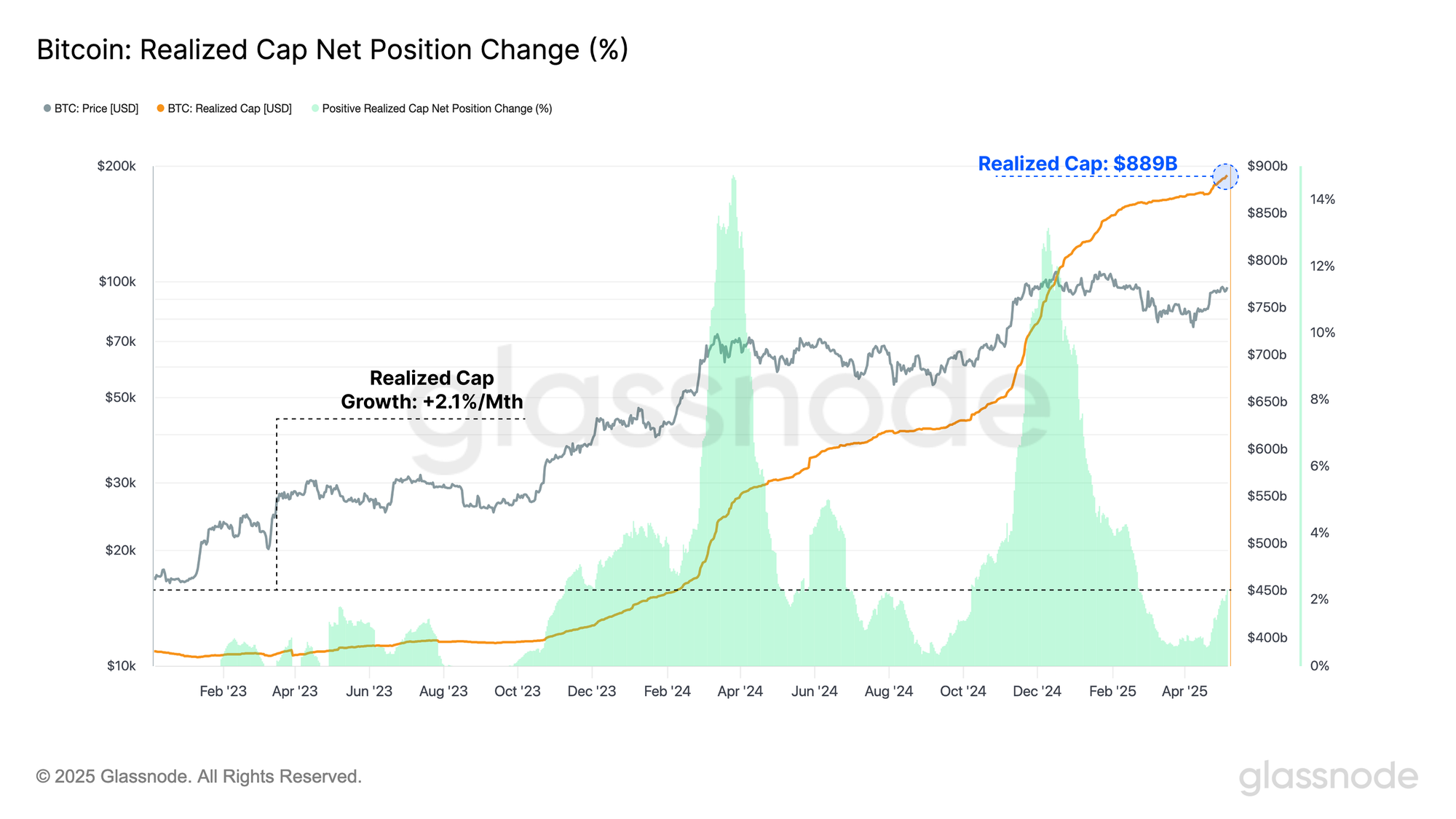
First, Bitcoin's Realized Cap climbed to a record high of $889 billion, up 2.1% over the past month. This indicator measures the cumulative net capital inflow, reflecting the strong momentum of capital injection. The net realized profit/loss indicator further shows that the daily net capital inflow has exceeded $1 billion in recent weeks, indicating that buyers are willing to absorb sell orders at current prices and demand is strong. In contrast, realized losses account for only 1-2% of total trading volume, suggesting that most investors who bought at high prices are still holding their coins and waiting, and market sentiment is optimistic.
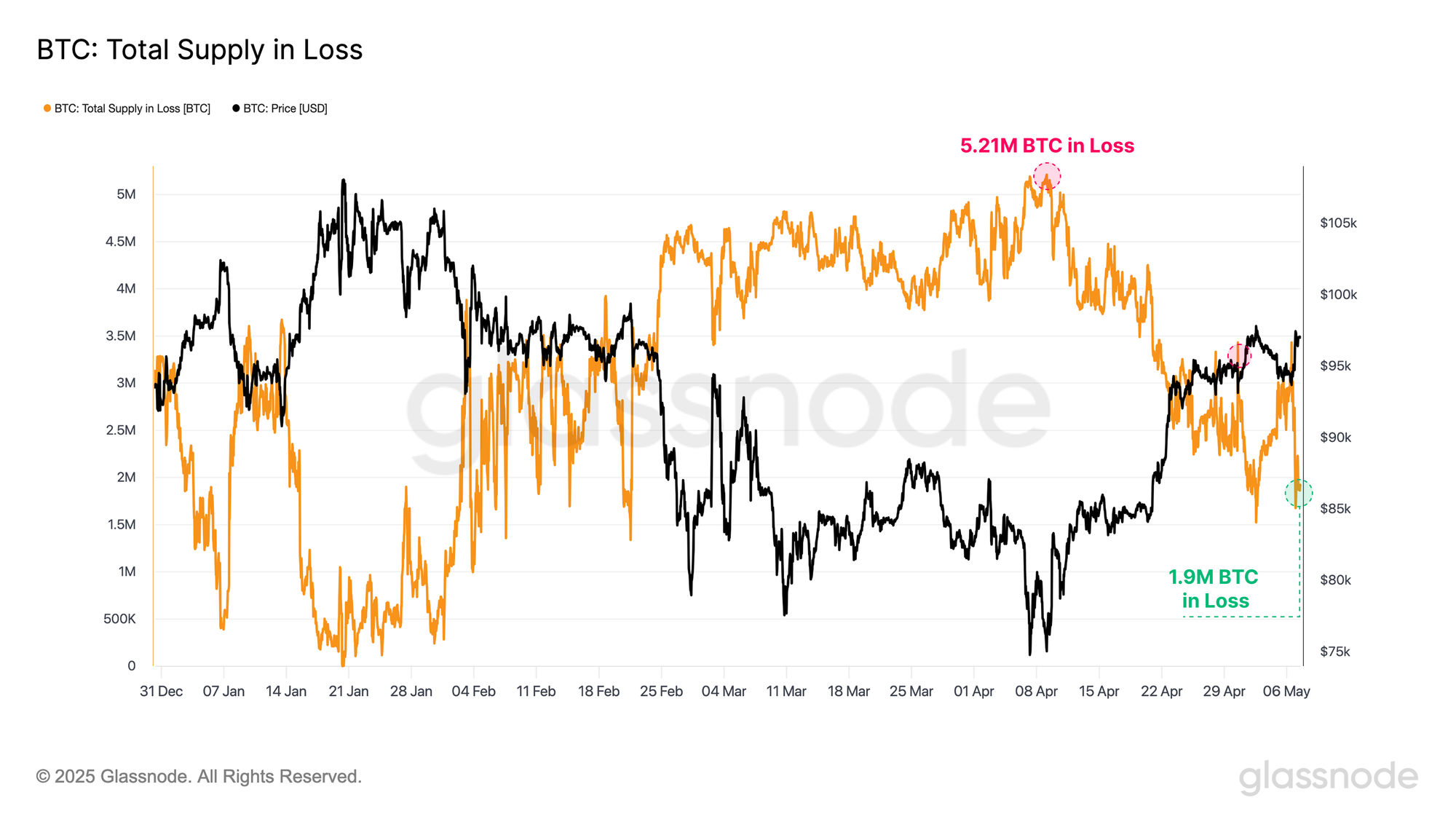
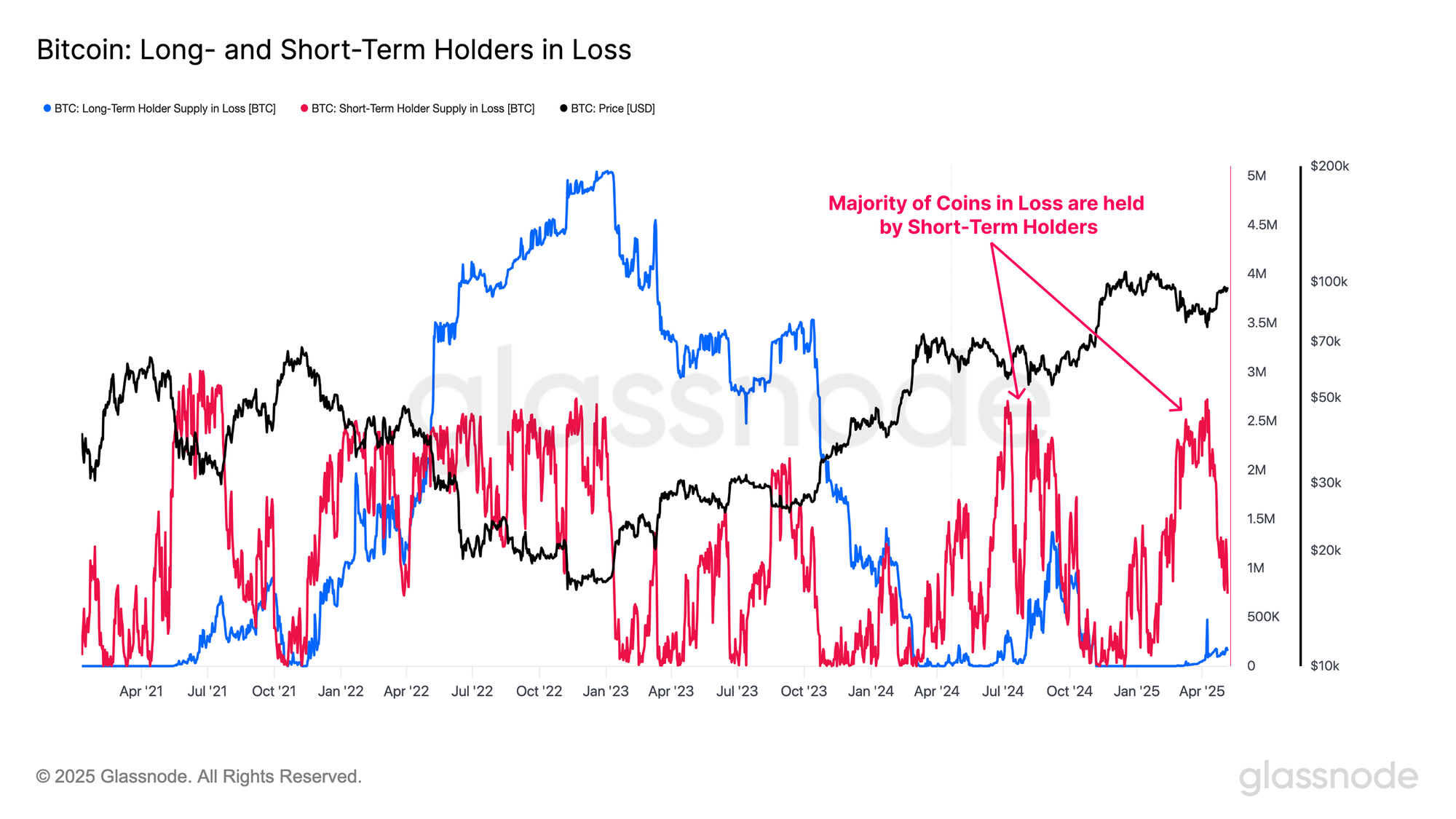
Second, the price recovery has significantly eased the financial pressure on investors. At the recent low of $74,000, more than 5 million BTC were in a state of unrealized loss. As the price rebounded to $97,000, about 3 million BTC returned to profitability, and the portfolios of short-term holders (STHs) in particular were repaired. The unrealized loss indicator shows that the financial pressure on short-term holders has fallen from the +2σ high during the collapse of the yen carry trade in August and the market downturn in early 2025 to a neutral level. This improvement is directly reflected in trading behavior: the proportion of profitable transactions by short-term holders has surged, marking a turning point in the market from loss-driven to profit-driven.
In addition, the behavior of long-term holders (LTH) is also worth paying attention to. Since the low, more than 254,000 BTC have been held for more than 155 days, showing the confidence of long-term investors in the current price. The Realized Supply Density indicator further reveals that a large number of BTC with similar cost basis are gathered near the current price. These coins were mainly accumulated between December 2024 and February 2025, and have not been sold after experiencing the test of the recent trough. The existence of this part of the supply increases the market's sensitivity to price fluctuations, and small changes may trigger large-scale transactions.
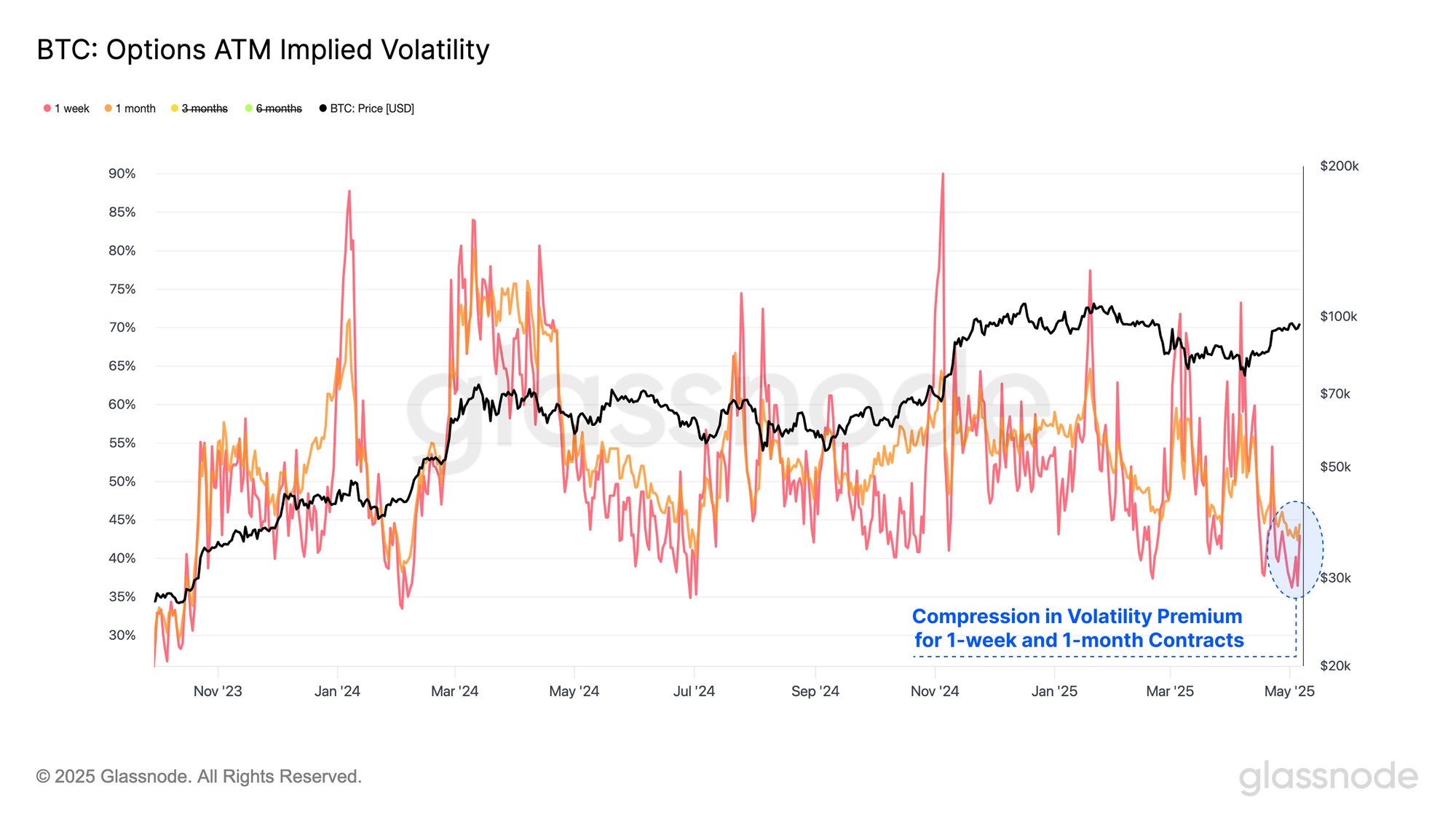
Finally, the options market provides an external perspective on volatility. The 1-week and 1-month ATM implied volatility fell to the lowest level since July 2024, reflecting investors' underestimation of future volatility. Historically, low volatility often heralds the arrival of a high volatility period. Combined with the high supply density on the chain, the market may be brewing a storm.
Market critical point: hidden worries amid the boom
Bitcoin's rally is in full swing, but the market is standing at a delicate tipping point. Prices are hovering near the short-term holders' cost basis (around $95,000), a level that has historically been a litmus test for gains. If this support holds, the market could see further gains; if it falls below, recent momentum could suffer.
Signals from on-chain and options markets further exacerbate this uncertainty. High supply density means the market is more sensitive to price fluctuations, while low implied volatility suggests that investors may underestimate the risk of future shocks. External catalysts—such as Trump's trip to the Middle East or the Fed's interpretation of economic data—could be the spark that ignites volatility.
Epilogue: Bitcoin’s opportunities and mysteries
The Bitcoin market in 2025 is like a drama with many climaxes. Trump's trade policy injects vitality into risk assets, the Fed's interest rate cut expectations ignite market imagination, and Wall Street's encryption layout endorses the long-term value of Bitcoin. On-chain data, with delicate strokes, outlines the picture of capital inflows, investor confidence restoration, and increased market sensitivity.
However, there are mysteries hidden beneath the craze. The market is at a critical juncture, and subtle changes in external variables may break the fragile balance. Trump's next move, the Fed's policy path, and the flow of institutional funds will be key clues in the short term. In the long run, Bitcoin's decentralized nature and scarcity remain its core charm, but macroeconomic uncertainty, regulatory pressure, and competition from traditional safe-haven assets may pose challenges.
For investors, this is a time of both opportunities and risks. A statement by an on-chain analyst may be worth recalling: "The value of Bitcoin lies in the sovereignty it gives to individuals, not the temporary price fluctuations." In this digital wave, rationality and patience will be the best beacons. No matter how the market fluctuates, maintaining a clear judgment may lead to a better future than chasing the craze.