
Article written by: Lesley, MetaEra
On June 24, Guotai Junan International (01788.HK) obtained the first full virtual asset license for a Chinese brokerage firm in Hong Kong. The market quickly gave it a technology stock-style revaluation premium: it rose by nearly 90% at the beginning of the trading session, and the cumulative increase in three trading days was 466%.
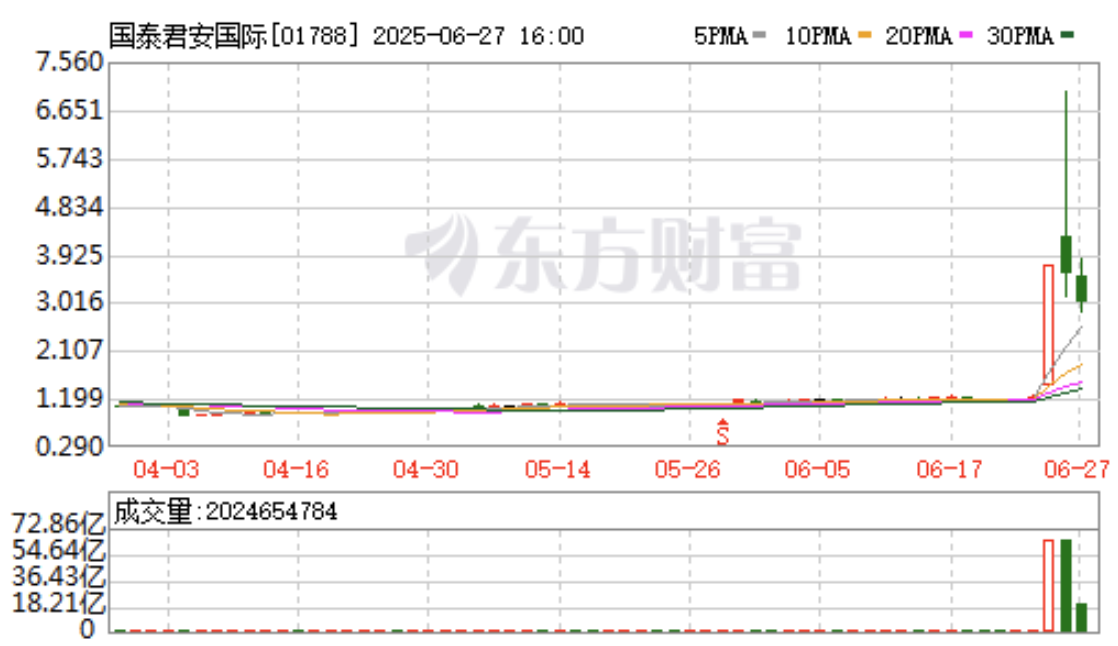
Guotai Junan International stock price
Subsequently, news came out that several securities firms had completed the upgrade of their No. 1 licenses, triggering a rush of capital.
On June 26, the "Hong Kong Digital Asset Development Policy Declaration 2.0" was released, and the Hong Kong capital market ushered in the "boiling point moment" of the digital asset era, adding a policy engine to the securities broker license boom.
The integration of traditional finance and digital assets has reached a substantial turning point in Hong Kong.
Policies are accelerating, capital is entering the market: Hong Kong’s digital asset ecosystem is accelerating its formation
Hong Kong is actively building a digital asset ecosystem, and relevant policies and market developments are being promoted simultaneously.
In May 2025, the Legislative Council passed the Stablecoin Bill, which was promulgated into law on May 30, marking the implementation of the world's first comprehensive regulatory framework for fiat stablecoins.
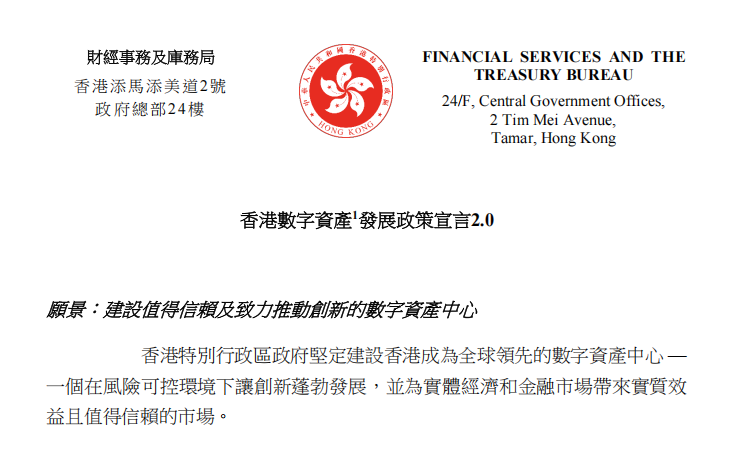
Hong Kong Digital Asset Development Policy Declaration 2.0
On June 26, the SAR government issued the "Hong Kong Digital Asset Development Policy Declaration 2.0", which clearly stated that it would use policy support to build a global digital asset innovation center.
At the same time, the Hong Kong Securities and Futures Commission has accelerated the implementation of the licensing system. So far, 41 companies have successfully upgraded to No. 1 licenses and obtained virtual asset licenses, and the share prices of related Hong Kong stocks have soared. Investors use real money to vote for the new era of Hong Kong digital assets.
MetaEra has compiled the top 5 Hong Kong stocks with the highest growth rates that received the No. 1 license upgrade within three trading days from June 25 for market reference.
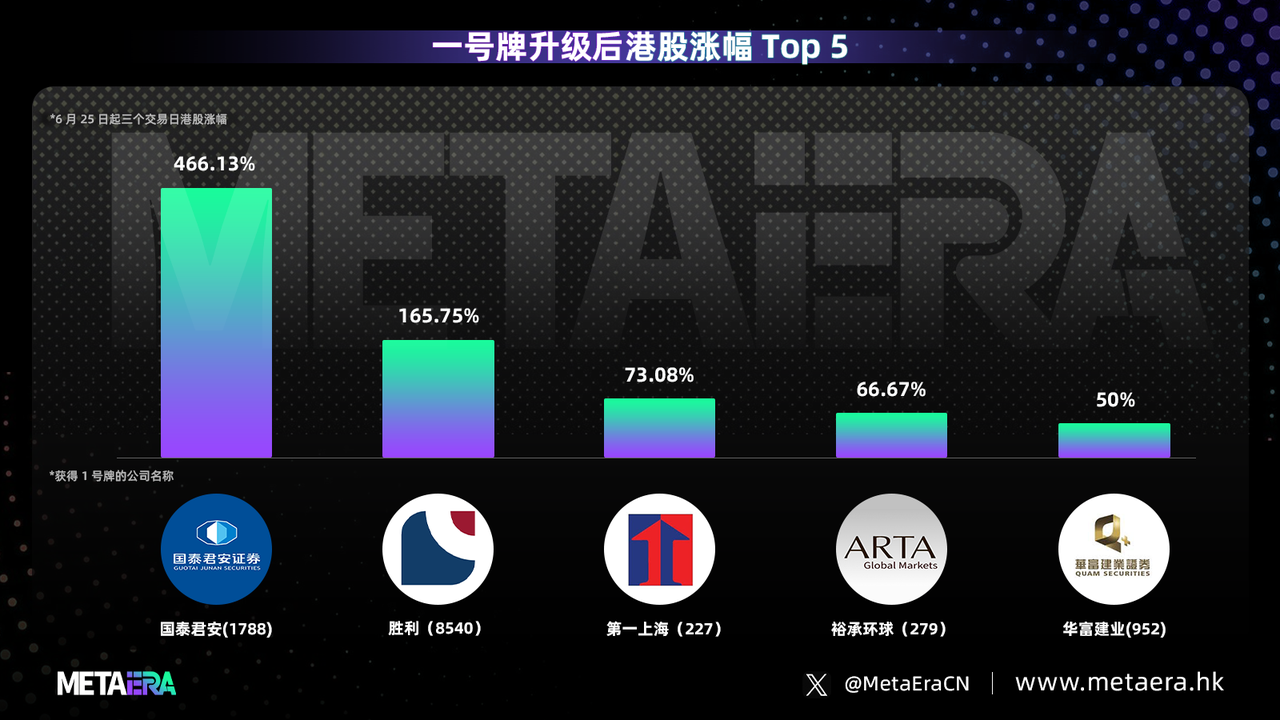
Hong Kong stocks’ gains related to the No. 1 license upgrade (June 25 - June 27)
The continued implementation of policies resonates with market conditions, stimulating investors' confidence and expectations for the development of Hong Kong's digital assets.
Why did Guotai Junan become the leader?
The concept of digital assets opens up a whole new growth story for traditional brokerages, but not all brokerages can truly seize the opportunity. Early layout and compliance awareness will be the most important factors.
As early as 2024, Guotai Junan International had proactively laid out its virtual asset business.
• In January 2024, we will start brokerage business for virtual asset related products (including ETFs and futures)
• In April 2024, the issuance and distribution of virtual asset related products (including over-the-counter derivatives) will be launched
• In December 2024, we will start introducing agent business for virtual asset trading platform
• In April 2025, digital bond issuance business will be launched
• May 2025, start providing services for distributing or advising on tokenized securities
• In June 2025, it began to provide advice on the basis of providing virtual asset trading services; it was officially approved by the Hong Kong Securities and Futures Commission to upgrade the existing securities trading license to the latest license that can provide virtual asset trading services
CITIC Securities pointed out that "As a state-owned enterprise and one of the largest securities companies in the mainland, the virtual asset trading service license obtained by Cathay Pacific Haitong Securities' Hong Kong subsidiary is a major breakthrough. Under the demonstration effect of Cathay Pacific Haitong Securities, the Hong Kong subsidiaries of mainland securities companies will speed up the application for relevant licenses, and securities companies are expected to accelerate the development of virtual asset-related businesses."
Traditional financial markets are weak: How can securities firms keep pace with digital assets?
Against the backdrop of sluggish growth in traditional businesses, digital asset business is becoming a key incremental engine for securities firms seeking transformation breakthroughs.
In recent years, the profit model of securities companies has been under continuous pressure due to market influence, and the overall profitability has faced significant challenges. In contrast, the digital asset field has shown greater growth potential. The high activity brought by high-frequency trading users has significantly improved the platform traffic and import efficiency. Combined with multiple sources of income such as transaction commissions, it has built a new growth curve for securities companies that is relatively independent of the fluctuations of the traditional capital market.
But the dividends are not equal. To stand out in the "traditional finance + digital assets" track, institutions must possess four key capabilities at the same time.
• Compliance awareness: strictly abide by regulatory requirements and apply for relevant qualifications in a timely manner
• Technical strength : Blockchain technology development and security protection capabilities
• Customer base : institutional clients and high net worth individual client resources
• Risk control system : a risk management framework adapted to the characteristics of digital assets
It is reported that the Hong Kong subsidiaries of many large securities firms are actively following up on license applications, especially the leading securities firms with a broad customer base, which are seen by the market as potential targets for the next round of speculation.
After the market boom, how does value settle?
Amid the craze, sober thinking is equally important. Hong Kong has ignited market sentiment with its first full virtual asset license. The seemingly scarce aura of "one license is hard to come by" is destined to fade as more institutions are approved one after another. The marginal effect of policy dividends decreases, the scarcity of licenses gradually disappears, and the actual landing of digital asset businesses will all be key variables to test whether this capital feast can continue.
From "obtaining qualifications" to "operating well", from "policy-driven" to "capability-driven", the entire industry is entering a deeper reshuffle period.
Digital assets are not a "quick game" in the capital market, but a deep participation in the reconstruction of the global financial order. Whoever can leave a sound structure after the bubble can truly define the standards of the next generation of financial platforms.