
Every cycle in the cryptocurrency market is fueled by certain engines. This year, a new capital narrative—Digital Asset Treasury (DAT)—has been the new engine of the crypto market over the past three months, injecting a surge of buying capital into major altcoins and redefining corporate balance sheets in the crypto era.
1. The first half of the bull market: Bitcoin’s four major driving forces
In all the cycles that the crypto market has experienced, Bitcoin has always been the first to rise. The rise of Bitcoin in this cycle is driven by the successive development of four major drivers:
The Faith of Long-Term Holders (LTH): Long-term holders (LTHs) are the stabilizing force of the Bitcoin market, forming a strong consensus around Bitcoin's shutdown price. On-chain data shows that after experiencing a period of decline during the previous cycle, BTC holdings by LTHs exceeded 14.52 million in Q4 2023, a record high. Their "diamond hand" nature provides a solid foundation for the market and underpins the tightening of circulating supply.
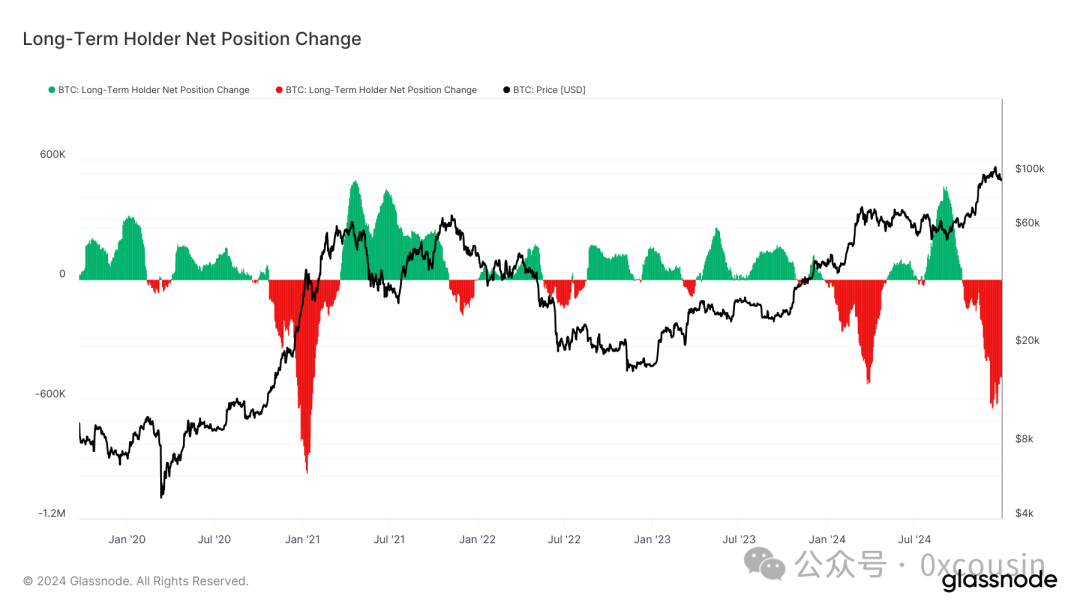
Data source: Glassnode
The flood of funds for Bitcoin ETFs: Since 2024, traditional giants such as BlackRock and Fidelity have launched Bitcoin spot ETFs, with net purchases exceeding US$15 billion within three months of listing. As of now, the cumulative net purchase has exceeded 596,300 BTC (market value of more than US$150 billion), completely rewriting the capital structure of the crypto market.
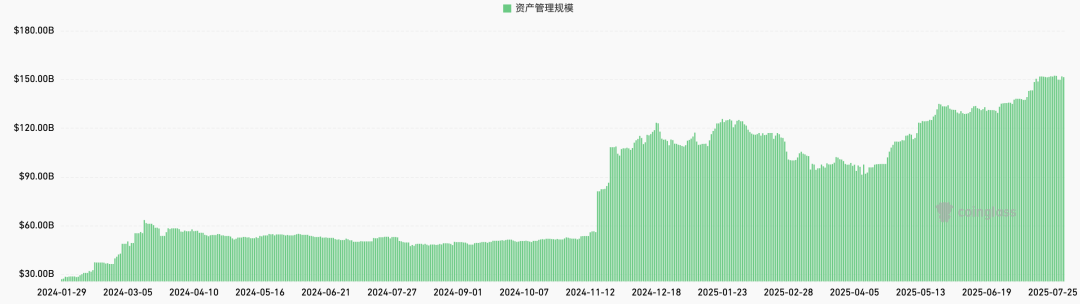
Data source: Coinglass
DAT strategies for listed companies: MicroStrategy has undergone a strategic transformation and launched its Bitcoin Treasury strategy, pioneering a capital alchemy model driven by equity, debt, and cryptocurrency. This model uses zero-interest convertible bonds and additional stock issuances to raise funds, purchase Bitcoin, and then feed back into valuations, boosting stock prices and further financing. The underlying logic of this strategy is that when a company's market capitalization is at a premium to the value of its on-balance-sheet crypto assets, it uses financial instruments such as private placements, convertible bonds, and preferred stock to raise funds from the market and purchase more crypto assets, thereby achieving the goal of accumulating more assets at a lower cost. MicroStrategy has purchased over 628,000 Bitcoins through this treasury strategy, and this has encouraged over 134 listed companies to incorporate Bitcoin into their treasuries, resulting in a cumulative reserve of over 949,000 Bitcoins.
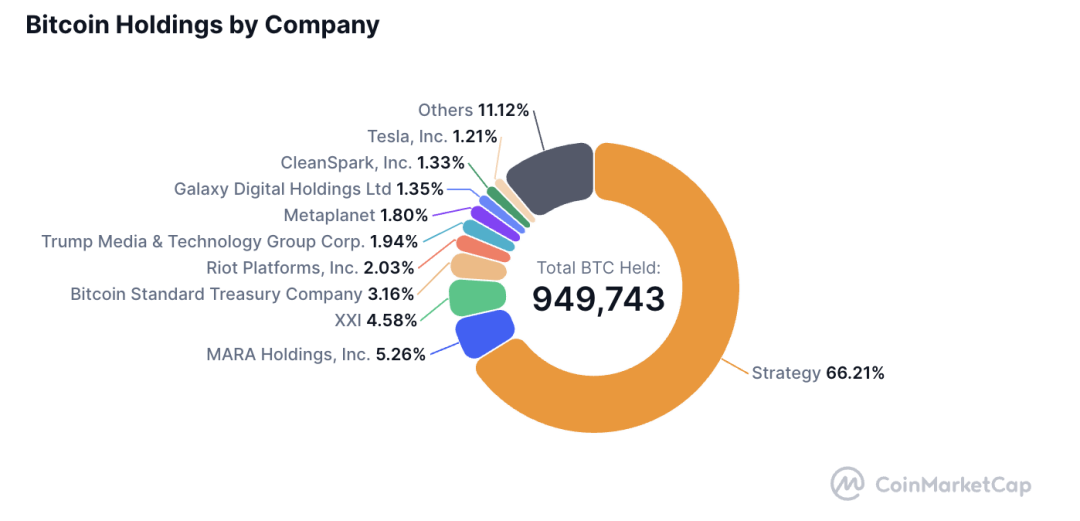
Data source: CoinMarketCap
National Strategic Bitcoin Reserve: In early 2025, after returning to the White House, Trump issued an executive order announcing the establishment of a national Strategic Bitcoin Reserve, promoting the Treasury Department and state governments to explore a strategic reserve model for BTC, giving Bitcoin a new geopolitical dimension of reserve value, and injecting unprecedented national narrative imagination space into Bitcoin.
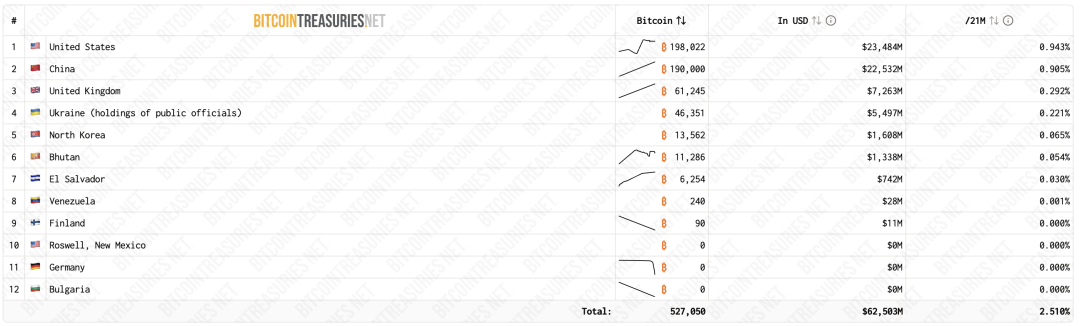
Data source: BitcoinTreasuries
Bitcoin has soared to $120,000 thanks to four key drivers, but a catalyst to propel it further upwards hasn't yet emerged. However, MicroStrategy's treasury strategy has inspired many institutions to apply DAT strategies to major altcoins, finding a new engine for some of these coins.
2. The second half of the bull market: DAT strategy becomes the new engine of mainstream altcoins
ETH rises due to the DAT paradigm: the "treasury duo" quietly appears
Although an Ethereum ETF was approved in 2024, it failed to trigger the expected rise in the ETH/BTC exchange rate, instead continuing to weaken. It wasn't until April 2025, when the DAT strategy was replicated on ETH, that the ETH market truly ignited. Leading the charge were two "treasury companies" whose ETH holdings surpassed those of the Ethereum Foundation: BitMine (BMNR) and Sharplink Gaming (SBET).
Sharplink Gaming (SBET)
On May 27, 2025, SharpLink Gaming announced a $425 million funding round to purchase ETH as its primary treasury reserve asset, making SBET the first company to hold an Ethereum reserve. Consensys led the investment, with participation from crypto institutions such as Pantera Capital, ParaFi Capital, and Galaxy Digital. Joseph Lubin was appointed Chairman of the Board and will serve as a strategic advisor to assist the company in developing its core business.
Joseph Rubin joined the Ethereum development team as early as late 2013, when Vitalik published the Ethereum white paper, and is widely considered one of Ethereum's eight co-founders. In 2015, to promote the implementation of applications on the Ethereum blockchain, Joseph Rubin founded ConsenSys, which subsequently incubated dozens of well-known sub-projects, including MetaMask and Linea.
Since the launch of SharpLink Gaming's ETH treasury strategy, it has continued to increase its ETH holdings, and its current holdings have reached 428,200, making it the first institution to surpass the Ethereum Foundation in terms of holdings.
BitMine (BMNR)
On June 30, 2025, BitMine announced a $250 million fundraising round to launch its Ethereum treasury strategy. Several crypto institutions participated in the fundraising, including Pantera Capital, Founders Fund, Galaxy Digital, and Kraken. Subsequently, the company received investments from Silicon Valley venture capitalist Peter Thiel and Ark Investment, founded by Wood Sister.
On the day BitMine launched its ETH treasury strategy, it appointed Tomas Jong Lee as Chairman. Former JPMorgan Chase Chief Equity Strategist, he began focusing on the cryptocurrency space in 2017 and frequently publicly predicted market trends, making him a die-hard bull. He was clearly well-suited to spearhead this strategy. Since assuming the chairmanship, Tomas Jong Lee has frequently appeared in mainstream media, explaining investment opportunities in Ethereum.
In just one month, BitMine's ETH holdings rapidly expanded to 625,000 ETH, surpassing Sharplink Gaming and the Ethereum Foundation to become the company with the largest ETH holdings.
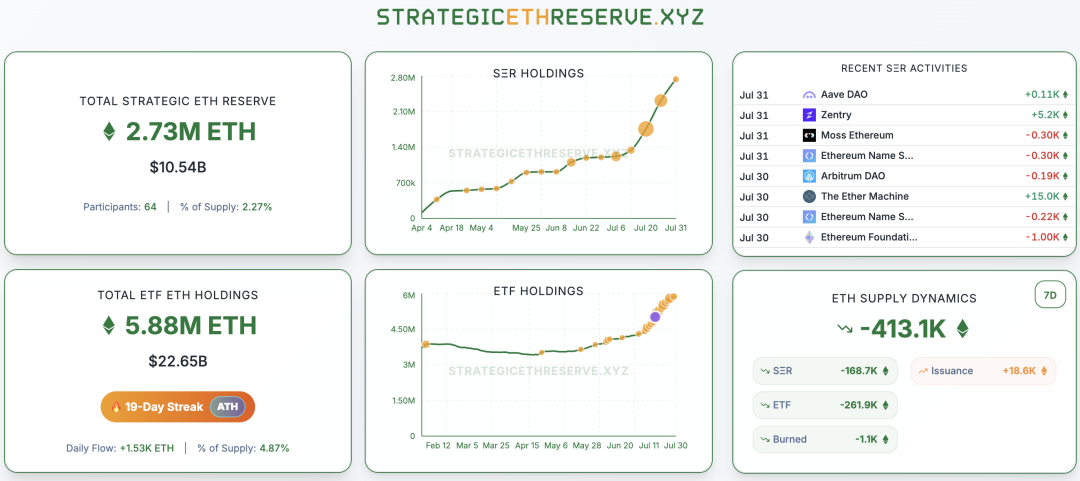
Data source: Strategic Threshold Reserve
The ETH treasury's "duo" not only brought in significant capital inflows but also attracted more companies, including The Ether Machine, Bit Digital, BTCS Inc., GameSquare Holdings, and Intchains Group, to initiate ETH treasury strategies. This, in turn, reversed the downward trend in ETH prices and even challenged the Ethereum Foundation's monopoly on community trust, pricing power, and influence. It's no exaggeration to say that Tomas Jong Lee and Joseph Rubin are the true voices in the current ETH price trend.
SOL, BNB, ENA, HYPE and other projects followed suit
Ethereum's DAT strategy reversed its downward trend in ETH prices, prompting more institutions to begin implementing DAT strategies. Treasury strategies have emerged in projects like SOL, BNB, ENA, and HYPE, and DAT strategies have become the driving force behind the growth of mainstream altcoins.
As of now, 8 companies have launched Strategic SOL Reserve, with a total reserve of more than 3 million SOL, of which Upexi and DeFi Development have the largest reserves.
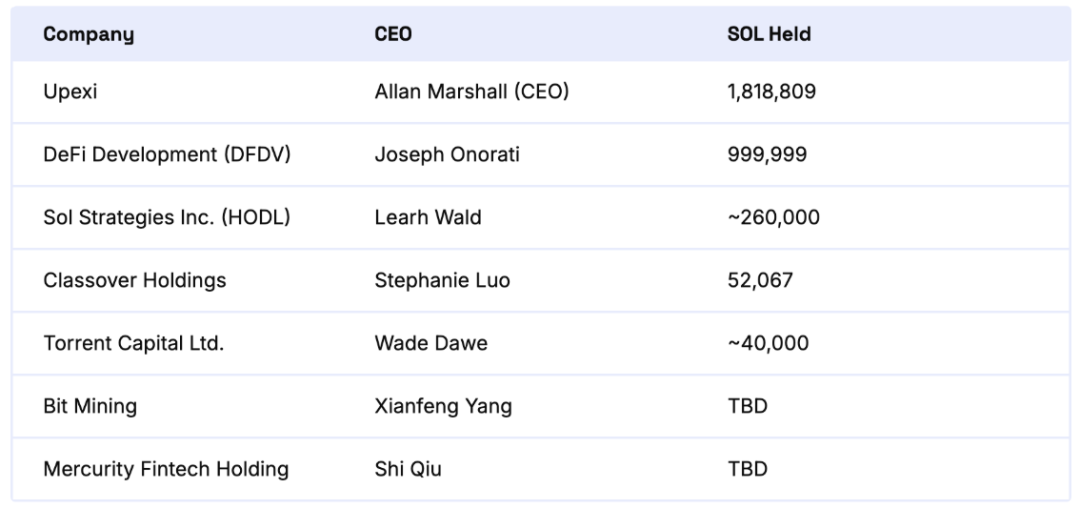
DeFi Development Corps (DFDV): In April 2025, Pantera Capital invested in DeFi Development Corps, the first publicly listed US company to use Sol as its reserve asset. DFDV's team, comprised primarily of Kraken executives, including the CFO, who previously operated a Solana validator node, possesses a deep understanding of Solana. To date, DFDV's Sol reserves have reached 999,900, and its stock price has increased over 20-fold in the past six months.
Upexi: Between April and July 2025, Upexi increased its SOL holdings from 73,500 to 1.8 million. Almost all of Upexi's SOL holdings are staked. Based on an 8% annualized yield, Upexi's SOL treasury strategy is expected to generate approximately $26 million in staking rewards annually. Upexi primarily increases its SOL reserves through discounted lock-in token purchases, staking strategies, and the issuance of additional equity and convertible notes.
SOL Strategies Inc. (HODL): This company was one of the first publicly traded companies to announce a phased acquisition of SOL to launch a strategic reserve program. In early 2025, they issued $500 million in convertible bonds to establish a SOL treasury and participate in validator node operations. Currently, SOL Strategies holds approximately 260,000 SOL, the majority of which is used for institutional validator node staking, generating a compounded yield of 6%-8%.
In addition, projects like BNB, ENA, and HYPE have each had institutions launch DAT strategies for their respective tokens. For example, BNB has CEA Industries Inc (VAPE), in which YZi Labs participated; Hyperliquid has Sonnet Bio Therapeutics (SONN), in which Paradigm invested; and Ethena has StablecoinX, which was established under the leadership of the Ethena Foundation.
3. Analysis of Two Paradigm Models of DAT
Bitcoin Paradigm: "Digital Gold" Anti-Inflation Anchor + Premium Leverage
MicroStrategy uses the "triple flywheel" (stock-to-coin resonance flywheel, stock-bond synergy flywheel, and currency-bond arbitrage flywheel) to play with the Bitcoin reserve strategy, and uses a tiered sales strategy to capture three types of capital (preferred stocks lock in fixed income investors, convertible bonds attract arbitrage funds, and stocks carry risk games).
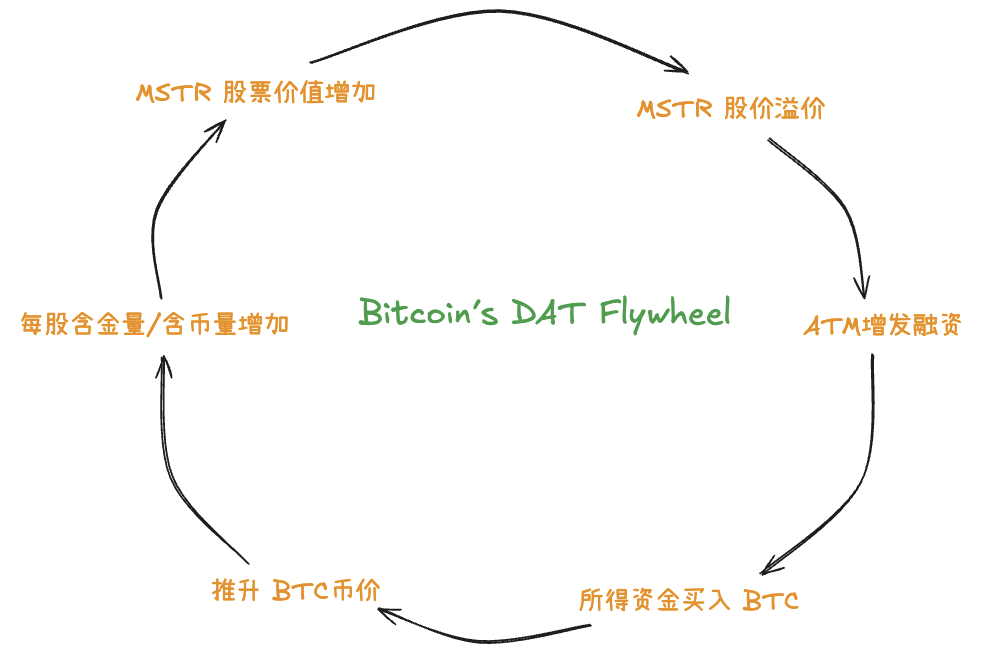
Graphics: IOBC Capital
MicroStrategy is currently the only DAT strategy company that has run for more than one cycle (4 years) and achieved a spiral increase in stock price.
Ethereum Paradigm: “Digital Treasury Bond” Yield Anchor
Unlike MicroStrategy, the two giants of ETH Treasury have only recently transformed into "ETH Treasury Strategy", and are backed by investment institutions that have heavy holdings in Ethereum.
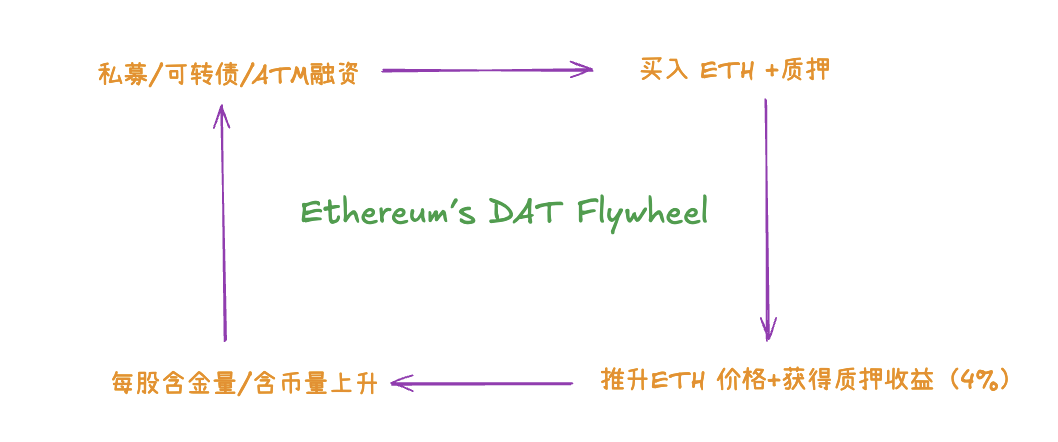
Graphics: IOBC Capital
Unlike Bitcoin, Ethereum uses a PoS mechanism, so ETH has the characteristics of being staking and generating stable on-chain income. Therefore, ETH is positioned similarly to a "digital treasury bond" with an annualized yield of approximately 4%. This is also an advantage for listed companies to reserve ETH - they can obtain relatively stable staking income - which makes it possible for listed companies to enjoy the asset appreciation brought by the rise in ETH prices, as well as the stable cash flow brought by staking.
Solana's DAT strategy is similar to Ethereum's, and can also generate staking income. Moreover, its annualized yield of 6%-8% is higher than ETH's staking yield. Combined with the expectation that the SOL spot ETF will be approved and launched in the second half of the year, SOL's market performance is also worth looking forward to.
4. DAT’s Strategic Significance and Reflexive Risks
The reasons why DAT has become a new engine for mainstream altcoins are primarily due to: For listed companies, it successfully integrates corporate financial strategies with on-chain assets, allowing them to access new assets; and for crypto asset projects, it not only provides a solid foundation of buying capital for the crypto market, but also attracts the attention of more traditional capital and long-term investors. When MicroStrategy's financial reports begin to mention "coin content per share," when BitMine's ETH staking returns become the focus of its quarterly conference calls, and when investors in SOL Strategies Inc.'s earnings calls focus on institutional validator staking returns... the crypto industry will enter a new era.
Be wary of DAT strategies that are simply castles in the air. We've observed that, with the exception of MicroStrategy's "triple flywheel" financing path, the initial funding for most mainstream altcoin DAT strategies comes from the project foundation itself, major token investors, or core ecosystem stakeholders. For example, SONN's 10 million HYPE tokens were directly injected from Paradigm's HYPE tokens, and StablecoinX's ENA tokens can be directly injected from PIPE investors using their own ENA tokens. These are not, in essence, new, real buying. The projects listed in this article are, in essence, examples of DAT strategies with some degree of real buying. Some projects not listed here have DAT strategies that are effectively "one foot in the right foot."
We must be wary of the reflexive nature of DAT strategies during Minsky moments. DAT strategies are highly dependent on capital market feedback mechanisms, forming a tight feedback loop between coin price, stock market capitalization, and refinancing capacity. When this cycle operates virtuously, both coin price and stock market capitalization grow, and the company's refinancing capacity is also strong. However, if this cycle becomes toxic, a chain reaction can occur: falling coin price → shrinking gold content per share → shrinking stock market capitalization premium → reduced refinancing capacity → forced share reduction → further coin price decline → other DAT strategy companies are also forced to reduce their holdings → a stampede occurs.
5. Conclusion
The emergence of digital asset reserve strategies may signal that the winner of this bull market is no longer determined solely by technological and application innovation; financial scalability is also crucial. Market capital may flock to a small number of currencies suitable for inclusion on balance sheets, demonstrating a trend of "the strong getting stronger."