
introduction
Recently, financial regulatory authorities in many parts of the country have issued documents to remind the public to be vigilant against illegal financial activities under the guise of "stablecoins". In fact, the concept of stablecoins has existed for a long time, but it is basically limited to a small circle. However, after the news that the United States passed the "Genius Act" and JD.com and Alibaba will issue stablecoins in Hong Kong came out, mainland people began to actively or passively learn about stablecoins and even other virtual currencies.
Some self-media accounts have transformed themselves into web3 "evangelists" and started to frequently output content related to stablecoins and other virtual currencies. With limited traditional investment channels, new things are often the most attractive. However, the so-called cryptocurrency circle is prone to harboring filth. Since the "September 4 Announcement" in 2017, the cryptocurrency fund projects that have been continuously hit have begun to wake up again. Therefore, it is not surprising that it has attracted the attention and vigilance of financial regulatory authorities.
But if we think about it a little more deeply, the mainland regulatory authorities’ “dislike” for virtual currency is not just because virtual currency has spawned illegal and criminal activities. The fundamental reason is that there is no soil for virtual currency to survive in mainland China.
To put it simply, the mainland can develop blockchain technology, but not virtual currency.
1. What have local financial regulatory authorities said?
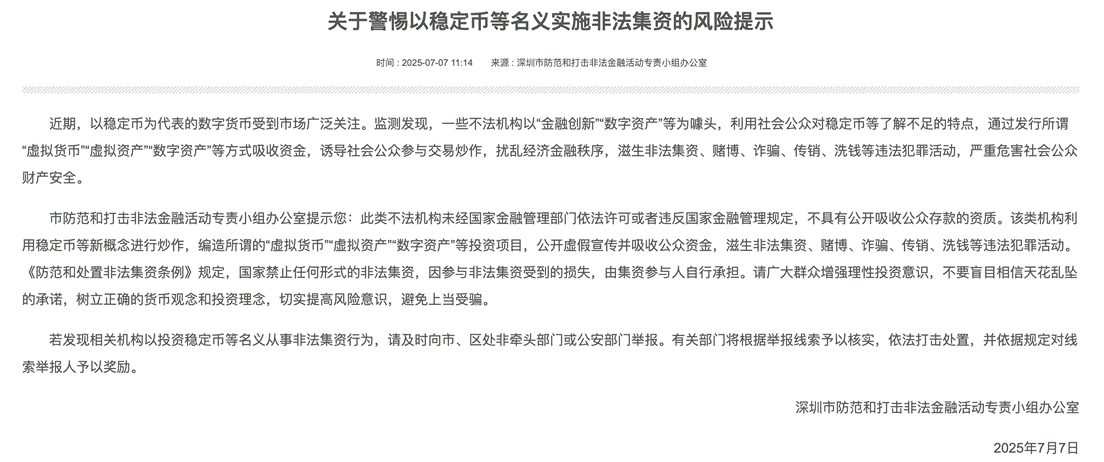
1. Shenzhen: Risk warning on being vigilant against illegal fundraising in the name of stablecoins, etc.
The "Office of the Special Task Force for Preventing and Combating Illegal Financial Activities" established by the Shenzhen Financial Committee, the Financial Administration Bureau and other departments issued a document on July 7. Interestingly, it pointed out that "digital currencies represented by stablecoins have received widespread attention from the market." This sentence does not actually deny the meaning of stablecoins, but only reminds that there are some illegal institutions in the market that use "financial innovation" and "digital assets" as gimmicks to absorb funds by issuing "virtual currencies", "virtual assets" and "digital assets", induce speculation, and breed illegal and criminal activities.
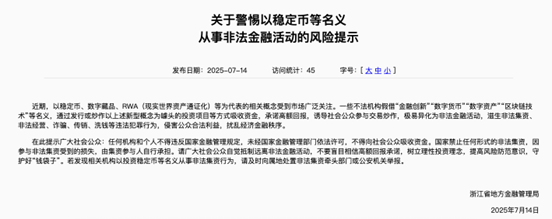
(II) Zhejiang Province: Risk Warning on Illegal Financial Activities in the Name of Stablecoins
On July 14, the Zhejiang Provincial Local Financial Management Bureau issued a document to remind the public to be vigilant against illegal financial activities in the name of stablecoins.
However, Zhejiang Province’s suggestion is obviously different from Shenzhen’s behavior style: “Related concepts represented by stablecoins, digital collections, RWA, etc. have received widespread attention from the market…” In the view of the Zhejiang Provincial Financial Management Department, stablecoins, etc. can only be regarded as a concept. The implication is that it does not conform to my country’s financial policies.
This is actually closely related to the performance of virtual currency in mainland China: Shenzhen and Hangzhou are definitely the two hottest places for web3 startups in China. My personal feeling is that Shenzhen has the best atmosphere, followed by Hangzhou. Of course, there are more virtual currency crimes in these two places than in other places (but not all cryptocurrency-related businesses are illegal activities).
On July 11, "Suzhou Finance" (the sponsoring agency is Suzhou Financial Committee) issued a "Risk Warning on Being Aware of Illegal Fund-raising in the Name of "Stablecoin" and Others"; on July 9, the Beijing Internet Financial Industry Association issued the aforementioned reminder of the same name. In addition, Gansu Province, Chongqing City, Ningxia and other places have issued similar notices or reminders, targeting illegal fundraising activities carried out in the name of stablecoins.
Doesn’t this feel a bit like the panic of the “9.4 Announcement” in 2017 or the “9.24 Notice” in 2021?
The policy logic here is actually very simple. Since September 15, 2021, my country's mainland policy on strong regulation of virtual currencies has not changed. Although Bitcoin surged to $120,000 a coin and Ethereum returned to its peak of $3,000 a few days ago, many people speculated that the reasons behind this were not only the resignation of the current Fed chairman Powell, but also the influence of the collective study of cryptocurrency by the Shanghai State-owned Assets Supervision and Administration Commission.
However, as a web3 lawyer, Lawyer Liu can most clearly feel the attitude of the Chinese mainland judicial authorities and even the financial regulatory authorities towards virtual currencies in his practice: if the use of "wipe out" is too serious, at least it is not allowed to prevail. We will analyze the specific reasons below.
2. The dispute between the “ chain circle ” and the “ coin circle ”
As early as 2013, after my country's central bank and other departments issued a notice on preventing Bitcoin risks, the mainland's encryption field has differentiated into two paths: the "chain circle" and the "currency circle".
The blockchain circle advocates the development of blockchain technology, especially alliance chains and public chains. This circle is mainly composed of programmers who are engaged in technology. It is relatively pure and has certain threshold attributes. They do not look down on those who rely on investment and speculation in virtual currency.
The meaning of the currency circle is also easy to understand. In a broad sense, all businesses related to virtual currency can be summarized under the category of the "big currency circle": in addition to virtual currency investment, the issuance of virtual currency, the exchange of RMB and virtual currency, the exchange of virtual currencies, the purchase and sale of virtual currency as a central counterparty, etc. (Most of these businesses can be covered by the functions of virtual currency exchanges, so mainland China strictly prohibits any virtual currency exchange from operating in the mainland). In addition, quantitative trading and "wooling" are also closely related to virtual currency, and even those who use virtual currency for black and gray production activities also call themselves mixed currency circles. An important feature of the currency circle is that you don't need to know much about the Internet and computers to enter, and the threshold is low. Of course, many virtual currency investments and transactions are essentially derivatives of traditional financial transactions, such as spot trading, perpetual contracts, pledges, loans, etc.
On September 15, 2021, the mainland of China officially announced that the cryptocurrency business is an illegal financial activity , "strictly prohibited and resolutely cracked down on". Since then, the dispute between the blockchain circle and the cryptocurrency circle has come to an end: there is no problem in China to engage in blockchain technology, and even many regulators welcome it very much; but engaging in virtual currency-related business is strictly prohibited. The only small loophole is that the mainland does not explicitly prohibit investment in virtual currency and its derivatives, but our country's laws do not recognize its legal effect, nor do they provide legal protection for virtual currency investment. Objectively, regulators have cut off all paths for virtual currency investment (for example, prohibiting virtual currency exchanges from operating in the mainland, prohibiting banks and third-party financial institutions from providing financial services for virtual currency transactions, etc.).
3. China currently does not have a viable environment for virtual currency
If you understand the highly centralized social governance model in the mainland, it is very easy to understand the logical path of " only blockchain, no virtual currency ". Although in terms of technical implementation, blockchain technology is only one of the conditions for the birth of Bitcoin. For blockchain technology, especially public chains, token incentive strategy is the cornerstone of its survival and development. In layman's terms, a blockchain separated from virtual currency is like an oasis without water. Not to mention growing big trees, it may even be difficult for grass to survive. But this is the reality, and no one can change it. For those who are really engaged in web3 construction, if they are not adaptable, they can only go overseas for development.