
Author: Nancy, PANews
"It's time to move beyond Bitcoin and MEME coins. The market is moving towards 24/7 on-chain transactions and real assets with real utility." After officially announcing the launch of tokenized stock trading, Robinhood CEO Vlad Tenev said this, depicting the current craze for tokenized stocks and revealing that the crypto market is undergoing profound changes.
As platforms such as Robinhood, Kraken, and Coinbase have successively deployed tokenized stocks, the crypto world is ushering in a reshaping of market structure and capital flow. Some voices believe that tokenized stocks, as an important innovation in the crypto field, are expected to expand the overall market capital scale and help the crypto ecosystem move from the margins to the mainstream. There are also views that the introduction of high-quality assets may bring severe impacts to narrative-driven altcoins. At present, tokenized stocks are still in the early stages, and multiple challenges such as insufficient liquidity and regulation need to be overcome.
Are altcoins becoming marginalized?
As traditional high-quality assets such as U.S. stocks are gradually being "on-chained", the flow of funds in the crypto market is quietly changing.
Some market opinions believe that tokenized traditional high-quality assets are becoming the new favorite of on-chain funds with clear business models, legal and compliant regulatory frameworks, and stable actual income support, and are forming a siphon effect on the altcoin market. In particular, those tokens that lack actual income models, have immature products, and rely solely on narratives to support market value are facing liquidity depletion and survival pressure.
For example, crypto KOL BITWU.ETH raised a sharp question: "When traditional high-quality assets are tokenized and tradable on the chain, do crypto native assets still have value? Investors can directly purchase Apple, Tesla and other targets with strong liquidity, stable volatility and clear valuation logic on the chain. Why do they need to bet on a "maybe build a product" altcoin? He believes that the structural differentiation of altcoins has officially begun, and there are more and more high-quality real assets on the chain. Narrative altcoins may be directly marginalized and then die out.
Of course, this trend also indicates that the crypto market may bid farewell to the era driven solely by narratives and move towards a more rational development path oriented to actual value. Crypto analyst Crypto_Painter pointed out that altcoins will not necessarily disappear, but it is becoming increasingly difficult to survive. In the crypto market, every new high-quality asset is a drain on assets that rely on consensus to maintain prices. The only way out for altcoins in the future is to generate actual application value, and it must be the kind of value that can bring actual income. All tokens that cannot be implemented and survive only on narratives will gradually enter a death loop. There may still be altcoin season, but the market where thousands of coins rise in general will never appear again, and the simple model should have become a thing of the past.
However, in the view of Qiao Wang of Alliance Dao, tokenized stocks will not kill altcoins, but stock perpetual contracts will. Because they have a constant stream of new narratives + high volatility after leverage adjustment.
Colin Wu, editor-in-chief of WuSaid Blockchain, expressed a similar view. He pointed out that if you just buy spot, it seems meaningless, and the perpetual contract of stock tokens may be the real killer. It may be difficult for traditional CEX to provide it. For example, decentralized platforms such as Hypeliquid provide perpetual stock contracts, and the effect is expected to be good. In addition to the difficulty of supervision, people who trade in cryptocurrencies and stocks will have a relatively long education process to trade such a mixed species.
Cross-border “invasion” of traditional finance
Regarding the popular trend of tokenized stocks, many crypto practitioners and KOLs have expressed optimism, believing that putting stocks on the chain is not only an innovation in trading tools, but is also likely to completely change the ecology and structure of securities trading and promote the scale and depth of the crypto market.
"The market environment, user profile, and infrastructure of the synthetic asset protocol Mirror Protoco (using stablecoins to synthesize stock assets) are not at the same level as today." Crypto KOL Chen Mo CM pointed out that earlier, some people questioned whether Hyperliquid was the next dYdX, and now they say that stocks on the chain are the next Mirror and FTX. In fact, the right thing may not succeed the first time, but success is a matter of time. The key lies in the integration of on-chain assets and ecology after stocks are put on the chain. Simply buying and selling is just the tip of the iceberg. Compared with before, the biggest change is the change in attitude at the regulatory level. Mirror's US stock tokens were once not allowed to appear on the trading front end of Uniswap, not to mention the integration of multiple chains and multiple ecosystems. This alone is not the same.
Crypto KOL Lanhu added that a major feature of crypto technology is to lower the threshold for transactions, in other words, it can promote trading freedom. For example, users in some regions were unable to buy securities before, but now they have the opportunity to buy them. Even the shares of some popular companies that are not circulated in the open market can be circulated through tokenization. These have not actually happened yet, but they have begun to sprout. At the same time, there will be a cruel thing. Behind free trading, there will be a concentration effect, and some head assets and head currencies will get more and more opportunities. Relatively weak currencies or assets will gradually be marginalized due to the loss of protection thresholds. Of course, new assets with narrative ability will also have more opportunities. The real influence of crypto technology has just begun. From an investment perspective, new opportunities and new traps will continue to come.
Crypto KOL @ Cody_DeFi emphasized that buying US stocks directly in the DeFi protocol is a big leap for stocks to be put on the chain, which means that stocks can also be priced by AMM, and loops and Yield Swaps can also be done. These financial derivatives, if done with traditional finance, will be very complicated and lengthy because they require quite troublesome middle and back-end support. When stock assets can flow smoothly on the chain like tokens, the simplicity and elegance of DeFi can be more intuitively reflected. To put it bluntly, the core function of blockchain at the financial level is the six words "payment is clearing", which cannot be achieved in any financial network with scale effect in traditional finance. Once "payment is clearing" is achieved, even if US stocks cannot be traded 24 hours a day, tokenized US stocks can. The core of the transaction is not infrastructure, but liquidity matching. Under the condition of payment and clearing, OTC can also have the ability to shoulder the exchange counter.
From a more macro perspective, BroLeon, a big lion from Australia , pointed out that the issuance of stock coins has shown the cross-border invasion from traditional financial platforms to blockchain infra, indicating that with the process of crypto asset compliance, traditional finance and crypto assets are no longer two distinct camps, but are beginning to merge. Traditional CEX should feel the advent of another dimension of strategic competition, and will most likely start to fight back soon. "Stock coins" should also be popularized in major CEXs soon. The tokenization and sale of private equity such as OpenAI and SpaceX to retail investors is the first in the world, which is very similar to the previous IEO model. This opens up the legal precedent for the tokenization of non-listed assets. After the ice is broken, it may inspire a large number of similar innovations (such as new potential companies, real estate, and even artwork tokenization).
"There will be many innovations in equity tokenization in the future, such as the exploration of equity perpetual contracts. These innovations may change the industry landscape. Now the US SEC is also encouraging trying new things, which makes companies bolder and no longer afraid of legal risks or regulatory suppression." Galaxy Digital founder Mike Novogratz said in a recent interview that Galaxy is currently working with the SEC and may tokenize Galaxy shares as a first step in the near future.
Ash, the head of the Aptos Foundation ecosystem, said that tokenized stocks are an arbitrage opportunity for users in emerging markets, and are also an entry point for attracting larger retail users to access cryptocurrencies. If this behavioral trend really emerges in the next 2-3 years, it will be a huge benefit.
Still facing multiple challenges such as insufficient liquidity and compliance
Although the concept of tokenized stocks is gaining popularity, it is still in its early stages and is far from forming sufficient market depth. Taking xStocks as an example, Dune data shows that its total transaction volume is only about 8.05 million US dollars, the number of users is less than 8,000, and there are only three stock tokens (SPYx, TSLAx, CRCLx) that have reached a million US dollars in transaction volume within 24 hours. It can be seen that the actual liquidity on the chain is still quite limited.
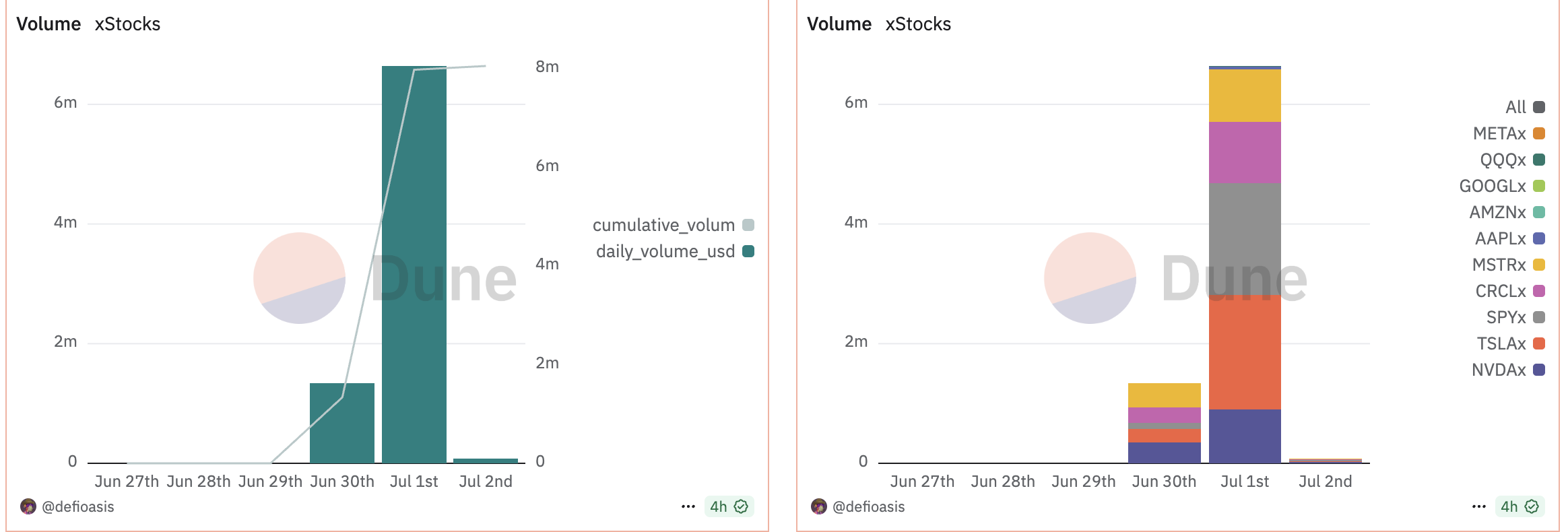
Velocity Capital investor DeFi Cheetah also combined early attempts such as Mirror Protocol and Synthetix, pointing out that the key to their failure is the lack of sufficient meaningful liquidity. It is not difficult to simply tokenize stocks. The real difficulty is to have sufficient liquidity to support global-scale transactions, but at the current stage it is still difficult to match the traditional market.
Dragonfly partner Rob Hadick also pointed out the shortcomings of the current tokenized stock product structure. He pointed out that the current market expectations for tokenized stocks are too high but the details are insufficient. He believes that at this stage, most platforms rely on SPV (special purpose vehicle) to purchase equivalent real stocks in the market as collateral, but most of them can only buy them during the opening hours of the US stock market. This means that all after-hours/weekend transactions require market makers to bear the price risk themselves. But these price fluctuations are difficult or almost impossible to hedge in traditional finance. And even for redemption, market makers have to bear a handling fee of up to 25 basis points (bps), which is a high cost for them. At the same time, any DeFi protocol or market maker that accidentally provides such token trading services to US users will face compliance risks far higher than other crypto assets. This means that weekend & after-hours trading is basically not suitable for professional traders, price fluctuations are highly coupled with the official opening price, and such products are not easy to use for most users.
Despite the current challenges, Rob is still optimistic about the long-term potential of tokenized stocks. "In the long run, when the primary market is truly on-chain, collateral is turned to tokenized stocks, and traditional institutions upgrade their backward technical architecture, we will eventually see: stocks truly appear on the chain in the form of large-scale liquidity; on-chain transactions are smooth, pricing is accurate, and institutional participation is active; the infrastructure integration between encryption and traditional finance will accelerate. Only then will it be the turning point for the outbreak of tokenized stocks. And this kind of product at present will only be a small 'disappointing transition product' on the road to the future. It may bring some topics and experimental value, but it will not be the end."