From MyStonks to Backed, why are US stocks in a hurry to tokenize?
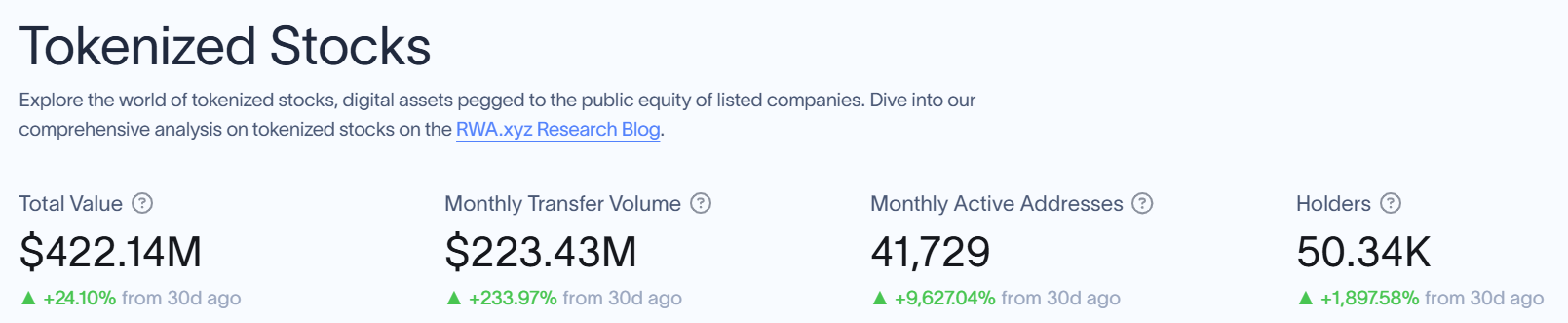
The tokenization of U.S. stocks is becoming the focus of the global blockchain market in 2025 at an unexpected speed. According to data from RWA.xyz, the current market value of tokenized stocks is $422 million, and there are 50,000 addresses holding tokenized stocks, a surge of nearly 2,000% compared to 30 days ago.
If you have recently paid attention to platforms such as MyStonks, Backed, and Kraken, or even Web3 exchanges such as Gate.io and Bybit, you have probably discovered that traditional US stock stars such as Apple, Tesla, and Nvidia have been quickly moved to the chain, and are no longer limited to Wall Street trading windows, but are circulating among global investors 24 hours a day, 7 days a week.
This rush to tokenize is not only a technological breakthrough, but also the inevitable result of market demand and regulatory relaxation, which is accelerating the change in the global investment landscape.
1. The sudden acceleration in 2025: Why did the US stock market begin to migrate to the chain?
It is not the first time that the concept of blockchain has been combined with traditional finance, but why did the tokenization of US stocks enter a period of explosive growth in 2025? Technological progress, market demand, regulatory relaxation and capital logic together constitute the underlying driving force of this trend.
First, the technical bottlenecks have been solved one by one. After years of development, mainstream public chains such as Ethereum and Solana have the ability to support large-scale asset tokenization. Ethereum provides the ERC-20 standard to ensure on-chain compatibility, while Solana has become a popular choice for trading platforms such as Kraken and Bybit due to its high throughput and low cost. At the same time, the gradual maturity of cross-chain bridges (such as Wormhole) and decentralized identity authentication (DID) mechanisms has made the barriers for traditional assets to enter the chain lower and lower.
More importantly, in 2025, investors in the global market, especially those in emerging economies, will have unprecedented enthusiasm for investing in U.S. stocks. However, the traditional trading channels for U.S. stocks have extremely high barriers to entry for overseas investors: complicated account opening procedures, high fees, and limited trading hours have significantly inhibited the inflow of overseas funds. On-chain U.S. stocks completely bypass the traditional account opening and trading processes, allowing global users to easily use stablecoins to directly participate in investment transactions in U.S. assets. This 24-hour, low-threshold, low-cost investment channel quickly meets the long-standing global market demand.
The deeper driving force comes from the global layout strategy of the US dollar. The stablecoin market has created a transaction volume of 27.6 trillion US dollars in 2024, even surpassing Visa and MasterCard. The tokenization of US stocks is providing a new value flow path for US dollar stablecoins, becoming another secret channel for the global return of US capital. The on-chainization of US stocks seems to be a financial innovation, but in fact it is deeply bound to the internationalization strategy of the US dollar. Using stablecoins and on-chain US stocks as tools, US financial institutions and regulators are attracting global capital to gather towards US dollar assets in a more flexible way.
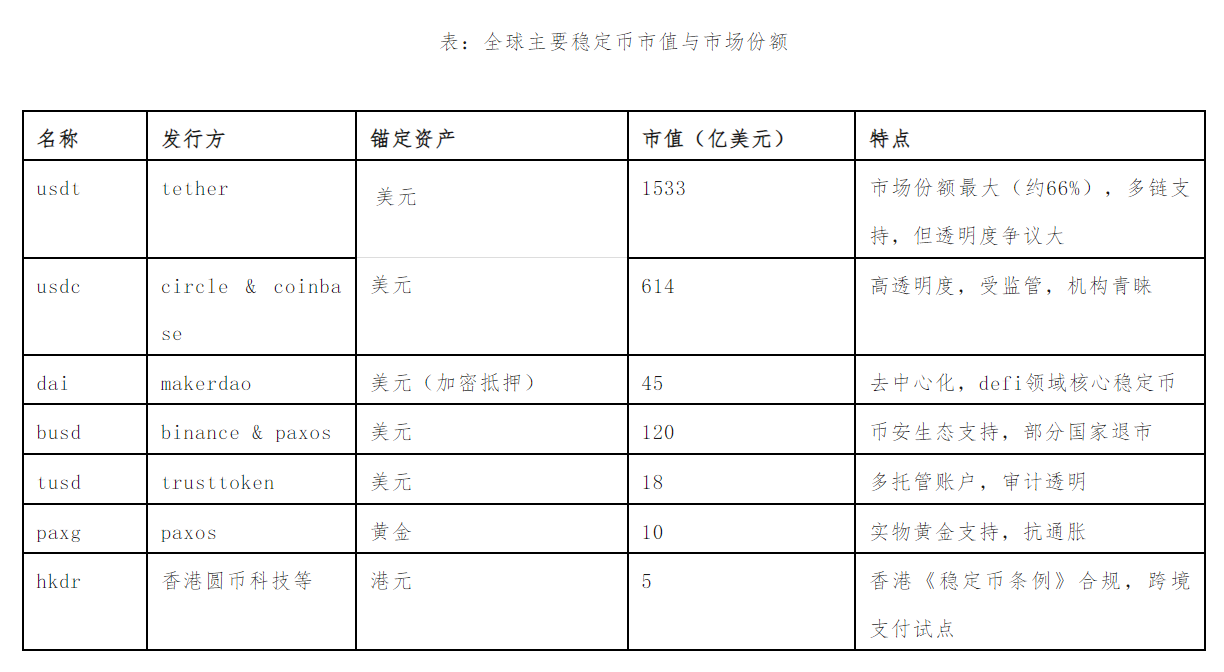
Image source: Zhongguancun Internet Finance Research Institute
From technical feasibility to global capital flows, and then to the US dollar financial hegemony strategy, the acceleration of US stock tokenization is not a coincidence, but a carefully planned financial ecological reconstruction. The "Apple" and "Tesla" on the chain are not just digital copies of traditional stocks, but also structural changes in the rules of the global capital game.
However, the explosion of on-chain US stocks is only superficial. Behind this "rush" to tokenize movement, the real operator is the strategic game between exchanges and tokenization platforms.
2. Behind the rise of on-chain US stocks: the real driving force of exchanges and platforms
The rapid development of on-chain U.S. stocks is not an active choice of the U.S. stock market itself, but the result of strategic promotion by on-chain asset platforms and exchanges. From MyStonks to Backed to Kraken, the rise of these platforms all demonstrates the different demands and games of different market players.
For professional asset tokenization platforms (such as Backed and MyStonks), on-chain U.S. stocks mean new business models and regulatory arbitrage space. Take Backed as an example. By cooperating with Interactive Brokers and European custodian Clearstream, they are able to bypass the vague regulatory area of the U.S. Securities and Exchange Commission (SEC), custodian the actual U.S. stock assets in the form of tokens in compliance with regulations in Europe, and sell them globally through on-chain platforms. This model not only reduces regulatory compliance costs, but also opens up more flexible investment channels for global users.
MyStonks has chosen a more decentralized path, developing an on-chain asset model based on the ERC-20 and NFT standards, cooperating with Fidelity's asset custody, emphasizing DID authentication and transparency, and attempting to build a new bridge between decentralized finance (DeFi) and the traditional securities market.
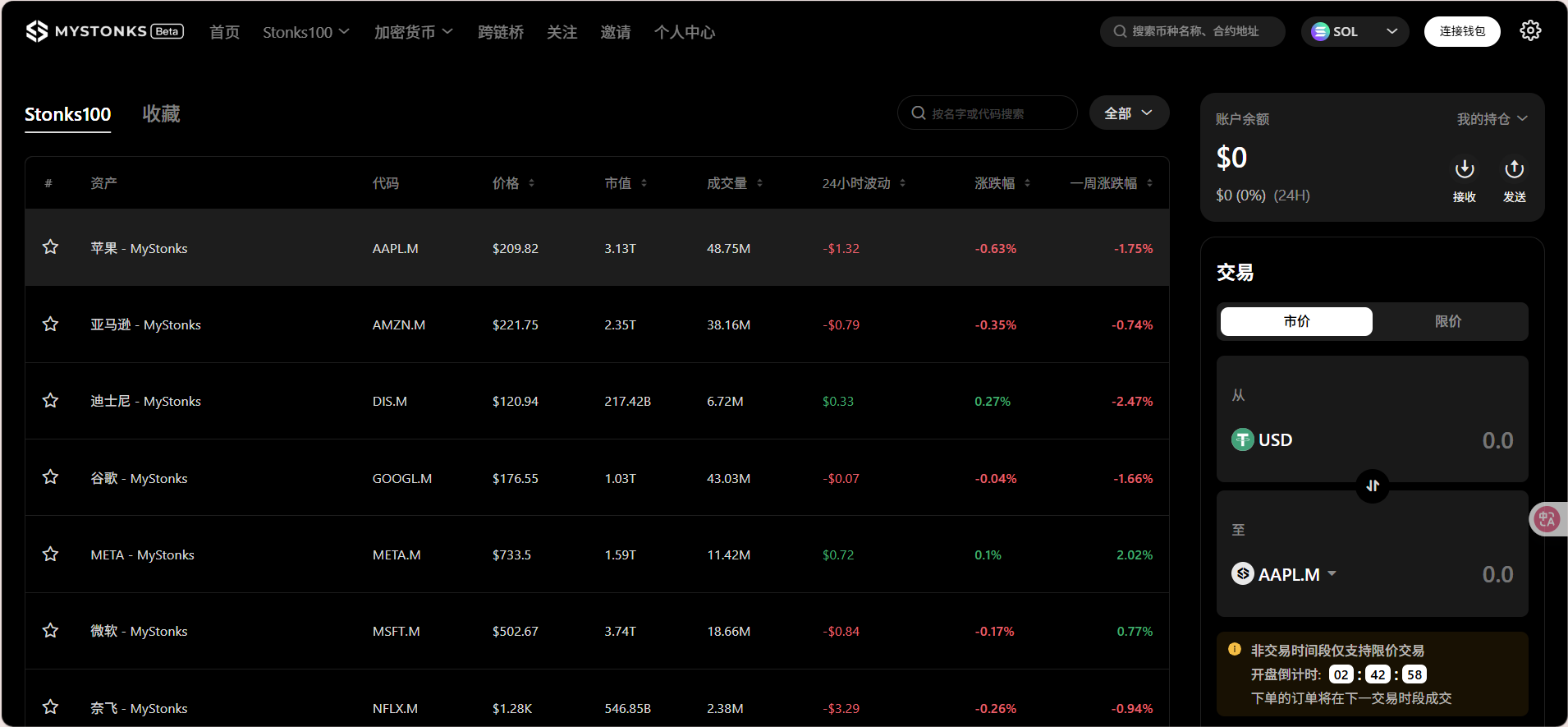
The participation of trading platforms such as Kraken is more like capturing the next narrative outlet: expanding trading categories, enhancing user stickiness, and reducing the risk of user assets flowing to traditional financial institutions by introducing US stock tokens. This participation strategy is not only a natural extension of business expansion, but also reflects the high expectations of on-chain exchanges for "connecting real assets to Web3."
The combined effect of these multiple driving forces ultimately led to an accelerated competition for "on-chain U.S. stocks". The mutual collaboration and competition between exchanges and asset tokenization platforms jointly shaped the trend of U.S. stock tokenization in 2025, and also laid the groundwork for the next evolution of the U.S. stock tokenization ecosystem.
3. Explorers of different paths try to answer how to put U.S. stocks on the chain?
MyStonks' approach is the most "native". It turns stocks into NFTs and ERC-20 tokens, which circulate on the chain through the Ethereum network. It also connects to the DID identity system, trying to meet compliance requirements while protecting privacy. On MyStonks, users can not only trade stock tokens, but also "own" them, just like a USDC in your wallet. But this model also brings an old problem: the liquidity and composability of NFTs are always limited, and the efficiency and user experience of on-chain transactions are still in the early stages.
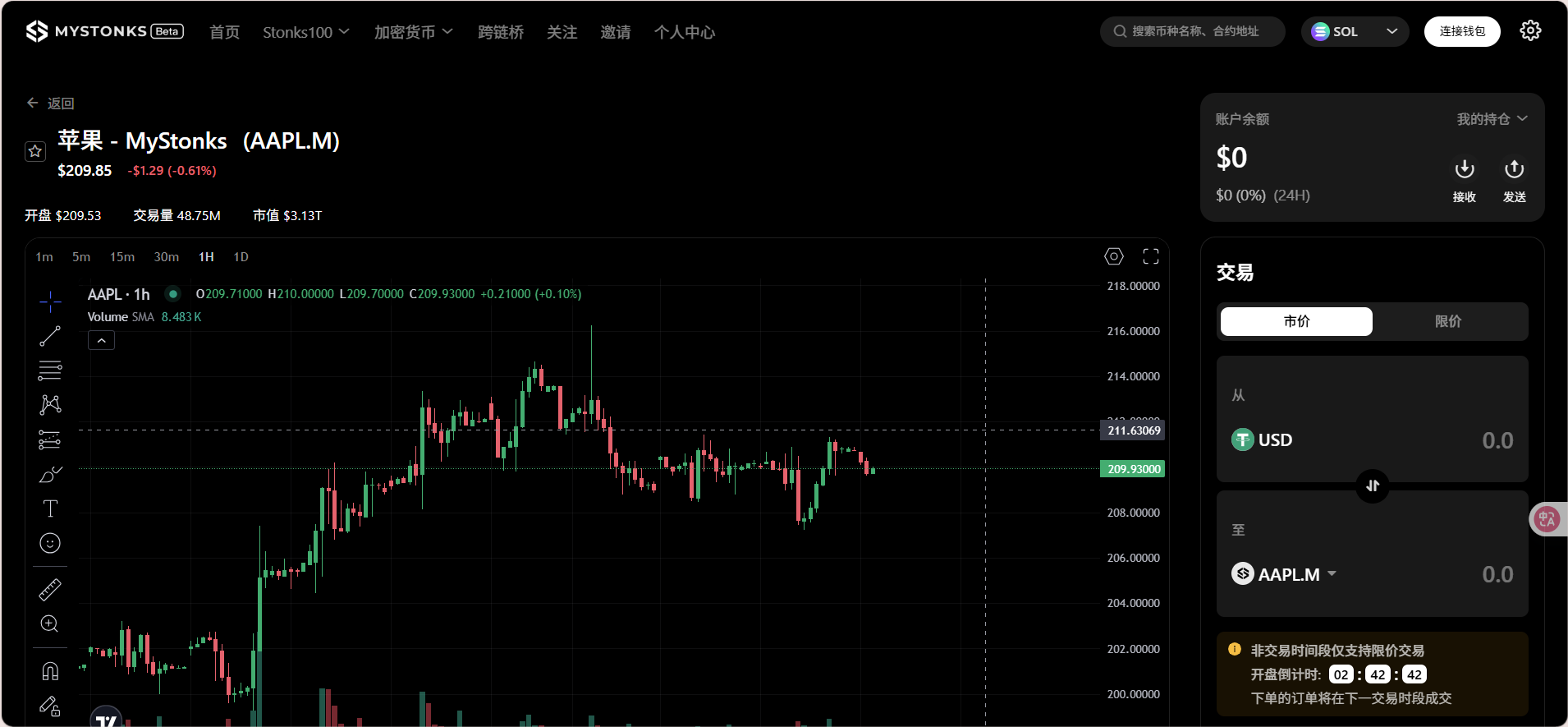
Backed takes a completely different path. It is more like an extension of a compliant financial institution, hosting real US stocks in the European regulated securities system, and then issuing 1:1 anchored tokens. These tokens can be traded on the chain, but the core assets are held by the platform rather than by the users. The value of Backed lies in lowering the threshold for traditional institutions to participate in Web3, but under this model, users still have limited control over their assets, and it is difficult to avoid the essential problem of "trusting intermediaries".
Kraken regards itself as an "interface platform" and does not build its own token model. Instead, it directly integrates existing token products such as Backed to provide traditional users with a familiar interface and convenient trading experience while maintaining basic compatibility with on-chain assets. Although this approach lowers the user threshold, it also means that its on-chain attributes are weaker and it still relies more on the credibility of the platform itself.
The three models emphasize different things: MyStonks emphasizes "assets belong to users", Backed emphasizes "assets are authentic", and Kraken emphasizes "transactions are convenient enough". They are three paths, and they are also answering a common question: Can the core assets of traditional finance also have their own "universal expression" on the chain like USDT?
The issue behind this is not a dispute over technical routes, but a design question of "who trusts whom": Do users trust the code? The platform? Or the brokerage firm and custodian behind it? These three companies are participating in a test of future standards with different answers.
4. Trend significance and impact: What financial landscape is being reshaped by on-chain US stocks?
With U.S. stocks on the chain, more than just the trading method is changing.
The most intuitive change is that stocks that were originally only traded during the opening hours of the US stock market have become assets that can be bought and sold 24 hours a day. Whether it is early morning in New York or late night in East Asia, users can place orders, match and trade. US stocks no longer belong only to "US daytime", but have become global assets that operate around the clock.
The bigger change is that it allows ordinary users around the world to "buy US stocks directly" for the first time. In the past, if you wanted to invest in stocks such as Tesla and Apple, you had to open a US stock account, exchange currency, and pass the compliance threshold first. Now, as long as you have a stablecoin, you can do it in one step. Cross-border investment has changed from a complicated process to a simple wallet operation.
For DeFi, the U.S. stocks on the chain not only bring a new asset class, but also the first time that real financial assets have truly entered the blockchain. These tokens have real corporate support and cash flow, and can directly participate in liquidity pools, lending, and even derivative design. Therefore, DeFi has a credit foundation linked to real assets.
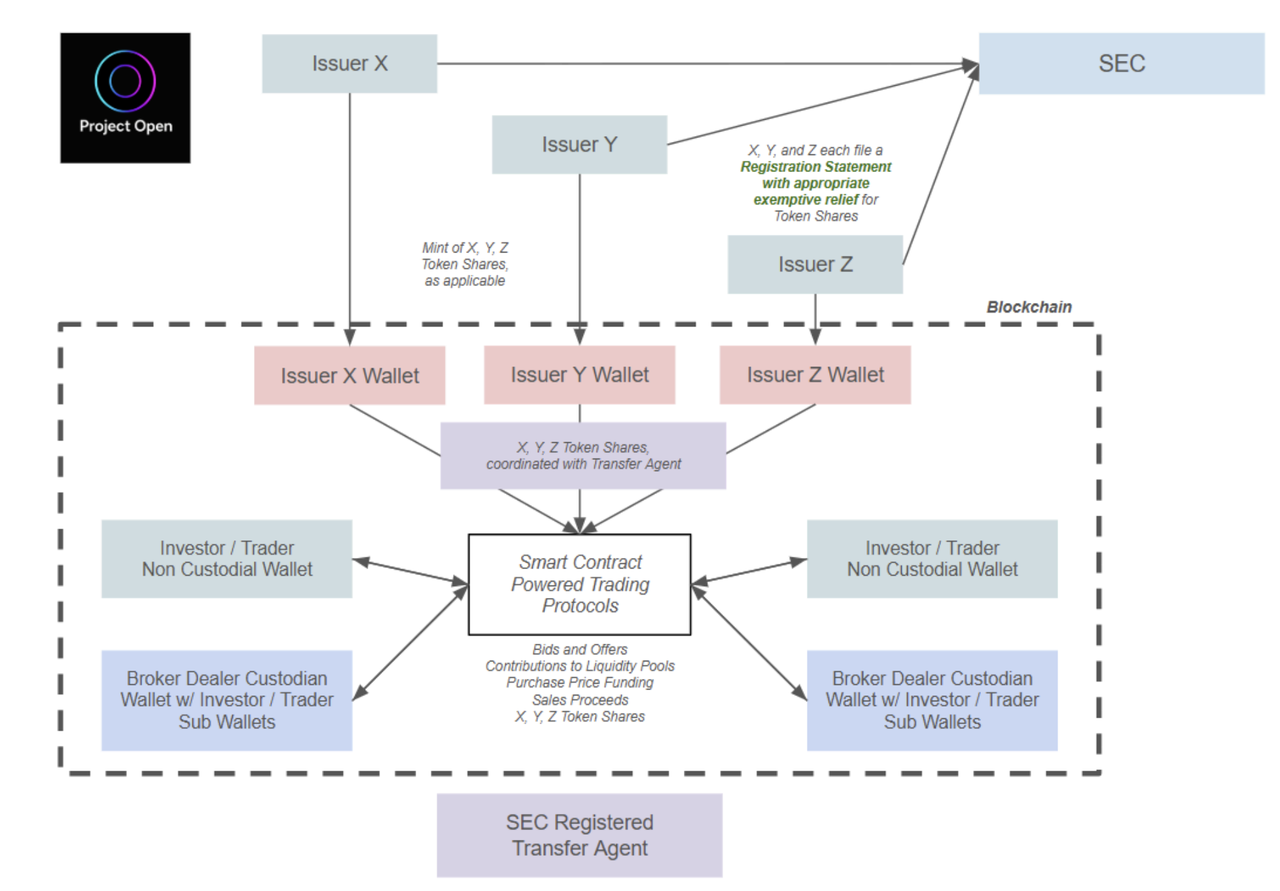
Image source: Project Open’s proposed tokenized U.S. stock issuance and trading process
When these assets enter DeFi, they are no longer "digital currencies" in an abstract sense, but operational financial instruments with stable valuation anchors and regulatory endorsements. They can be combined, mortgaged, split, and repackaged, gradually building a more mature on-chain financial ecosystem.
So when we ask “Why are U.S. stocks in a hurry to tokenize”, we may see a trend or a craze. But if we look deeper, it is because of the dominance of U.S. dollar assets over global liquidity, the active approach of crypto platforms to the real credit system, and another milestone for blockchain to break the dimensional wall.
Conclusion
From MyStonks to Backed and Kraken, they seem to be three different product solutions, but in fact they reflect the blockchain's strong desire for real assets. In the past few years, we have witnessed how stablecoins have become a new carrier of the US dollar. Now, the tokenization of US stocks is also on the same path - not to copy traditional finance, but to introduce a more credible, familiar and liquid asset anchor for the on-chain market.
That is why we say that the reason why the tokenization of U.S. stocks is “urgent” is not because the U.S. stocks themselves are so anxious, but because the on-chain market really needs a more stable, more real, and easier to understand physical asset.
On the surface, this tokenization trend is the tokenization of traditional assets, but in fact, Web3 is actively looking for an asset logic that can support transactions, liquidity, and user trust. Especially at a time when crypto-native assets are highly volatile and DeFi TVL growth is slowing down, U.S. stocks, as "high-quality targets in the real world", have been quickly introduced into the Web3 ecosystem, becoming a traffic tool that exchanges are competing for, and also the starting point of a new round of narratives.
From 24-hour non-stop trading, to cross-border investment without brokerage firms, to stablecoins as settlement channels, the changes brought about by the tokenization of U.S. stocks have long surpassed the product itself.