Author: Li Zhongzhen, Song Zeting
What is RWA?
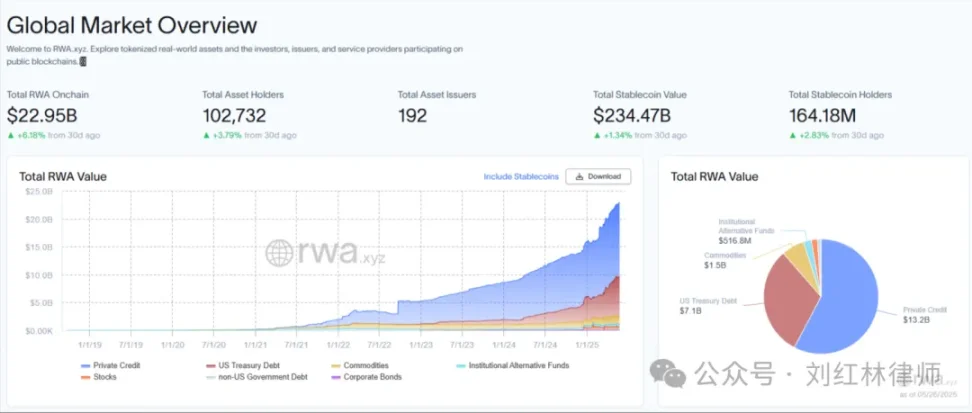
RWA (Real World Assets) refers to the use of blockchain technology to convert real-world physical assets (such as real estate, gold, artworks, etc.) or property rights (such as debt, income rights, fund shares, etc.) into digital tokens that can be circulated on the chain. It realizes an innovative model of asset segmentation, public ledgers, free circulation and automated management. Its underlying technology relies on the immutability of blockchain and the automatic execution ability of smart contracts, and it is necessary to ensure the consistency of ownership of on-chain rights and interests with underlying assets through laws. In layman's terms, RWA is very similar to asset securitization in traditional finance, but it is more novel and flexible.
For example, if you own a house worth 3 million yuan and want to sell it in reality, you may need to list the house on real estate agencies and Anjuke.com, and receive multiple potential buyers to view the house and negotiate the price for a period of time. After finally finding a buyer, you sell the whole house to the buyer, who needs to pay in full. This process has a long transaction cycle and complicated procedures. But if you use blockchain technology to convert this house into a digital token that can be circulated on the chain - house, you divide the ownership of this 3 million house into 30,000 house tokens, each house token is worth 100 yuan, that is, each house token represents one thirty-thousandth of the ownership of the house. In this way, anyone can buy one thirty-thousandth of the ownership of the property for only 100 yuan, and can buy and sell these tokens freely at any time - this is RWA.
However, we all know that in mainland China, the change of real estate ownership requires going to the Real Estate Registration Center to handle the transfer. If the house token is issued on the chain as described in the above example, can you own the corresponding ownership (property right) by buying this house token? Obviously not, this is obviously in conflict with Chinese law.
In fact, the core of RWA is not to move the assets themselves to the chain (houses cannot be moved, and equity cannot be moved), but to tokenize the "equity certificates that prove that you own assets" - for example, converting legally recognized equity certificates such as stocks, bonds, and property rights certificates into tokens on the chain. That is, the essence of assets is "rights", and the carrier of rights is "legally recognized certificates". What RWA needs to do is to repackage these "legally protected certificates" with blockchain technology to make the circulation of certificates more efficient and transparent, but the premise is: first there are rights under the legal framework, and then there are tokens on the chain.
Of course, it can be seen from here that the first step of RWA is tokenization - issuing RWA project tokens.
Securitization of RWA Tokens
1. Classification of Tokens
When it comes to the securitization of RWA tokens, we must first understand the classification of cryptocurrencies. However, since countries, regions, and organizations around the world have not reached a unified classification standard, the classification of cryptocurrencies is still in a state of confusion. The following is a general classification of cryptocurrencies in various regions around the world:
1. Hong Kong, China
The Securities and Futures Commission (SFC) of Hong Kong, together with the Hong Kong Monetary Authority, divides tokens into security tokens and non-security tokens. Among them, security tokens are regulated by the Securities and Futures Ordinance, while non-security tokens are regulated by the Anti-Money Laundering Ordinance.
2. Singapore
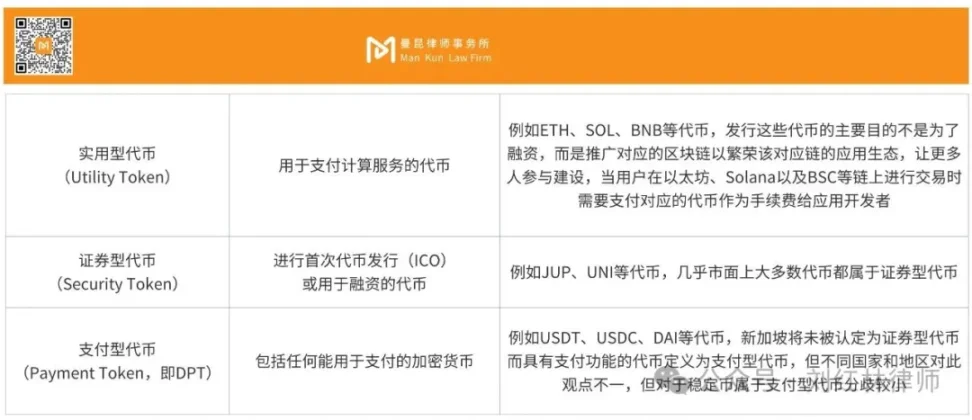
The Monetary Authority of Singapore (MAS) classifies cryptocurrencies into three categories: utility tokens, security tokens, and payment tokens. However, on March 27, 2025, the MAS issued the Consultation Paper on the Prudential Treatment of Cryptoasset Exposures and Requirements for Additional Tier 1 and Tier 2 Capital Instruments for Banks, which intends to align the classification of crypto assets with the Basel standards.
3. United States
The United States divides tokens into commodities and securities, but has not yet made a more detailed classification of cryptocurrencies. The U.S. Commodity Futures Trading Commission (CFTC) has clearly classified Bitcoin and Ethereum as commodities, and the U.S. Securities and Exchange Commission (SEC) uses the "Howey Test" to determine whether an asset is a security. However, the SEC and CFTC have regulatory conflicts over whether cryptocurrencies are "securities" or "commodities."
The Howey test is the legal standard used by the SEC and courts to determine whether a transaction constitutes a "security" (specifically, an "investment contract").
Under the Howey Test, a transaction is considered a “security” and is subject to U.S. securities laws if it meets the following four conditions:
a) One party invests
b) The investment is for a specific business
c) The investment is expected to make a profit
d) The benefits arise from the efforts of the issuer or a third party
In 2019, the SEC ruled that Bitcoin did not pass the Howey test. According to the ruling, Bitcoin only meets the first requirement of the framework, which is that money must be invested. However, because there is no central company controlling Bitcoin, the SEC ruled that Bitcoin does not meet the other requirements of the Howey test: investors do not pool funds into a "joint enterprise" and the value of Bitcoin does not depend on a third party (i.e., the product developer).
4. European Union
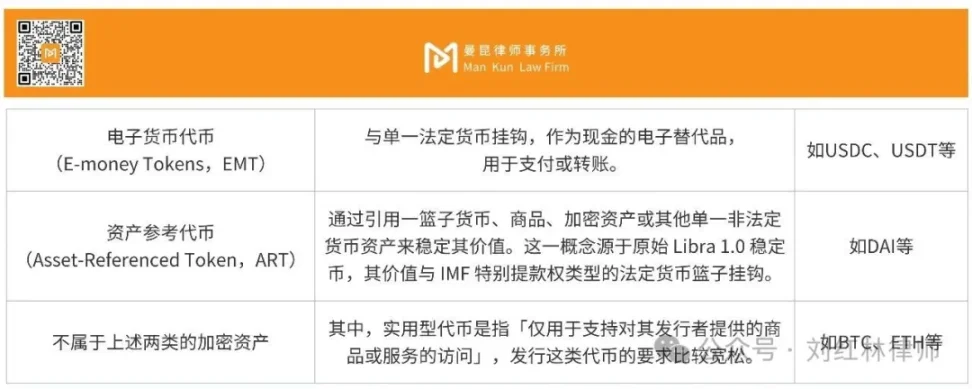
The EU's Markets in Crypto-Assets (MiCA) Regulation divides crypto assets into electronic currency tokens, asset-referenced tokens, and other crypto assets. It is worth mentioning that the EU divides the so-called stablecoins into two categories: electronic currency tokens and asset-referenced tokens.
5. Basel Committee
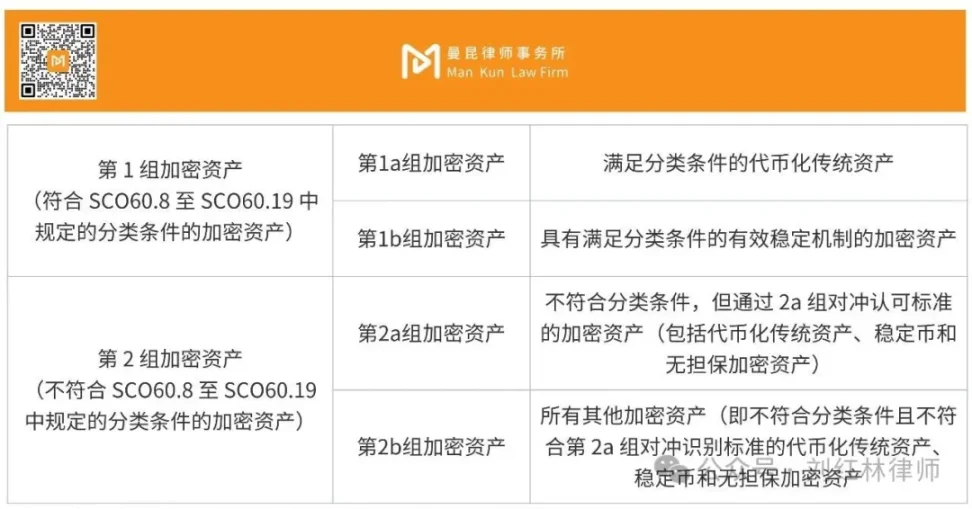
The Basel Committee on Banking Supervision (BCBS) is the main global standard setter for prudential supervision of banks and provides a platform for regular cooperation on banking supervision matters. Its 45 members include central banks and banking regulators from 28 jurisdictions. The Basel Framework it publishes is the full set of standards of the Basel Committee on Banking Supervision (BCBS), and the members of BCBS have agreed to fully implement these standards and apply them to internationally active banks in their jurisdictions. Its published SCO60- Crypto-Asset Exposure classifies crypto assets into the following categories:
2. Why should RWA tokens be securitized?
As mentioned earlier, although there is no unified standard for the classification of tokens in major regions of the world, there are classifications of security tokens in Hong Kong, Singapore and the United States.
So the question is, what type does the RWA token belong to?
In fact, the classification of RWA tokens should be based on their real-world assets:
- A small number of RWA tokens are non-security tokens. For example, USDT and USDC, which occupy the main market of stablecoins, are both products of tokenizing the real-world asset of the US dollar. It can be said that USDT and USDC also belong to RWA, but they are definitely not security tokens.
- Most RWA tokens are security tokens. For example, if you invest $1,000 in the BlackRock tokenized fund BUIDL, the fund promises to provide a stable value of $1 per token while helping holders manage their finances and earn investment returns.
Since most RWA tokens may be security tokens, they must be securitized (identified as securities), which means that these RWA tokens must comply with the securities regulatory policies of the regions where they are circulated. Otherwise, once they are deemed non-compliant, they may face huge fines at best, or even criminal risks at worst.
RWA Token Global Regulatory Landscape
At present, there is no specific regulatory policy for RWA tokens. RWA tokens are essentially crypto assets, and their regulation is still subject to the regulatory policies and regulations on crypto assets in various regions.
1. Hong Kong, China
The draft regulation of RWA stable tokens in Hong Kong was officially passed on May 21, 2025, and the RWA stable token compliance framework and regulatory possibilities were discussed in depth from 8 key points. They are:
1. Licensing system and entry threshold
2. Reserve Assets Requirements
3. Transparency and Information Disclosure
4. Anti-money laundering and counter-terrorist financing
5. Enforcement powers of supervisory authorities
6. Cross-border coordination and enforcement rights
7. Investor protection mechanism
8. Technological progress and sustainable regulation
According to the Stablecoin Bill, any entity that wants to engage in the issuance, promotion or related activities of legal currency stablecoins in Hong Kong must meet certain conditions. For example, the license issued by the Hong Kong Monetary Authority, the company's qualifications, the purpose of issuing the currency, the public review and anti-money laundering measures, and the continuous supervision after obtaining the license. There are potential conflicts and balances, such as the contradiction between innovation and regulation. It should be noted that if the regulatory licensing requirements are too high, it may hinder market innovation.
The reserve asset requirements focus on whether the licensee has "high-quality and highly liquid assets". For example, cash, short-term government bonds, repurchase agreements and other assets close to cash. These assets have two core characteristics-low volatility and high liquidity, which can be quickly converted into cash during market fluctuations or large-scale redemptions to maintain a fixed exchange rate between stablecoins and anchored assets. According to the Stored Value Facility License (SVF), licensed institutions are required to pay a margin of HK$25 million or 5% of the asset size. We can also refer to this for the stablecoin licensing standards. For example, if you want to issue HK$10 billion in stablecoins, the reserve assets must be ≥ HK$10 billion in fiat currency. To ensure that stablecoins can be redeemed at par at any time, as well as the risk of bank runs.
The transparency and information disclosure of stablecoins are important aspects of market security and confidence. According to traditional finance, investors’ confidence in a trading market determines the efficiency and capacity of a market. This is why listed companies in the stock market must disclose some company revenue (such as 10K, 10Q, 8K, 13F...) and operating information every quarter and every year. This allows investors to have more trust in the market and ensure the certainty and security of money.
Another obvious problem is raised in the draft. Stablecoins may also be used by criminals as a tool for money laundering and terrorist financing due to their anonymity and cross-border liquidity. To this end, a set of targeted rules are formulated to ensure that stablecoin transactions are legal and transparent. Identity verification (KYC), fund tracing and record keeping are the three key issues of this issue. In the draft, Hong Kong plans to further benchmark international standards (such as the FATF Virtual Asset Guidelines). As long as the transparency of funds and a reasonable range of privacy are guaranteed, this problem can be solved.
In addition, the Stablecoin Bill gives the Monetary Authority (HKMA) strong legal enforcement powers to ensure that the stablecoin market operates in compliance with regulations. For example, if a stablecoin issuer is suspected of misappropriating reserve assets, its financial records and transaction data can be directly retrieved. If necessary, a third-party institution (such as an accounting firm) can be appointed to assist in the investigation, or even an international team of experts can be hired to crack the cross-border money laundering chain.
In the context of globalization, the Hong Kong Stablecoin Bill has established a global regulatory network through cross-border coordination mechanisms and strong enforcement powers to ensure that the issuance and trading of stablecoins are legal and compliant. For example, if an overseas stablecoin issuer is suspected of money laundering, the Hong Kong Monetary Authority may request local regulators to assist in the investigation (commonly known as offshore fishing). By obtaining the right to supervise overseas entities, emergency disposal rights, and cross-border application rights for criminal and civil sanctions, it paves the way for the compliance globalization of stablecoins.
In short, after the draft is passed, a "firewall" for investor protection will be built based on the six mechanisms of standardized access screening, risk isolation, transparent disclosure, tiered sales, rapid compensation and severe punishment for violations. Its core logic is:
- Beforehand: Strictly control the qualifications of issuers to prevent “empty-handed tricks”;
- During the process: enforce transparent operations to prevent shady operations;
- Afterwards: Provide relief channels and reduce the cost of rights protection.
This framework not only lays a compliance foundation for the Hong Kong stablecoin market, but also sets a benchmark for global investor protection - while embracing innovation, it ensures that "retail wallets" are not eroded by financial risk-taking. A serious violation punishment and enforcement framework has been established, such as unlicensed issuance or false advertising, or fraudulent behavior, which will result in a fine of 5 million and 7 years in prison, with a maximum fine of 10 million Hong Kong dollars and 10 years in prison.
In the future, Hong Kong may further explore the embedding of compliance rules into smart contracts, and use blockchain technology to achieve automated supervision, so as to meet regulatory needs while protecting user privacy. With "controllable risks and orderly innovation" as the core, it not only injects compliance genes into Hong Kong's virtual asset ecosystem, but also contributes oriental wisdom to global financial governance. While maintaining the bottom line of security, Hong Kong is welcoming the future of financial technology with an open attitude, and is committed to becoming a "super contact person" for virtual asset supervision and innovation.
2. US GENIUS Act
On May 19, 2025, the U.S. Senate passed the Guiding and Establishing National Innovation for US Act by a vote of 66 to 32. The bill contains precise definitions of stablecoins, who can issue them, and the requirements for issuing them. The most concerned point is the need for stablecoins to maintain reserves.
The bill states that legal stablecoins in the United States must reserve 100% of the issued stablecoins, and must reach cash or equivalent to cash or short-term bills, CDs liquidity. And regularly audit and disclose this reserve. And each stablecoin issuer will have 18 months to adjust liquidity to adapt to new laws and regulations. So far, the stablecoin called USD1 traded on the trading platform is in full compliance.
The GENIUS Act also mentions that algorithmic stablecoins will gradually fade out and some will be disabled. Due to the death spiral of Terra/Luna coins in 2022, the fatal shortcomings of algorithmic stablecoins and their unstable nature were exposed, so stricter legal control is needed to ensure that similar incidents do not happen again. The bill also strengthens a series of concerns such as anti-money laundering (AML) and handling of interests, and prohibits US government officials from issuing stablecoins. Ensure the legal endorsement of Web3.0 and the continuous popularization of education in the future. Thereby reducing a series of criminal acts such as fraud, money laundering, and network security risks.
3. Singapore
On January 14, 2019, Singapore passed the Payment Services Act 2019 (PSA) and continued to revise it. As a "forward-looking and flexible framework for regulating Singapore's payment systems and payment service providers", the Act replaced the previous Payment Systems Supervision Act and the Exchange and Remittance Business Act. In addition, the Monetary Authority of Singapore (MAS) issued Notice PSN01 (Preventing Money Laundering and Combating the Financing of Terrorism - Designated Payment Services) in accordance with the PSA, introducing requirements for anti-money laundering (AML) and combating the financing of terrorism (CFT) for regulated payment service providers. This means that payment service providers must do the following to achieve regulatory compliance:
- Risk Assessment and Risk Mitigation
- Customer Due Diligence
- Reliance on third parties
- Correspondent Accounts and Wire Transfers
- Save records
- Suspicious Transaction Report
- Internal policies, compliance, audits and training
On March 27, 2025, the Monetary Authority of Singapore issued the Consultation Paper on the Prudential Treatment of Cryptoasset Exposures and Requirements for Additional Tier 1 and Tier 2 Capital Instruments for Banks, which aims to implement the Basel Committee on Banking Supervision (BCBS)'s updated prudent treatment and disclosure standards for cryptoasset risks. It mentions that crypto assets that pass all classification conditions are classified as Group 1a crypto assets (tokenized versions of traditional assets) or Group 1b crypto assets (crypto assets designed to exchange for a pegged value, which is the value of a predefined reference asset or asset and has an effective stabilization mechanism).
For crypto assets classified as Group 1b crypto assets, the BCBS’s prudential treatment of crypto asset exposures provides for a redemption risk test, the goal of which is to ensure that reserve assets are sufficient to allow the crypto assets to be redeemed for the pegged value at any time. To pass the redemption risk test, banks must ensure that the reserve assets of crypto assets meet conditions related to the value and composition of the reserve assets and the management of the reserve assets.
4. European Union
In June 2023, the European Union officially released the Crypto-Asset Market Regulation Act (MiCA). MiCA's regulatory objects are divided into two categories:
1) The first category is crypto asset issuers, including stablecoin issuers and other cryptocurrency issuers.
MiCA has the following requirements for stablecoin issuers:
- Obtain authorization before issuance
- Fulfilling disclosure obligations
- Hold a certain amount of own funds and reserve assets
MiCA has relatively loose requirements for other crypto asset issuers:
- Issuers must have a legal entity established in the EU
- Release white paper
2) The second type of regulatory object is crypto asset service providers. MiCA’s requirements for crypto asset service providers mainly include four aspects:
- Get Authorization
- Improved governance structure
- Minimum capital requirements
- Consumer protection and transparency requirements
Beyond the law, potential problems with RWA practice
The passage of the Hong Kong Stablecoin Draft, the US GENIUS, the European MiCA and the Southeast Asia Act is undoubtedly a major step forward in the application of RWA. However, in addition to laws and regulations, there are some potential problems that cannot be solved by regulation alone. For example, the liquidity of RWA on major central trading platforms, and the RWA Web3.0 anti-fraud legal education. These problems are not the weaknesses of RWA, but more of the uncertainties that exist and things that can only be promoted with time.
While people focus on improving the legal framework, RWA still faces multiple hidden challenges in practice, and its development trajectory may be closer to a "marathon" rather than a "sprint."
1. Liquidity dilemma: the “false proposition” of centralized platforms
At present, the liquidity of RWA on centralized trading platforms (CEX) and the assets bound to it on traditional financial exchanges show obvious polarization. Taking Hong Kong as an example, although the issuance of compliance licenses has accelerated the entry of institutional funds, some funds, such as BlackRock's BUIDL U.S. Treasury tokens, have obviously insufficient daily liquidity. This split between theory and practice stems from the heterogeneity of RWA assets themselves: securitized tokens require a relatively new and complex custody and clearing system. More importantly, the liquidity premium mechanism of the traditional financial market has not yet been fully migrated to the chain. The on-chain tokens of the same commercial real estate may be repeatedly pledged on multiple platforms, and the delayed synchronization of the off-chain registration system and the public chain data makes it difficult for arbitrageurs to bridge the price gap.
2. Education gap: cognitive dissonance between Web3 natives and the real world
The complexity of anti-fraud education goes far beyond simple risk warnings. Web3 users in many legalized regions, such as some investors in Singapore, misunderstand "RWA" as a new type of stablecoin, while European pension fund investors compare the yields of RWA tokenized bonds with those of traditional ABS products. This cognitive bias has given rise to new forms of fraud. For example, a project illegally raised funds on a decentralized forum by forging a government digital signature and packaging its bonds as "central bank-endorsed" RWA tokens. The information disclosure templates required by regulators are difficult to cover this type of targeted fraud targeting differences in technical cognition.
3. Technical Debt: Underestimated Off-Chain-On-Chain Collaboration Costs
Existing RWA solutions generally fall into the "oracle paradox". For example, when a certain trust synchronizes rental income through the Chainlink oracle, the node operator requires it to provide a double audit report offline and online. This hybrid architecture leads to increasing marginal costs. A European railway asset tokenization project was forced to postpone an asset migration plan worth 800 million euros due to a security dispute between the Polkadot and Cosmos cross-chain bridge. These undoubtedly exceed the wear and tear and risks that would not have existed in the traditional financial system. Since the architecture is so complex and there are more problems than traditional architectures at this stage, what solutions or incentives are there to make people more willing to use the RWA token system?
Solving these deep-seated contradictions requires going beyond the simple technical or regulatory dimensions: at the liquidity level, we can discuss the use of a dual-track system of "custody + oracle" to allow traditional custodians to issue digital ownership certificates on the chain, such as Ondo finance and its series of product solutions. In terms of popular education, the RWA sandbox simulator launched by Hong Kong Cyberport has begun to use a gamified interface to display the full-process risk nodes of asset tokenization. The true maturity of RWA may give birth to a "third infrastructure" between traditional finance and cryptography. When the market is eagerly discussing the milestone of RWA's market value exceeding US$50 billion, perhaps more attention should be paid to the hidden costs that are not included in the financial statements. These undercurrent details remind us that the evolution speed of RWA ultimately depends on the running-in efficiency of the real world and the digital native ecosystem, and this is destined to be a long-term game that requires patience and wisdom.