
Author: Kedar@Foresight Ventures, Alice@Foresight Ventures
In today’s world, cross-border payments often take days to process, and businesses are burdened with billions of dollars in transaction fees. PayFi is an innovative solution that combines the power of decentralized finance (DeFi) with the The advantages and immediacy of modern payment systems are expected to reshape the future of transactions.
As the global financial landscape continues to evolve, PayFi has emerged at the intersection of blockchain technology and payment systems, committed to combining the efficiency of DeFi with the immediacy and convenience of modern payment solutions to transform the way transactions are conducted. This article will explore in depth The reasons for the rise of PayFi, an overview of the current status of the industry in which it operates, and key cases are listed to explore its potential application scenarios.
1. Background and advantages of PayFi
1) Filling the gap between DeFi and payments
The traditional financial system has long suffered from inefficient settlement, such as long settlement times, high transaction costs, and limited accessibility, which were exposed during the 2008 financial crisis. Although DeFi has introduced innovative financial services through decentralized platforms, There are deficiencies in real-time processing capabilities for daily transactions.
PayFi uses blockchain technology to achieve real-time settlement of transactions. Based on the theory of time value of money (TVM), which states that the money available today is more valuable than the same amount of money in the future due to its potential earning power, PayFi uses instant, secure and low-cost transactions to , maximize financial efficiency.
2. PayFi’s unique advantages
Real-time settlement: Transactions are completed instantly, eliminating the delays associated with traditional banking systems.
Safe and reliable: The tamper-proof ledger feature of blockchain ensures that transactions are secure and transparent, providing protection for users.
Cost reduction: Eliminate intermediaries, significantly reduce transaction fees, and save user expenses.
Globally accessible: Its decentralized platform reaches markets that are not adequately covered by traditional financial services, including the unbanked population, achieving financial inclusion.
Innovative products: giving rise to novel financial service models such as “buy now, pay never” and innovative applications such as providing creators with advanced monetization methods.
2. PayFi industry overview and insights into sub-sectors
The PayFi ecosystem is thriving, with industries innovating to address financial challenges. Here’s a breakdown of its key segments and examples of innovative companies in each space.
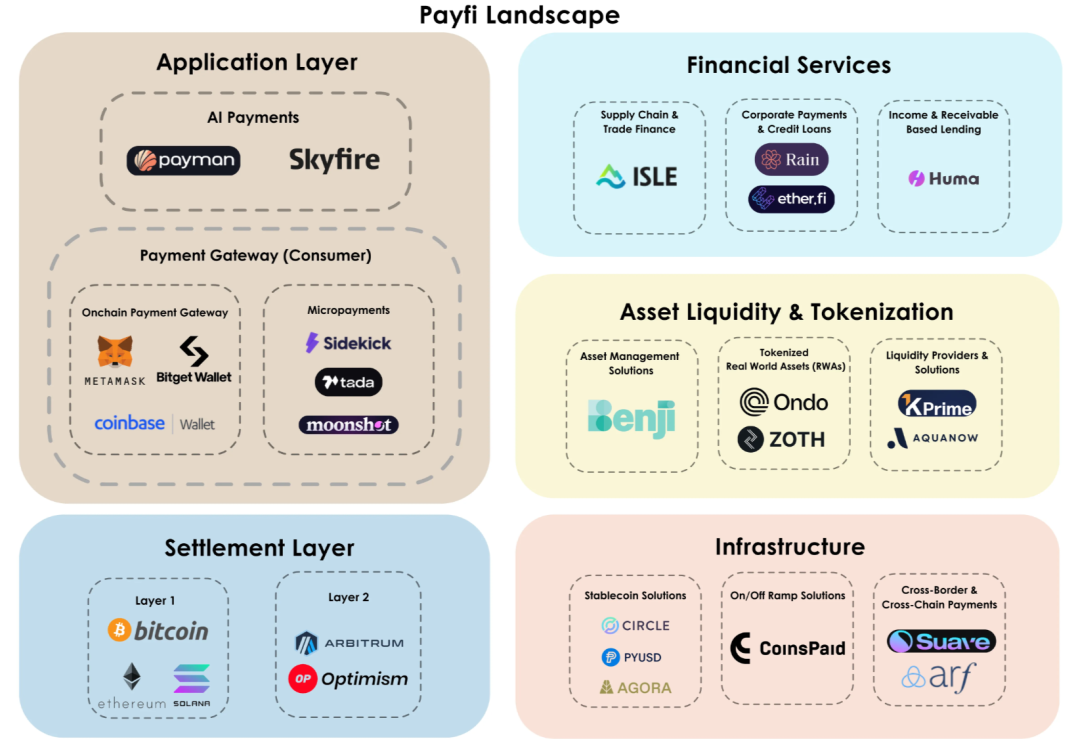
1. Cross-chain and cross-border payments
- The chronic problems of traditional cross-border payments
Slow speed and high latency: Traditional payment channels are inefficient, settlement often takes several days, and the complex settlement process across time zones and banking hours exacerbates payment delays.
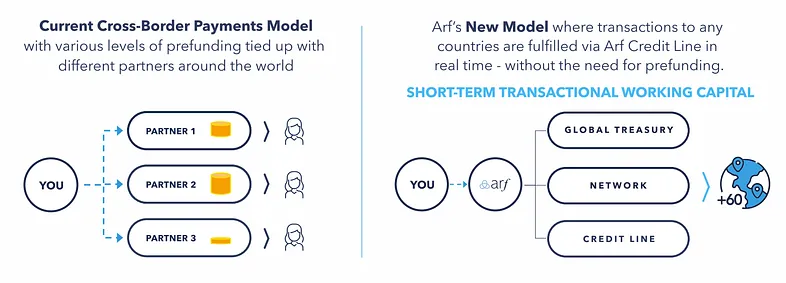
Inefficient capital and constraints of pre-deposited funds: The pre-deposit requirement forces financial institutions to maintain foreign currency funds in nostro accounts, resulting in a global liquidity gap of US$4 trillion. Idle funds cannot generate income, becoming a hidden cost for financial institutions and passed on to the end users. users, resulting in users paying higher fees.
High transaction costs: There are multiple intermediary institutions charging various fees, including pre-deposit fees, currency exchange fees, etc. The average transaction cost of global cross-border remittances is as high as 6.35% (World Bank statistics).
- Industry innovation cases
- Arf: Build a regulated global settlement banking platform to provide on-chain liquidity solutions for financial institutions. Use stablecoins such as USDC to achieve the immediacy and low-cost advantages of cross-border settlement, and provide on-demand cross-border transactions through blockchain. Real-time liquidity eliminates the reliance of nostro accounts on large cash reserves; provides instant credit lines based on USDC, allowing financial institutions to temporarily borrow funds during transactions and repay after payment settlement. Arf abandons the pre-deposited fund account model and uses short-term liquidity based on USDC. The solution effectively reduces funding requirements and settlement time, significantly reducing the operating costs of financial institutions engaged in global transactions. Emphasis on transparency, creating a complete traceable loan record, with the help of blockchain, all loans, repayments and receivables can be easily traced Information. Adhering to the concept of strict compliance, as a member of the VQF Financial Services Standards Association, it follows the international standards of anti-money laundering and financial supervision, setting an example for the industry. So far, it has successfully processed more than $1.6 billion in on-chain transactions and maintained a zero default record.
- suave.money: Create a cross-chain payment solution that enables enterprises to receive cryptocurrency payments from any blockchain network. Enterprises can seamlessly connect to various token payments and flexibly choose to receive the tokens they like according to their own needs, improving the region Payment flexibility in the blockchain ecosystem. suave.money’s platform simplifies cross-chain transactions, allowing companies to attract user groups from different blockchain ecosystems without having to manage multiple wallets or rewrite decentralized applications (DApps), broadening Customer source. By promoting payment convenience from more than 10 blockchain networks and enhancing liquidity acquisition capabilities, it provides strong support for the expansion of DeFi and Web3 projects and expands market coverage. It simplifies cross-chain transaction processes and reduces the complexity of enterprise operations. , so that enterprises can attract customers more widely in the blockchain ecosystem without relying on professional infrastructure construction, creating more opportunities for enterprise development. With innovative capabilities, we help enterprises tap into the trillion-dollar cross-chain capital potential. It occupies an important position in the rapidly developing DeFi and crypto payment fields, providing users with unparalleled flexibility and convenience.
(II) Borrowing based on income and receivables
The dilemma of the traditional lending model: Traditional lending business relies on collateral, excluding potential borrowers who lack substantial assets or credit records, limiting the accessibility and fairness of financial services.
The emergence of innovative solutions: Platforms such as Huma Finance allow users to borrow against future income or receivables, using blockchain technology to make the lending process transparent and efficient.
Positive benefits: This innovative model significantly improves financial inclusion, provides new ways for underserved markets neglected by traditional financial institutions to obtain funds, and promotes balanced economic development and social equity and justice.
Huma Finance's practical case: Building a decentralized lending protocol to provide lending services based on future income and receivables for businesses and individuals. Connecting borrowers with global investors through an on-chain platform, creating an over-collateralization solution with traditional DeFi. Income-supported lending models with different models. Partnering with Circle, Request Network, Superfluid and other platforms, we launched the world’s first on-chain factoring market on Ethereum and Polygon, where users can use tokenized invoices or payment flows as collateral for the first time. , broadening the scope and form of collateral. With the efficiency of blockchain, the on-chain processing time of factoring process is shortened to less than one minute, providing users with a convenient experience. Huma Finance's technical architecture consists of several key parts. Decentralization The income portfolio layer converts income sources such as invoices, payrolls, and pledge income into tokenizable assets, providing a rich asset base for lending business. The assessment agent framework is responsible for accurate risk assessment of various lending needs to ensure reliable credit quality on the chain. Stable. The smart contract suite uses configurable smart contracts to achieve diverse lending use cases from invoice factoring to general credit lines to meet the personalized needs of different users. Huma Finance focuses on providing much-needed liquidity support to small and medium-sized enterprises and the unbanked population. Through innovative lending models, it helps these groups break through traditional financial constraints, obtain financial resources that were previously difficult to reach, promote their economic development and social integration, and build a Make positive contributions to a more fair and inclusive financial ecosystem.
Tokenization of real-world assets
Difficulties of traditional asset transactions: The transaction process of real-world assets such as real estate is cumbersome, with high intermediate costs and slow transaction speeds, which brings inconvenience and financial burden to both buyers and sellers.
Innovative breakthroughs in tokenization: Tokenization of real estate and other real-world assets. Through smart contract technology, asset ownership can be divided into multiple parts to achieve partial ownership transactions, while greatly speeding up transaction speed and processes, creating a new asset trading market. Inject new vitality.
Significant advantages: This tokenization model significantly lowers the threshold for investors to enter the market, allowing more investors to participate in real-world asset investments, while greatly improving asset liquidity, accelerating the asset trading process, and making market resources more Efficient configuration and circulation.
Ondo Finance's success: Launching tokenized U.S. Treasury bonds and other yield-generating products on a blockchain platform, opening up a new investment channel for investors to easily access short-term U.S. Treasury bonds through decentralized finance (DeFi) and other fixed-income assets, realizing the organic integration of traditional financial markets and DeFi. Ondo Finance's innovative products provide investors with stable, profitable, liquid and secure investment options, breaking the gap between traditional financial markets and DeFi. Barriers, so that more investors can share the dividends of the relatively closed capital market, enrich investors' asset allocation portfolio, and enhance the efficiency and vitality of the entire financial market. As of September 2024, Ondo Finance has achieved Its total locked value (TVL) has exceeded the $600 million mark. Among them, the locked amount of USDY (interest-bearing stablecoin) reached $384 million, and the locked amount of OUSG (tokenized U.S. Treasury bonds) was $221 million. These data fully demonstrate the market's high recognition and wide acceptance of its innovative products, highlighting its leading position and strong influence in the field of tokenization of real-world assets.
Zoth's innovative contribution: Building a market platform dedicated to tokenized trade finance assets, providing investors with a convenient way to obtain fixed-income products denominated in US dollars. Tokenization builds a bridge between traditional finance and decentralized finance (DeFi), creating high-yield, low-risk investment opportunities for investors, while providing companies with new financing channels and fund management methods. It plays an important role in the market, not only bringing high-quality investment options to investors, helping them to increase and preserve their assets, but also providing strong support for corporate development. By tokenizing trade finance assets, companies can unlock working capital more efficiently and optimize At the same time, this will help promote the optimal allocation of capital in the global market, promote a more reasonable flow of financial resources to enterprises and projects in need, further improve the on-chain trade finance ecosystem, and provide a Make positive contributions to the stability and development of financial markets.
(IV) Enterprise payment and credit solutions
New consumer demands and limitations of traditional credit: In today's consumer market, consumers have higher requirements for payment flexibility and expect to enjoy a more convenient and diversified payment experience without incurring heavy debt burdens. However, traditional credit Models often fail to meet this demand, causing inconvenience and economic pressure on consumers.
PayFi’s innovative model: To meet this market demand, PayFi innovatively introduced unique payment models such as “buy now, pay never”, which cleverly used the interest income obtained from DeFi lending platforms to offset the purchase cost, providing consumers with a new , more flexible and debt-free payment solutions, greatly enhancing consumer purchasing power and shopping experience.
- Industry innovation cases
- Rain: Launching a corporate card backed by USDC, designed for the daily business payment needs of Web3 teams (such as decentralized autonomous organizations DAOs and various protocol projects). With this corporate card, Web3 teams can easily use their on-chain assets ( Rain’s corporate card is an important part of its expense management platform. , making full use of the advantages of blockchain technology to achieve seamless integration of digital assets and traditional payment systems. Through this innovative payment method, enterprises can manage finances more efficiently, reduce the cost and time consumption of intermediate links, and at the same time provide a platform for blockchain and cryptocurrencies. It provides more convenient and secure payment solutions for enterprises in this field, and effectively promotes the development and popularization of Web3 industry.
- Ether.fi: The “Ether.fi Cash” product launched by Ether.fi has attracted wide attention in the market. This is a credit card in cooperation with Visa with unique and innovative features. Users holding this card can use their crypto assets (including Ethereum assets) as collateral to easily obtain loan limits, so that users can spend fiat currency without having to sell crypto assets, providing users with a more flexible fund management method and consumption experience. In addition, the "Ether.fi Cash" credit card Deep integration with Ethereum's Layer 2 network Scroll, this technical advantage significantly reduces transaction costs and further improves the user's cost-effectiveness. At the same time, the card supports peer-to-peer USDC transfer function, allowing users to transfer and manage funds more conveniently, meeting It can meet payment needs in different scenarios and bypass the traditional bank intermediary, saving users extra expenses. In addition, in order to improve user enthusiasm and satisfaction, the "Ether.fi Cash" credit card also provides an attractive cashback reward mechanism. The user consumption process brings tangible economic benefits, further enhancing product market competitiveness and user stickiness.
- Bitget Card: The Visa card launched by Bitget Card serves as an important bridge between cryptocurrency and traditional payment systems, providing users with convenient and efficient payment solutions. The card is closely connected to a multi-currency wallet, allowing businesses or individual users to easily hold Bitcoin in their wallets. There are various mainstream cryptocurrencies, such as USDT, BTC, ETH, USDC, BGB, etc. (currently, the fund account is mainly recharged with USDT, and more cryptocurrencies are planned to be introduced gradually in the future). Card can automatically convert cryptocurrency into legal tender based on the real-time exchange rate, ensuring that users can successfully complete payment at any merchant that accepts Visa cards around the world without having to worry about cumbersome currency exchange procedures and exchange rate fluctuation risks, truly realizing the integration of cryptocurrency and The seamless connection of legal currency payment provides great convenience for users. The emergence of Bitget Card has an important impact on the field of corporate payment. It not only simplifies the corporate payment process, but also enables enterprises to make payments in real time without having to manually perform complex cryptocurrency and legal currency conversion operations. Using traditional currency for consumption greatly improves payment efficiency and capital utilization efficiency. At the same time, its powerful cross-border payment capabilities make it easier for enterprises to expand and operate international businesses, without having to worry about opening and managing foreign currency accounts, effectively reducing corporate operating costs and financial risks. Currently, Bitget Card has more than 180 branches around the world. It has been widely accepted and recognized in many countries and regions, providing strong support for the global development of enterprises. In addition, Bitget Card also has a wealth of potential DeFi use cases. For example, in terms of supplier payments, enterprises can directly use the card to pay suppliers in legal currency. , avoiding the tedious process of manually converting cryptocurrencies and improving the efficiency and stability of supply chain payments; in terms of travel expense reimbursement, employees can use the card to easily make business-related consumer payments during cross-border travel, such as air ticket bookings, hotel accommodation, etc., without the need for Worrying about payment restrictions and handling fees, it provides a more convenient payment solution for enterprises' cross-border business activities; in terms of corporate reward mechanism, enterprises can also use the cryptocurrency payment function provided by Bitget Card to issue cryptocurrency-based rewards to employees. You can convert cryptocurrencies into legal tender for consumption according to your needs, or use them directly in scenarios that support cryptocurrency payments, bringing more innovation and flexibility to corporate employee incentives and welfare systems, and further enhancing corporate competitiveness and attractiveness. .
(V) Supply chain and trade finance
Dilemma of traditional supply chain finance: In the traditional supply chain finance system, suppliers often face long and complex payment cycles, with large amounts of funds locked up for a long time, which seriously restricts their operational efficiency and capital turnover, making it difficult to maintain normal production and operation activities and business expansion. According to statistics, due to the limitations of traditional financial institutions, global companies have up to 2.5 trillion US dollars in trade financing needs that cannot be effectively met each year. This has become a bottleneck in the development of global trade, hindering the coordinated development of the industrial chain and the stable growth of the economy.
PayFi’s solution: PayFi provides an innovative solution to the invoice financing problem in supply chain finance by introducing a decentralized platform. In this model, suppliers can leverage the advantages of blockchain technology to represent the invoices they hold. Monetization and rapid financing on a decentralized platform can greatly improve liquidity. At the same time, buyers can continue to settle according to the original payment plan without changing their traditional payment habits and financial process, achieving a balance of interests and coordinated development between buyers and sellers, and providing strong guarantees for the efficient operation of supply chain finance.
- Industry innovation cases
- Isle Finance: It is deeply engaged in the on-chain credit market in the field of supply chain finance. Its platform can accurately connect high-credit buyers with liquidity providers, thus helping enterprises obtain financing at a faster speed. The blockchain technology greatly enhances the liquidity and security of the entire supply chain by rigorously verifying real-world assets (RWAs) and implementing early payment strategies for buyers (especially those suppliers with low credit ratings). The stable development of supply chain finance has laid a solid foundation. Isle Finance has vigorously promoted the development of reverse factoring business with its own platform, which not only significantly accelerated the payment speed of enterprises, but also greatly optimized the cash flow situation. Innovative solutions enable companies to flexibly provide early payment discounts, creating extremely stable and substantial returns in the field of supply chain finance. It also broadens the channels for companies to obtain liquidity and injects strong impetus into their sustainable development.
(VI) Stablecoin Payment Platform
- Example: Agora
- Business content: Carefully created the U.S. digital dollar (AUSD), which is backed by full support of cash, U.S. Treasury bonds and overnight repurchase agreements. The platform is committed to using blockchain technology to enable the U.S. dollar to be used globally. Wider and more convenient circulation, especially focusing on areas where traditional financial systems are insufficiently covered, fully implementing the concept of financial inclusion, and opening up a new path for the public to more easily obtain stable and globally recognized currency.
- Impact: It has strongly promoted the democratization of access to US dollars, which is highly consistent with PayFi's grand vision of expanding financial inclusion. It fully utilizes the technical advantages of blockchain to build a decentralized and accessible financial system. It enables individuals and businesses to benefit from financial instruments backed by US dollars. The results are particularly significant in Argentina, Southeast Asia and other regions, providing strong support for local economic development and financial stability.
- Achievements: Successfully launched the stablecoin AUSD, initially on Ethereum and then on Avalanche. Remarkably, within a few weeks of its launch, its minting volume exceeded 2,000 Today, the platform is steadily advancing its global layout of digital dollars, continuing to expand its international market, while always adhering to the development strategy of financial inclusion and regulatory compliance, and gradually establishing a good reputation and influence in the field of stablecoins. .
- Example: PayPal
- Business content: PayPal USD (PYUSD) was officially launched in August 2024, first launched on the Ethereum blockchain, and then successfully expanded to Solana in May 2024. The original intention of this stablecoin is to fully integrate the two blockchains. Especially after expanding to Solana, with its superior transaction speed and low fee advantages, PYUSD's usability in various commercial and DeFi application scenarios has been greatly improved. Provides users with more efficient and convenient payment options.
- Impact: With its fast speed and high cost-effectiveness, it is expected to become a powerful alternative to traditional payment systems, thereby significantly improving global payment efficiency. It has successfully realized the seamless transfer function across different platforms (including PayPal and Venmo, etc.), allowing users to The ability to easily hold and transfer stablecoins and fully leverage the technological advantages of blockchain brings more convenience and innovative experience to users' digital asset management and payment transactions.
- Achievements: After expanding to Solana, PYUSD’s market adoption has shown a rapid growth trend, with its market value rapidly climbing and successfully breaking through the $500 million mark. This remarkable achievement fully demonstrates its uniqueness in centralized and decentralized platforms. The deep integration and wide recognition also indicate that PayPal has achieved a major stage victory in its exploration of the stablecoin field, laying a solid foundation for its further development in the digital payment field in the future.
- Example: Bridge (acquired by Stripe)
- Business content: As a platform focusing on stablecoin payments, Bridge has always taken simplifying cross-border digital payments as its core goal. Through convenient API interfaces, it can easily realize stablecoin-based payment integration, providing low-cost and high-efficiency payment services to global users. Before being acquired by Stripe, Bridge had already achieved remarkable results in the integration of e-commerce platforms, successfully helping merchants to seamlessly connect and efficiently process stablecoin payment services in any corner of the world, greatly expanding The scope of application of stablecoins in the commercial field.
- Impact: Bridge was recently acquired by the US payment giant Stripe. This major event is undoubtedly a key milestone in the integration of stablecoins into mainstream financial services. With Stripe's strong infrastructure and extensive market network, Bridge is able to further expand its business coverage and comprehensively improve itself. This move is highly consistent with PayFi’s vision to promote the global adoption of digital currencies by promoting financial inclusion and seamless cross-border transactions. Stripe's existing advantages and Bridge's stablecoin technology expertise will accelerate the widespread application and deep integration of blockchain-supported payment methods in mainstream financial channels, injecting new vitality into the innovative development of the global financial payment field.
- Achievements: In August 2024, Bridge's annualized payment volume exceeded $5 billion, a remarkable achievement. During its development, Bridge has established close partnerships with many industry-leading companies, such as Coinbase and SpaceX, and It is still providing high-quality payment services to these companies, has accumulated rich practical experience and a good market reputation in the field of stablecoin payments, and has become one of the important forces driving the development of the industry.
Conclusion
Overall, PayFi is not a completely new concept. The problems it aims to solve already exist in the traditional financial system and have corresponding solutions. But this does not mean that PayFi is worthless, because traditional solutions are still not enough. By addressing the core inefficiencies of the global payment system and leveraging the transformative potential of blockchain, PayFi is poised to unlock unprecedented liquidity and drive financial inclusion. As more companies enter this space, The vision of creating a completely decentralized financial ecosystem where payments are instant, secure and borderless is getting closer to reality. Now is the time to embrace the PayFi revolution and shape the future of global finance.