In November 2025, a subtle yet significant shift occurred in the global financial landscape. The Singapore Exchange (SGX) announced the launch of perpetual futures for Bitcoin and Ethereum on November 24th. Almost simultaneously, Cboe Global Markets across the Pacific announced the launch of its "Continuous Futures"—a product functionally equivalent to perpetual contracts—on December 15th.
This is not an isolated product launch, but a strategic collaboration spanning two continents. Traditional financial giants are no longer content with the more "traditional" dated futures market dominated by the Chicago Mercantile Exchange (CME) since 2017. Their target has been set—the core profit center of crypto-native exchanges (CEXs, such as Binance and Bybit): a massive market with a daily trading volume exceeding $187 billion.
TradFi's entry into the market was extremely shrewd. Instead of simply copying, they "reinvented" products to comply with regulations. SGX, within the strict framework of the Monetary Authority of Singapore (MAS), successfully "complied" by explicitly limiting its products to institutional and accredited investors.
Cboe's "continuous futures" represent a more sophisticated regulatory engineering feat. By setting an ultra-long 10-year expiration date and supplementing it with daily cash adjustments, it functionally replicates perpetual contracts (without the need for rolling over), but legally avoids the term "perpetual," which has been "tainted" by offshore markets. This approach provides the U.S. Commodity Futures Trading Commission (CFTC) with a stepping stone to approve a functionally identical but nominally "clean" product. This is typical TradeFi wisdom: not circumventing regulation, but reshaping the regulatory discourse.
SGX President Michael Syn put it succinctly: "Bringing perpetual contracts into a regulated framework cleared by an exchange...we are giving institutions the trust and scalability they have been waiting for."
At the heart of this battle is TradFi's attempt to use "trust" and "regulatory certainty" as weapons to wrest institutional liquidity from CEXs.
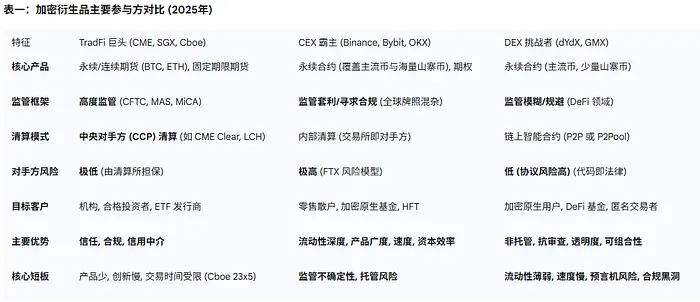
The hunt by TradFi giants: using "trust" as a weapon
The organization's core pain point: FTX's "Post-Traumatic Stress Disorder (PTSD)".
The collapse of FTX three years ago was a turning point in the institutional crypto narrative. It exposed the fundamental flaws of the crypto-native exchange (CEX) model: asset opacity, conflicts of interest, and catastrophic counterparty risk.
For a pension fund or large asset management company, the biggest risk is not Bitcoin price volatility (Market Risk), but rather the risk of exchanges abusing customer funds or running away with the money (Counterparty Risk). Institutional investors are deeply uneasy about the high counterparty risk posed by opaque, offshore, and unregulated crypto exchanges.
The "original sin" of CEXs lies in their dual roles as market maker, broker, custodian, and clearinghouse. This is a structural conflict of interest strictly prohibited by regulations in traditional finance (such as the Dodd-Frank Act). Institutional risk control and compliance departments cannot answer a core question: "Who is my counterparty? Where is my collateral?" In CEXs, the answer is "the exchange itself." After the FTX incident, this answer became "unacceptable."
TradFi's "silver bullet": Central Counterparty Clearing (CCP)
TradFi's solution is structured. When institutions trade on the CME or SGX, they are not trading "each other," but rather "clearinghouses." CME Clear, London Clearing House's LCH Digital Asset Clear, and Cboe Clear US act as central counterparties (CCPs).
These CCPs intervene in every transaction through "novation," becoming "the buyer of every seller and the seller of every buyer." This means that even if a counterparty defaults, the CCP will use its massive margin pool and default cascade fund to guarantee the performance of the transaction. This "eliminates all counterparty, settlement, operational, default, and legal risks."
CME and LCH are not selling “Bitcoin futures”; they are selling “Bitcoin exposure liquidated by CCPs.” The “asset protection funds” offered by CEXs (such as Binance’s SAFU Fund) are a form of “corporate guarantee,” the credibility of which depends on the CEX’s willingness and financial resources. TradeFi’s CCP, on the other hand, is a “legal structure” whose credibility is backed by regulation, law, and a vast, transparent financial firewall. Institutional legal and compliance departments have no choice but to opt for the latter.
The different paths of the three giants
CME (USA): A Victory for "Compliance Brands" and "ETF Lock-Ups" CME has become a "fortress" for institutional crypto derivatives in 2025. Its average daily trading volume (ADV) for crypto products reached $14.1 billion in the third quarter of 2025, and open interest (OI) reached a record $31.3 billion. An even more crucial metric is the number of "Large Open Interest Holders" (LOIHs)—a synonym for institutional investors—reaching a record 1,014 in September 2025, far exceeding the 2024 figure.
Back in 2023, CME had already surpassed Binance on Bitcoin futures open interest (OI). This marked the beginning of institutional (“smart money”) liquidity flowing back from offshore CEXs to the regulated TradeFi.
CME's victory goes beyond mere compliance. It has "structurally welded" its benchmark rate (CME CF Bitcoin Reference Rate, BRR) to the U.S. spot Bitcoin ETF approved in 2024.
Analysis indicates that most US spot ETFs use the CME's BRRNY (New York variant) to calculate their net asset value (NAV). CME futures contracts, however, are settled based on the BRR (London variant). This creates what is known as "price singularity."
Authorized participants (APs) of ETFs—such as large investment banks—need to hedge their Bitcoin exposure when managing ETF creations and redemptions. They must use CME futures because only CME futures are perfectly linked to the ETF's NAV benchmark, thus eliminating "tracking error." CME thus locks in hedging liquidity from the trillion-dollar US ETF market. Perpetual contracts from Binance or Bybit, no matter how liquid, cannot provide this zero-basis-risk hedging for ETF APs.
SGX (Asia): Competing for $187 billion in onshore liquidity in Asia . Asia is the epicenter of this growth in perpetual contracts. But as SGX points out, these daily flows of up to $187 billion are "still primarily priced and settled on offshore platforms outside of Asia."
SGX's strategy is very clear: leverage Singapore's AAA rating and the clear regulatory framework of MAS to provide an "on-exchange," "trusted" trading venue for family offices, hedge funds, and institutions in Asia. Its goal is not to attract retail investors from Binance, but rather institutional funds that wish to trade cryptocurrencies but are prohibited from using offshore CEXs.
Cboe & Eurex (Europe & America): Innovative Followers. Cboe's "continuous futures" and Eurex's (via LSEG) FTSE index futures demonstrate that TradeFi's strategy is diversified. While Cboe's 23x5 trading hours are not as convenient as CEX's 24/7, it offers regulated, centrally cleared perpetual exposure, which is a significant improvement in itself. Eurex, on the other hand, lowers the financial threshold for institutional participation through "nano" and "reduced-value" contracts.
The formation of the "Compliance Premium"
TradFi's liquidity is currently far inferior to that of CEXs, but institutions are willing to pay the price for security. Research has found that CME's Bitcoin futures basis "has consistently maintained an annualized premium of 4% higher than Deribit (a crypto-native exchange)."
This 4% premium represents the market price for "compliance premium" and "counterparty risk aversion." It signifies that the market is quantifying regulatory risk. Institutions are willing to forgo a 4% annualized return in exchange for trading on CME, thereby mitigating custody risk and gaining access through their existing prime broker. TradFi and CEX prices will never perfectly converge; they cater to two different risk appetites.
The Battle for CEXs: The Difficult Transition from "Offshore" to "Compliance"
CEXs still hold an absolute dominant position. In 2024, the top ten CEXs alone had a perpetual contract trading volume of $58.5 trillion. Binance is at the center of this universe, with a market share consistently maintained between 35% and 43%, and monthly trading volume often reaching trillions.
Product breadth is the "killer app" of CEXs. TradFi currently only dares to touch BTC and ETH. CEXs (such as Binance, Bybit, and OKX) offer a "supermarket" with perpetual contracts for hundreds of altcoins. If a hedge fund wants to go long on SOL and short on AVAX, CME is powerless, but Binance can. CEXs can launch futures for a new hot token within weeks, while TradFi requires months of regulatory approval.
The Achilles' heel: A global regulatory constraint.
CEXs were built on quicksand of regulatory arbitrage. Now, that quicksand is disappearing. Binance paid a $4.3 billion fine and admitted to money laundering in 2023, and its CEO resigned. Bybit was banned from operating in the US, UK, and several other countries. OKX faced scrutiny for providing services to US customers between 2018 and 2024.
The fundamental question facing CEXs is no longer "whether to regulate," but rather "how to be regulated," a question of survival. A 2025 report criticizes the "accountability voids" in CEX governance and the use of "techwashing" to cover up risks. This model of unchecked growth has come to an end.
CEX's response strategies: differentiation, imitation, and isolation.
Faced with the encroachment of TradeFi and tightening global regulations, CEX is adopting multiple strategies to cope.
First and foremost is the pursuit of "legalization." CEXs are frantically "collecting" licenses globally. OKX boasts its "extensive portfolio" of licenses in Singapore, Dubai, and Europe. Kraken attracts institutions with its compliance reputation in Europe and the US. This is their only way to attract institutional funding.
Secondly, there's the trend of "imitating TradeFi." CEXs are frantically copying TradeFi's infrastructure. The most typical examples are Coinbase Prime and Binance Institutional. They attempt to emulate the "Prime Brokerage" model, packaging trade execution, custody, financing, and reporting into a "one-stop" service, thereby solving institutional counterparty risk and operational challenges within their own walled gardens.
Finally, there's "isolation and differentiation." The future of CEXs will inevitably be one of "dual personality." They must divide their businesses in two:
- "Compliance-compliant entities" (such as Coinbase, Kraken, Binance.US): This entity will strictly adhere to KYC/AML regulations, offer a limited range of products, have low leverage, and exclusively serve US and European institutions and ETFs. It will increasingly resemble CME.
- "Offshore entities" (such as Binance.com and Bybit): This entity will remain in "friendly" locations like Dubai and Seychelles, offering hundreds of altcoins, high leverage, and financial innovations. It will serve global retail and crypto-native funds.
TradFi's intrusion has forced centralized exchanges (CEXs) to make this painful but necessary transition. CEXs that cannot complete the transformation will be squeezed out of the market.
The Rise of DEX: Solving Trust Issues with "Code"
The core narrative of DEXs: ultimate security without custody. Decentralized exchanges (DEXs) offer a more radical solution than TradeFi. TradeFi says, "Trust our clearinghouse (CCP)." DEXs say, "You don't need to trust anyone."
On DEXs, transactions are executed on-chain via smart contracts, and user funds always remain in their own wallets. This fundamentally eliminates the custody and counterparty risks of CEX-style (FTX) transactions. For crypto-native funds, this is the gold standard for risk aversion. The DEX derivatives market is booming, with trading volume projected to more than double from $1.5 trillion in 2024 to $3.48 trillion by 2025.
Competition between the two modes: dYdX (order book) vs. GMX (GLP pool)
dYdX (Order Book Mode): A “CEX on Chain” dYdX v4 is an outlier in the DEX world. It abandons Ethereum, building its own proprietary L1 blockchain based on Cosmos. Its sole purpose is speed. It delivers a CEX-level experience: a Central Limit Order Book (CLOB) processing over 2000 trades per second with zero gas fees. Designed specifically for institutional and high-frequency traders, dYdX offers institutional-grade APIs and dominates DEX derivatives trading volume.
GMX (GLP Pool Model): "On-Chain Betting" GMX has no order book. It has only one "GLP" multi-asset liquidity pool. Traders are "P2Pool" (trading with the pool) rather than "P2P" (peer-to-peer). This brings a unique "zero-slippage" (zero-price impact) trading experience and utilizes Chainlink oracles to obtain prices from CEXs.
GMX and dYdX represent two extremes of DEXs, exposing their respective institutional vulnerabilities. GMX's model involves traders betting against LPs (Limited Partners). As analyzed, GMX may face a "death spiral" in a bull market: if all traders go long and profit, the GLP pool will be depleted. Furthermore, its reliance on oracles exposes it to the risk of "oracle attacks." For an institution seeking hedging, this betting model is far too risky.
dYdX’s “CEX-like” model is the only DEX model that may be adopted by institutions, but it must also face the next, and most fatal, obstacle.
The "Glass Ceiling" of DEXs: The Fog of Liquidity and Regulation
DEX trading volume is only a fraction of CEX volume. One commentator pointedly remarked that a professional trader wanting to trade $100 million worth of futures "needs CME, Binance, or OKX—no DEX can handle that scale without causing massive slippage." Liquidity is DEX's first major weakness.
Regulatory loopholes are the real Achilles' heel of DEXs. While the "permissionless" and "anonymous" nature of DEXs is their core value, it is also a nightmare for institutional compliance.
DEXs face a compliance paradox: they must choose between decentralization and institutional adoption, and it's nearly impossible to have both. How would a compliant fund (like Fidelity) use dYdX? It cannot perform KYC/AML on a DEX. How can it prove to the SEC that its counterparties are not sanctioned entities?
Until DEXs can resolve issues related to "on-chain identity" and compliance reporting, they will be excluded from the portfolios of large, regulated institutions such as pension funds and sovereign wealth funds. This forces these institutions to choose only CME, SGX, and Cboe.
Endgame scenario: Liquidity disruption and market restructuring
The solidification of the "two-track market"
The intrusion of TradFi will not "kill" CEXs, nor will the DEXs "kill" CEXs. Instead, the market is splitting into two (or even three) parallel ecosystems.
Track One: "Regulated Institutional Market"
- Players: CME, SGX, Cboe, LCH.
- Product: Cash-settled (USD-settled) BTC/ETH futures.
- Clients: ETF issuers, large asset management companies, banks, hedge funds.
- Characteristics: High compliance, CCP liquidation, high "compliance premium," and slow innovation. This is a market focused on "risk management."
Track Two: "Offshore Crypto-Native Market"
- Players: CEXs such as Binance, Bybit, and OKX; DEXs such as dYdX.
- Products: Stablecoin/crypto-based perpetual contracts, covering hundreds of altcoins.
- Clients: Retail traders, crypto-native funds, high-frequency trading firms.
- Characteristics: High risk, high leverage, extremely rapid product innovation, and regulatory uncertainty. This is a market of "speculation and Alpha".
The direct consequence of this "dual-track system" is the fragmentation of liquidity. In TradFi, liquidity is highly concentrated (like the NYSE). But in the crypto market, liquidity is now fragmented between CEXs (Binance), DEXs (dYdX), TradFi (CME, SGX), and various L2s (Arbitrum, Base).
This is an operational nightmare for institutions: "Each exchange needs its own risk management team…the legal team has to negotiate dozens of separate agreements…the finance team has to manage collateral across multiple venues…this severely impacts capital efficiency." Liquidity is plentiful, but it's difficult to access it efficiently.
Who will be the ultimate winner? Crypto Prime Brokerage.
Since liquidity fragmentation is inevitable, the "middleware" that aggregates these fragments has become the "holy grail" of the market.
The dilemma for institutions is that they don't want to open accounts in 10 places; they want to open an account in one place but be able to trade the liquidity of all 10 places. This is precisely the role of the "Prime Brokerage" (PB) in TradeFi.
A crypto PB (such as Talos or Fireblocks) will provide a "unified margin account." Institutions hold their assets with the PB, which leverages its technology and legal framework to connect to all liquidity venues such as CME, SGX, Binance, and dYdX. Through a single PB interface, institutions can hedge on the regulated CME while simultaneously trading altcoins on Binance.
The influx of SGX and CME has objectively created explosive demand for crypto private servers (PBs). The future winners may not be exchanges, but rather the PB platforms that can "glue together" this fragmented market for institutions.
Weaponization of Regulation: The Liquidity Wars of Geopolitics
Regulation is no longer just a "rule"; it has become a "tool" for the state to attract capital.
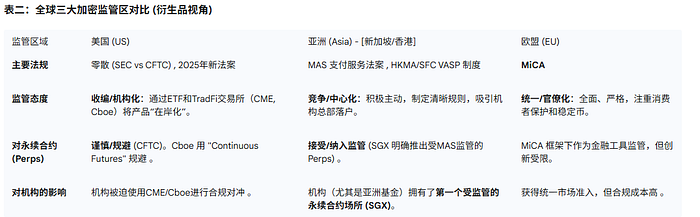
United States (CFTC/SEC): The US strategy is "co-optation." By approving ETFs and CME/Cboe, it is channeling institutional traffic to domestic, regulated venues. The new administration's pro-crypto stance in 2025 will accelerate this process.
Asia (MAS/HKMA): Singapore and Hong Kong's strategy is to "build a nest to attract phoenixes." They are creating the clearest and most institutionally-friendly customized crypto regulatory framework globally. Their goal is to become the global institutional crypto hub outside the United States. SGX's launch of perpetual contracts is a financial weapon in Singapore's national strategy.
The European Union (MiCA): MiCA provides a unified market, but at the cost of being "expensive" and "bureaucratic." It is strong in stablecoins, but may lag behind Asia's flexible regulations in derivatives innovation.
We will see liquidity pools fragmented geopolitically. A Zurich-based fund might prioritize Eurex; a Singaporean family office might find SGX its preferred option; and a US ETF issuer might be locked into CME. The utopian dream of “globally unified liquidity” for cryptocurrencies has been shattered. In its place is a fragmented global market divided by regulatory landscape.
This will be a reconstruction without an end!
The actions of the Singapore Exchange (SGX) and Cboe at the end of 2025 are not the end of the TradeFi invasion, but rather the "Normandy landings" of this war to reshape the trillion-dollar derivatives landscape.
This war will not have a single victor, but will instead lead to permanent bifurcation in the market. TradFi giants (CME, SGX), with their unparalleled "trust" weapon—Central Counterparty Clearing (CCP)—will firmly lock in the most fertile territory of "compliant institutions," especially the hedging flows tied to ETFs.
The current dominant CEXs (Binance, Bybit) will not disappear. They are forced into a "split personality": one part of their business will "go ashore" to seek compliance, becoming bloated and slow; the other part will remain "offshore," relying on its unparalleled product breadth and innovation speed to serve high-risk crypto-native funds and global retail investors.
DEX (dYdX) represents the ultimate direction of technology, but its fatal flaw of being a "compliance black hole" means that it will remain an "experimental field" for institutions rather than a "main battlefield" for the foreseeable future.
Ultimately, this fragmented market will give rise to true winners: Crypto Prime Brokerages. Platforms that can aggregate liquidity from TradeFi, CEXs, and DEXs, providing institutions with "one-stop" margin and risk management, will become the "super connectors" of the new landscape. TradeFi's encroachment will ultimately relegate "exchanges" to the sidelines, while "middleware" will reign supreme.