Author: @Jjay_dm
Compiled by: Deep Tide TechFlow
Last week's market sell-off was primarily driven by the repricing of interest rate cut expectations, rather than a structural collapse. Current positioning is nearing completion, and global easing policies continue. Bitcoin (BTC) needs to re-establish itself within its trading range to improve broader market sentiment.
Macro Update
Last week, the market's focus was on digesting the sudden repricing of expectations for a December rate cut. The probability of a rate cut plummeted from approximately 70% to 42% in just one week, a shift amplified by the lack of other macroeconomic data. Federal Reserve Chairman Powell's retreat from the near-certainty of a December rate cut forced investors to re-examine the views of various FOMC (Federal Open Market Committee) members, revealing that a rate cut was not a consensus. The market reacted swiftly: US risk assets weakened, with cryptocurrencies, as the most sentiment-driven risk asset, suffering particularly severe losses.
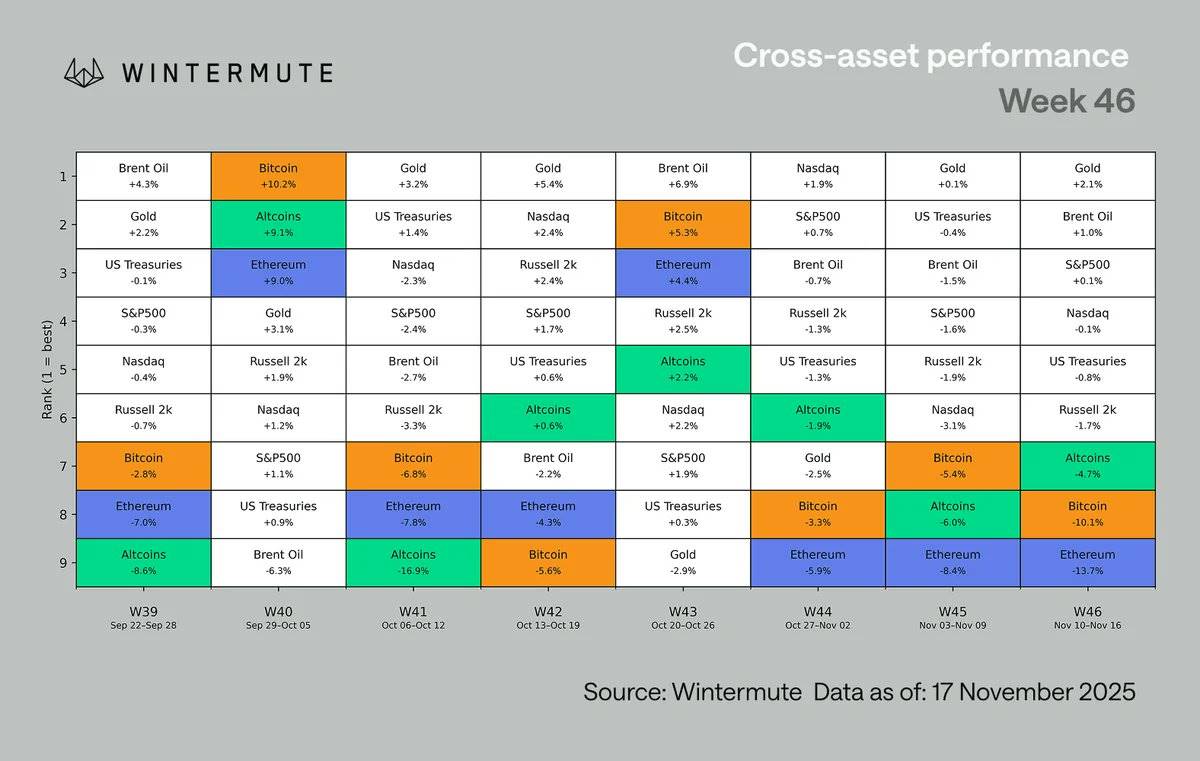
Among various asset classes, digital assets remain at the bottom of the performance rankings. This underperformance is not new; cryptocurrencies have lagged behind the stock market since early summer, partly due to their persistent negative skewness relative to equities. Notably, Bitcoin (BTC) and Ethereum (ETH) have actually underperformed altcoins as a whole, which is relatively rare during a downtrend. Two main reasons explain this phenomenon:
- Altcoins have been declining for some time now;
- A few areas (such as privacy coins and fee switching mechanisms) continue to show localized strength.
From an industry perspective, the performance was generally negative. The GMCI-30 index (@gmci_) fell 12%, with most sectors declining between 14% and 18%. Leading decliners included Artificial Intelligence (AI), Decentralized Internet of Things (DePIN), Gaming, and Memes. Even typically more resilient categories such as Layer 1 networks (L1s), Layer 2 networks (L2s), and Decentralized Finance (DeFi) experienced widespread weakness. This market volatility reflects a broad-based risk aversion rather than sector rotation.
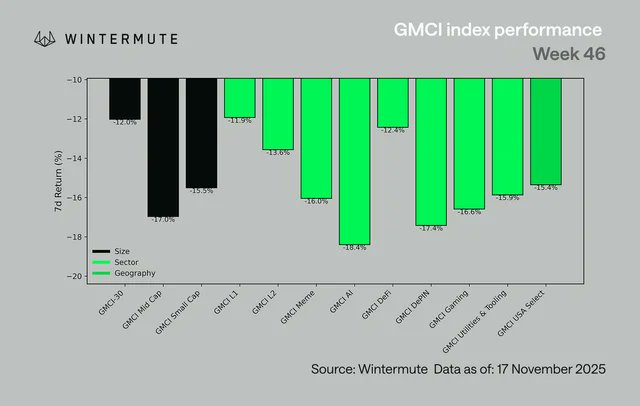
The chart above shows data from Monday to Monday, so it differs from the first chart.
Bitcoin (BTC) has fallen below the $100,000 mark again, the first time this has happened since May. Prior to last week, Bitcoin had successfully held the $100,000 level twice (on November 4th and 7th), and even briefly rebounded to $110,000 at the beginning of last week. However, this rebound quickly faded during the US trading session, with hourly candlesticks showing a clear pattern of selling pressure – sell orders emerged whenever the US market opened, ultimately pushing the price below $100,000 after two attempts.
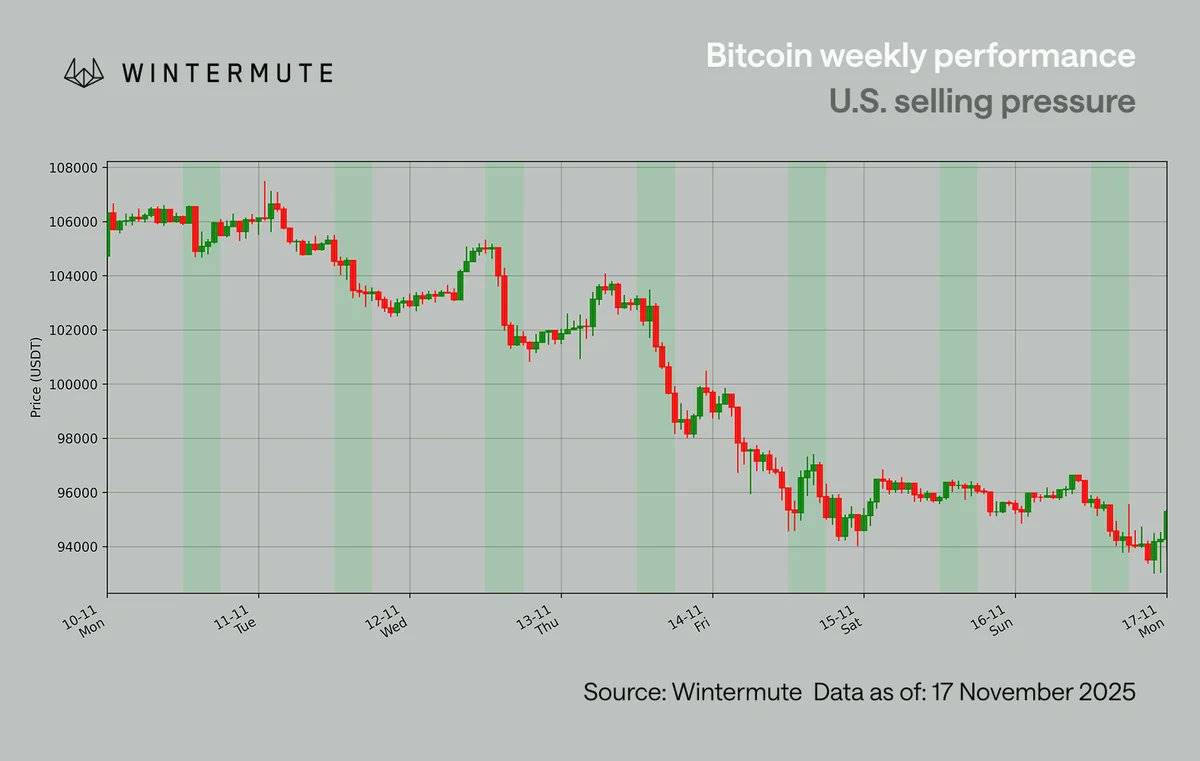
Part of the pressure stems from whales (investors holding large amounts of crypto assets) reducing their positions. While sell-offs typically occur from the fourth quarter to the first quarter, this trend has come earlier this year, partly because many traders anticipate a weaker year in the four-year cycle. This expectation is self-fulfilling, as early risk-taking by participants amplifies market volatility. It's worth noting that there hasn't been a genuine fundamental collapse this time; the pressure is primarily driven by the US market and macroeconomic factors.
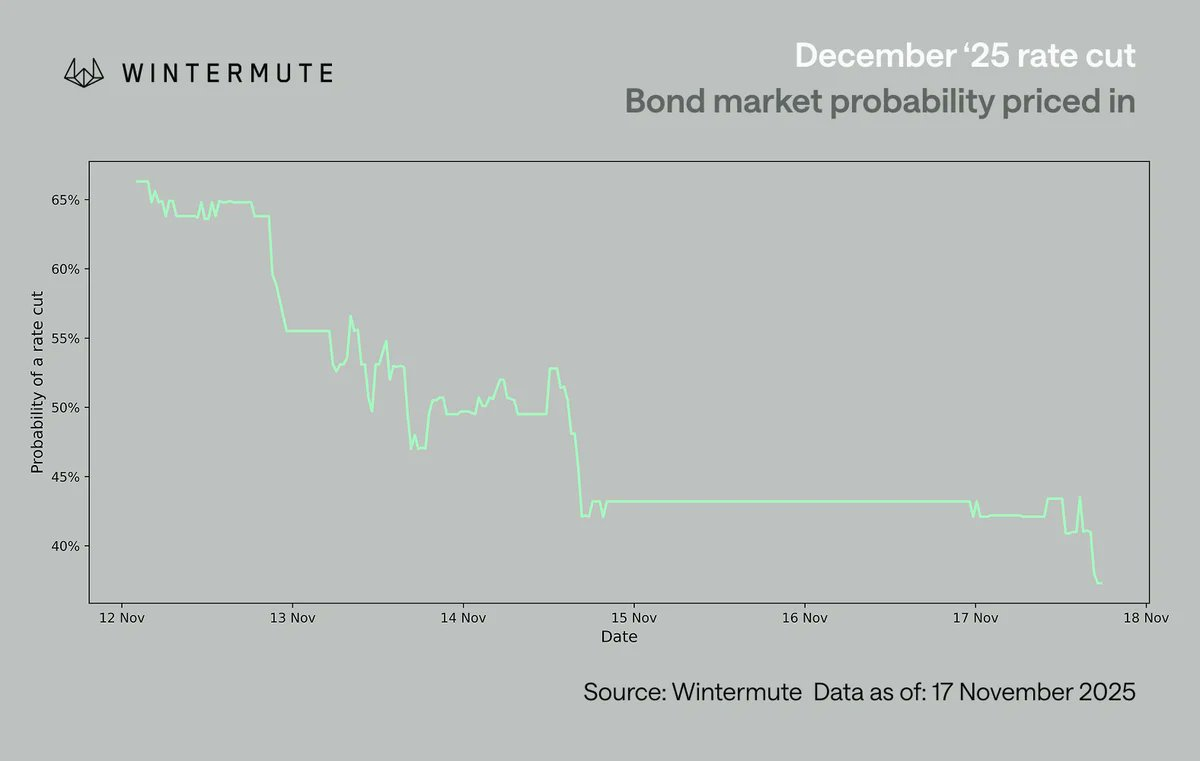
The repricing of interest rate cut expectations is a more reasonable driving factor. After Federal Reserve Chairman Powell retracted his comments regarding a December rate cut, US traders began to analyze the views of various FOMC members in depth. US trading seats gradually lowered their expectations for a December rate cut from about 70% to the low 60% range, a shift that global markets only subsequently recognized. This also explains why the strongest selling pressure was concentrated in the US trading session from November 10th to 12th, even though the probability of a rate cut was still in the mid-60% range at that time.
While expectations of interest rate cuts have impacted short-term market sentiment, the overall macroeconomic environment has not deteriorated. The global easing cycle is still underway.
- Japan is preparing a $110 billion stimulus package.
- China continues to implement an accommodative monetary policy.
- The United States' quantitative easing (QT) program will end next month.
- Fiscal channels remain active, such as the proposed $2,000 stimulus package.
Current market changes are more about timing than direction—specifically, how quickly liquidity will be released and how long it will take to impact speculative risk assets. Currently, the crypto market is almost entirely driven by macroeconomic factors, lacking new data to stabilize interest rate cut expectations; the market remains in a reactive rather than constructive development phase.
Our Viewpoint
The macro environment remains supportive of the market, and position adjustments have made the market clearer, but stable sentiment still depends on the performance of mainstream cryptocurrencies.
This market sell-off appears to be more of a macro-driven shock than a structural collapse. Current positions have been cleared, the US-led pressures have been fully understood, and the cyclical dynamics of whales and year-end flow trends have well explained this volatility.
The overall backdrop remains constructive: global easing continues, the US quantitative easing (QT) program will end next month, stimulus channels remain active, and liquidity is expected to improve in the first quarter of next year. What the market currently lacks is confirmation from major cryptocurrencies. Unless Bitcoin (BTC) returns to the top of its range, market breadth is likely to remain limited, and the narrative will be unsustainable. This macro environment does not resemble a prolonged bear market. As the market is driven by macro factors, the next catalyst is more likely to come from policy and interest rate expectations rather than liquidity within the crypto industry. Once major cryptocurrencies regain momentum, a broader market recovery is expected.