
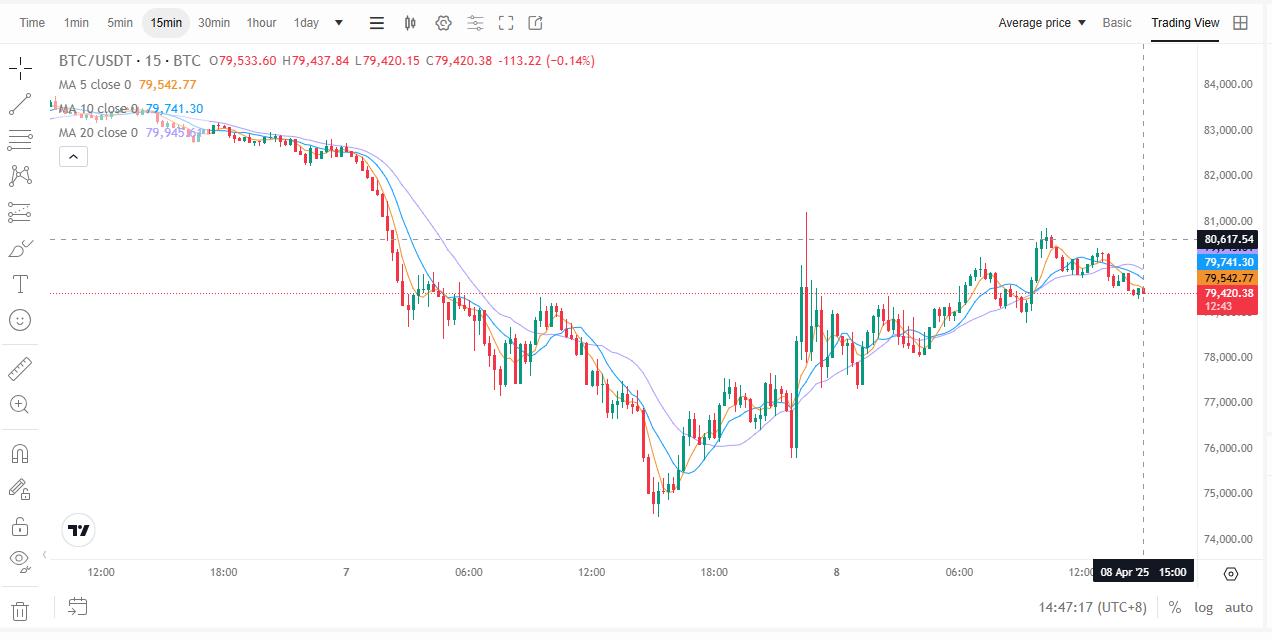
After yesterday's plunge, the crypto market rebounded. On April 8, 2025, Bitcoin once broke through $80,500 in the morning and is now hovering around the $80,000 mark. Although Ethereum also rebounded, its trend was obviously weak, and the market's concerns about its long-term competitiveness have intensified.
According to BTCC market data, BTC fell to as low as $74,500 yesterday, with the market leading the decline. However, a piece of false news about "US tariffs will be postponed for 90 days" was quickly transmitted to the market in the evening, triggering a comprehensive rebound in crypto assets. Bitcoin rose above $81,000 in a short period of time, then fell back, and is currently fluctuating around $80,000, with a 24-hour increase of 0.7%.
Be cautious when buying on dips
The market fluctuated violently last night, mainly due to a simple rumor - "the imposition of tariffs will be postponed for 90 days". This news instantly triggered the market's anxiety about "missing the bottom".
According to analysis by The Kobeissi Letter, this behavior is a continuation of the "buy on dips" model of a few years ago. Investors are still betting on a rebound brought about by the Fed's rescue, policy easing or sudden positive news, but whether this strategy is still applicable in the current market environment of high inflation, high interest rates and strong uncertainty is a question worth rethinking.
If the China-US trade agreement is not reached on April 9, market panic may reappear and the rebound may be short-lived.
Bitcoin is currently facing two major pressure points: one is $81,211, which was once an important support and has now turned into a strong resistance; the other is the 0.618 retracement level of the hourly decline - $80,261, which was touched in the early trading but has not yet shown any obvious signs of a pullback.
Ethereum was particularly weak in yesterday's market, and once dropped to $1,411 during the session, ranking first among mainstream currencies in terms of decline. Although it rebounded slightly today, its increase was significantly lower than that of Bitcoin, and the pressure of $1,600 above is still difficult to break through. Data shows that ETH's market capitalization has fallen to its lowest level in a year, and Ethereum's core position in the future competition among Web3, L2 and smart contracts cannot help but raise doubts.
The dual concerns of macro risks and Satoshi Nakamoto’s “black swan”
The Trump administration's new round of tariff policies has triggered a chain reaction in multiple economies, putting global risk assets under pressure. The current financial market is in turmoil, with US stocks fluctuating and US bond interest rates high, and the crypto market is in the extension zone of this storm.
Although the market is expecting the Fed to rescue the market, inflation pressure remains high. In the absence of a serious systemic crisis, it is difficult for the Fed to intervene on a large scale in the short term. Therefore, the market may continue to seek direction in high volatility.
Investors should focus on key data and events this week, including the Federal Reserve meeting minutes on Wednesday, CPI data on Thursday, and PPI data on Friday, which may become the "barometer" for judging the market direction in the next stage.
In addition, it is worth noting that the market has recently once again hyped up the risk of Satoshi Nakamoto holding coins. According to foreign media reports, crypto lawyer James Murphy filed a lawsuit against the U.S. Department of Homeland Security (DHS) on April 7 under the Freedom of Information Act, claiming that the agency has information about Satoshi Nakamoto's true identity. This revelation quickly triggered market associations.
It is estimated that Satoshi Nakamoto holds about 1 million bitcoins, accounting for 5% of the total bitcoin supply. These coins have never been moved since their creation and are considered to be in a "dormant state". However, once Satoshi Nakamoto's identity is exposed, or his wallet address changes, it may trigger market concerns about large-scale sell-offs, thereby triggering extreme volatility and even systemic risks. Although the probability of this event is extremely low, it is a black swan factor that cannot be ignored.
Behind the rebound is investor sentiment dominating the market
This round of rebound is not only due to the bull market's "buy on dips" mentality, but also the crypto market's high reliance on news. An unconfirmed rumor of "tariff delay" pushed the price of Bitcoin to soar by thousands of dollars in an instant. This reaction is not based on fundamentals or macro support, but a typical "emotion-driven market."
For retail investors, "buy on dips" is still the mainstream mentality, but this strategy should be more rational and prudent. In an environment with extremely high uncertainty, controlling positions, setting stop losses, and staying away from high leverage are the keys to protecting principal and winning in a stable manner. In short, not all rebounds are worth chasing high, especially on the eve of a storm.