
Author: Nancy, PANews
On February 24, after the time tokenization platform Time.fun officially landed on Solana, the Solana official team quickly gave strong support, and even Solana co-founder Toly frequently mentioned it in tweets, giving it enough market exposure. Behind this move, it is not only a strong response to Pump.fun's liquidity sucking, but also another growth exploration after the chaos of celebrity coin issuance hit the Solana ecosystem hard.
Pump.fun intends to "turn over the table", Solana's ecological crisis intensifies
After the Libra and other celebrity currency scandals, Solana's liquidity was quickly withdrawn, and market sentiment continued to be depressed. As the flow engine of the Solana ecosystem in this cycle, and also the "money printing machine" on the chain, the protocol is now difficult to continue to provide liquidity, and multiple factors such as self-built AMM, coin issuance rumors, continuous token selling, and uncertainty in regulatory lawsuits have also caused Solana officials to be "dissatisfied."
In January this year, Pump.fun's business was unfortunately sued despite continued growth. According to Bloomberg law at the time, Pump.fun faced a class action lawsuit, accused of violating US securities laws, exposing investors to huge financial risks by marketing and issuing unregistered and highly volatile Meme coins, and charging nearly $500 million in fees. The lawsuit has been filed in the United States District Court for the Southern District of New York, and the plaintiff described it as "a new evolution of Ponzi schemes and pump and dumps." Soon after, two US law firms, Burwick Law and Wolf Popper, also sued Pump.fun, demanding that the platform delete tokens using its IP, pointing out that these tokens used intellectual property (including its logo and name) without permission.
What’s worse is that with the “shutdown” of MEME, as the first to be hit by this wave of impact, Pump.fun’s graduation rate and trading volume have also dropped sharply, which in turn affected the overall activity of the Solana ecosystem.
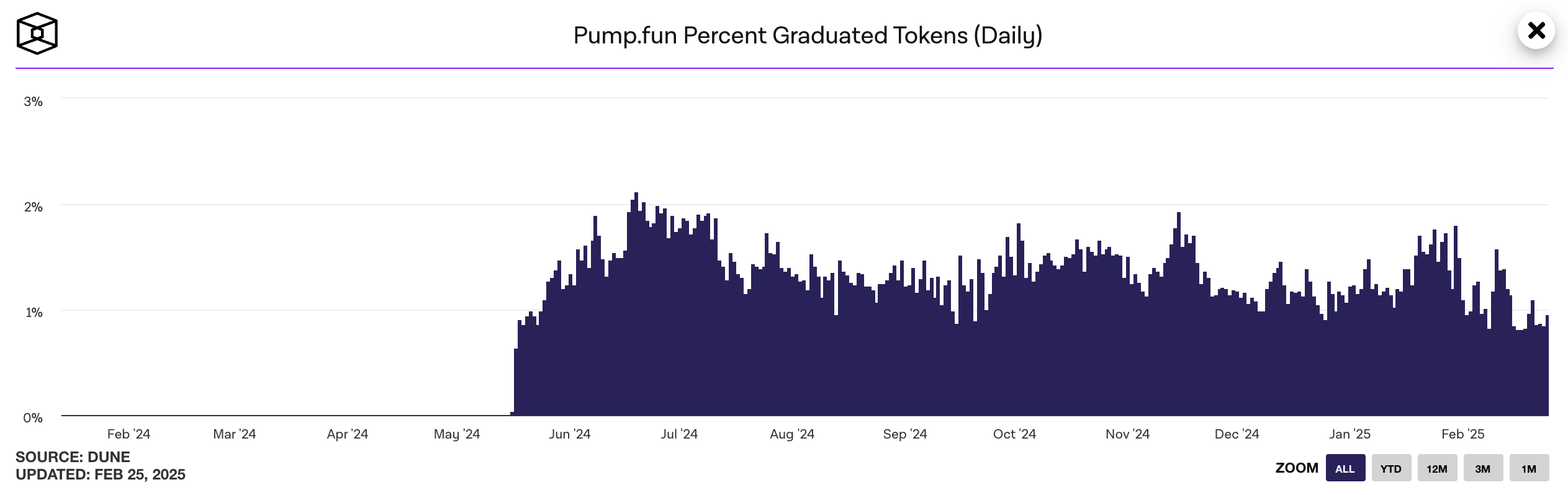
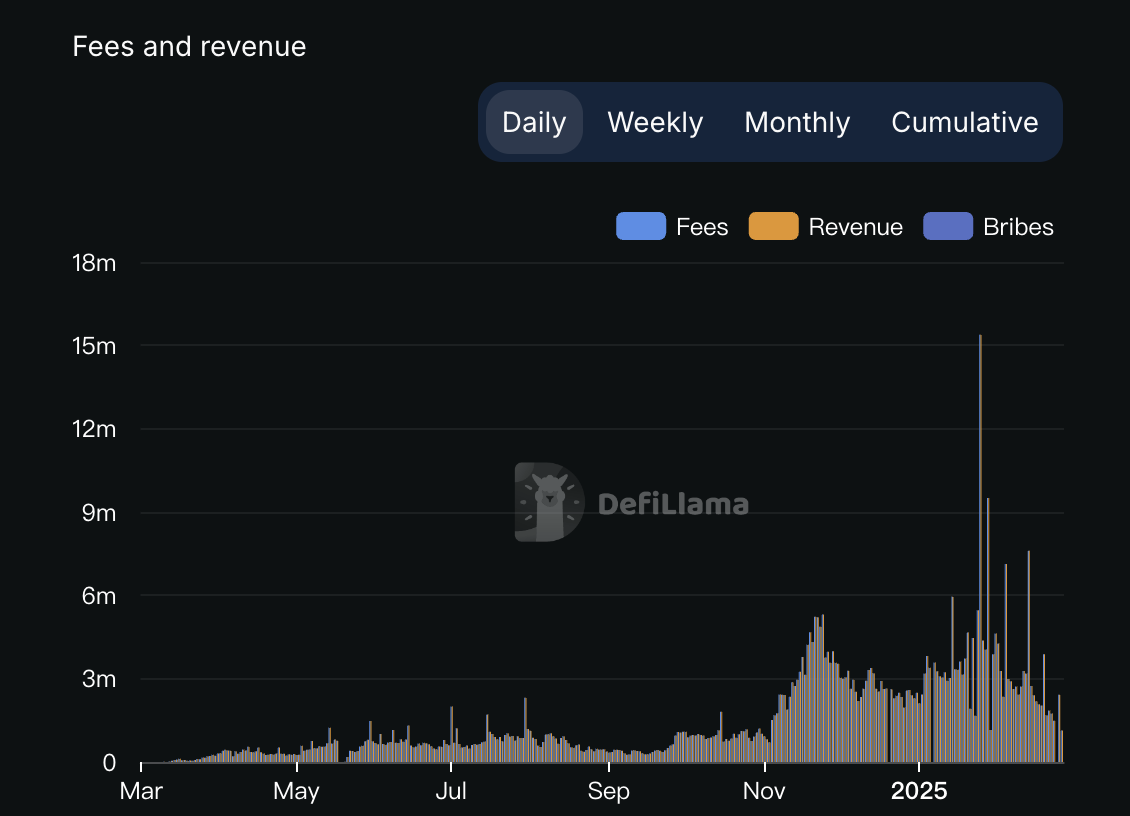
Data from The Block shows that as of February 24, the graduation rate of Pump.fun tokens transferred to Raydium was only 0.96%, down 54.7% from the historical peak of 2.12%. At the same time, Pump.fun's on-chain transactions also cooled down significantly, with the average daily trading volume falling from a peak of $3.13 billion in January this year to $190 million as of February 24, a drop of 93.9%. And from the perspective of protocol fee income, DefiLlama data shows that as of February 25, Pump.fun's protocol fee income was $2.45 million, a decrease of nearly 84.1% from the historical peak ($15.38 million on January 25).
The sharp decline in business has forced Pump.fun to explore more products. However, some of these measures are undoubtedly a heavy blow to Solana, whose ecology has not yet recovered. Earlier this month, crypto KOL Hebi (@hebi555) published a post on X that Pump.fun intends to adopt the Dutch auction model to conduct public offerings on multiple CEXs (centralized exchanges). Although Alon, co-founder of Pump.fun, denied the rumor and said that the news of potential tokens was untrue, this response was questioned by many industry insiders. For example, Wu said that blockchain publicly pointed out that Alon was lying, and several CEX listed companies confirmed Pump.fun's coin issuance plan and stated that they could disclose relevant preparation documents after obtaining permission. Once Pump.fun finally issues coins, it will inevitably have a huge impact on the Solana market, especially when liquidity is already tight, which will inevitably lead to a greater degree of capital withdrawal.
What's more, Pump.fun has earned considerable income through transaction fees, and even ranked among the world's 10th largest gaming companies in 2024 with an annual revenue of US$1 billion. According to Onchain Lens monitoring, Pump.fun has earned a total of about 2.99 million SOL, with a current market value of about US$431 million, and its continued cashing out behavior has also brought considerable selling pressure on SOL tokens.
What is more concerning is that Pump.fun has recently intended to "turn over the table". On February 24, market rumors said that Pump.fun was internally testing its self-developed AMM (automatic market maker) liquidity pool. The community speculated that it might launch its own Swap platform to replace the third-party supplier Raydium to extract more transaction fees. This move was also generally considered by the community to be too greedy. If the news is true, it will undoubtedly deal a heavy blow to the DEX on Solana. After all, DEXs such as Raydium and Jupiter carry a lot of liquidity from Pump.fun, and these DEXs are also the liquidity center of the Solana ecosystem. To make matters worse, platforms such as Raydium and Jupiter have recently been implicated in the Libra insider coin issuance scandal.
As the news came out, Coingecko data showed that the price of Raydium token RAY has plummeted by 40.9% since the news of Pump.fun’s AMM came out, although the overall market decline also had a certain impact on this.
In response to the possibility that Pump.fun may completely abandon Raydium, InfraRAY, a core contributor of Raydium, said that this was a "strategic misjudgment" and questioned whether Pump.fun could replicate its existing success. He also pointed out that if Pump.fun turns to a new AMM, it may face multiple risks such as insufficient infrastructure, low demand for migration tokens, and insufficient trading volume in the early stage of listing. It is worth noting that the Solana Foundation invested in Raydium and Jupiter in October 2020 and March 2021, respectively. Pump.fun's "solo" move undoubtedly touched the interests of the Solana Foundation. This series of actions undoubtedly brought greater uncertainty to the Solana ecosystem.
"Those assholes who disrupt the market to maximize their profits can now suffer the consequences. But those companies that build quality products, charge transparent fees, and compete for users are great. Their revenue should be your motivation to compete and take their market share." toly's latest tweet was also interpreted by the community as a criticism of Pump.fun.
With the support of MEME core, Time.fun is officially supported by Solana
MEME is one of the important driving forces behind Solana's comeback. After being backstabbed by Pump.fun, Time.fun became a new product of the same type that Solana officially began to support.
As a product that also originated from AllianceDAO , Time.fun is a time tokenization platform similar to the previously popular Friend.tech, which allows creators to tokenize time and sell it as tradable tokens. Initially, the product was based on the Base network, but in November 2024 it was announced that it would migrate to Solana. At that time, 0xKawz, co-founder of Time.fun, said, "Over the past year or so, Solana has taken a significant lead in many aspects. In contrast, Ethereum's ecosystem feels tired, often too focused on technology and arrogant. The atmosphere of Ethereum is like a group of high-handed philosophers. If Ethereum does not solve its cultural problems, Solana will gradually dominate as more developers like Time.fun choose to migrate."
On February 24 this year, after Time.fun officially migrated to the Solana network, it publicly promoted the MEME token named "toly's minutes" for the first time on X. The tweet also received a reply from toly himself, who also said that time is fun and business communication is my favorite crypto application case. This statement once pushed the market value of the token toly to soar. After that, toly also posted more than ten tweets about Time.fun in succession, and his support was very obvious. In addition to toly, Solana co-founder Raj Gokal and Solana ecosystem project Helius CEO Mert Mumtaz also participated in the promotion of Time.fun.
For Solana, Time.fun and Pump.fun are similar in gameplay, both of which have MEME cores, and support for this product may continue this trend. At the same time, Time.fun adopts a celebrity coin issuance model with a verification mechanism, which to a certain extent reduces the RUG risk common in the previous celebrity MEME coin chaos.
According to The Block, Time.fun founder Kawz said that in the future, he would consider issuing the platform's own tokens. If other platforms are built on tokenized time, then a platform-based token can connect them all together. But Kawz also admitted that it is too early to discuss the discovery of Time.fun tokens at this stage, because the platform must first find the market fit of the product, and the key goal of the platform is to make tokenized time composable so that it can be used by other platforms built on Time.fun. He pointed out that the real long-term goal of Time.fun is to create a new asset class that allows people to own other people's time, trade it, and use it for a variety of products and services.
Ecosystem is in decline, but many key indicators remain strong
The Solana ecosystem has faced many challenges recently, and there has been constant FUD in the market.
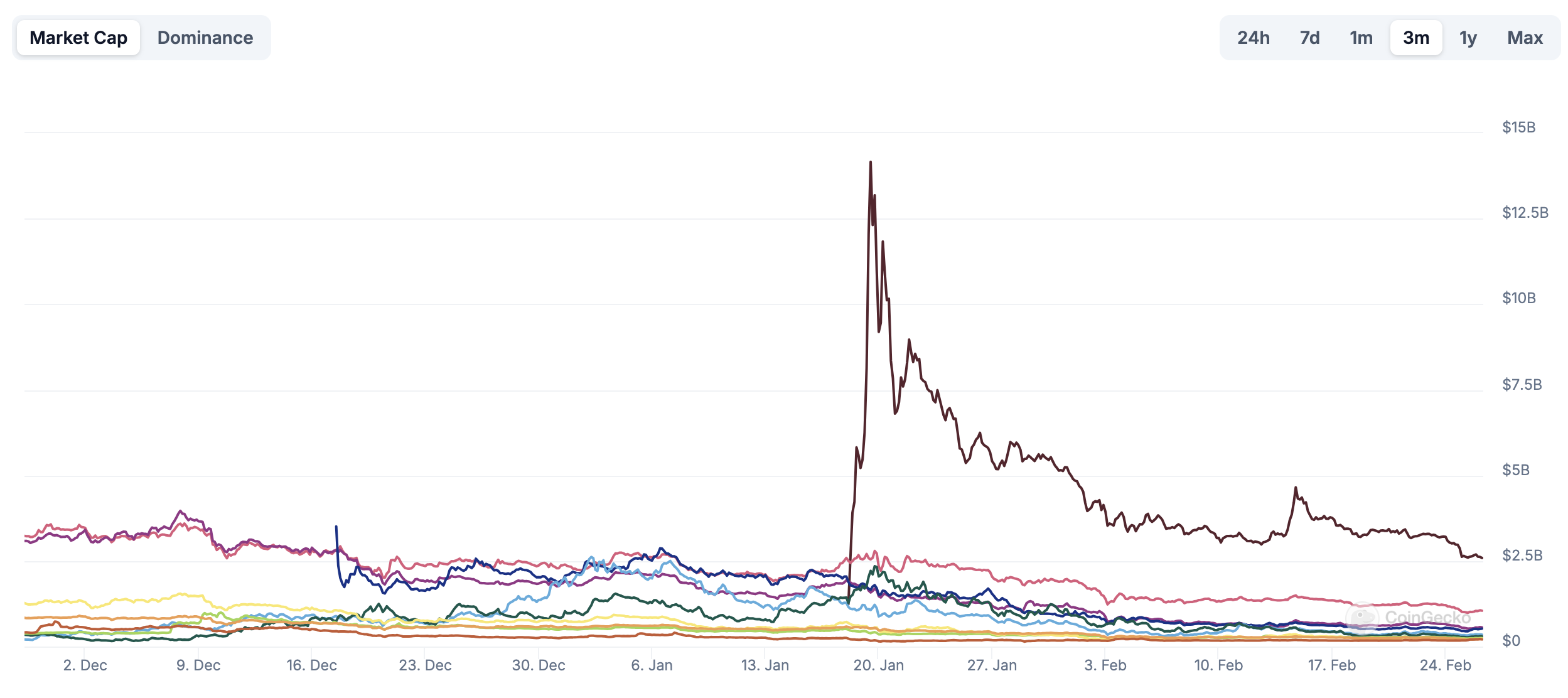
On the one hand, the market value of MEME on Solana has been halved after the cooling down. CoinGecko data shows that as of February 26, the market value of MEME on Solana was US$8.64 billion, while the highest in January was close to US$15 billion.
At the same time, the imminent unlocking of huge amounts of SOL also brings liquidity pressure. 11.2 million SOL will be unlocked for circulation on March 1, which is the largest token unlocking in history (worth $2 billion). According to crypto analyst Artchick.eth, more than 15 million SOL (about $2.5 billion) will enter circulation in the next three months, most of which will be purchased by institutions such as Galaxy Digital, Pantera Capital and Figure through FTX auctions at $64 per SOL, and many VCs still have huge profits. "Trader RunnerXBT pointed out that Galaxy Digital, Pantera and Figure hold $3 billion, $1 billion and $150 million in unrealized profits on SOL, respectively. The market speculates that these institutions may sell their positions, and the recent MEME coin LIBRA scam endorsed by Argentine President Milley has exacerbated market panic.
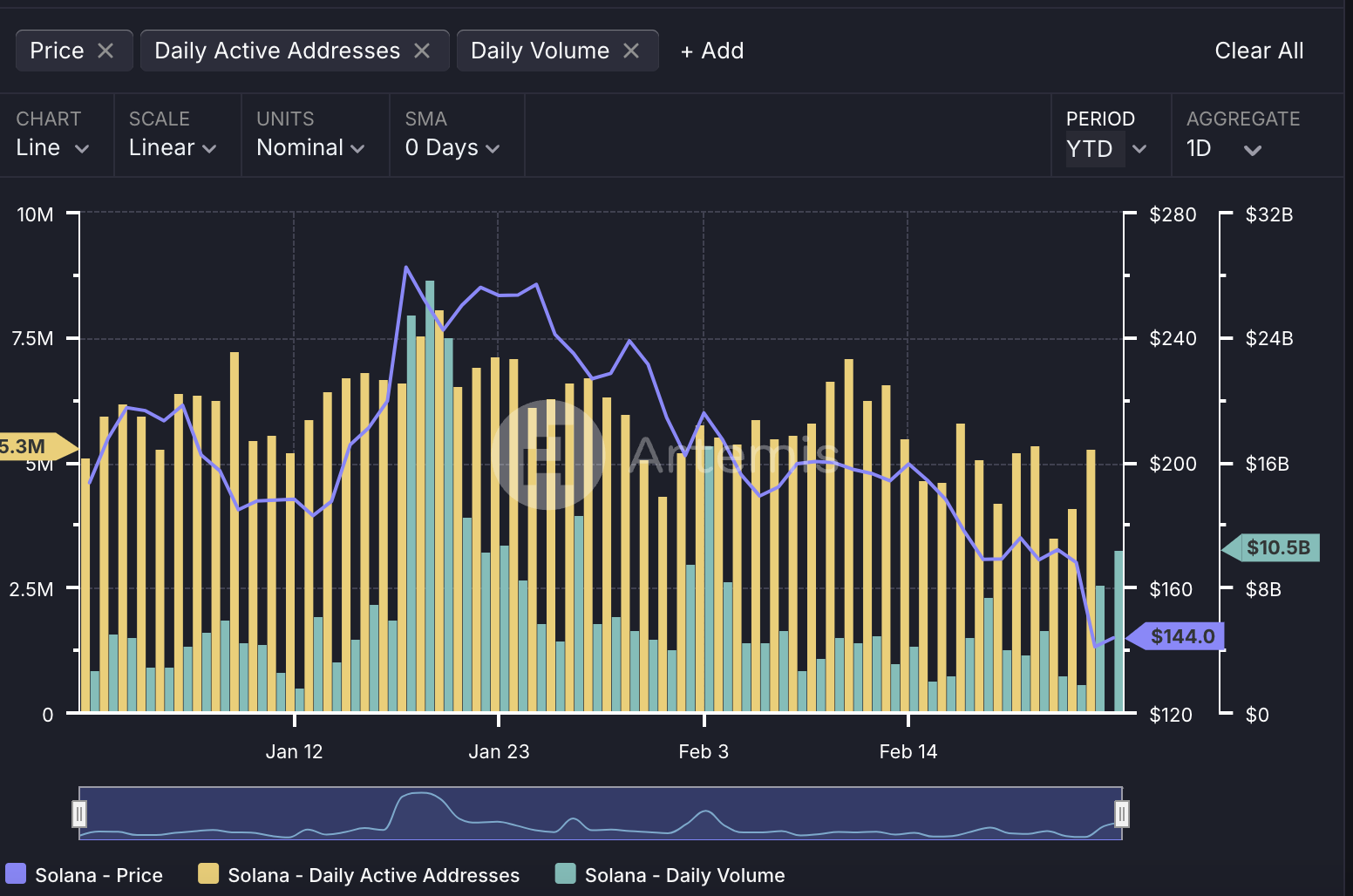
The data also intuitively reflects the pressure facing the Solana ecosystem. Artemis data shows that as of February 24, Solana's daily active addresses were 5.3 million, down more than 34.5% from this year's peak; daily trading volume also fell sharply from the year's high of $27.7 billion, a drop of 62.1%, currently only $10.5 billion. Among them, the decline in DEX trading volume is particularly significant. Although it still ranks second among all chains, it has fallen 89.9% from the peak in January; in addition, the price of SOL tokens has also fallen 46.2% from this year's peak of $262.6.
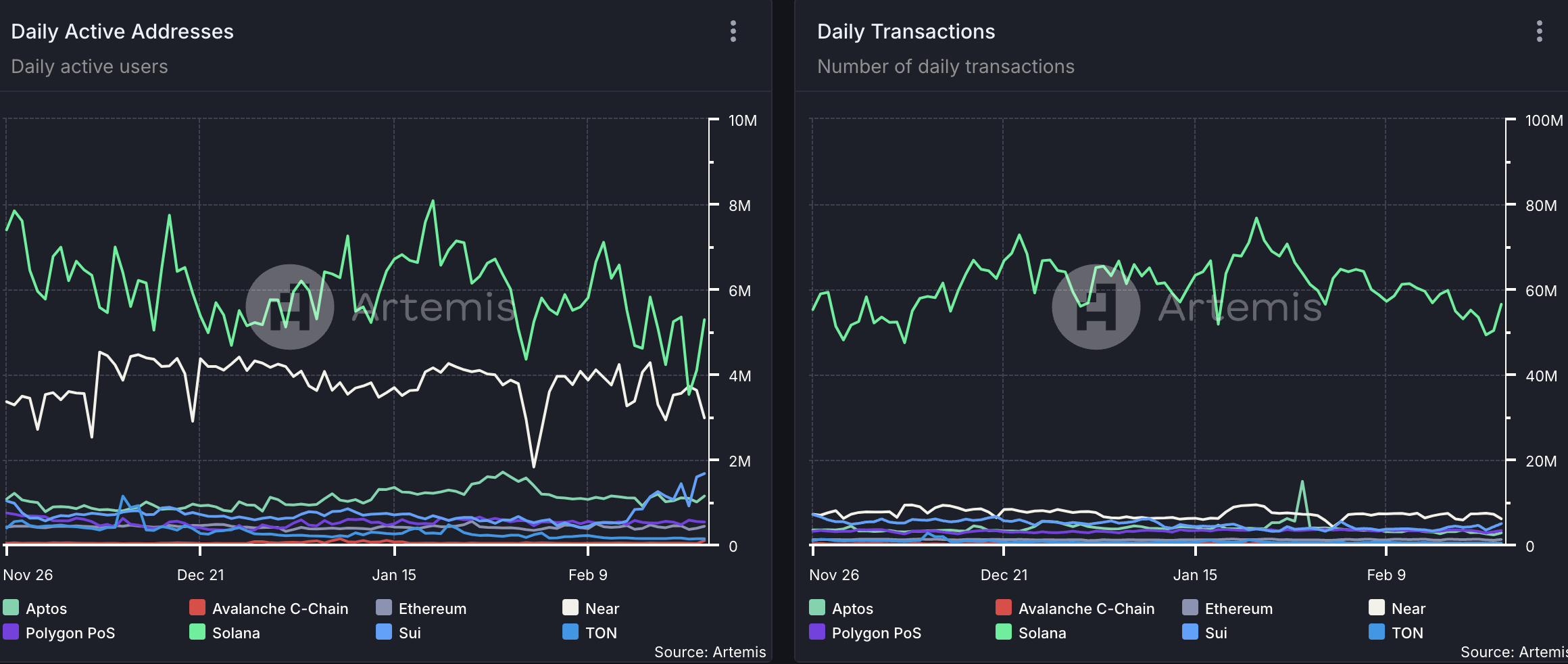
These data reflect a significant decline in the activity and market popularity of the Solana ecosystem. However, Solana still performs well in many key indicators. Artemis data shows that as of February 24, in terms of daily active addresses, Solana ranked first with 5.3 million, surpassing Ethereum, NEAR, SUI, and Aptos. In terms of the number of transactions, Solana's daily transaction volume is far ahead with 56.5 million times, compared with only millions or even less for other chains. In terms of TVL, Solana's TVL reached US$7.3 billion, second only to Ethereum, surpassing Sui, Avalanche, and Aptos.
In addition, Solana has many potential benefits, such as the expected application of SOL spot ETF and the opening of Solana inflation model modification proposal SIMD-0228, which may inject more confidence and liquidity into Solana.