
Author: BitpushNews Mary Liu
Cryptocurrency markets continued to fall as crypto exchange-traded products (ETPs) saw their first net outflow in 19 weeks amid growing inflation concerns.
According to Bitpush data, in the past 24 hours, Bitcoin hit an intraday low of $93,388.83, and rebounded to above $95,000 as of press time. Ethereum fell 3% to $2,600, and Solana (SOL) fell nearly 5%, falling to a low of $163.
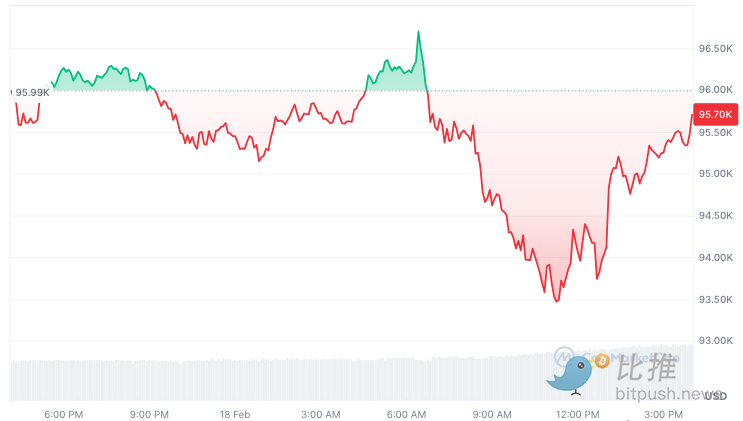
Sid Powell, CEO of Maple Finance, said: "It's not too surprising that the cryptocurrency market fell 3% today - this seems to be mainly driven by macro factors. The recent inflation report shows that inflation will continue, so the possibility of rate cuts in the short term is less."
Crypto Fund Outflows
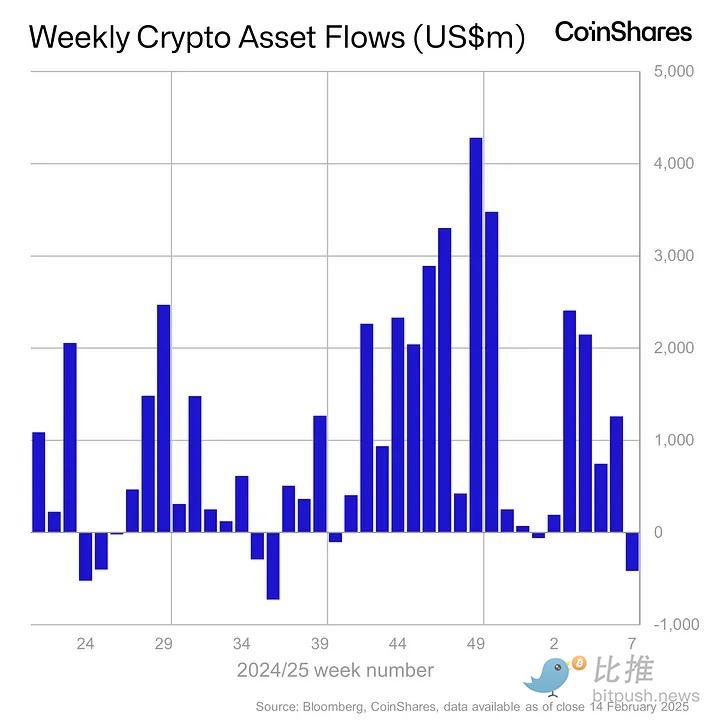
The pullback also coincided with the first net outflows from digital asset exchange-traded products (ETPs) in 19 weeks.
According to the latest CoinShares Digital Asset Fund Flow Weekly Report, digital asset investment products saw a large outflow of funds last week, totaling $415 million. This marks the end of a trend of 19 consecutive weeks of cumulative inflows of $29.4 billion.
"ETFs ended a 19-week streak of inflows and saw their first week of net outflows, leading to selling pressure as investors have been looking to cut risk exposure," the report said. CoinShares attributed the outflows to recent hawkish signals from Federal Reserve Chairman Jerome Powell and higher-than-expected U.S. inflation data.
The report noted that BTC was particularly affected, with outflows of $430 million, reflecting its sensitivity to interest rate expectations. Interestingly, products that short Bitcoin also recorded outflows of $9.6 million.
In comparison, Solana led with $8.9 million in inflows, followed by XRP and Sui with $8.5 million and $6 million, respectively. Crypto stocks attracted $20.8 million in inflows, bringing their total year-to-date to $220 million.
Technical indicators show a possible retest of $92,000 support
According to an analysis shared by Material Indicators on Feb. 17, Bitcoin could fall further due to a “death cross” that appeared on the daily chart. A death cross is when a short-term moving average falls below a long-term moving average, typically indicating weakening price momentum. However, the analysis also noted that there is buy order liquidity around $95,000 and $92,000 as minor support, which could help stabilize prices.
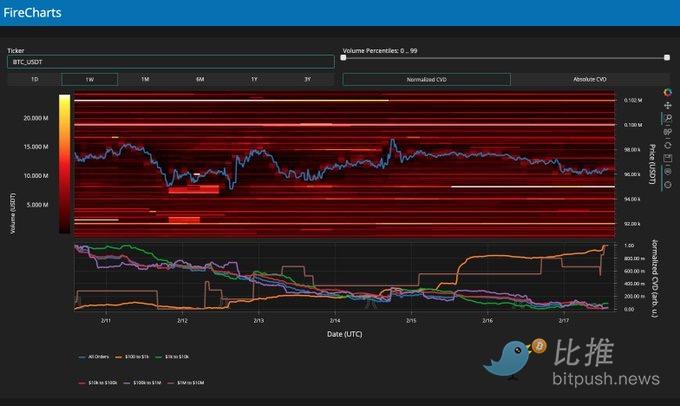
Analysis of Binance order book data further supports the view of an upcoming test. A technical chart shared by Material Indicators shows significant buy interest around $95,000, while almost all order categories, except retail traders, have reduced their exposure. The $92,000 support level suggests that further declines could validate the key support area, setting the stage for future price action.
Traders remain cautious, with many keeping a close eye on technical signals. The appearance of a death cross suggests a possible long-term downtrend, but some investors see current conditions as an opportunity to accumulate more Bitcoin. Material Indicators highlights the importance of strategic planning in such market conditions, advising traders to remain patient and stick to their goals.
Standard Chartered Bank reiterates its $500,000 Bitcoin price target
Standard Chartered Bank maintained its $500,000 price target for Bitcoin, citing a changing investor landscape to include institutional, bank and sovereign buyers. The bank expects Bitcoin to reach that level before U.S. President Donald Trump leaves office, driven by increased access and lower volatility.
According to Standard Chartered, spot Bitcoin ETF purchases in 2024 were 499,000 BTC, while Strategy purchased 257,000 BTC. The bank expects institutional inflows to increase further in 2025, but emphasizes that new buyers are needed to maintain momentum.
“To achieve this we need new buyers; bank buying has been substantial and now sovereigns are joining in,” the analysts wrote.
A key factor supporting this outlook is data from SEC 13F filings, which show that banks and hedge funds increased their Bitcoin positions in the fourth quarter.
Standard Chartered noted: "The type of buyers will gradually evolve, from retail buyers before ETFs, to hedge funds in the early days of ETFs, and finally to sovereign investors." Looking ahead, Standard Chartered expects pension funds and central banks to join the market as long-term institutional investors.